
Homework Answers


Add Answer to:
Problem 3 (Inner Products). (a) Let V, W be two finite dimensional vector spaces, dim V = n, dim ...
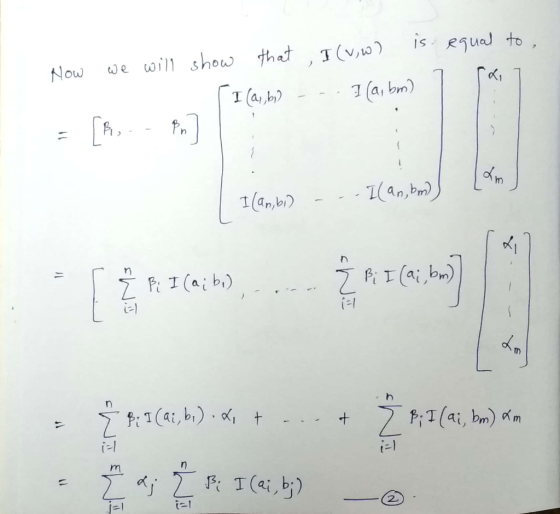
(e) Let V and W be finite dimensional vector spaces, dim V-n and din W-m. Show that there is a bi...
 (e) Let V and W be finite dimensional vector spaces, dim V-n and din W-m. Show that there is a bijection between the set Bil V, W;R) of all bilinear functions on V and W and the set GLn(m)R of all matrices of order n x m Hint: Uselal & rbl
(e) Let V and W be finite dimensional vector spaces, dim V-n and din W-m. Show that there is a bijection between the set Bil V, W;R) of all...
(e) Let V and W be finite dimensional vector spaces, dim V-n and din W-m. Show that there is a bijection between the set Bil V, W;R) of all bilinear functions on V and W and the set GLn(m)R of all matrices of order n x m Hint: Uselal & rbl
(e) Let V and W be finite dimensional vector spaces, dim V-n and din W-m. Show that there is a bijection between the set Bil V, W;R) of all...
E finite dimensional vector Spaces, dim Show that there is a bijection between the set Bil(V,W;R)...
 e finite dimensional vector Spaces, dim Show that there is a bijection between the set Bil(V,W;R) of all bilinear functions on V and W and the set ĢLn(m)R of all matrices of order n x m.
e finite dimensional vector Spaces, dim Show that there is a bijection between the set Bil(V,W;R) of all bilinear functions on V and W and the set ĢLn(m)R of all matrices of order n x m.
e finite dimensional vector Spaces, dim Show that there is a bijection between the set Bil(V,W;R) of all bilinear functions on V and W and the set ĢLn(m)R of all matrices of order n x m.
Problem 3. Let V and W be vector spaces, let T : V -> W be...
 Problem 3. Let V and W be vector spaces, let T : V -> W be a linear transformation, and suppose U is a subspace of W (a) Recall that the inverse image of U under T is the set T-1 U] := {VE V : T(v) E U). Prove that T-[U] is a subspace of V (b) Show that U nim(T) is a subspace of W, and then without using the Rank-Nullity Theorem, prove that dim(T-1[U]) = dim(Unin (T))...
Let V and W be finite dimensional vector spaces and let T:V → W be a...
 Let V and W be finite dimensional vector spaces and let T:V → W be a linear transformation. We say a linear transformation S :W → V is a left inverse of T if ST = Iy, where Iy denotes the identity transformation on V. We say a linear transformation S:W → V is a right inverse of T if TS = Iw, where Iw denotes the identity transformation on W. Finally, we say a linear transformation S:W → V...
Let V be a finite-dimensional inner product space, and let U and W be subspaces of...
 Let V be a finite-dimensional inner product space, and let U and W be subspaces of V. Denote dim(V) = n, dim(U) = r, dim(W) = s. Recall that the proj and perp maps with respect to any subspace of V are linear transformations from V to V. Select all statements that are true. Note that not all definitions above may be used in the statements below If proju and perpu are both surjective, then n > 0 If perpw...
Let V and W be finite dimensional vector spaces over R and T:V + W be...
 Let V and W be finite dimensional vector spaces over R and T:V + W be linear. Let V be a subspace of V and Wo = T(V). (Select ALL that are TRUE) If T is surjective then Vo = {v EV : there is w E Wo such that T(v) = w} If T is injective then dim(VO) = dim(W). dim(ker(T) n Vo) = dim(VO) - dim(Wo).
Problem 6. Let V, W, and U be finite-dimensional vector spaces, and let T : V → W and S : W → U be linear transformatio...
 Problem 6. Let V, W, and U be finite-dimensional vector spaces, and let T : V → W and S : W → U be linear transformations (a) Prove that if B-(Un . . . , v. . . . ,6) is a basis of V such that Bo-(Un .. . ,%) s a basis of ker(T) then (T(Fk+), , T(n)) is a basis of im(T) (b) Prove that if (w!, . . . ,u-, υ, . . . ,i)...
Q10.2 3 Points Let V and W be finite dimensional vector spaces over R and T:V...
 Q10.2 3 Points Let V and W be finite dimensional vector spaces over R and T:V + W be linear. Let Vo be a subspace of V and Wo = T(V). (Select ALL that are TRUE) If T is surjective then Vo = {v E V: there is w E Wo such that T(v) = w}. If T is injective then dim(V.) = dim(Wo). dim(ker(T) n ) = dim(V.) - dim(Wo). Save Answer
Let V, W, and U be three finite dimensional vector spaces over R and T:V +...
 Let V, W, and U be three finite dimensional vector spaces over R and T:V + Wand S : W → U be two linear transformations. Show that rank( ST) > rank(T) + rank(S) - dim(W)
Let (V,〈 , 〉v) and (W.〈 , 〉w) be finite-dimensional inner product spaces. Recall that the adjoint L* : W → V of a l...
 Let (V,〈 , 〉v) and (W.〈 , 〉w) be finite-dimensional inner product spaces. Recall that the adjoint L* : W → V of a linear function L Hom(V,W) is completely determined by the equation <L(v), w/w,-(v, L* (w)של for every v є V and w є W . Use this to prove the following facts: (a) (Li + L2)* = Lİ + L: for Li, L26 Horn(V,W) (b) (α L)* =aL' for a R and L€ Horn(V,W) (c) (L*)* =...
 (e) Let V and W be finite dimensional vector spaces, dim V-n and din W-m. Show that there is a bijection between the set Bil V, W;R) of all bilinear functions on V and W and the set GLn(m)R of all matrices of order n x m Hint: Uselal & rbl
(e) Let V and W be finite dimensional vector spaces, dim V-n and din W-m. Show that there is a bijection between the set Bil V, W;R) of all...
(e) Let V and W be finite dimensional vector spaces, dim V-n and din W-m. Show that there is a bijection between the set Bil V, W;R) of all bilinear functions on V and W and the set GLn(m)R of all matrices of order n x m Hint: Uselal & rbl
(e) Let V and W be finite dimensional vector spaces, dim V-n and din W-m. Show that there is a bijection between the set Bil V, W;R) of all...
 e finite dimensional vector Spaces, dim Show that there is a bijection between the set Bil(V,W;R) of all bilinear functions on V and W and the set ĢLn(m)R of all matrices of order n x m.
e finite dimensional vector Spaces, dim Show that there is a bijection between the set Bil(V,W;R) of all bilinear functions on V and W and the set ĢLn(m)R of all matrices of order n x m.
e finite dimensional vector Spaces, dim Show that there is a bijection between the set Bil(V,W;R) of all bilinear functions on V and W and the set ĢLn(m)R of all matrices of order n x m.
 Problem 3. Let V and W be vector spaces, let T : V -> W be a linear transformation, and suppose U is a subspace of W (a) Recall that the inverse image of U under T is the set T-1 U] := {VE V : T(v) E U). Prove that T-[U] is a subspace of V (b) Show that U nim(T) is a subspace of W, and then without using the Rank-Nullity Theorem, prove that dim(T-1[U]) = dim(Unin (T))...
 Let V and W be finite dimensional vector spaces and let T:V → W be a linear transformation. We say a linear transformation S :W → V is a left inverse of T if ST = Iy, where Iy denotes the identity transformation on V. We say a linear transformation S:W → V is a right inverse of T if TS = Iw, where Iw denotes the identity transformation on W. Finally, we say a linear transformation S:W → V...
 Let V be a finite-dimensional inner product space, and let U and W be subspaces of V. Denote dim(V) = n, dim(U) = r, dim(W) = s. Recall that the proj and perp maps with respect to any subspace of V are linear transformations from V to V. Select all statements that are true. Note that not all definitions above may be used in the statements below If proju and perpu are both surjective, then n > 0 If perpw...
 Let V and W be finite dimensional vector spaces over R and T:V + W be linear. Let V be a subspace of V and Wo = T(V). (Select ALL that are TRUE) If T is surjective then Vo = {v EV : there is w E Wo such that T(v) = w} If T is injective then dim(VO) = dim(W). dim(ker(T) n Vo) = dim(VO) - dim(Wo).
 Problem 6. Let V, W, and U be finite-dimensional vector spaces, and let T : V → W and S : W → U be linear transformations (a) Prove that if B-(Un . . . , v. . . . ,6) is a basis of V such that Bo-(Un .. . ,%) s a basis of ker(T) then (T(Fk+), , T(n)) is a basis of im(T) (b) Prove that if (w!, . . . ,u-, υ, . . . ,i)...
 Q10.2 3 Points Let V and W be finite dimensional vector spaces over R and T:V + W be linear. Let Vo be a subspace of V and Wo = T(V). (Select ALL that are TRUE) If T is surjective then Vo = {v E V: there is w E Wo such that T(v) = w}. If T is injective then dim(V.) = dim(Wo). dim(ker(T) n ) = dim(V.) - dim(Wo). Save Answer
 Let V, W, and U be three finite dimensional vector spaces over R and T:V + Wand S : W → U be two linear transformations. Show that rank( ST) > rank(T) + rank(S) - dim(W)
 Let (V,〈 , 〉v) and (W.〈 , 〉w) be finite-dimensional inner product spaces. Recall that the adjoint L* : W → V of a linear function L Hom(V,W) is completely determined by the equation <L(v), w/w,-(v, L* (w)של for every v є V and w є W . Use this to prove the following facts: (a) (Li + L2)* = Lİ + L: for Li, L26 Horn(V,W) (b) (α L)* =aL' for a R and L€ Horn(V,W) (c) (L*)* =...
Most questions answered within 3 hours.
-
Where is the error in this code sequence?
String s1 = "Hello";
String s2 = "ello";...
asked 11 months ago -
Financial data for Joel de Paris, Inc., for last year
follow:
Joel de Paris, Inc.
Balance...
asked 11 months ago -
Consider this reaction:
Al2(SO4)3 (aq)+ BaCl3
(aq) Al2Cl6 (aq)- +
3BaSO4(s) . What is the...
asked 11 months ago -
Suppose that Savneet is considering increasing her
recent random sample from 20 car rentals to 40...
asked 11 months ago -
Trucks arrive at an unloading terminal at an average rate of 120
per hour.
Trucks arrive...
asked 11 months ago -
Why are methanol and ethanol completely soluble in water while
octanol is not very little soluble....
asked 11 months ago -
A facilities manager at a university reads in a research report
that the mean amount of...
asked 11 months ago -
When the CuSO4 is rehydrated by adding water to the anhydrous
compound, is this an endothermic...
asked 11 months ago -
A ray of sunlight is passing from diamond into crown glass; the
angle of incidence is...
asked 11 months ago -
A block of mass 0.249 kg is placed on top of a light, vertical
spring of...
asked 11 months ago -
how do the kidneys compensate in the presences of acidosis
a) trigger hyperventilate
b) reserve acid...
asked 11 months ago -
Question 501 pts
The rental rate of capital to the firm increases. Which of the
following...
asked 11 months ago