4. True or False. Write true or false in the blanks.
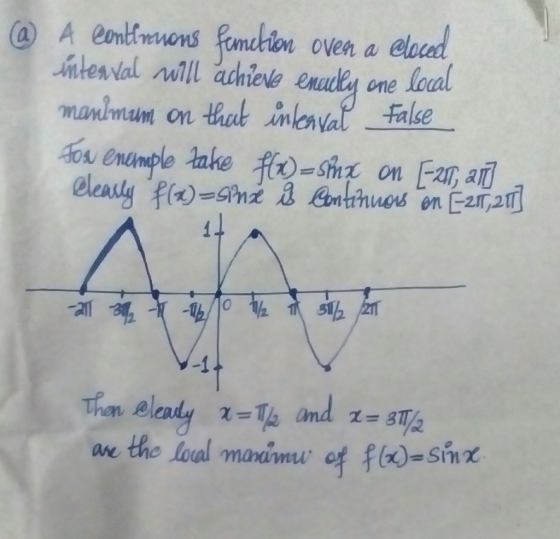
a, A continuous function over a closed interval will achieve exactly one local maximum on that interval ______________
b. If f(x) and g(x) both have a local maximum at x=a then

c. If 

d. If 


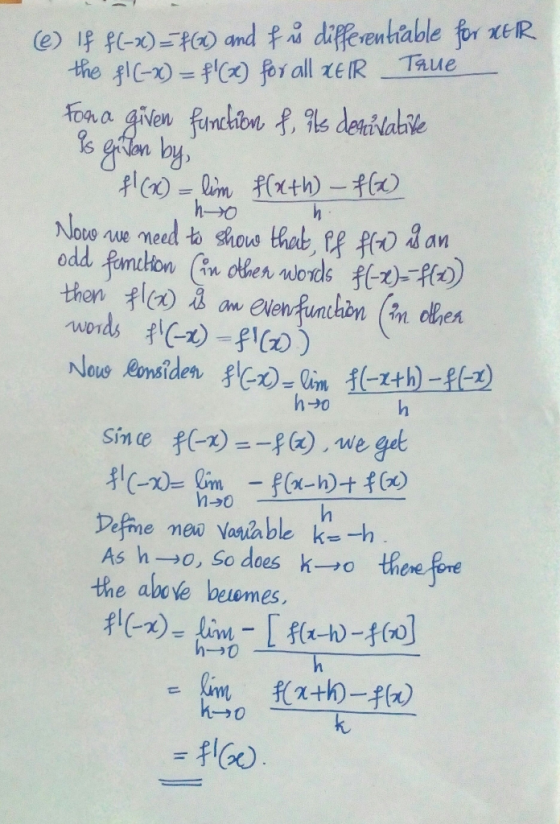
e. If 


f(x) > 0
f(c
f()f
f(-x) =-f(x)
f(-r)f(x)
Homework Answers
Add Answer to:
4. True or False. Write true or false in the blanks. a, A continuous function over a closed inter...
Put (v) for true and (x) for false sentences 1. () If f'(a) 0, then f (a) is a local extrema of f...
 Put (v) for true and (x) for false sentences 1. () If f'(a) 0, then f (a) is a local extrema of f. 2. () A function on a closed interval must have a local extrema. 3. ( ) If f have a local max at x = a, then its square f2 must also have a local max at x = a as well 4. () If f and g have both local minima at a, then their sum...
1. Determine whether the statement is true or false. If false, explain why and correct the statement (T/FIf)exists, then lim ()f) o( T / F ) If f is continuous, then lim f(x) = f(r) (TFo)-L, then...
 1. Determine whether the statement is true or false. If false, explain why and correct the statement (T/FIf)exists, then lim ()f) o( T / F ) If f is continuous, then lim f(x) = f(r) (TFo)-L, then lim f(x)- lim F(x) "( T / F ) If lim -f(x)s lim. f(x) L, then lim f(x)s 1. "(T/F) lim. In x -oo . (T/F) lim0 ·(T / F ) The derivative f' (a) is the instantaneous rate of change of y...
Question 4* (Similar to 18.1) Suppose f is a continuous function on a closed interval [a,...
 Question 4* (Similar to 18.1) Suppose f is a continuous function on a closed interval [a, b]. In class, we proved that f attains its maximum on that interval, i.e. there exists Imar E la, so that f(Imar) > f(x) for all r E (a,b]. We didn't prove that f attains its minimum on the interval, but I claimed that the proof is similar. In fact, you can use the fact that f attains its maximum on any closed interval...
Consider the following graph of f(x) on the closed interval (0,5): 5 4 3 2 1...
 Consider the following graph of f(x) on the closed interval (0,5): 5 4 3 2 1 0 -1 0 1 2 3 5 6 (If the picture doesn't load, click here 95graph2) Use the graph of f(x) to answer the following: (a) On what interval(s) is f(x) increasing? (b) On what interval(s) is f(x) decreasing? (c) On what interval(s) is f(x) concave up? (d) On what interval(s) is f(x) concave down? (e) Where are the inflection points (both x and...
Write ‘T' for true or ‘F' for false. You do not need to show any work...
 Write ‘T' for true or ‘F' for false. You do not need to show any work or justify your answers for this question. The questions are 2 points each. (a) __If (xn) is a convergent sequence (converging to a finite limit) and f:RR is a continuous function, then (f (xn)) is a convergent sequence. (b) _If (xn) is a Cauchy sequence with Yn € (0,1) and f :(0,1) + R is contin- uous, then (f(xn)) is also a Cauchy sequence....
true or false The real valued function f : (1,7) + R defined by f(x) =...
 true or false
The real valued function f : (1,7) + R defined by f(x) = 2is uniformly contin- uous on (0,7). Let an = 1 -1/n for all n € N. Then for all e > 0) and any N E N we have that Jan - am) < e for all n, m > N. Let f :(a,b) → R be a differentiable function, if f'() = 0 for some point Xo € (a, b) then X, is...
true or false
The real valued function f : (1,7) + R defined by f(x) = 2is uniformly contin- uous on (0,7). Let an = 1 -1/n for all n € N. Then for all e > 0) and any N E N we have that Jan - am) < e for all n, m > N. Let f :(a,b) → R be a differentiable function, if f'() = 0 for some point Xo € (a, b) then X, is...
Let Which of the following are TRUE? Select ALL that apply. Please show all your work....
 Let
Which of the following are TRUE? Select ALL that apply. Please
show all your work.
a.
has a local maximum at
whenever
is an even integer
b.
has a saddle point at
whenever
is an even integer
c.
has a saddle point at
whenever
is an odd integer
d.
has a local minimum at
whenever
is an odd integer
fr, y) = sin(x + 7/2) +y? We were unable to transcribe this imageWe were unable to transcribe this imageWe...
Let
Which of the following are TRUE? Select ALL that apply. Please
show all your work.
a.
has a local maximum at
whenever
is an even integer
b.
has a saddle point at
whenever
is an even integer
c.
has a saddle point at
whenever
is an odd integer
d.
has a local minimum at
whenever
is an odd integer
fr, y) = sin(x + 7/2) +y? We were unable to transcribe this imageWe were unable to transcribe this imageWe...
Determine whether the statement is TRUE or FALSE. You are NOT required to justify your answers....
 Determine whether the statement is TRUE or FALSE. You are NOT required to justify your answers. (a) Suppose both f and g are continuous on (a, b) with f > 9. If Sf()dx = Sº g(x)dx, then f(x) = g(x) for all 3 € [a, b]. (b) If f is an infinitely differentiable function on R with f(n)(0) = 0 for all n = 0,1,2,..., then f(x) = 0 for all I ER. (c) f is improperly integrable on (a,...
Are the following statements true or false? Justify your answer. (i) If f(x) > 0 for all x ∈ [a, b] with a < b, then f(x) dx > 0. (ii) If f(x) dx < 0 then f(x) < 0 for all x ∈ [a, b]. W...
Are the following statements true or false? Justify your answer. (i) If f(x) > 0 for all x ∈ [a, b] with a < b, then f(x) dx > 0. (ii) If f(x) dx < 0 then f(x) < 0 for all x ∈ [a, b]. We were unable to transcribe this imageWe were unable to transcribe this image
Problem 1: Determine whether the statement is true or false. If the statement is true, then...
 Problem 1: Determine whether the statement is true or false. If the statement is true, then prove it. Otherwise, provide a counterexample. (a) If a continuous function f:R +R is bounded, then f'(2) exists for all x. (b) Suppose f.g are two functions on an interval (a, b). If both f + g and f - g are differentiable on (a, b), then both f and g are differentiable on (a,b). Problem 2: Define functions f,g: RR by: x sin(-),...
 Put (v) for true and (x) for false sentences 1. () If f'(a) 0, then f (a) is a local extrema of f. 2. () A function on a closed interval must have a local extrema. 3. ( ) If f have a local max at x = a, then its square f2 must also have a local max at x = a as well 4. () If f and g have both local minima at a, then their sum...
 1. Determine whether the statement is true or false. If false, explain why and correct the statement (T/FIf)exists, then lim ()f) o( T / F ) If f is continuous, then lim f(x) = f(r) (TFo)-L, then lim f(x)- lim F(x) "( T / F ) If lim -f(x)s lim. f(x) L, then lim f(x)s 1. "(T/F) lim. In x -oo . (T/F) lim0 ·(T / F ) The derivative f' (a) is the instantaneous rate of change of y...
 Question 4* (Similar to 18.1) Suppose f is a continuous function on a closed interval [a, b]. In class, we proved that f attains its maximum on that interval, i.e. there exists Imar E la, so that f(Imar) > f(x) for all r E (a,b]. We didn't prove that f attains its minimum on the interval, but I claimed that the proof is similar. In fact, you can use the fact that f attains its maximum on any closed interval...
 Consider the following graph of f(x) on the closed interval (0,5): 5 4 3 2 1 0 -1 0 1 2 3 5 6 (If the picture doesn't load, click here 95graph2) Use the graph of f(x) to answer the following: (a) On what interval(s) is f(x) increasing? (b) On what interval(s) is f(x) decreasing? (c) On what interval(s) is f(x) concave up? (d) On what interval(s) is f(x) concave down? (e) Where are the inflection points (both x and...
 Write ‘T' for true or ‘F' for false. You do not need to show any work or justify your answers for this question. The questions are 2 points each. (a) __If (xn) is a convergent sequence (converging to a finite limit) and f:RR is a continuous function, then (f (xn)) is a convergent sequence. (b) _If (xn) is a Cauchy sequence with Yn € (0,1) and f :(0,1) + R is contin- uous, then (f(xn)) is also a Cauchy sequence....
 true or false
The real valued function f : (1,7) + R defined by f(x) = 2is uniformly contin- uous on (0,7). Let an = 1 -1/n for all n € N. Then for all e > 0) and any N E N we have that Jan - am) < e for all n, m > N. Let f :(a,b) → R be a differentiable function, if f'() = 0 for some point Xo € (a, b) then X, is...
true or false
The real valued function f : (1,7) + R defined by f(x) = 2is uniformly contin- uous on (0,7). Let an = 1 -1/n for all n € N. Then for all e > 0) and any N E N we have that Jan - am) < e for all n, m > N. Let f :(a,b) → R be a differentiable function, if f'() = 0 for some point Xo € (a, b) then X, is...
 Let
Which of the following are TRUE? Select ALL that apply. Please
show all your work.
a.
has a local maximum at
whenever
is an even integer
b.
has a saddle point at
whenever
is an even integer
c.
has a saddle point at
whenever
is an odd integer
d.
has a local minimum at
whenever
is an odd integer
fr, y) = sin(x + 7/2) +y? We were unable to transcribe this imageWe were unable to transcribe this imageWe...
Let
Which of the following are TRUE? Select ALL that apply. Please
show all your work.
a.
has a local maximum at
whenever
is an even integer
b.
has a saddle point at
whenever
is an even integer
c.
has a saddle point at
whenever
is an odd integer
d.
has a local minimum at
whenever
is an odd integer
fr, y) = sin(x + 7/2) +y? We were unable to transcribe this imageWe were unable to transcribe this imageWe...
 Determine whether the statement is TRUE or FALSE. You are NOT required to justify your answers. (a) Suppose both f and g are continuous on (a, b) with f > 9. If Sf()dx = Sº g(x)dx, then f(x) = g(x) for all 3 € [a, b]. (b) If f is an infinitely differentiable function on R with f(n)(0) = 0 for all n = 0,1,2,..., then f(x) = 0 for all I ER. (c) f is improperly integrable on (a,...
 Problem 1: Determine whether the statement is true or false. If the statement is true, then prove it. Otherwise, provide a counterexample. (a) If a continuous function f:R +R is bounded, then f'(2) exists for all x. (b) Suppose f.g are two functions on an interval (a, b). If both f + g and f - g are differentiable on (a, b), then both f and g are differentiable on (a,b). Problem 2: Define functions f,g: RR by: x sin(-),...
Most questions answered within 3 hours.
-
Where is the error in this code sequence?
String s1 = "Hello";
String s2 = "ello";...
asked 11 months ago -
Financial data for Joel de Paris, Inc., for last year
follow:
Joel de Paris, Inc.
Balance...
asked 11 months ago -
Consider this reaction:
Al2(SO4)3 (aq)+ BaCl3
(aq) Al2Cl6 (aq)- +
3BaSO4(s) . What is the...
asked 11 months ago -
Suppose that Savneet is considering increasing her
recent random sample from 20 car rentals to 40...
asked 11 months ago -
Trucks arrive at an unloading terminal at an average rate of 120
per hour.
Trucks arrive...
asked 11 months ago -
Why are methanol and ethanol completely soluble in water while
octanol is not very little soluble....
asked 11 months ago -
A facilities manager at a university reads in a research report
that the mean amount of...
asked 11 months ago -
When the CuSO4 is rehydrated by adding water to the anhydrous
compound, is this an endothermic...
asked 11 months ago -
A ray of sunlight is passing from diamond into crown glass; the
angle of incidence is...
asked 11 months ago -
A block of mass 0.249 kg is placed on top of a light, vertical
spring of...
asked 11 months ago -
how do the kidneys compensate in the presences of acidosis
a) trigger hyperventilate
b) reserve acid...
asked 11 months ago -
Question 501 pts
The rental rate of capital to the firm increases. Which of the
following...
asked 11 months ago