
Homework Answers
Given the above formula for Taylor rule and the below description of inflation rate,, inflation gap and output gap, the target federal fund rate can be found as:
| Target inflation rate | inflation rate | inflation gap | output gap | Federal fund target rate |
| 1% | 4% | -3% | 4% | 6.5% |
| 1% | 4% | -3% | -4% | 2.5% |
Under such a rule, the Fed will set lower real interest rate whenever output is lower than potential GDP
Add Answer to:
6. The Taylor rule Aa Aa Economist John B. Taylor found empirically that the Federal Reserve (the...
According to the Taylor Rule, the Fed will increase Federal Funds rate if there is -positive...
According to the Taylor Rule, the Fed will increase Federal Funds rate if there is -positive output gap or negative inflation gap -negative output gap or positive inflation gap -positive output or positive inflation gap -negative output or negative inflation gap
Use the Taylor rule to: Calculate the target for the federal funds rate for October 2012,...
Use the Taylor rule to: Calculate the target for the federal funds rate for October 2012, using the following information: equilibrium real federal funds rate of 2%, target inflation rate of 2%, current inflation rate of 1.2%, and a (negative) output gap of 5.9%. In your calculations, the inflation gap is negative if the current inflation rate is below the target inflation rate. How does the targeted federal funds rate calculated using the Taylor rule compare to the actual federal...
Using the Taylor rule, calculate the target for the federal funds rate for July 2010 using the following information:
Using the Taylor rule, calculate the target for the federal funds rate for July 2010 using the following information: Equilibrium real federal funds rate 2% Target inflation rate 2% Current inflation rate 0.9% Output gap -6%The target for the federal funds rate for July 2010 is _______ %. (Enter your response rounded to two decimal places and include a minus sign if necessary) In your calculations, the inflation gap is negative if the current inflation rate is below the target inflation rate. How does the...
The Taylor rule specifies how policymakers should set the federal funds rate target. Suppose that U.S....
The Taylor rule specifies how policymakers should set the federal funds rate target. Suppose that U.S. real GDP rises 3% above potential GDP, all else constant. According to the Taylor rule, the Fed should (raise lower) the federal funds rate target by (1.75%,1.25%,1.5%,2%) . Suppose instead that the U.S. inflation rate rises by 3%, all else constant. According to the Taylor rule, the Fed should (raise,lower) the federal funds rate target by (4.5%,4.75%,5%,4.25%) . 1. The opportunity cost of holding...
8. Federal funds rate targeting Aa Aa In conducting monetary policy, the Federal Open Market Committee (FOMC) targets a Federal funds rate and the Federal Reserve Bank of New York uses open-marke...
 8. Federal funds rate targeting Aa Aa In conducting monetary policy, the Federal Open Market Committee (FOMC) targets a Federal funds rate and the Federal Reserve Bank of New York uses open-market operations to achieve and maintain the target rate. Suppose that the following graph shows the demand for Federal funds. Use the orange line (square symbols) to plot the supply of Federal funds (also called "the supply of excess reserves") when the FOMC targets a Federal funds rate of...
a. What does the Taylor Rule imply that monetary policymakers should due to the Federal Funds...
a. What does the Taylor Rule imply that monetary policymakers should due to the Federal Funds Rate under the following scenarios? Please explain your answer using the information in the Taylor Rule. (Hint: you may want to start with the equation for the Taylor Rule.) The Taylor Rule: 1. Unemployment rises due to a recession. 2. An oil price shock causes the inflation rate to rise by 1% and output to fall by 1%. 3. The Fed decreases its target...
Assume that the equilibrium real federal funds rate is 2% and the target for inflation is...
Assume that the equilibrium real federal funds rate is 2% and the target for inflation is 1.0%. Suppose that the inflation rate is at 3.5%, leading to an inflation gap of 2.5% (equal to 3.5% -1.0%), and real GDP is 1.0% above its potential, resulting in a positive output gap of 1.0%. The Taylor rule suggests that the federal funds rate should be set at: A. 5.25%. B. 7.25%. C. 6.00%. D. 3.25%
Use the following Taylor rule to calculate what would happen to the real interest rate if...
 Use the following Taylor rule to calculate what would happen to
the real interest rate if inflation increased by 7 percentage
points.
Target federal funds rate
= Natural rate of interest + Current inflation + 1/2(Inflation gap)
+ 1/2(Output gap)
Use the following Taylor rule to calculate what would happen to the real interest rate if inflation increased by 7 percentage points. Target federal funds rate = Natural rate of interest + Current inflation + 1/2(Inflation gap) + 1/2(Output gap)...
Use the following Taylor rule to calculate what would happen to
the real interest rate if inflation increased by 7 percentage
points.
Target federal funds rate
= Natural rate of interest + Current inflation + 1/2(Inflation gap)
+ 1/2(Output gap)
Use the following Taylor rule to calculate what would happen to the real interest rate if inflation increased by 7 percentage points. Target federal funds rate = Natural rate of interest + Current inflation + 1/2(Inflation gap) + 1/2(Output gap)...
According to the Taylor Rule, if the inflation rate is 3 percent and the GDP gap...
According to the Taylor Rule, if the inflation rate is 3 percent and the GDP gap is 2 percent, what does the federal funds rate target equal? Group of answer choices 8.5 percent 5.5 percent 3.5 percent 6.5 percent
Question 47 0.1 pts According to the Taylor Rule: if the inflation rate is 2% and...
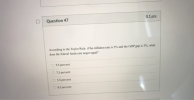 Question 47 0.1 pts According to the Taylor Rule: if the inflation rate is 2% and the GDP gap is 3%, what does the federal funds rate target cqual? 9.5 percent 7.5 percent 5.5 percent 8.5 percent If GDP is $12,000 and velocity is 4, the money supply is $27,000. $12,000. $4,000. $3,000. Ouestions
 8. Federal funds rate targeting Aa Aa In conducting monetary policy, the Federal Open Market Committee (FOMC) targets a Federal funds rate and the Federal Reserve Bank of New York uses open-market operations to achieve and maintain the target rate. Suppose that the following graph shows the demand for Federal funds. Use the orange line (square symbols) to plot the supply of Federal funds (also called "the supply of excess reserves") when the FOMC targets a Federal funds rate of...
 Use the following Taylor rule to calculate what would happen to
the real interest rate if inflation increased by 7 percentage
points.
Target federal funds rate
= Natural rate of interest + Current inflation + 1/2(Inflation gap)
+ 1/2(Output gap)
Use the following Taylor rule to calculate what would happen to the real interest rate if inflation increased by 7 percentage points. Target federal funds rate = Natural rate of interest + Current inflation + 1/2(Inflation gap) + 1/2(Output gap)...
Use the following Taylor rule to calculate what would happen to
the real interest rate if inflation increased by 7 percentage
points.
Target federal funds rate
= Natural rate of interest + Current inflation + 1/2(Inflation gap)
+ 1/2(Output gap)
Use the following Taylor rule to calculate what would happen to the real interest rate if inflation increased by 7 percentage points. Target federal funds rate = Natural rate of interest + Current inflation + 1/2(Inflation gap) + 1/2(Output gap)...
 Question 47 0.1 pts According to the Taylor Rule: if the inflation rate is 2% and the GDP gap is 3%, what does the federal funds rate target cqual? 9.5 percent 7.5 percent 5.5 percent 8.5 percent If GDP is $12,000 and velocity is 4, the money supply is $27,000. $12,000. $4,000. $3,000. Ouestions
Most questions answered within 3 hours.
-
Where is the error in this code sequence?
String s1 = "Hello";
String s2 = "ello";...
asked 11 months ago -
Financial data for Joel de Paris, Inc., for last year
follow:
Joel de Paris, Inc.
Balance...
asked 11 months ago -
Consider this reaction:
Al2(SO4)3 (aq)+ BaCl3
(aq) Al2Cl6 (aq)- +
3BaSO4(s) . What is the...
asked 11 months ago -
Suppose that Savneet is considering increasing her
recent random sample from 20 car rentals to 40...
asked 11 months ago -
Trucks arrive at an unloading terminal at an average rate of 120
per hour.
Trucks arrive...
asked 11 months ago -
Why are methanol and ethanol completely soluble in water while
octanol is not very little soluble....
asked 11 months ago -
A facilities manager at a university reads in a research report
that the mean amount of...
asked 11 months ago -
When the CuSO4 is rehydrated by adding water to the anhydrous
compound, is this an endothermic...
asked 11 months ago -
A ray of sunlight is passing from diamond into crown glass; the
angle of incidence is...
asked 11 months ago -
A block of mass 0.249 kg is placed on top of a light, vertical
spring of...
asked 11 months ago -
how do the kidneys compensate in the presences of acidosis
a) trigger hyperventilate
b) reserve acid...
asked 11 months ago -
Question 501 pts
The rental rate of capital to the firm increases. Which of the
following...
asked 11 months ago