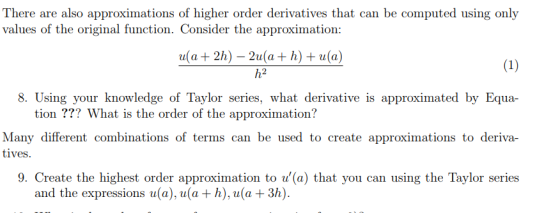
Number 9 requires number 8 so please can you answer both? Thanks. Here's more context:

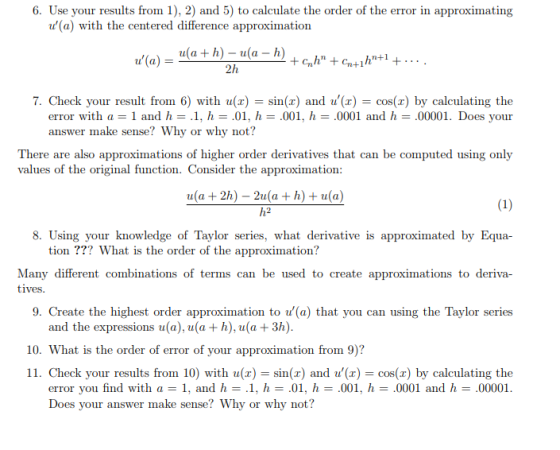
You can determine what the order of error is for a numerical approximation of this type by using Taylor series expansions. 1. Write down the 4th degree Taylor polynomial for u() expanded around the point a 2. Evaluate the 4th degree Taylor polynomial for u(x) at the point a +h 3. Use your results from 2) to calculate the order of the error in approximating u'(a) with the difference quotient a th-u(a) 4. Check your result from 3) with u(x)n(x and u'(x cos(x) by calculating the error of this numerical approximation with a 1 and h .1, h .01, h .001. h0001 and h00001. Compare the results that you have computed. Is your error getting smaller at a rate comparable to h" for the n that you found in 3)? Explain why your results support your computation in 3) It is possible to use different combinations of terms to get a numerical approximation to u' (a) that has a higher order of error. Consider the rule that 2h 5. Evaluate the Taylor polynomial for u(x) at the point a - h
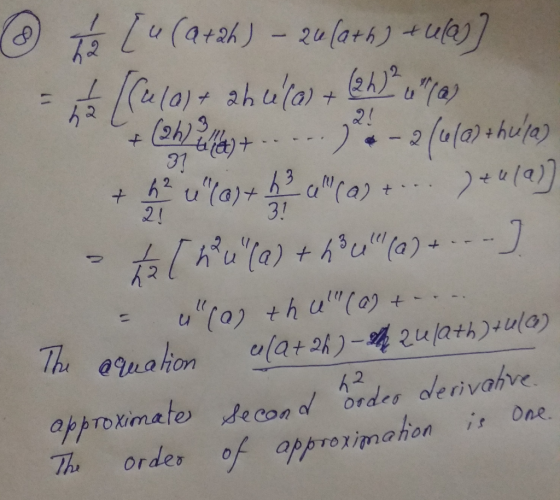
6. Use your results from 1), 2) and 5) to calculate the order of the error in approximating u'(a) with the centered difference approximation u'(a) = u(a + h)-u(a-h) 2h 7. Check your result from 6) with a(z) = sin(x) and u,(x) = cos(z) by calculating the error with a 1 and h-1, h-.01, h-.001, h0001 andh00001. Does your answer make sense? Why or why not? There are also approximations of higher order derivatives that can be computed using only values of the original function. Consider the approximation u(a 2h) - 2u(a + h) + u(a) h2 8. Using your knowledge of Taylor series, what derivative is approximated by Equ Many different combinations of terms can be used to create approximations to deriva- tion ??? What is the order of the approximation? tives 9. Create the highest order approximation to u'(a) that you can using the Taylor series and the expressions u(a), u(a + h), u(a + 3h) 10. What is the order of error of your approximation from 9)? 11. Check your results from 10) with u(x)-sin(x) and u'()co( by calculating the error you find with a = 1, and h = .1, h = .01, h = .001, h = .0001 and h = .00001 Does your answer make sense? Why or why not?
Homework Answers
Add Answer to:
There are also approximations of higher order derivatives that can be computed using only values ...
Use forward and backward difference approximations of O(h)
Use forward and backward difference approximations of O(h) and a centered difference approximation of O(h2) to estimate the first derivative of the following function:f(x)=25x³-6x²+7x-88Evaluate the derivative at x=2 using a step size of h=0.25. Compare your results with the true value of the derivative. Interpret your results on the basis of the remainder term of the Taylor series expansion.
4. Given a function f(x), use Taylor approximations to derive a second order one-sided ap- proximation to f'(ro...
 4. Given a function f(x), use Taylor approximations to derive a second order one-sided ap- proximation to f'(ro) is given by f(zo + h) + cf (zo + 21) + 0(h2). f' (zo) = af(xo) + What is the precise form of the error term? Using the formula approximate f' (1) where r) = e* for h 1/(2p) for p = 1 : 15, Form a table with columns giving h, the approximation, absolute error and absolute error divided by...
The nth-order Taylor polynomial for a function f(x) using the h notation is given as: Pa...
 The nth-order Taylor polynomial for a function f(x) using the h notation is given as: Pa (x + h) = f(x) + f'(a)h + salt) 12 + () +...+ m (s) n." The remainder of the above nth-order Taylor polynomial is defined as: R( +h) = f(n+1)(C) +1 " hn+1, where c is in between x and c+h (n+1)! A student is using 4 terms in the Taylor series of f(x) = 1/x to approximate f(0.7) around x = 1....
For the following set of data, calculate the derivative using the higher order finite-difference approximations for...
 For the following set of data, calculate the derivative using the higher order finite-difference approximations for each data point, as shown in Figures 21.43-21.5. Round your answers to 2 decimal places, if needed. 0 0.5 1.0 1.5 2.0 2.5 X f(x) 33 72 80 10 25 58 Using the forward finite-difference approximation: f'(0) ~ f'(0.5) Using the centered finite-difference approximation: f'(1.0) f'(1.5) Using the backward finite-difference approximation: f'(2.0) f'(2.5) 은 8
Derive the following numerical approximation to the second derivative of f(x) using Taylor's series. Show all...
 Derive the following numerical approximation to the second derivative of f(x) using Taylor's series. Show all of your steps and derive also the order of accuracy of this approximation in terms of h. - f(x + 2h) + 16f(x + h) – 30f(x) + 16 f(x – h) – f(x – 2h) 12h2 1 (C)
the question is from my Numerical methods and analysis course et /()-sin(), where is measured in radians. (a...
 the
question is from my Numerical methods and analysis course
et /()-sin(), where is measured in radians. (a). Calculate approximations to ) using Theorem 6.1 with h-0.1, h-0.01 and h-0.001, Carry eight or nine decimal places. (b). Compare with the value /(0.8)-cos(08), i.e. calculating the error of approximation. s(0.8) Theorem 6.1 (Centered Formula of Order 0(h)). Assume that fe Cla, bl and that x -h. x, x + h e la, bl. Then The notation S) stands for the set...
the
question is from my Numerical methods and analysis course
et /()-sin(), where is measured in radians. (a). Calculate approximations to ) using Theorem 6.1 with h-0.1, h-0.01 and h-0.001, Carry eight or nine decimal places. (b). Compare with the value /(0.8)-cos(08), i.e. calculating the error of approximation. s(0.8) Theorem 6.1 (Centered Formula of Order 0(h)). Assume that fe Cla, bl and that x -h. x, x + h e la, bl. Then The notation S) stands for the set...
(e) Consider the Runge-Kutta method in solving the following first order ODE: dy First, using Taylor series expansion, we have the following approximation of y evaluated at the time step n+1 as a...
 (e) Consider the Runge-Kutta method in solving the following first order ODE: dy First, using Taylor series expansion, we have the following approximation of y evaluated at the time step n+1 as a function of y at the time step n: where h is the size of the time step. The fourth order Runge-Kutta method assumes the following form where the following approximations can be made at various iterations: )sh+รู้: ,f(t.ta, ),. Note that the first term is evaluated at...
dont ans this question Euler's method is based on the fact that the tangent line gives...
 dont ans this question
Euler's method is based on the fact that the tangent line gives a good local approximation for the function. But why restrict ourselves to linear approximants when higher degree polynomial approximants are available? For example, we can use the Taylor polynomial of degree about = No, which is defined by P.(x) = y(x) + y (xo)(x – Xa) + 21 (x- This polynomial is the nth partial sum of the Taylor series representation (te) (x –...
dont ans this question
Euler's method is based on the fact that the tangent line gives a good local approximation for the function. But why restrict ourselves to linear approximants when higher degree polynomial approximants are available? For example, we can use the Taylor polynomial of degree about = No, which is defined by P.(x) = y(x) + y (xo)(x – Xa) + 21 (x- This polynomial is the nth partial sum of the Taylor series representation (te) (x –...
Exercise 6: Given the table of the function f(x)-2" 2 X 0 3 2 f(x) 1 2 4 8 a) Write down the Newton polynomial...
 Exercise 6: Given the table of the function f(x)-2" 2 X 0 3 2 f(x) 1 2 4 8 a) Write down the Newton polynomials P1(x), P2(x), Pa(x). b) Evaluate f(2.5) by using Pa(x). c) Obtain a bound for the errors E1(x), E2(x), Es(x) Exercise 7: Consider f(x)- In(x) use the following formula to answer the given questions '(x) +16-30f+16f,- 12h a) Derive the numerical differentiation formula using Taylor Series and find the truncation error b) Approximate f'(1.2) with h-0.05...
Exercise 1: The Taylor series for In(y) about y = 1 is (4) In(y) = 9...
 Exercise 1: The Taylor series for In(y) about y = 1 is (4) In(y) = 9 (-1)"+(v - 1) n=1 for y-1€ (-1,1] (that is, y E (0,2]). What polynomials do we get if we truncate this series at n = 1? n = 2? n = 0 (hint: the n = Oth approximation is defined!)? Compare the value of each of these with that of In(y) at y = 1.1 and y = 1.75. Note how the error differs...
 4. Given a function f(x), use Taylor approximations to derive a second order one-sided ap- proximation to f'(ro) is given by f(zo + h) + cf (zo + 21) + 0(h2). f' (zo) = af(xo) + What is the precise form of the error term? Using the formula approximate f' (1) where r) = e* for h 1/(2p) for p = 1 : 15, Form a table with columns giving h, the approximation, absolute error and absolute error divided by...
 The nth-order Taylor polynomial for a function f(x) using the h notation is given as: Pa (x + h) = f(x) + f'(a)h + salt) 12 + () +...+ m (s) n." The remainder of the above nth-order Taylor polynomial is defined as: R( +h) = f(n+1)(C) +1 " hn+1, where c is in between x and c+h (n+1)! A student is using 4 terms in the Taylor series of f(x) = 1/x to approximate f(0.7) around x = 1....
 For the following set of data, calculate the derivative using the higher order finite-difference approximations for each data point, as shown in Figures 21.43-21.5. Round your answers to 2 decimal places, if needed. 0 0.5 1.0 1.5 2.0 2.5 X f(x) 33 72 80 10 25 58 Using the forward finite-difference approximation: f'(0) ~ f'(0.5) Using the centered finite-difference approximation: f'(1.0) f'(1.5) Using the backward finite-difference approximation: f'(2.0) f'(2.5) 은 8
 Derive the following numerical approximation to the second derivative of f(x) using Taylor's series. Show all of your steps and derive also the order of accuracy of this approximation in terms of h. - f(x + 2h) + 16f(x + h) – 30f(x) + 16 f(x – h) – f(x – 2h) 12h2 1 (C)
 the
question is from my Numerical methods and analysis course
et /()-sin(), where is measured in radians. (a). Calculate approximations to ) using Theorem 6.1 with h-0.1, h-0.01 and h-0.001, Carry eight or nine decimal places. (b). Compare with the value /(0.8)-cos(08), i.e. calculating the error of approximation. s(0.8) Theorem 6.1 (Centered Formula of Order 0(h)). Assume that fe Cla, bl and that x -h. x, x + h e la, bl. Then The notation S) stands for the set...
the
question is from my Numerical methods and analysis course
et /()-sin(), where is measured in radians. (a). Calculate approximations to ) using Theorem 6.1 with h-0.1, h-0.01 and h-0.001, Carry eight or nine decimal places. (b). Compare with the value /(0.8)-cos(08), i.e. calculating the error of approximation. s(0.8) Theorem 6.1 (Centered Formula of Order 0(h)). Assume that fe Cla, bl and that x -h. x, x + h e la, bl. Then The notation S) stands for the set...
 (e) Consider the Runge-Kutta method in solving the following first order ODE: dy First, using Taylor series expansion, we have the following approximation of y evaluated at the time step n+1 as a function of y at the time step n: where h is the size of the time step. The fourth order Runge-Kutta method assumes the following form where the following approximations can be made at various iterations: )sh+รู้: ,f(t.ta, ),. Note that the first term is evaluated at...
 dont ans this question
Euler's method is based on the fact that the tangent line gives a good local approximation for the function. But why restrict ourselves to linear approximants when higher degree polynomial approximants are available? For example, we can use the Taylor polynomial of degree about = No, which is defined by P.(x) = y(x) + y (xo)(x – Xa) + 21 (x- This polynomial is the nth partial sum of the Taylor series representation (te) (x –...
dont ans this question
Euler's method is based on the fact that the tangent line gives a good local approximation for the function. But why restrict ourselves to linear approximants when higher degree polynomial approximants are available? For example, we can use the Taylor polynomial of degree about = No, which is defined by P.(x) = y(x) + y (xo)(x – Xa) + 21 (x- This polynomial is the nth partial sum of the Taylor series representation (te) (x –...
 Exercise 6: Given the table of the function f(x)-2" 2 X 0 3 2 f(x) 1 2 4 8 a) Write down the Newton polynomials P1(x), P2(x), Pa(x). b) Evaluate f(2.5) by using Pa(x). c) Obtain a bound for the errors E1(x), E2(x), Es(x) Exercise 7: Consider f(x)- In(x) use the following formula to answer the given questions '(x) +16-30f+16f,- 12h a) Derive the numerical differentiation formula using Taylor Series and find the truncation error b) Approximate f'(1.2) with h-0.05...
 Exercise 1: The Taylor series for In(y) about y = 1 is (4) In(y) = 9 (-1)"+(v - 1) n=1 for y-1€ (-1,1] (that is, y E (0,2]). What polynomials do we get if we truncate this series at n = 1? n = 2? n = 0 (hint: the n = Oth approximation is defined!)? Compare the value of each of these with that of In(y) at y = 1.1 and y = 1.75. Note how the error differs...
Most questions answered within 3 hours.
-
Where is the error in this code sequence?
String s1 = "Hello";
String s2 = "ello";...
asked 11 months ago -
Financial data for Joel de Paris, Inc., for last year
follow:
Joel de Paris, Inc.
Balance...
asked 11 months ago -
Consider this reaction:
Al2(SO4)3 (aq)+ BaCl3
(aq) Al2Cl6 (aq)- +
3BaSO4(s) . What is the...
asked 11 months ago -
Suppose that Savneet is considering increasing her
recent random sample from 20 car rentals to 40...
asked 11 months ago -
Trucks arrive at an unloading terminal at an average rate of 120
per hour.
Trucks arrive...
asked 11 months ago -
Why are methanol and ethanol completely soluble in water while
octanol is not very little soluble....
asked 11 months ago -
A facilities manager at a university reads in a research report
that the mean amount of...
asked 11 months ago -
When the CuSO4 is rehydrated by adding water to the anhydrous
compound, is this an endothermic...
asked 11 months ago -
A ray of sunlight is passing from diamond into crown glass; the
angle of incidence is...
asked 11 months ago -
A block of mass 0.249 kg is placed on top of a light, vertical
spring of...
asked 11 months ago -
how do the kidneys compensate in the presences of acidosis
a) trigger hyperventilate
b) reserve acid...
asked 11 months ago -
Question 501 pts
The rental rate of capital to the firm increases. Which of the
following...
asked 11 months ago