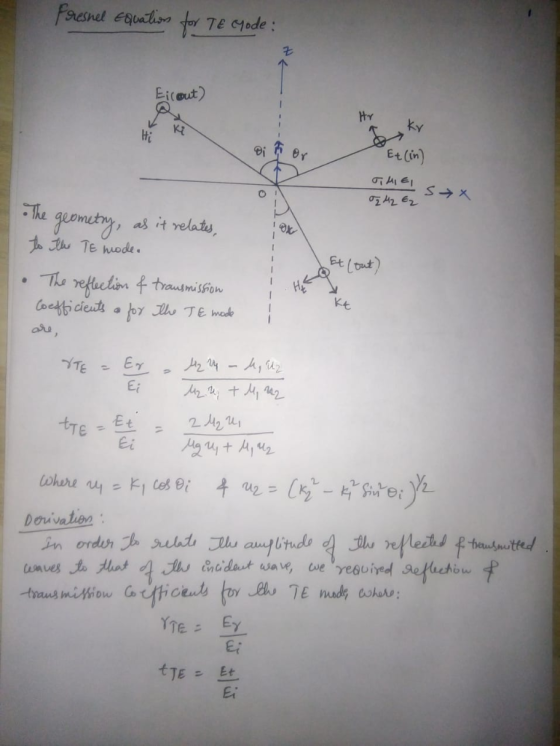
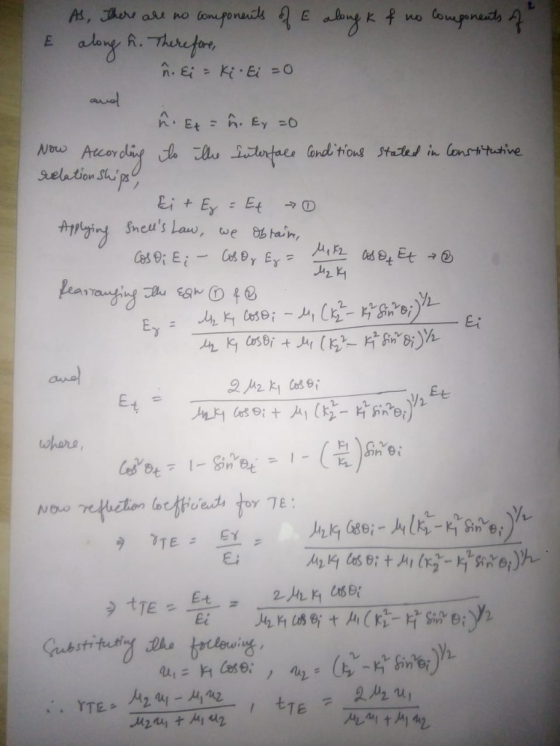
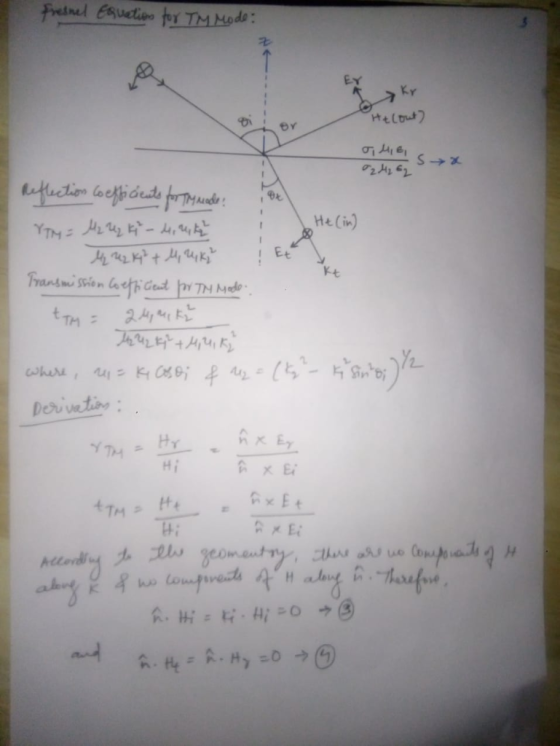
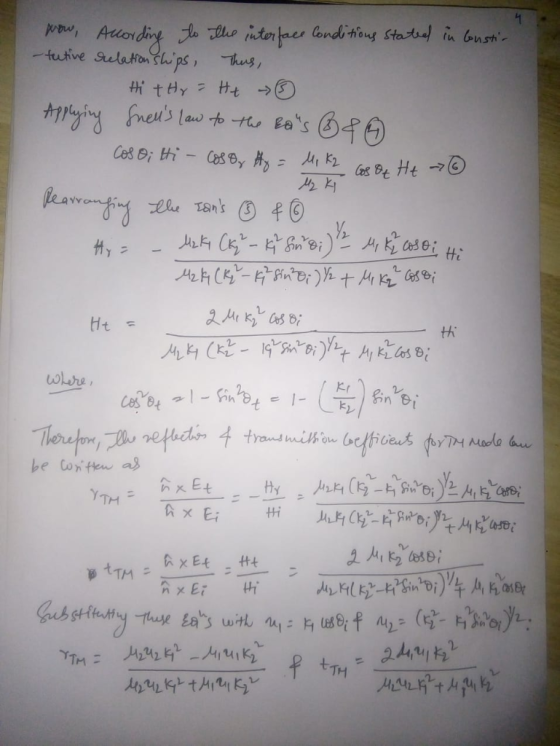
Calculate the H field associated with the transmitted wave (careful here, the transmitted wave is...
Calculate the H field associated with the transmitted wave (careful here, the transmitted wave is NOT PLANE). Hence derive the Fresnel equations (Er/Ei and Et/Ei as function of θi) for this polarization direction.
Homework Answers

Add Answer to:
Calculate the H field associated with the transmitted wave (careful here, the transmitted wave is...
Calculate the H field associated with the transmitted wave (careful here, the transmitted wave is NOT...
Calculate the H field associated with the transmitted wave (careful here, the transmitted wave is NOT PLANE). Hence derive the Fresnel equations (Er/Ei and Et/Ei as function of θi) for this polarization direction.
Find the intensity of reflected and transmitted waves through an interface between two linear non-conducting media...
Find the intensity of reflected and transmitted waves through an interface between two linear non-conducting media in terms of the intensity of the incident wave and the indices of refraction of the two media. Note: To do this, suppose a plane wave of frequency ω and electric field polarization in the x direction is traveling in the positive z direction. The wave approaches the interface between two media on the xy plane from left. Write complex waves equations for the...
I) Sketch a ray diagram of a normally polarized electromagnetic field interacting with a glass/ai...
 i) Sketch a ray diagram of a normally polarized electromagnetic field interacting with a glass/air interface. Calculate the critical angle for the glass/air interface (nI(pure glass).5; n2(air)-l). For this calculation, you can ignore the polarization because the critical angle is the same for either normal or parallel normalisation. ii)Derive an expression for the wavelength of the transmitted wave as a function of the refractive index ni at®i-0c from the phase matching boundary requirement at the glass/air interface (see Fig. 1)....
2. [5 Marks] A perpendicularly polarised plane wave (i.e the E-field is in the y-direction), propagates...
 2. [5 Marks] A perpendicularly polarised plane wave (i.e the E-field is in the y-direction), propagates from region 1 with ?,-8.5 and into region 2 which is a vacuum. The wave exits at an angle of 15°. Given that the incident E-field amplitude is 10??/cm, find: a) The amplitude of the reflected electric field. b) The amplitude of the transmitted electric field c) The amplitude of the reflected magnetic field. d) The amplitude of the transmitted magnetic field. Useful Equations:...
mainly just looking for clarification of part c) a= cos theta t / cos theta i , b=sin theta i/ sin theta t 5. A plane electrom netic wave is obliquely incident upon an infinite plane boundary two die...
 mainly just looking for clarification of part c)
a= cos theta t / cos theta i , b=sin theta i/ sin theta t
5. A plane electrom netic wave is obliquely incident upon an infinite plane boundary two dielectrics with refractive indices, permittivities and permeabilities m. ει, μι and respectively. In terms of the angles of incidence, O, and refraction, e, define n2-E2, μ2 sin θ sin6, (a) State succinctly what assumptions have been made about the materials to write...
mainly just looking for clarification of part c)
a= cos theta t / cos theta i , b=sin theta i/ sin theta t
5. A plane electrom netic wave is obliquely incident upon an infinite plane boundary two dielectrics with refractive indices, permittivities and permeabilities m. ει, μι and respectively. In terms of the angles of incidence, O, and refraction, e, define n2-E2, μ2 sin θ sin6, (a) State succinctly what assumptions have been made about the materials to write...
An Omni-directional antenna with a gain of 1.77 dB in horizontal direction is transmitting 1 Watt...
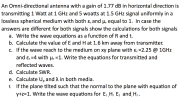 An Omni-directional antenna with a gain of 1.77 dB in horizontal direction is transmitting 1 Watt at 1 GHz and 5 woatts at 1.5 GHz signal uniformly in a lossless spherical medium with both ?,and ?,equal to 1, in case the answers are different for both signals show the calculations for both signals a. Write the wave equations as a function of R and t. b. Calculate the value of E and H at 1.6 km away from transmitter. c....
Please show steps We have that the instantaneous magnetic field H of a wave propagating in...
 Please show steps
We have that the instantaneous magnetic field H of a wave propagating in 5. lossless linear, homogeneous, isotropic, (LHI) material that is charge free, non-magnetic Ho) and has a dielectric relative permittivity of e, The instantaneous representation of the magnetic field intensity is given as; H 25 cos(T x 10e + 0.5ry) uA/m (a) Is this wave a uniform plane wave? If so, explain which plane, and why, or wity not, is te wave uniform. Which direction...
Please show steps
We have that the instantaneous magnetic field H of a wave propagating in 5. lossless linear, homogeneous, isotropic, (LHI) material that is charge free, non-magnetic Ho) and has a dielectric relative permittivity of e, The instantaneous representation of the magnetic field intensity is given as; H 25 cos(T x 10e + 0.5ry) uA/m (a) Is this wave a uniform plane wave? If so, explain which plane, and why, or wity not, is te wave uniform. Which direction...
(30 pts) The magnetic field of a uniform plane wave propagating in a lossless medium with...
 (30 pts) The magnetic field of a uniform plane wave propagating in a lossless medium with E,=2 is H(x,t) = cos(3x10⁸t+4x)ā, – sin(3x10$t +4x)ā.(Alm). Find: (1) The phasor form expression for the magnetic field (2) The direction of propagation for the wave (3) The velocity Vp (4) The polarization state. If it is a circular polarization, you need to determine it is left or right handed. Provide details for your reasoning. (5) The average power density Sav.
expression corresponding to the phasor representation of the electric field of a electromagnetic plane wave propagating through a low loss dielectric (“good dielectric”)
 Consider the following expression corresponding to the phasor representation of the electric field
of a electromagnetic plane wave propagating througlh a low loss dielectric ("good dielectrie")
with e, 4:
E -(&-) - iv22) e-(0.01+ (=+y V/m
Determine:
a) The direction of propagation of the wave.
b) The frequency.
e The velocity of propagation.
2
d) The loss tangent of the dielectric.
e) The type of polarization and the sense of rotation (if proceeds).
Make a two-dimensional plot with the figure...
Consider the following expression corresponding to the phasor representation of the electric field
of a electromagnetic plane wave propagating througlh a low loss dielectric ("good dielectrie")
with e, 4:
E -(&-) - iv22) e-(0.01+ (=+y V/m
Determine:
a) The direction of propagation of the wave.
b) The frequency.
e The velocity of propagation.
2
d) The loss tangent of the dielectric.
e) The type of polarization and the sense of rotation (if proceeds).
Make a two-dimensional plot with the figure...
Need help with this question. The electric field associated with an electromagnetic wave is expressed as,...
 Need help with this question.
The electric field associated with an electromagnetic wave is expressed as, E(r, t) = [2i - 3j + 2k] (10^4 V/m) cos [{5X10^7 pi (x + 2y + 2z)/3) - 15 pi X 10^15 t], where x, y, z are in meter and t is in second. Find (a) the direction of propagation, (b) velocity, (c) wavelength, (d) B(r, t), and (e) intensity and (f polarization state of the wave.
Need help with this question.
The electric field associated with an electromagnetic wave is expressed as, E(r, t) = [2i - 3j + 2k] (10^4 V/m) cos [{5X10^7 pi (x + 2y + 2z)/3) - 15 pi X 10^15 t], where x, y, z are in meter and t is in second. Find (a) the direction of propagation, (b) velocity, (c) wavelength, (d) B(r, t), and (e) intensity and (f polarization state of the wave.
 i) Sketch a ray diagram of a normally polarized electromagnetic field interacting with a glass/air interface. Calculate the critical angle for the glass/air interface (nI(pure glass).5; n2(air)-l). For this calculation, you can ignore the polarization because the critical angle is the same for either normal or parallel normalisation. ii)Derive an expression for the wavelength of the transmitted wave as a function of the refractive index ni at®i-0c from the phase matching boundary requirement at the glass/air interface (see Fig. 1)....
 2. [5 Marks] A perpendicularly polarised plane wave (i.e the E-field is in the y-direction), propagates from region 1 with ?,-8.5 and into region 2 which is a vacuum. The wave exits at an angle of 15°. Given that the incident E-field amplitude is 10??/cm, find: a) The amplitude of the reflected electric field. b) The amplitude of the transmitted electric field c) The amplitude of the reflected magnetic field. d) The amplitude of the transmitted magnetic field. Useful Equations:...
 mainly just looking for clarification of part c)
a= cos theta t / cos theta i , b=sin theta i/ sin theta t
5. A plane electrom netic wave is obliquely incident upon an infinite plane boundary two dielectrics with refractive indices, permittivities and permeabilities m. ει, μι and respectively. In terms of the angles of incidence, O, and refraction, e, define n2-E2, μ2 sin θ sin6, (a) State succinctly what assumptions have been made about the materials to write...
mainly just looking for clarification of part c)
a= cos theta t / cos theta i , b=sin theta i/ sin theta t
5. A plane electrom netic wave is obliquely incident upon an infinite plane boundary two dielectrics with refractive indices, permittivities and permeabilities m. ει, μι and respectively. In terms of the angles of incidence, O, and refraction, e, define n2-E2, μ2 sin θ sin6, (a) State succinctly what assumptions have been made about the materials to write...
 An Omni-directional antenna with a gain of 1.77 dB in horizontal direction is transmitting 1 Watt at 1 GHz and 5 woatts at 1.5 GHz signal uniformly in a lossless spherical medium with both ?,and ?,equal to 1, in case the answers are different for both signals show the calculations for both signals a. Write the wave equations as a function of R and t. b. Calculate the value of E and H at 1.6 km away from transmitter. c....
 Please show steps
We have that the instantaneous magnetic field H of a wave propagating in 5. lossless linear, homogeneous, isotropic, (LHI) material that is charge free, non-magnetic Ho) and has a dielectric relative permittivity of e, The instantaneous representation of the magnetic field intensity is given as; H 25 cos(T x 10e + 0.5ry) uA/m (a) Is this wave a uniform plane wave? If so, explain which plane, and why, or wity not, is te wave uniform. Which direction...
Please show steps
We have that the instantaneous magnetic field H of a wave propagating in 5. lossless linear, homogeneous, isotropic, (LHI) material that is charge free, non-magnetic Ho) and has a dielectric relative permittivity of e, The instantaneous representation of the magnetic field intensity is given as; H 25 cos(T x 10e + 0.5ry) uA/m (a) Is this wave a uniform plane wave? If so, explain which plane, and why, or wity not, is te wave uniform. Which direction...
 (30 pts) The magnetic field of a uniform plane wave propagating in a lossless medium with E,=2 is H(x,t) = cos(3x10⁸t+4x)ā, – sin(3x10$t +4x)ā.(Alm). Find: (1) The phasor form expression for the magnetic field (2) The direction of propagation for the wave (3) The velocity Vp (4) The polarization state. If it is a circular polarization, you need to determine it is left or right handed. Provide details for your reasoning. (5) The average power density Sav.
 Need help with this question.
The electric field associated with an electromagnetic wave is expressed as, E(r, t) = [2i - 3j + 2k] (10^4 V/m) cos [{5X10^7 pi (x + 2y + 2z)/3) - 15 pi X 10^15 t], where x, y, z are in meter and t is in second. Find (a) the direction of propagation, (b) velocity, (c) wavelength, (d) B(r, t), and (e) intensity and (f polarization state of the wave.
Need help with this question.
The electric field associated with an electromagnetic wave is expressed as, E(r, t) = [2i - 3j + 2k] (10^4 V/m) cos [{5X10^7 pi (x + 2y + 2z)/3) - 15 pi X 10^15 t], where x, y, z are in meter and t is in second. Find (a) the direction of propagation, (b) velocity, (c) wavelength, (d) B(r, t), and (e) intensity and (f polarization state of the wave.
Most questions answered within 3 hours.
-
Where is the error in this code sequence?
String s1 = "Hello";
String s2 = "ello";...
asked 10 months ago -
Financial data for Joel de Paris, Inc., for last year
follow:
Joel de Paris, Inc.
Balance...
asked 10 months ago -
Consider this reaction:
Al2(SO4)3 (aq)+ BaCl3
(aq) Al2Cl6 (aq)- +
3BaSO4(s) . What is the...
asked 10 months ago -
Suppose that Savneet is considering increasing her
recent random sample from 20 car rentals to 40...
asked 10 months ago -
Trucks arrive at an unloading terminal at an average rate of 120
per hour.
Trucks arrive...
asked 10 months ago -
Why are methanol and ethanol completely soluble in water while
octanol is not very little soluble....
asked 10 months ago -
A facilities manager at a university reads in a research report
that the mean amount of...
asked 10 months ago -
When the CuSO4 is rehydrated by adding water to the anhydrous
compound, is this an endothermic...
asked 10 months ago -
A ray of sunlight is passing from diamond into crown glass; the
angle of incidence is...
asked 10 months ago -
A block of mass 0.249 kg is placed on top of a light, vertical
spring of...
asked 10 months ago -
how do the kidneys compensate in the presences of acidosis
a) trigger hyperventilate
b) reserve acid...
asked 10 months ago -
Question 501 pts
The rental rate of capital to the firm increases. Which of the
following...
asked 10 months ago