
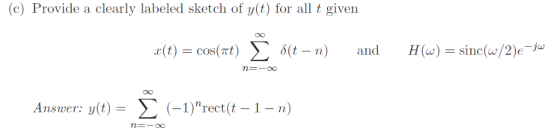
c) Provide a clearly labeled sketch of y(t) for a given x(t)-: cos(mt) δ(t-n) and H(w)-sine(w/2)e-jw Answer: y(t) Σ (-1)"rect(t-1-n)
Homework Answers


Add Answer to:
Problem 2 In each step to follow the signals h(t) r (t) and y(t) denote respectively the impulse ...
In each step to follow, the signals h(t), a(t), and y(t) denote respectively the impulse response...
 In each step to follow, the signals h(t), a(t), and y(t) denote respectively the impulse response, input, and output of a continuous-time LTI system. Accordingly, H(w), X(w) and Y(w) denote their Fourier transforms. Hint: Carefully consider for each step whether to work in the time domain or frequency domain. (b) (25 points) On the axes below, provide a clearly labeled sketch of y(t) for all t given Σ H(w)-( ) sine? (w/8) j2Tt r(t)-e δ(t-n/2) and with sinc(t) = sin(t)/t...
For the remainder of this problem, the signals (t) and y(t) denote the input and output, respecti...
 For the remainder of this problem, the signals (t) and y(t) denote the input and output, respectively, of a stable LTI system whose (double-sided) frequency response is known to be w-4m 27T 4m H(w) = rect ( 2π with rect(t) denoting the unit-pulse function i.e., rect(t) 1 for lt| < 1/2 and is zero otherwise. Hint: Use sketches as a guide for answering each question most efficiently. (c) (15 points) Determine y(t) for all t given the applied input is...
(b) (5 pts) Unit Impulse. Suppose we have an impulse train signal h(t)-Σ δ(t-nT). Given an arbitrary signal r(t), find r(t)h(t) and (t) h(t) in terms of r(t) Show that r(t)h(t)-Σ r(nT)δ(t-nT) and r(...
 (b) (5 pts) Unit Impulse. Suppose we have an impulse train signal h(t)-Σ δ(t-nT). Given an arbitrary signal r(t), find r(t)h(t) and (t) h(t) in terms of r(t) Show that r(t)h(t)-Σ r(nT)δ(t-nT) and r(t) * h(t)-Σ r(t-nT) (b) (5 pts) Find the Fourier Transform of r(t) (t 2n). Hint: Find wo and the Fourier series coefjicients then use the Fourier Transform property for periodic signals.
(b) (5 pts) Unit Impulse. Suppose we have an impulse train signal h(t)-Σ δ(t-nT). Given...
(b) (5 pts) Unit Impulse. Suppose we have an impulse train signal h(t)-Σ δ(t-nT). Given an arbitrary signal r(t), find r(t)h(t) and (t) h(t) in terms of r(t) Show that r(t)h(t)-Σ r(nT)δ(t-nT) and r(t) * h(t)-Σ r(t-nT) (b) (5 pts) Find the Fourier Transform of r(t) (t 2n). Hint: Find wo and the Fourier series coefjicients then use the Fourier Transform property for periodic signals.
(b) (5 pts) Unit Impulse. Suppose we have an impulse train signal h(t)-Σ δ(t-nT). Given...
(e) Consider an LTI system with impulse response h(t) = π8ǐnc(2(t-1). i. (5 pts) Find the frequency response H(jw). Hint: Use the FT properties and pairs tables. ii. (5 pts) Find the output y(t) when...
 (e) Consider an LTI system with impulse response h(t) = π8ǐnc(2(t-1). i. (5 pts) Find the frequency response H(jw). Hint: Use the FT properties and pairs tables. ii. (5 pts) Find the output y(t) when the input is (tsin(t) by using the Fourier Transform method. 3. Fourier Transforms: LTI Systems Described by LCCDE (35 pts) (a) Consider a causal (meaning zero initial conditions) LTI system represented by its input-output relationship in the form of a differential equation:-p +3讐+ 2y(t)--r(t). i....
Question-3 (20 marks) Convolve the continuous time signals r(t) with their impulse response h(t) and find...
 Question-3 (20 marks) Convolve the continuous time signals r(t) with their impulse response h(t) and find y(t) = r(t) *h(t). • (a) r(t) = 0.5rect(-2) and h(t) = 38(2t) – 58(t – 1). . (b) r(t) = rect(t – 1), h(t) = rect(t/2) . (c) r(t) = rect(t – 5) + rect(t + 5), h(t) = rect(t – 4) + rect(t + 4) . (c) r(t) = tri(t), h(t) = 8r(t) = - (t - nT) where T = 3,...
Plz explain 9. The impulse response of a continuous-time LTI system is obtained by plying two signals, f(t) and g(t). h(t) = f(t) g(t) where f(t) = sine(t), g(t) = 5 sine(5). (a) Accurately sketch th...
 Plz explain
9. The impulse response of a continuous-time LTI system is obtained by plying two signals, f(t) and g(t). h(t) = f(t) g(t) where f(t) = sine(t), g(t) = 5 sine(5). (a) Accurately sketch the frequency response H() of the system. (b) What kind of system is H) (LPF, HPF, BPF, BSF, or none of these)? (c) Can this system be implemented with a finite order differential equa tion Explain.
9. The impulse response of a continuous-time LTI system...
Plz explain
9. The impulse response of a continuous-time LTI system is obtained by plying two signals, f(t) and g(t). h(t) = f(t) g(t) where f(t) = sine(t), g(t) = 5 sine(5). (a) Accurately sketch the frequency response H() of the system. (b) What kind of system is H) (LPF, HPF, BPF, BSF, or none of these)? (c) Can this system be implemented with a finite order differential equa tion Explain.
9. The impulse response of a continuous-time LTI system...
Q4) Calculate the Fourier transform of the following time domain signals. Use the properties of t...
 Q4) Calculate the Fourier transform of the following time domain signals. Use the properties of the Fourier transform found in the "Properties of Fourier Transforms" table in textbook and the "Famous Fourier Transforms Table" in textbook instead of direct integration as much as possible to simplify your calculation wherever appropriate: 2-2
For a continuous time linear time-invariant system, the input-output relation is the following (x(t) the input, y(t) the...
 For a continuous time linear time-invariant system, the
input-output relation is the following (x(t) the input, y(t)
the
output):
, where h(t) is the impulse response function of the
system.
Please explain why a signal like e/“* is always an eigenvector
of
this linear map for any w. Also, if ¥(w),X(w),and H(w) are
the
Fourier transforms of y(t),x(t),and h(t), respectively.
Please
derive in detail the relation between Y(w),X(w),and H(w),
which means to reproduce the proof of the basic convolution
property...
For a continuous time linear time-invariant system, the
input-output relation is the following (x(t) the input, y(t)
the
output):
, where h(t) is the impulse response function of the
system.
Please explain why a signal like e/“* is always an eigenvector
of
this linear map for any w. Also, if ¥(w),X(w),and H(w) are
the
Fourier transforms of y(t),x(t),and h(t), respectively.
Please
derive in detail the relation between Y(w),X(w),and H(w),
which means to reproduce the proof of the basic convolution
property...
Practice problem All parts of this problem involve the infinite-duration periodic signal r(t) shown below. )...
 Practice problem All parts of this problem involve the infinite-duration periodic signal r(t) shown below. ) (periodic 7-5 -1 7 0 (a) (15 points) On the axes below, provide a clearly labeled sketch of the spectrum X(w). Hint: Employ the infinite impulse train b) (10 points) Suppose r(t) is the input to a continuous-time LTI system with impulse response 3 2TT πί. h(t)-2-sine(9) . Determine the output y(t) for -oo<t<oo
2.7.5 The impulse response of a continuous-time LTI system is given by h(t) = f(t) -...
 2.7.5 The impulse response of a continuous-time LTI system is given by h(t) = f(t) - et u(t). (a) What is the frequency response H (w) of this system? (b) Find and sketch H(w). (c) Is this a lowpass, bandpass, or highpass filter, or none of those? 2.7.6 The impulse response of a continuous-time LTI system is given by h(t) = S(t – 2). (This is a delay of 2.) (a) What is the frequency response H (w) of this...
 In each step to follow, the signals h(t), a(t), and y(t) denote respectively the impulse response, input, and output of a continuous-time LTI system. Accordingly, H(w), X(w) and Y(w) denote their Fourier transforms. Hint: Carefully consider for each step whether to work in the time domain or frequency domain. (b) (25 points) On the axes below, provide a clearly labeled sketch of y(t) for all t given Σ H(w)-( ) sine? (w/8) j2Tt r(t)-e δ(t-n/2) and with sinc(t) = sin(t)/t...
 For the remainder of this problem, the signals (t) and y(t) denote the input and output, respectively, of a stable LTI system whose (double-sided) frequency response is known to be w-4m 27T 4m H(w) = rect ( 2π with rect(t) denoting the unit-pulse function i.e., rect(t) 1 for lt| < 1/2 and is zero otherwise. Hint: Use sketches as a guide for answering each question most efficiently. (c) (15 points) Determine y(t) for all t given the applied input is...
 (b) (5 pts) Unit Impulse. Suppose we have an impulse train signal h(t)-Σ δ(t-nT). Given an arbitrary signal r(t), find r(t)h(t) and (t) h(t) in terms of r(t) Show that r(t)h(t)-Σ r(nT)δ(t-nT) and r(t) * h(t)-Σ r(t-nT) (b) (5 pts) Find the Fourier Transform of r(t) (t 2n). Hint: Find wo and the Fourier series coefjicients then use the Fourier Transform property for periodic signals.
(b) (5 pts) Unit Impulse. Suppose we have an impulse train signal h(t)-Σ δ(t-nT). Given...
(b) (5 pts) Unit Impulse. Suppose we have an impulse train signal h(t)-Σ δ(t-nT). Given an arbitrary signal r(t), find r(t)h(t) and (t) h(t) in terms of r(t) Show that r(t)h(t)-Σ r(nT)δ(t-nT) and r(t) * h(t)-Σ r(t-nT) (b) (5 pts) Find the Fourier Transform of r(t) (t 2n). Hint: Find wo and the Fourier series coefjicients then use the Fourier Transform property for periodic signals.
(b) (5 pts) Unit Impulse. Suppose we have an impulse train signal h(t)-Σ δ(t-nT). Given...
 (e) Consider an LTI system with impulse response h(t) = π8ǐnc(2(t-1). i. (5 pts) Find the frequency response H(jw). Hint: Use the FT properties and pairs tables. ii. (5 pts) Find the output y(t) when the input is (tsin(t) by using the Fourier Transform method. 3. Fourier Transforms: LTI Systems Described by LCCDE (35 pts) (a) Consider a causal (meaning zero initial conditions) LTI system represented by its input-output relationship in the form of a differential equation:-p +3讐+ 2y(t)--r(t). i....
 Question-3 (20 marks) Convolve the continuous time signals r(t) with their impulse response h(t) and find y(t) = r(t) *h(t). • (a) r(t) = 0.5rect(-2) and h(t) = 38(2t) – 58(t – 1). . (b) r(t) = rect(t – 1), h(t) = rect(t/2) . (c) r(t) = rect(t – 5) + rect(t + 5), h(t) = rect(t – 4) + rect(t + 4) . (c) r(t) = tri(t), h(t) = 8r(t) = - (t - nT) where T = 3,...
 Plz explain
9. The impulse response of a continuous-time LTI system is obtained by plying two signals, f(t) and g(t). h(t) = f(t) g(t) where f(t) = sine(t), g(t) = 5 sine(5). (a) Accurately sketch the frequency response H() of the system. (b) What kind of system is H) (LPF, HPF, BPF, BSF, or none of these)? (c) Can this system be implemented with a finite order differential equa tion Explain.
9. The impulse response of a continuous-time LTI system...
Plz explain
9. The impulse response of a continuous-time LTI system is obtained by plying two signals, f(t) and g(t). h(t) = f(t) g(t) where f(t) = sine(t), g(t) = 5 sine(5). (a) Accurately sketch the frequency response H() of the system. (b) What kind of system is H) (LPF, HPF, BPF, BSF, or none of these)? (c) Can this system be implemented with a finite order differential equa tion Explain.
9. The impulse response of a continuous-time LTI system...
 Q4) Calculate the Fourier transform of the following time domain signals. Use the properties of the Fourier transform found in the "Properties of Fourier Transforms" table in textbook and the "Famous Fourier Transforms Table" in textbook instead of direct integration as much as possible to simplify your calculation wherever appropriate: 2-2
 For a continuous time linear time-invariant system, the
input-output relation is the following (x(t) the input, y(t)
the
output):
, where h(t) is the impulse response function of the
system.
Please explain why a signal like e/“* is always an eigenvector
of
this linear map for any w. Also, if ¥(w),X(w),and H(w) are
the
Fourier transforms of y(t),x(t),and h(t), respectively.
Please
derive in detail the relation between Y(w),X(w),and H(w),
which means to reproduce the proof of the basic convolution
property...
For a continuous time linear time-invariant system, the
input-output relation is the following (x(t) the input, y(t)
the
output):
, where h(t) is the impulse response function of the
system.
Please explain why a signal like e/“* is always an eigenvector
of
this linear map for any w. Also, if ¥(w),X(w),and H(w) are
the
Fourier transforms of y(t),x(t),and h(t), respectively.
Please
derive in detail the relation between Y(w),X(w),and H(w),
which means to reproduce the proof of the basic convolution
property...
 Practice problem All parts of this problem involve the infinite-duration periodic signal r(t) shown below. ) (periodic 7-5 -1 7 0 (a) (15 points) On the axes below, provide a clearly labeled sketch of the spectrum X(w). Hint: Employ the infinite impulse train b) (10 points) Suppose r(t) is the input to a continuous-time LTI system with impulse response 3 2TT πί. h(t)-2-sine(9) . Determine the output y(t) for -oo<t<oo
 2.7.5 The impulse response of a continuous-time LTI system is given by h(t) = f(t) - et u(t). (a) What is the frequency response H (w) of this system? (b) Find and sketch H(w). (c) Is this a lowpass, bandpass, or highpass filter, or none of those? 2.7.6 The impulse response of a continuous-time LTI system is given by h(t) = S(t – 2). (This is a delay of 2.) (a) What is the frequency response H (w) of this...
Most questions answered within 3 hours.
-
Where is the error in this code sequence?
String s1 = "Hello";
String s2 = "ello";...
asked 11 months ago -
Financial data for Joel de Paris, Inc., for last year
follow:
Joel de Paris, Inc.
Balance...
asked 11 months ago -
Consider this reaction:
Al2(SO4)3 (aq)+ BaCl3
(aq) Al2Cl6 (aq)- +
3BaSO4(s) . What is the...
asked 11 months ago -
Suppose that Savneet is considering increasing her
recent random sample from 20 car rentals to 40...
asked 11 months ago -
Trucks arrive at an unloading terminal at an average rate of 120
per hour.
Trucks arrive...
asked 11 months ago -
Why are methanol and ethanol completely soluble in water while
octanol is not very little soluble....
asked 11 months ago -
A facilities manager at a university reads in a research report
that the mean amount of...
asked 11 months ago -
When the CuSO4 is rehydrated by adding water to the anhydrous
compound, is this an endothermic...
asked 11 months ago -
A ray of sunlight is passing from diamond into crown glass; the
angle of incidence is...
asked 11 months ago -
A block of mass 0.249 kg is placed on top of a light, vertical
spring of...
asked 11 months ago -
how do the kidneys compensate in the presences of acidosis
a) trigger hyperventilate
b) reserve acid...
asked 11 months ago -
Question 501 pts
The rental rate of capital to the firm increases. Which of the
following...
asked 11 months ago