Please only answer if 100% sure I keep getting incorrect
responses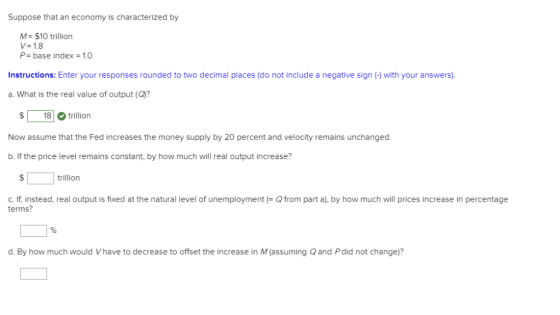
Suppose that an economy is characterized by M-$10 trillion V- 1.8 P-base index 1.0
Instructions: Enter your responses rounded to two decimal places (do not include a negative sign ()with your answers).
a. What is the real value of output (Q)? $18 trillion Now assume that the Fed increases the money supply by 20 percent and velocity remains unchanged
b. If the price level remains constant, by how much will real output increase?
c. If, instead, real output is fixed at the natural level of unemployment (-Q from part a), by how much will prices increase in percentage terms?
d. By how much would Vhave to decrease to offset the increase in M (assuming Qand P did not change)?
Homework Answers
(a)
The equation of exchange is as follows -
M * V = P * Q
$10 trillion * 1.8 = 1 * Q
Q = $18 trillion
Thus,
The real value of output (Q) is $18 trillion.
(b)
Now, money supply increases by 20 percent.
New money supply = $10 trillion + ($10 trillion * 0.20) = $10 trillion + $2 trillion = $12 trillion
Price level and velocity remains unchanged.
So,
M * V = P * Q
$12 trillion * 1.8 = 1 * Q
$21.6 trillion = Q
Thus,
The real output increases by $3.6 trillion.
(c)
New money supply = $12 trillion
Velocity and real output remains unchanged.
So,
M * V = P * Q
$12 trillion * 1.8 = P * $18 trillion
$21.6 trillion = P * $18 trillion
P = $21.6 trillion/$18 trillion
P = 1.2
Increase in price level = [(1.2 - 1)/1] * 100 = 20%
The price level will increase by 20%.
(d)
M = $12 trillion
P = 1
Q = 18 trillion
M * V = P * Q
$12 trillion * V = 1 * $18 trillion
V = $18 trillion/$12 trillion
V = 1.5
Thus,
The V would have decreased by 0.3
Add Answer to:
Suppose that an economy is characterized by M-$10 trillion V- 1.8 P-base index 1.0 nstructions: E...
Suppose that an economy is characterized by M= $9 trillion V=2 P= base index = 1.0...
 Suppose that an economy is characterized by M= $9 trillion V=2 P= base index = 1.0 Instructions: Enter your responses rounded to two decimal places (do not include a negative sign (-) with your answers). a. What is the real value of output (Q)? $D 18 trillion Now assume that the Fed increases the money supply by 20 percent and velocity remains unchanged. b. If the price level remains constant, by how much will real output increase? c. If, instead, real output is fixed...
1. GDP is _____ 11 trillion/ 16 trillion/ 10 trillion / 14 trillion /12 trillion 2. currently...
 1. GDP is _____ 11
trillion/ 16 trillion/ 10 trillion / 14 trillion /12
trillion
2. currently _____ recessionary gap / inflationary
gap
3. of ______ 4 trillion / 1 trillion / 5 trillion / 2
trillion / 3 trillion
4. the Fed will ____ increase / decrease
5. which will _____ increase/ decrease
6. incentive to ____ increase / decrease
7. shifting the ____ AD / SRAS / LRAS
8. curve to the ____ left / right
9. relatively high...
1. GDP is _____ 11
trillion/ 16 trillion/ 10 trillion / 14 trillion /12
trillion
2. currently _____ recessionary gap / inflationary
gap
3. of ______ 4 trillion / 1 trillion / 5 trillion / 2
trillion / 3 trillion
4. the Fed will ____ increase / decrease
5. which will _____ increase/ decrease
6. incentive to ____ increase / decrease
7. shifting the ____ AD / SRAS / LRAS
8. curve to the ____ left / right
9. relatively high...
Please make sure to answer which way the lines on the graft shift. Also, all parts of the second photo. M x v-F7x Q. where M is the money supply, V is the velocty of money, P is the economy's...
 Please make sure to answer which way the lines on the graft
shift. Also, all parts of the second photo.
M x v-F7x Q. where M is the money supply, V is the velocty of money, P is the economy's price level, and Q is Real GDP ng diagram shows the current aggregate demand (AD) and aggregate supply (AS) curves in a hypothetical economy. 12 AD 10 AS 12 15 18 REAL GDP (Trillions of dollars) What is the GDP...
Please make sure to answer which way the lines on the graft
shift. Also, all parts of the second photo.
M x v-F7x Q. where M is the money supply, V is the velocty of money, P is the economy's price level, and Q is Real GDP ng diagram shows the current aggregate demand (AD) and aggregate supply (AS) curves in a hypothetical economy. 12 AD 10 AS 12 15 18 REAL GDP (Trillions of dollars) What is the GDP...
Suppose that workers and firms perfectly forecast inflation, so that the real wage remains unchanged as...
 Suppose that workers and firms perfectly forecast inflation, so that the real wage remains unchanged as the price level rises over time. Prices and wages rise at the same rate, which implies that the real wage stays constant. The following graph shows the aggregate demand curve (AD) in an economy in long-run equilibrium. Assume the natural rate of unemployment is 6%, and potential output is $50 trillion. Use the orange points (square symbol) to draw the aggregate supply curve in...
17-26 17) Real GDP in 2000 was $8.0 trillion and $8.5 trillion in 2001. What was...
 17-26
17) Real GDP in 2000 was $8.0 trillion and $8.5 trillion in 2001. What was the annual growth rate in percentage terms? 18) If GDP is $14.3 trillion, consumption is $10 trillion, and investment $1.6 trillion, what percent of GDP is consumption, and what percent is investment? 19) If the price at time t is $8 and the price at time t+1 is $9, by what percent did the price increase? 20) The inflation rate is the annual percentage...
17-26
17) Real GDP in 2000 was $8.0 trillion and $8.5 trillion in 2001. What was the annual growth rate in percentage terms? 18) If GDP is $14.3 trillion, consumption is $10 trillion, and investment $1.6 trillion, what percent of GDP is consumption, and what percent is investment? 19) If the price at time t is $8 and the price at time t+1 is $9, by what percent did the price increase? 20) The inflation rate is the annual percentage...
solve question 4 and 5 3. Calculate the following given the information about the economy in...
 solve question 4 and 5
3. Calculate the following given the information about the economy in the table: Total population Noninstitutional population Incapable of working Not in the labour force Employed Unemployed 260 million 200 million 60 million 66 million 134 million 10 million 5. Calculate the following given the following information about the economy in 1985, 1995, and 1999: 1985 1995 1999 Nominal GDP 4,213 9,256.1 (in billions of dollars) GDP deflator 73.7 98.1 (index, 1996=100) Real GDP 7,543.8...
solve question 4 and 5
3. Calculate the following given the information about the economy in the table: Total population Noninstitutional population Incapable of working Not in the labour force Employed Unemployed 260 million 200 million 60 million 66 million 134 million 10 million 5. Calculate the following given the following information about the economy in 1985, 1995, and 1999: 1985 1995 1999 Nominal GDP 4,213 9,256.1 (in billions of dollars) GDP deflator 73.7 98.1 (index, 1996=100) Real GDP 7,543.8...
Consider the following misperceptions model of the economy. AD: Y =600 + 10(M/P) SRAS: Y=Y +P...
 Consider the following misperceptions model of the economy. AD: Y =600 + 10(M/P) SRAS: Y=Y +P - pe Okun's Law: (Y - Ý )/Y = - 2ệu - 4) Let 7 =750, ū=0.05, M =600, and pe =40. a. b. What is the price level? (2%) Suppose there is an unanticipated increase in the nominal money supply to 800. What is the short-run equilibrium level of output, the unemployment rate, and the price level? (3%) When price expectations adjust fully,...
Help with graph, fill in the blanks and drop downs.Drop Downs:1. more/less2. higher/lower...
 Help with graph, fill in the blanks and drop downs.Drop Downs:1. more/less2. higher/lower3. (short-run change in output):no change/decrease/increase4. (long-run change in price level):same/lower/higher than/as initial expectations5. (long-run change in output):no change/decrease/increase4. The rational expectations model Suppose the U.S. economy is in equilibrium at a potential output of $10 trillion so that unemployment is at the natural rate. At the beginning of the year, the Federal Reserve announces that its monetary policy will aim to maintain output at potential output and sustain...
Question 3: (45 marks] Suppose the price-setting equation is given by P= (1 + m)W where...
 Question 3: (45 marks] Suppose the price-setting equation is given by P= (1 + m)W where m is the markup. The wage-setting equation is given by W = pe? where z are unemployment benefts and u is the unemployment rate. 1. Derive the real wage and unemployment consistent with equilibrium in the labor market in the medium run. Is this the natural rate of unemployment? Does the equilibrium rate of unemployment change if unemployment benefts decrease? Explain? (8 marks] 2....
Question 3: (45 marks] Suppose the price-setting equation is given by P= (1+mW where m is...
 Question 3: (45 marks] Suppose the price-setting equation is given by P= (1+mW where m is the markup. The wage-setting equation is given by W = pe? where z are unemployment benefts and u is the unemployment rate. 1. Derive the real wage and unemployment consistent with equilibrium in the labor market in the medium run. Is this the natural rate of unemployment? Does the equilibrium rate of unemployment change if unemployment benefts decrease? Explain? (8 marks] 2. Draw the...
 Suppose that an economy is characterized by M= $9 trillion V=2 P= base index = 1.0 Instructions: Enter your responses rounded to two decimal places (do not include a negative sign (-) with your answers). a. What is the real value of output (Q)? $D 18 trillion Now assume that the Fed increases the money supply by 20 percent and velocity remains unchanged. b. If the price level remains constant, by how much will real output increase? c. If, instead, real output is fixed...
 1. GDP is _____ 11
trillion/ 16 trillion/ 10 trillion / 14 trillion /12
trillion
2. currently _____ recessionary gap / inflationary
gap
3. of ______ 4 trillion / 1 trillion / 5 trillion / 2
trillion / 3 trillion
4. the Fed will ____ increase / decrease
5. which will _____ increase/ decrease
6. incentive to ____ increase / decrease
7. shifting the ____ AD / SRAS / LRAS
8. curve to the ____ left / right
9. relatively high...
1. GDP is _____ 11
trillion/ 16 trillion/ 10 trillion / 14 trillion /12
trillion
2. currently _____ recessionary gap / inflationary
gap
3. of ______ 4 trillion / 1 trillion / 5 trillion / 2
trillion / 3 trillion
4. the Fed will ____ increase / decrease
5. which will _____ increase/ decrease
6. incentive to ____ increase / decrease
7. shifting the ____ AD / SRAS / LRAS
8. curve to the ____ left / right
9. relatively high...
 Please make sure to answer which way the lines on the graft
shift. Also, all parts of the second photo.
M x v-F7x Q. where M is the money supply, V is the velocty of money, P is the economy's price level, and Q is Real GDP ng diagram shows the current aggregate demand (AD) and aggregate supply (AS) curves in a hypothetical economy. 12 AD 10 AS 12 15 18 REAL GDP (Trillions of dollars) What is the GDP...
Please make sure to answer which way the lines on the graft
shift. Also, all parts of the second photo.
M x v-F7x Q. where M is the money supply, V is the velocty of money, P is the economy's price level, and Q is Real GDP ng diagram shows the current aggregate demand (AD) and aggregate supply (AS) curves in a hypothetical economy. 12 AD 10 AS 12 15 18 REAL GDP (Trillions of dollars) What is the GDP...
 Suppose that workers and firms perfectly forecast inflation, so that the real wage remains unchanged as the price level rises over time. Prices and wages rise at the same rate, which implies that the real wage stays constant. The following graph shows the aggregate demand curve (AD) in an economy in long-run equilibrium. Assume the natural rate of unemployment is 6%, and potential output is $50 trillion. Use the orange points (square symbol) to draw the aggregate supply curve in...
 17-26
17) Real GDP in 2000 was $8.0 trillion and $8.5 trillion in 2001. What was the annual growth rate in percentage terms? 18) If GDP is $14.3 trillion, consumption is $10 trillion, and investment $1.6 trillion, what percent of GDP is consumption, and what percent is investment? 19) If the price at time t is $8 and the price at time t+1 is $9, by what percent did the price increase? 20) The inflation rate is the annual percentage...
17-26
17) Real GDP in 2000 was $8.0 trillion and $8.5 trillion in 2001. What was the annual growth rate in percentage terms? 18) If GDP is $14.3 trillion, consumption is $10 trillion, and investment $1.6 trillion, what percent of GDP is consumption, and what percent is investment? 19) If the price at time t is $8 and the price at time t+1 is $9, by what percent did the price increase? 20) The inflation rate is the annual percentage...
 solve question 4 and 5
3. Calculate the following given the information about the economy in the table: Total population Noninstitutional population Incapable of working Not in the labour force Employed Unemployed 260 million 200 million 60 million 66 million 134 million 10 million 5. Calculate the following given the following information about the economy in 1985, 1995, and 1999: 1985 1995 1999 Nominal GDP 4,213 9,256.1 (in billions of dollars) GDP deflator 73.7 98.1 (index, 1996=100) Real GDP 7,543.8...
solve question 4 and 5
3. Calculate the following given the information about the economy in the table: Total population Noninstitutional population Incapable of working Not in the labour force Employed Unemployed 260 million 200 million 60 million 66 million 134 million 10 million 5. Calculate the following given the following information about the economy in 1985, 1995, and 1999: 1985 1995 1999 Nominal GDP 4,213 9,256.1 (in billions of dollars) GDP deflator 73.7 98.1 (index, 1996=100) Real GDP 7,543.8...
 Consider the following misperceptions model of the economy. AD: Y =600 + 10(M/P) SRAS: Y=Y +P - pe Okun's Law: (Y - Ý )/Y = - 2ệu - 4) Let 7 =750, ū=0.05, M =600, and pe =40. a. b. What is the price level? (2%) Suppose there is an unanticipated increase in the nominal money supply to 800. What is the short-run equilibrium level of output, the unemployment rate, and the price level? (3%) When price expectations adjust fully,...
 Help with graph, fill in the blanks and drop downs.Drop Downs:1. more/less2. higher/lower3. (short-run change in output):no change/decrease/increase4. (long-run change in price level):same/lower/higher than/as initial expectations5. (long-run change in output):no change/decrease/increase4. The rational expectations model Suppose the U.S. economy is in equilibrium at a potential output of $10 trillion so that unemployment is at the natural rate. At the beginning of the year, the Federal Reserve announces that its monetary policy will aim to maintain output at potential output and sustain...
 Question 3: (45 marks] Suppose the price-setting equation is given by P= (1 + m)W where m is the markup. The wage-setting equation is given by W = pe? where z are unemployment benefts and u is the unemployment rate. 1. Derive the real wage and unemployment consistent with equilibrium in the labor market in the medium run. Is this the natural rate of unemployment? Does the equilibrium rate of unemployment change if unemployment benefts decrease? Explain? (8 marks] 2....
 Question 3: (45 marks] Suppose the price-setting equation is given by P= (1+mW where m is the markup. The wage-setting equation is given by W = pe? where z are unemployment benefts and u is the unemployment rate. 1. Derive the real wage and unemployment consistent with equilibrium in the labor market in the medium run. Is this the natural rate of unemployment? Does the equilibrium rate of unemployment change if unemployment benefts decrease? Explain? (8 marks] 2. Draw the...
Most questions answered within 3 hours.
-
Where is the error in this code sequence?
String s1 = "Hello";
String s2 = "ello";...
asked 11 months ago -
Financial data for Joel de Paris, Inc., for last year
follow:
Joel de Paris, Inc.
Balance...
asked 11 months ago -
Consider this reaction:
Al2(SO4)3 (aq)+ BaCl3
(aq) Al2Cl6 (aq)- +
3BaSO4(s) . What is the...
asked 11 months ago -
Suppose that Savneet is considering increasing her
recent random sample from 20 car rentals to 40...
asked 11 months ago -
Trucks arrive at an unloading terminal at an average rate of 120
per hour.
Trucks arrive...
asked 11 months ago -
Why are methanol and ethanol completely soluble in water while
octanol is not very little soluble....
asked 11 months ago -
A facilities manager at a university reads in a research report
that the mean amount of...
asked 11 months ago -
When the CuSO4 is rehydrated by adding water to the anhydrous
compound, is this an endothermic...
asked 11 months ago -
A ray of sunlight is passing from diamond into crown glass; the
angle of incidence is...
asked 11 months ago -
A block of mass 0.249 kg is placed on top of a light, vertical
spring of...
asked 11 months ago -
how do the kidneys compensate in the presences of acidosis
a) trigger hyperventilate
b) reserve acid...
asked 11 months ago -
Question 501 pts
The rental rate of capital to the firm increases. Which of the
following...
asked 11 months ago