
Homework Answers
In this solution some basic concepts of Vibration Mechanics are used. For more information, refer to any standard textbook or drop a comment below. Please give a Thumbs Up, if solution is helpful.
NOTE : Feel free to ask further queries. Your positive
rating would be appreciated and motivate me !
Add Answer to:
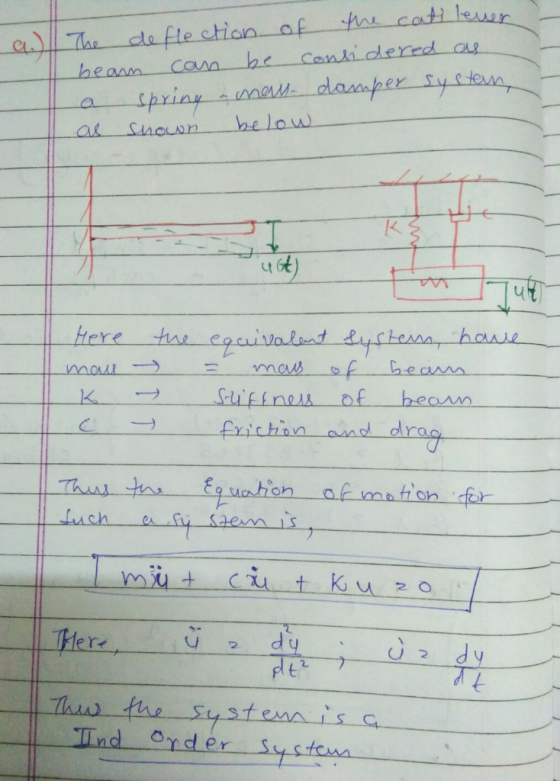
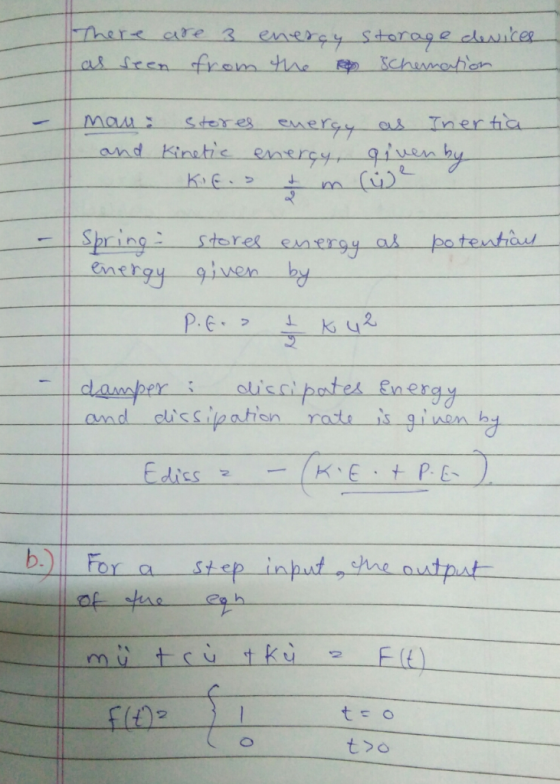
A cantilever can be considered as a mass, spring, damper system. a) Is this a first, second, or t...
A second order mechanical system of a mass connected to a spring and a damper is subjected to a s...
 A second order mechanical system of a mass connected to a spring and a damper is subjected to a sinusoidal input force mi+ci +kx- Asin(ot) The mass is m-5 kg, the damping constant is c = 1 N-sec/m, the spring stiffness is 2 N/m, and the amplitude of the input force is A- 3 N. For this system give explicit numerical values for the damping factor un-damped natural frequency on a. and the
A second order mechanical system of a...
A second order mechanical system of a mass connected to a spring and a damper is subjected to a sinusoidal input force mi+ci +kx- Asin(ot) The mass is m-5 kg, the damping constant is c = 1 N-sec/m, the spring stiffness is 2 N/m, and the amplitude of the input force is A- 3 N. For this system give explicit numerical values for the damping factor un-damped natural frequency on a. and the
A second order mechanical system of a...
Consider a mass-spring-damper system whose motion is described by the following system of differe...
 Consider a mass-spring-damper system whose motion is described by the following system of differentiat equations [c1(f-k)+k,(f-х)-c2(x-9), f=f(t), y:' y(t) with x=x( t), where the function fit) is the input displacement function (known), while xit) and yt) are the two generalized coordinates (both unknown) of the mass-spring-damper systenm. 1. Identify the type of equations (e.g. H/NH, ODE/PDE, L/NL, order, type of coefficients, etc.J. 2. Express this system of differential equations in matrix form, assume f 0 and then determine its general...
A s Spring (k)-mass (m)- damper (c) system is subject to two impulses: F-2F and F-F escribe the d...
 A s Spring (k)-mass (m)- damper (c) system is subject to two impulses: F-2F and F-F escribe the displacement of the mass as a function of time in terms of m,c, k, o, and the constants in the applied force? Assume it is an underdamped system.
A s Spring (k)-mass (m)- damper (c) system is subject to two impulses: F-2F and F-F escribe the displacement of the mass as a function of time in terms of m,c, k, o, and...
A s Spring (k)-mass (m)- damper (c) system is subject to two impulses: F-2F and F-F escribe the displacement of the mass as a function of time in terms of m,c, k, o, and the constants in the applied force? Assume it is an underdamped system.
A s Spring (k)-mass (m)- damper (c) system is subject to two impulses: F-2F and F-F escribe the displacement of the mass as a function of time in terms of m,c, k, o, and...
Problem 2 - A modified mass-spring-damper system: Model the modified mass-spring-damper system shown below. The mass...
 Problem 2 - A modified mass-spring-damper system: Model the modified mass-spring-damper system shown below. The mass of the handle is negligi- ble (only 1 FBD is necessary). Consider the displacement (t) to be the input to the system and the cart displacement az(t) to be the output. You may assume negligible drag. MwSpring-Damper System M0 Problem 3 Repeat problem 2, but with the following differences: • Assume the mass of the handle m, is not equal to zero. You may...
A second order mechanical system of a mass connected to a spring and a damper is subjected to a s...
 A second order mechanical system of a mass connected to a spring and a damper is subjected to a sinusoidal input force mx+cx + kx = A sin(at) The mass is m-5 kg, the damping constant is c = 1 N-sec/m, the spring stiffness is 2 N/m, and the amplitude of the input force is A- 3 N. For this system give explicit numerical values for the damping factor 5 and the un-damped natural frequency Using the given formulas for...
Consider the following second-order ODE representing a spring-mass-damper system for zero initial...
 Consider the following second-order ODE representing a spring-mass-damper system for zero initial conditions (forced response): where u is the Unit Step Function (of magnitude 1 a. Use MATLAB to obtain an analytical solution x() for the differential equation, using the Laplace Transforms approach (do not use DSOLVE). Obtain the analytical expression for ao. Also obtain a plot of x() (for a simulation of 14 seconds) b. Obtain the Transfer Function representation for the system. c. Use MATLAB to obtain the...
The equations of motion for a mass-spring-damper system can be described by mE(t) + ci(t) +...
 The equations of motion for a mass-spring-damper system can be described by mE(t) + ci(t) + k2(t) = F(t), where z(t) is the position of the mass, c is the damper coefficient, k is the spring constant, and F(t) is an external force applied to the mass as an input. If the system state vector is defined by 2(t) = lat) a(t)=F(t), y(t)=2(t), given below: x=Ax + Bu y=Cx + Du.
Question 6 (Second-order system - log decrement). A mass-spring-damper system has a mass of 100 kg....
 Question 6 (Second-order system - log decrement). A mass-spring-damper system has a mass of 100 kg. Its free response amplitude decays such that the amplitude of the 30th cycle is 20% of the amplitude of the 1st cycle. It takes 60 sec to complete 30 cycles. Estimate the damping constant c and the spring constant k.
Problem 1. Consider the following mass, spring, and damper system. Let the force F be the...
 Problem 1. Consider the following mass, spring, and damper system. Let the force F be the input and the position x be the output. M-1 kg b- 10 N s/m k 20 N/nm F = 1 N when t>=0 PART UNIT FEEDBACK CONTROL SYSTEM 5) Construct a unit feedback control for the mass-spring-damper system 6) Draw the block diagram of the unit feedback control system 7) Find the Transfer Function of the closed-loop (CL) system 8) Find and plot the...
3 dismo plesis The spring mass damper system shown is subjected to a force f(t), which...
 3
dismo plesis
The spring mass damper system shown is subjected to a force f(t), which is a step function. b m f(t) At time t=0, with zero initial conditions, the system is subjected to the force. The magnitude of the force is 4 newton, while the spring rate is 8.2 newton/meter, and the damping coefficient is 10 newton-sec/meter. Calculate the energy stored in the spring, in Joules, in steady state.
3
dismo plesis
The spring mass damper system shown is subjected to a force f(t), which is a step function. b m f(t) At time t=0, with zero initial conditions, the system is subjected to the force. The magnitude of the force is 4 newton, while the spring rate is 8.2 newton/meter, and the damping coefficient is 10 newton-sec/meter. Calculate the energy stored in the spring, in Joules, in steady state.
 A second order mechanical system of a mass connected to a spring and a damper is subjected to a sinusoidal input force mi+ci +kx- Asin(ot) The mass is m-5 kg, the damping constant is c = 1 N-sec/m, the spring stiffness is 2 N/m, and the amplitude of the input force is A- 3 N. For this system give explicit numerical values for the damping factor un-damped natural frequency on a. and the
A second order mechanical system of a...
A second order mechanical system of a mass connected to a spring and a damper is subjected to a sinusoidal input force mi+ci +kx- Asin(ot) The mass is m-5 kg, the damping constant is c = 1 N-sec/m, the spring stiffness is 2 N/m, and the amplitude of the input force is A- 3 N. For this system give explicit numerical values for the damping factor un-damped natural frequency on a. and the
A second order mechanical system of a...
 Consider a mass-spring-damper system whose motion is described by the following system of differentiat equations [c1(f-k)+k,(f-х)-c2(x-9), f=f(t), y:' y(t) with x=x( t), where the function fit) is the input displacement function (known), while xit) and yt) are the two generalized coordinates (both unknown) of the mass-spring-damper systenm. 1. Identify the type of equations (e.g. H/NH, ODE/PDE, L/NL, order, type of coefficients, etc.J. 2. Express this system of differential equations in matrix form, assume f 0 and then determine its general...
 A s Spring (k)-mass (m)- damper (c) system is subject to two impulses: F-2F and F-F escribe the displacement of the mass as a function of time in terms of m,c, k, o, and the constants in the applied force? Assume it is an underdamped system.
A s Spring (k)-mass (m)- damper (c) system is subject to two impulses: F-2F and F-F escribe the displacement of the mass as a function of time in terms of m,c, k, o, and...
A s Spring (k)-mass (m)- damper (c) system is subject to two impulses: F-2F and F-F escribe the displacement of the mass as a function of time in terms of m,c, k, o, and the constants in the applied force? Assume it is an underdamped system.
A s Spring (k)-mass (m)- damper (c) system is subject to two impulses: F-2F and F-F escribe the displacement of the mass as a function of time in terms of m,c, k, o, and...
 Problem 2 - A modified mass-spring-damper system: Model the modified mass-spring-damper system shown below. The mass of the handle is negligi- ble (only 1 FBD is necessary). Consider the displacement (t) to be the input to the system and the cart displacement az(t) to be the output. You may assume negligible drag. MwSpring-Damper System M0 Problem 3 Repeat problem 2, but with the following differences: • Assume the mass of the handle m, is not equal to zero. You may...
 A second order mechanical system of a mass connected to a spring and a damper is subjected to a sinusoidal input force mx+cx + kx = A sin(at) The mass is m-5 kg, the damping constant is c = 1 N-sec/m, the spring stiffness is 2 N/m, and the amplitude of the input force is A- 3 N. For this system give explicit numerical values for the damping factor 5 and the un-damped natural frequency Using the given formulas for...
 Consider the following second-order ODE representing a spring-mass-damper system for zero initial conditions (forced response): where u is the Unit Step Function (of magnitude 1 a. Use MATLAB to obtain an analytical solution x() for the differential equation, using the Laplace Transforms approach (do not use DSOLVE). Obtain the analytical expression for ao. Also obtain a plot of x() (for a simulation of 14 seconds) b. Obtain the Transfer Function representation for the system. c. Use MATLAB to obtain the...
 The equations of motion for a mass-spring-damper system can be described by mE(t) + ci(t) + k2(t) = F(t), where z(t) is the position of the mass, c is the damper coefficient, k is the spring constant, and F(t) is an external force applied to the mass as an input. If the system state vector is defined by 2(t) = lat) a(t)=F(t), y(t)=2(t), given below: x=Ax + Bu y=Cx + Du.
 Question 6 (Second-order system - log decrement). A mass-spring-damper system has a mass of 100 kg. Its free response amplitude decays such that the amplitude of the 30th cycle is 20% of the amplitude of the 1st cycle. It takes 60 sec to complete 30 cycles. Estimate the damping constant c and the spring constant k.
 Problem 1. Consider the following mass, spring, and damper system. Let the force F be the input and the position x be the output. M-1 kg b- 10 N s/m k 20 N/nm F = 1 N when t>=0 PART UNIT FEEDBACK CONTROL SYSTEM 5) Construct a unit feedback control for the mass-spring-damper system 6) Draw the block diagram of the unit feedback control system 7) Find the Transfer Function of the closed-loop (CL) system 8) Find and plot the...
 3
dismo plesis
The spring mass damper system shown is subjected to a force f(t), which is a step function. b m f(t) At time t=0, with zero initial conditions, the system is subjected to the force. The magnitude of the force is 4 newton, while the spring rate is 8.2 newton/meter, and the damping coefficient is 10 newton-sec/meter. Calculate the energy stored in the spring, in Joules, in steady state.
3
dismo plesis
The spring mass damper system shown is subjected to a force f(t), which is a step function. b m f(t) At time t=0, with zero initial conditions, the system is subjected to the force. The magnitude of the force is 4 newton, while the spring rate is 8.2 newton/meter, and the damping coefficient is 10 newton-sec/meter. Calculate the energy stored in the spring, in Joules, in steady state.
Most questions answered within 3 hours.
-
Where is the error in this code sequence?
String s1 = "Hello";
String s2 = "ello";...
asked 10 months ago -
Financial data for Joel de Paris, Inc., for last year
follow:
Joel de Paris, Inc.
Balance...
asked 10 months ago -
Consider this reaction:
Al2(SO4)3 (aq)+ BaCl3
(aq) Al2Cl6 (aq)- +
3BaSO4(s) . What is the...
asked 10 months ago -
Suppose that Savneet is considering increasing her
recent random sample from 20 car rentals to 40...
asked 10 months ago -
Trucks arrive at an unloading terminal at an average rate of 120
per hour.
Trucks arrive...
asked 10 months ago -
Why are methanol and ethanol completely soluble in water while
octanol is not very little soluble....
asked 10 months ago -
A facilities manager at a university reads in a research report
that the mean amount of...
asked 10 months ago -
When the CuSO4 is rehydrated by adding water to the anhydrous
compound, is this an endothermic...
asked 10 months ago -
A ray of sunlight is passing from diamond into crown glass; the
angle of incidence is...
asked 10 months ago -
A block of mass 0.249 kg is placed on top of a light, vertical
spring of...
asked 10 months ago -
how do the kidneys compensate in the presences of acidosis
a) trigger hyperventilate
b) reserve acid...
asked 10 months ago -
Question 501 pts
The rental rate of capital to the firm increases. Which of the
following...
asked 10 months ago