
Homework Answers


Add Answer to:
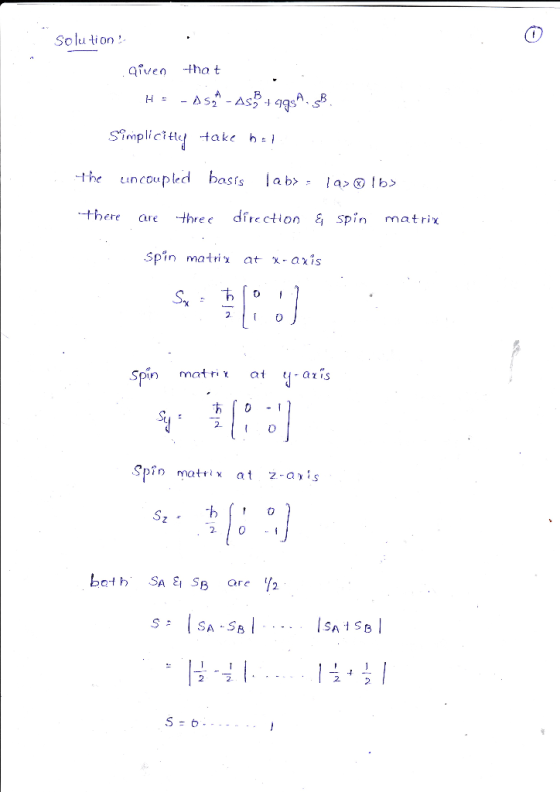
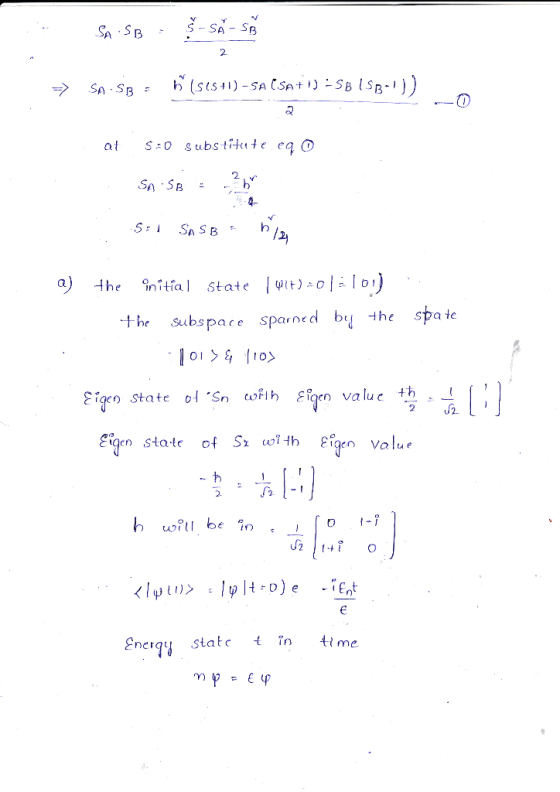
1. (30 points). Coupled spins. Spin-1/2 particles A and B evolve under the influence of the follo...
Problem 111.3. A spin 1/2 particle interacts with a nnagnetic field B = Boe through the...
 Problem 111.3. A spin 1/2 particle interacts with a nnagnetic field B = Boe through the Pauli interaction H-μσ. B where μ is the magnetic moment. The Pauli spin matrices are İ-(Oz,@yMwwhere the σί are T0 1 0-il The eigenstates for d, are the spinors 0 (a) (3 pts.) Suppose that at time t-0 the particle is in an eigenstate Xx corresponding to spin pointing along the positive z-axis. Find the eigenstatexz in terms of α and β. (b) (7...
2. (25 points). Rabi oscillations. Consider a spin-1/2 particle in a magnetic field B - Bo2 such ...
 2. (25 points). Rabi oscillations. Consider a spin-1/2 particle in a magnetic field B - Bo2 such that the spin eigenstates are split in energy by hwo (let's label the ground state |0) and the excited state |1)). The Hamiltonian for the system is written as hwo Zeeman - _ here and below. ơng,z are the usual Pauli matrices. A second, oscillating field is applied in the transverse plane, giving rise to a time-dependent term in the Hamiltoniain hw Rabi-...
qm 2019.3 3. The Hamiltonian corresponding to the magnetic interaction of a spin 1/2 particle with...
 qm 2019.3
3. The Hamiltonian corresponding to the magnetic interaction of a spin 1/2 particle with charge e and mass m in a magnetic field B is À eB B. Ŝ, m where Ŝ are the spin angular momentum operators. You should make use of expres- sions for the spin operators that are given at the end of the question. (i) Write down the energy eigenvalue equation for this particle in a field directed along the y axis, i.e. B...
qm 2019.3
3. The Hamiltonian corresponding to the magnetic interaction of a spin 1/2 particle with charge e and mass m in a magnetic field B is À eB B. Ŝ, m where Ŝ are the spin angular momentum operators. You should make use of expres- sions for the spin operators that are given at the end of the question. (i) Write down the energy eigenvalue equation for this particle in a field directed along the y axis, i.e. B...
2. Spin-1/2 system: (20 points) The Pauli matrices are, 0 -1 from which we can define...
 2. Spin-1/2 system: (20 points) The Pauli matrices are, 0 -1 from which we can define the spin matrices, s.-슬&z, Šv = , S.-출.. We'll use the eigenkets of S that, for the spin half system, they can be represented by the spinors, a) Show, by matrix multiplication that |+) and |-) are eigenstates of the S operator and determine the eigenvalues. Show that they are not eigenstates of S and Sy b) Show that the matrix squares s ,...
A spin-1 particle interacts with an external magnetic field B = B. The interaction Hamiltonian for the system is H = gB-S, where S-Si + Sỳ + SE is the spin operator. (Ignore all degrees of freedom ot...
 A spin-1 particle interacts with an external magnetic field B = B. The interaction Hamiltonian for the system is H = gB-S, where S-Si + Sỳ + SE is the spin operator. (Ignore all degrees of freedom other than spin.) (a) Find the spin matrices in the basis of the S. S eigenstates, |s, m)) . (Hint: Use the ladder operators, S -S, iS, and S_-S-iS,, and show first that s_ | 1,0-ћ /2 | 1.-1)) . Then use these...
Problem 2. (30 points) The spin states: s 1,m) and Is -2, m1) composed of spin-3/2 and spin-1/2 states are linear combi...
 Problem 2. (30 points) The spin states: s 1,m) and Is -2, m1) composed of spin-3/2 and spin-1/2 states are linear combinations of s1 3/2,m-3/2;2 1/2,m2 1/2) and 81-3/2, m-1/2; 2 1/2, m2--1/2), that is 11.-1)-cos θ3/2,-3/2; 1/2, 1/2) _ sin θ|3/2.-1/2; 1/2,-1/2), 2.-1) sin θ|3/2,-3/2; 1/2, 1/2) + cos θ|3/2.-1/2: 1/2,-1/2) a) Determine the values for cos θ and sin θ b) Express |3/2,-3/2; 1/2, 1/2) and |3/2,-1/2;1/2,-1/2) as functions of |1, -1) and 2,-1) c) A system of...
PLEASE COMPLETE B) and stay tuned for my following 2 questions where I will ask part c) and d). P...
 PLEASE COMPLETE B) and stay tuned for my
following 2 questions where I will ask part c) and d). Part a) has
already been posted.
The lowest energy state of a hydrogen-like atom has total angular momentum J-1/2 (from the l-O orbital angular momentum and the electron spin s 1/2). Furthermore, the nucleus also has a spin, conventionally labeled I (for hydrogen, this is the proton spin, 1 1/2). This spin leads to an additional degeneracy. For example, in the...
PLEASE COMPLETE B) and stay tuned for my
following 2 questions where I will ask part c) and d). Part a) has
already been posted.
The lowest energy state of a hydrogen-like atom has total angular momentum J-1/2 (from the l-O orbital angular momentum and the electron spin s 1/2). Furthermore, the nucleus also has a spin, conventionally labeled I (for hydrogen, this is the proton spin, 1 1/2). This spin leads to an additional degeneracy. For example, in the...
1. The aim of this problem set is to understand the dynamics of a spin-1/2 system...
 1. The aim of this problem set is to understand the dynamics of a spin-1/2 system in its full glory. Note that formally a spin-1/2 system and a qubit are equivalent hence, all what you will discover in this problem set will carry over to single qubits. Consider an electron spin (spin 1/2, magnetic moment gHB) interacting with a strong magnetic field Bo (0,0, B) in the z direction as well as with a much weaker magnetic field Brf =...
1. We begin with a two state system with states labeled by |1) and [2). This...
 1. We begin with a two state system with states labeled by |1) and [2). This may seem unphysical; however, there are many two state systems in quantum mechanics such spin 1/2 particles. The Hamiltonian we consider is (a) Compute the eigenvalues of H (b) Compute the eigenvectors of H, normalize them, and express them both as column vectors and in terms of | 1〉 and |2) (c) Denoting the two eigenvectors as lva) and |Vb), compute l/a) <>a and...
Question 1 (8 marks in total) The deuteron is a bound state of a proton and a neutron. Treating nucleons as identical particles with spin and isospin degrees of freedom, the total state of the deuter...
 Question 1 (8 marks in total) The deuteron is a bound state of a proton and a neutron. Treating nucleons as identical particles with spin and isospin degrees of freedom, the total state of the deuteron can be writ- ten space Ψ spin Ψ isospin. The deuteron has a total angular momentum quantum number J - 1 and a total spin S -1. Our goal is to determine the parity of the deuteron Q1-1 (1 mark) Show that the possible...
 Problem 111.3. A spin 1/2 particle interacts with a nnagnetic field B = Boe through the Pauli interaction H-μσ. B where μ is the magnetic moment. The Pauli spin matrices are İ-(Oz,@yMwwhere the σί are T0 1 0-il The eigenstates for d, are the spinors 0 (a) (3 pts.) Suppose that at time t-0 the particle is in an eigenstate Xx corresponding to spin pointing along the positive z-axis. Find the eigenstatexz in terms of α and β. (b) (7...
 2. (25 points). Rabi oscillations. Consider a spin-1/2 particle in a magnetic field B - Bo2 such that the spin eigenstates are split in energy by hwo (let's label the ground state |0) and the excited state |1)). The Hamiltonian for the system is written as hwo Zeeman - _ here and below. ơng,z are the usual Pauli matrices. A second, oscillating field is applied in the transverse plane, giving rise to a time-dependent term in the Hamiltoniain hw Rabi-...
 qm 2019.3
3. The Hamiltonian corresponding to the magnetic interaction of a spin 1/2 particle with charge e and mass m in a magnetic field B is À eB B. Ŝ, m where Ŝ are the spin angular momentum operators. You should make use of expres- sions for the spin operators that are given at the end of the question. (i) Write down the energy eigenvalue equation for this particle in a field directed along the y axis, i.e. B...
qm 2019.3
3. The Hamiltonian corresponding to the magnetic interaction of a spin 1/2 particle with charge e and mass m in a magnetic field B is À eB B. Ŝ, m where Ŝ are the spin angular momentum operators. You should make use of expres- sions for the spin operators that are given at the end of the question. (i) Write down the energy eigenvalue equation for this particle in a field directed along the y axis, i.e. B...
 2. Spin-1/2 system: (20 points) The Pauli matrices are, 0 -1 from which we can define the spin matrices, s.-슬&z, Šv = , S.-출.. We'll use the eigenkets of S that, for the spin half system, they can be represented by the spinors, a) Show, by matrix multiplication that |+) and |-) are eigenstates of the S operator and determine the eigenvalues. Show that they are not eigenstates of S and Sy b) Show that the matrix squares s ,...
 A spin-1 particle interacts with an external magnetic field B = B. The interaction Hamiltonian for the system is H = gB-S, where S-Si + Sỳ + SE is the spin operator. (Ignore all degrees of freedom other than spin.) (a) Find the spin matrices in the basis of the S. S eigenstates, |s, m)) . (Hint: Use the ladder operators, S -S, iS, and S_-S-iS,, and show first that s_ | 1,0-ћ /2 | 1.-1)) . Then use these...
 Problem 2. (30 points) The spin states: s 1,m) and Is -2, m1) composed of spin-3/2 and spin-1/2 states are linear combinations of s1 3/2,m-3/2;2 1/2,m2 1/2) and 81-3/2, m-1/2; 2 1/2, m2--1/2), that is 11.-1)-cos θ3/2,-3/2; 1/2, 1/2) _ sin θ|3/2.-1/2; 1/2,-1/2), 2.-1) sin θ|3/2,-3/2; 1/2, 1/2) + cos θ|3/2.-1/2: 1/2,-1/2) a) Determine the values for cos θ and sin θ b) Express |3/2,-3/2; 1/2, 1/2) and |3/2,-1/2;1/2,-1/2) as functions of |1, -1) and 2,-1) c) A system of...
 PLEASE COMPLETE B) and stay tuned for my
following 2 questions where I will ask part c) and d). Part a) has
already been posted.
The lowest energy state of a hydrogen-like atom has total angular momentum J-1/2 (from the l-O orbital angular momentum and the electron spin s 1/2). Furthermore, the nucleus also has a spin, conventionally labeled I (for hydrogen, this is the proton spin, 1 1/2). This spin leads to an additional degeneracy. For example, in the...
PLEASE COMPLETE B) and stay tuned for my
following 2 questions where I will ask part c) and d). Part a) has
already been posted.
The lowest energy state of a hydrogen-like atom has total angular momentum J-1/2 (from the l-O orbital angular momentum and the electron spin s 1/2). Furthermore, the nucleus also has a spin, conventionally labeled I (for hydrogen, this is the proton spin, 1 1/2). This spin leads to an additional degeneracy. For example, in the...
 1. The aim of this problem set is to understand the dynamics of a spin-1/2 system in its full glory. Note that formally a spin-1/2 system and a qubit are equivalent hence, all what you will discover in this problem set will carry over to single qubits. Consider an electron spin (spin 1/2, magnetic moment gHB) interacting with a strong magnetic field Bo (0,0, B) in the z direction as well as with a much weaker magnetic field Brf =...
 1. We begin with a two state system with states labeled by |1) and [2). This may seem unphysical; however, there are many two state systems in quantum mechanics such spin 1/2 particles. The Hamiltonian we consider is (a) Compute the eigenvalues of H (b) Compute the eigenvectors of H, normalize them, and express them both as column vectors and in terms of | 1〉 and |2) (c) Denoting the two eigenvectors as lva) and |Vb), compute l/a) <>a and...
 Question 1 (8 marks in total) The deuteron is a bound state of a proton and a neutron. Treating nucleons as identical particles with spin and isospin degrees of freedom, the total state of the deuteron can be writ- ten space Ψ spin Ψ isospin. The deuteron has a total angular momentum quantum number J - 1 and a total spin S -1. Our goal is to determine the parity of the deuteron Q1-1 (1 mark) Show that the possible...
Most questions answered within 3 hours.
-
Where is the error in this code sequence?
String s1 = "Hello";
String s2 = "ello";...
asked 10 months ago -
Financial data for Joel de Paris, Inc., for last year
follow:
Joel de Paris, Inc.
Balance...
asked 10 months ago -
Consider this reaction:
Al2(SO4)3 (aq)+ BaCl3
(aq) Al2Cl6 (aq)- +
3BaSO4(s) . What is the...
asked 10 months ago -
Suppose that Savneet is considering increasing her
recent random sample from 20 car rentals to 40...
asked 10 months ago -
Trucks arrive at an unloading terminal at an average rate of 120
per hour.
Trucks arrive...
asked 10 months ago -
Why are methanol and ethanol completely soluble in water while
octanol is not very little soluble....
asked 10 months ago -
A facilities manager at a university reads in a research report
that the mean amount of...
asked 10 months ago -
When the CuSO4 is rehydrated by adding water to the anhydrous
compound, is this an endothermic...
asked 10 months ago -
A ray of sunlight is passing from diamond into crown glass; the
angle of incidence is...
asked 10 months ago -
A block of mass 0.249 kg is placed on top of a light, vertical
spring of...
asked 10 months ago -
how do the kidneys compensate in the presences of acidosis
a) trigger hyperventilate
b) reserve acid...
asked 10 months ago -
Question 501 pts
The rental rate of capital to the firm increases. Which of the
following...
asked 10 months ago