(Linear Algebra)
Consider the vector space
H = Span {1, cos(t), cos2(t), cos3(t), cos4(t), cos5(t), cos6(t)}.
Make a conjecture: what simple function could be used in place
of g(t)= -1 + 18cos2(t) - 48cos4(t) +
32cos6(t) on the interval 
(Use the graph of g(t) to find a much "easier" looking function that could be used in place of g(t)).
Homework Answers
As shown below we will do further calculations for other value
of t 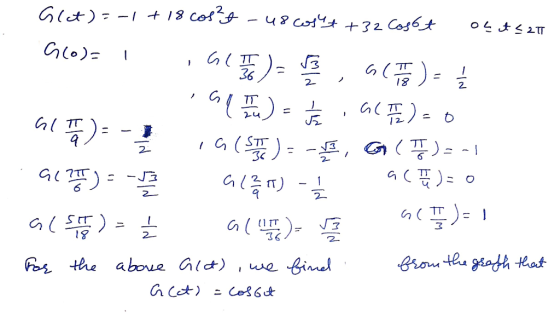
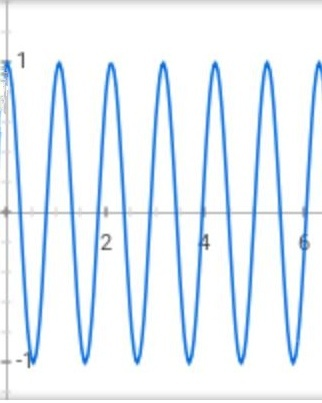
Add Answer to:
(Linear Algebra) Consider the vector space H = Span {1, cos(t), cos2(t), cos3(t), cos4(t), cos5(t...
(Linear Algebra) Consider the vector space H = Span {1, cos(t), cos2(t), cos3(t), cos4(t), cos5(t...
(Linear Algebra) Consider the vector space H = Span {1, cos(t), cos2(t), cos3(t), cos4(t), cos5(t), cos6(t)} Make a conjecture: what simple function could be used in place of f(t) = 1-8cos2(t)+ 8cos4(t) on the interval (use the graph of f(t) to find a much easier looking function that could be used in place of f(t)). 0<t<2π
Advanced linear algebra thxxxxxxxx Consider the complex vector space P4(C) of polynomials of deg...
 advanced linear algebra thxxxxxxxx
Consider the complex vector space P4(C) of polynomials of
degree at most 4 with coeffi- cients in C, equipped with the inner
product ⟨ , ⟩ defined by
5. Consider the complex vector space P4(C) of polynomials of degree at most 4 with coeffi- cients in C, equipped with the inner product (, ) defined by (f, g)fx)g(xJdx. (a) Find an orthogonal basis of the subspace Pi(C)span,x (b) Find the element of Pi (C) that is...
advanced linear algebra thxxxxxxxx
Consider the complex vector space P4(C) of polynomials of
degree at most 4 with coeffi- cients in C, equipped with the inner
product ⟨ , ⟩ defined by
5. Consider the complex vector space P4(C) of polynomials of degree at most 4 with coeffi- cients in C, equipped with the inner product (, ) defined by (f, g)fx)g(xJdx. (a) Find an orthogonal basis of the subspace Pi(C)span,x (b) Find the element of Pi (C) that is...
Using Mathematica Consider the vector-valued function r(t)=et cos t i+(sin t)/(t+4) j +t k. a) Plot...
Using Mathematica Consider the vector-valued function r(t)=et cos t i+(sin t)/(t+4) j +t k. a) Plot the curve with t going over the interval [-2, 2]. b) Plot the curve again over the same interval, but this time add the velocity vector in blue at (1, 0, 0) to the graph. c) Plot the curve again over the same interval, along with the blue velocity vector at (1, 0, 0), but this time add the acceleration vector in red at...
Linear Algebra Question: 18. Consider the system of equations Ax = b where | A= 1...
 Linear Algebra Question:
18. Consider the system of equations Ax = b where | A= 1 -1 0 3 1 -2 -1 4 2 0 4 -1 –4 4 2 0 0 3 -2 2 2 and b = BENA 1 For each j, let a; denote the jth column of A. e) Let T : Ra → Rb be the linear transformation defined by T(x) = Ax. What are a and b? Find bases for the kernel and image...
Linear Algebra Question:
18. Consider the system of equations Ax = b where | A= 1 -1 0 3 1 -2 -1 4 2 0 4 -1 –4 4 2 0 0 3 -2 2 2 and b = BENA 1 For each j, let a; denote the jth column of A. e) Let T : Ra → Rb be the linear transformation defined by T(x) = Ax. What are a and b? Find bases for the kernel and image...
Problem 4. Let V be the vector space of all infinitely differentiable functions f: [0, ]...
 Problem 4. Let V be the vector space of all infinitely differentiable functions f: [0, ] -» R, equipped with the inner product f(t)g(t)d (f,g) = (a) Let UC V be the subspace spanned by B = (sinr, cos x, 1) (you may assume without proof that B is linearly independent, and hence a basis for U). Find the B-matrix [D]93 of the "derivative linear transformation" D : U -> U given by D(f) = f'. (b) Let WC V...
Advanced linear algebra, need full proof thanks Let V be an inner product space (real or comple...
 advanced linear algebra, need full proof thanks
Let V be an inner product space (real or complex, possibly
infinite-dimensional). Let
{v1, . . . , vn} be an orthonormal set of vectors.
4. Let V be an inner product space (real or complex, possibly infinite-dimensional. Let [vi,..., Vn) be an orthonormal set of vectors. a) Show that 1 (b) Show that for every x e V, with equality holding if and only if x spanfvi,..., vn) (c) Consider the space...
advanced linear algebra, need full proof thanks
Let V be an inner product space (real or complex, possibly
infinite-dimensional). Let
{v1, . . . , vn} be an orthonormal set of vectors.
4. Let V be an inner product space (real or complex, possibly infinite-dimensional. Let [vi,..., Vn) be an orthonormal set of vectors. a) Show that 1 (b) Show that for every x e V, with equality holding if and only if x spanfvi,..., vn) (c) Consider the space...
Please provide answer in neat handwriting. Thank you Let P2 be the vector space of all polynomials with degree at most 2, and B be the basis {1,T,T*). T(p(x))-p(kr); thus, Consider the linear operato...
 Please provide answer in neat handwriting. Thank you
Let P2 be the vector space of all polynomials with degree at most 2, and B be the basis {1,T,T*). T(p(x))-p(kr); thus, Consider the linear operator T : P) → given by where k 0 is a parameter (a) Find the matrix Tg,b representing T in the basis B (b) Verify whether T is one-to-one and whether or not it is onto. (c) Find the eigenvalues and the corresponding eigenspaces of the...
Please provide answer in neat handwriting. Thank you
Let P2 be the vector space of all polynomials with degree at most 2, and B be the basis {1,T,T*). T(p(x))-p(kr); thus, Consider the linear operator T : P) → given by where k 0 is a parameter (a) Find the matrix Tg,b representing T in the basis B (b) Verify whether T is one-to-one and whether or not it is onto. (c) Find the eigenvalues and the corresponding eigenspaces of the...
3. Consider the vector space V = R2[x] with its standard ordered basisE = 1,x,x2 and the linear map T :R2[x]−→R2[x], T(p...
3. Consider the vector space V = R2[x] with its standard ordered basisE = 1,x,x2 and the linear map T :R2[x]−→R2[x], T(p)=p(x−1)−p(0)x2 (a) (1 point) What is [T]E? (b) (1 point) Is T invertible? (c) (6 points) Compute the eigenvalues of T and their algebraic multiplicity. (d) (2 points) Is T diagonalisable? If so, find a matrix Q such that Q−1[T]EQ is diagonal. If not, findQ, so that the above matrix is upper triangular.
 advanced linear algebra thxxxxxxxx
Consider the complex vector space P4(C) of polynomials of
degree at most 4 with coeffi- cients in C, equipped with the inner
product ⟨ , ⟩ defined by
5. Consider the complex vector space P4(C) of polynomials of degree at most 4 with coeffi- cients in C, equipped with the inner product (, ) defined by (f, g)fx)g(xJdx. (a) Find an orthogonal basis of the subspace Pi(C)span,x (b) Find the element of Pi (C) that is...
advanced linear algebra thxxxxxxxx
Consider the complex vector space P4(C) of polynomials of
degree at most 4 with coeffi- cients in C, equipped with the inner
product ⟨ , ⟩ defined by
5. Consider the complex vector space P4(C) of polynomials of degree at most 4 with coeffi- cients in C, equipped with the inner product (, ) defined by (f, g)fx)g(xJdx. (a) Find an orthogonal basis of the subspace Pi(C)span,x (b) Find the element of Pi (C) that is...
 Linear Algebra Question:
18. Consider the system of equations Ax = b where | A= 1 -1 0 3 1 -2 -1 4 2 0 4 -1 –4 4 2 0 0 3 -2 2 2 and b = BENA 1 For each j, let a; denote the jth column of A. e) Let T : Ra → Rb be the linear transformation defined by T(x) = Ax. What are a and b? Find bases for the kernel and image...
Linear Algebra Question:
18. Consider the system of equations Ax = b where | A= 1 -1 0 3 1 -2 -1 4 2 0 4 -1 –4 4 2 0 0 3 -2 2 2 and b = BENA 1 For each j, let a; denote the jth column of A. e) Let T : Ra → Rb be the linear transformation defined by T(x) = Ax. What are a and b? Find bases for the kernel and image...
 Problem 4. Let V be the vector space of all infinitely differentiable functions f: [0, ] -» R, equipped with the inner product f(t)g(t)d (f,g) = (a) Let UC V be the subspace spanned by B = (sinr, cos x, 1) (you may assume without proof that B is linearly independent, and hence a basis for U). Find the B-matrix [D]93 of the "derivative linear transformation" D : U -> U given by D(f) = f'. (b) Let WC V...
 advanced linear algebra, need full proof thanks
Let V be an inner product space (real or complex, possibly
infinite-dimensional). Let
{v1, . . . , vn} be an orthonormal set of vectors.
4. Let V be an inner product space (real or complex, possibly infinite-dimensional. Let [vi,..., Vn) be an orthonormal set of vectors. a) Show that 1 (b) Show that for every x e V, with equality holding if and only if x spanfvi,..., vn) (c) Consider the space...
advanced linear algebra, need full proof thanks
Let V be an inner product space (real or complex, possibly
infinite-dimensional). Let
{v1, . . . , vn} be an orthonormal set of vectors.
4. Let V be an inner product space (real or complex, possibly infinite-dimensional. Let [vi,..., Vn) be an orthonormal set of vectors. a) Show that 1 (b) Show that for every x e V, with equality holding if and only if x spanfvi,..., vn) (c) Consider the space...
 Please provide answer in neat handwriting. Thank you
Let P2 be the vector space of all polynomials with degree at most 2, and B be the basis {1,T,T*). T(p(x))-p(kr); thus, Consider the linear operator T : P) → given by where k 0 is a parameter (a) Find the matrix Tg,b representing T in the basis B (b) Verify whether T is one-to-one and whether or not it is onto. (c) Find the eigenvalues and the corresponding eigenspaces of the...
Please provide answer in neat handwriting. Thank you
Let P2 be the vector space of all polynomials with degree at most 2, and B be the basis {1,T,T*). T(p(x))-p(kr); thus, Consider the linear operator T : P) → given by where k 0 is a parameter (a) Find the matrix Tg,b representing T in the basis B (b) Verify whether T is one-to-one and whether or not it is onto. (c) Find the eigenvalues and the corresponding eigenspaces of the...
Most questions answered within 3 hours.
-
Where is the error in this code sequence?
String s1 = "Hello";
String s2 = "ello";...
asked 11 months ago -
Financial data for Joel de Paris, Inc., for last year
follow:
Joel de Paris, Inc.
Balance...
asked 11 months ago -
Consider this reaction:
Al2(SO4)3 (aq)+ BaCl3
(aq) Al2Cl6 (aq)- +
3BaSO4(s) . What is the...
asked 11 months ago -
Suppose that Savneet is considering increasing her
recent random sample from 20 car rentals to 40...
asked 11 months ago -
Trucks arrive at an unloading terminal at an average rate of 120
per hour.
Trucks arrive...
asked 11 months ago -
Why are methanol and ethanol completely soluble in water while
octanol is not very little soluble....
asked 11 months ago -
A facilities manager at a university reads in a research report
that the mean amount of...
asked 11 months ago -
When the CuSO4 is rehydrated by adding water to the anhydrous
compound, is this an endothermic...
asked 11 months ago -
A ray of sunlight is passing from diamond into crown glass; the
angle of incidence is...
asked 11 months ago -
A block of mass 0.249 kg is placed on top of a light, vertical
spring of...
asked 11 months ago -
how do the kidneys compensate in the presences of acidosis
a) trigger hyperventilate
b) reserve acid...
asked 11 months ago -
Question 501 pts
The rental rate of capital to the firm increases. Which of the
following...
asked 11 months ago