Solve the differential equation for P(t)
Homework Answers
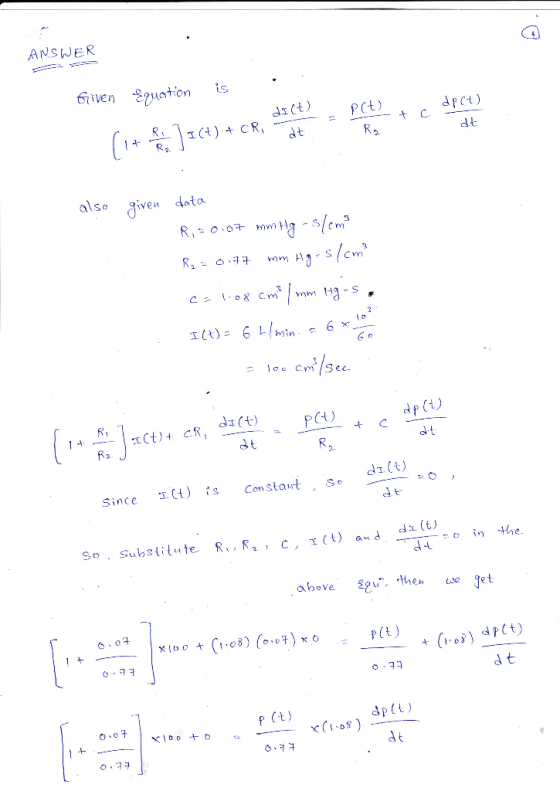
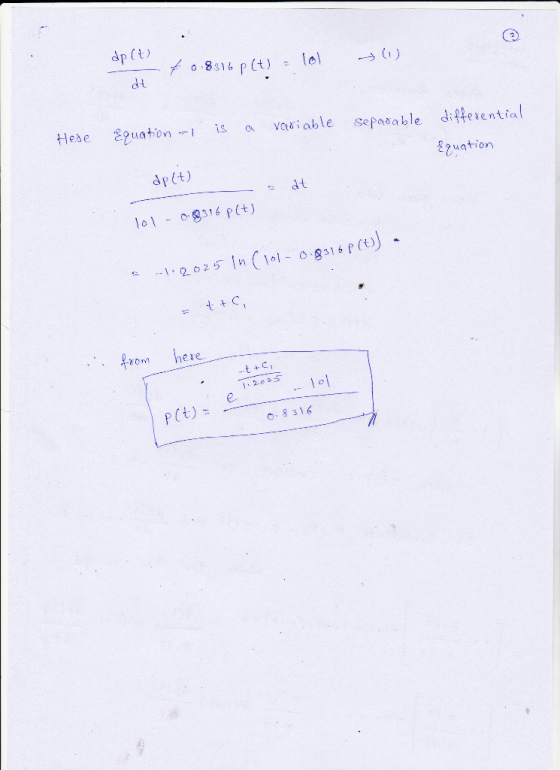
Solve equation (10) from Section 7.4 t di L Ri(t) + dt 1 i(T) dt E(t)...
 Solve equation (10) from Section 7.4 t di L Ri(t) + dt 1 i(T) dt E(t) (10) - 0 with L, R, C, and E(t) as given subject to i(0) 3 Ω, C 0.05 f L 0.1 h, R E(t) 80 t1) Ut - 2 J4-1)+( i(t) t -
2. Suppose a population P(t) satisfies the logistic differential equation dP dt = 0.1P 1 −...
 2. Suppose a population P(t) satisfies the logistic differential
equation dP dt = 0.1P 1 − P 2000 P(0) = 100 Find the following: a)
P(20) b) When will the population reach 1200?
2. Suppose a population P(t) satisfies the logistic differential equation 2P = 0.1P (1–2000) = 0.1P | P(0) = 100 2000 Find the following: a) P(20) b) When will the population reach 1200?
2. Suppose a population P(t) satisfies the logistic differential
equation dP dt = 0.1P 1 − P 2000 P(0) = 100 Find the following: a)
P(20) b) When will the population reach 1200?
2. Suppose a population P(t) satisfies the logistic differential equation 2P = 0.1P (1–2000) = 0.1P | P(0) = 100 2000 Find the following: a) P(20) b) When will the population reach 1200?
Let P(t) be a function and Q(t) be functions. dP/dt = aQ dQ/dt = -bP (1) Find the equilibrium poi...
Let P(t) be a function and Q(t) be functions. dP/dt = aQ dQ/dt = -bP (1) Find the equilibrium point(s) and discuss their stability. (2) Find the trajectories of P and Q. (3) Solve the system to find P and Q as functions of t.
dp xH) (PA) dt T a) sketch the differential equation Show transcribed image text
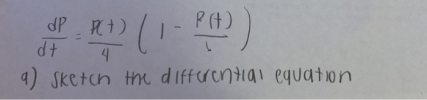 dp xH) (PA) dt T a) sketch the differential equation
show works please Q71 5 Points A population is modeled by dP Р = 9P1 dt...
 show works please
Q71 5 Points A population is modeled by dP Р = 9P1 dt 2500 (a) For what values of P is the population increasing? (b) For what values of P is the population decreasing? (c) What are the equilibrium solutions? Upload your file showing your work. Please select file(s) Select file(s) Q7.2 5 Points Solve the differential equation and show your work. dz + 7e2z+t = 0 dt
show works please
Q71 5 Points A population is modeled by dP Р = 9P1 dt 2500 (a) For what values of P is the population increasing? (b) For what values of P is the population decreasing? (c) What are the equilibrium solutions? Upload your file showing your work. Please select file(s) Select file(s) Q7.2 5 Points Solve the differential equation and show your work. dz + 7e2z+t = 0 dt
For the equation (dp/dt)=(P+2)(P^2-6P+5) find the equilibrium points and make a phase portrait of the differential...
For the equation (dp/dt)=(P+2)(P^2-6P+5) find the equilibrium points and make a phase portrait of the differential equation. Classify each equilibrium point as asymptotically stable, unstable or semi-stable. Sketch typical solution curves determined by the graphs of equilibrium solutions.
Problem #7: Suppose that a population P(t) follows the following Gompertz differential equation. dP = 6P(17-InP), di with initial condition P(O) 80. (a) What is the limiting value of the population&#...
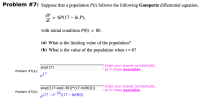 Problem #7: Suppose that a population P(t) follows the following Gompertz differential equation. dP = 6P(17-InP), di with initial condition P(O) 80. (a) What is the limiting value of the population'? (b) What is the value of the population when 62 Enter your answer symbolically as in these examples exp(17) Problem #7(a): e17 Enter your answer symbolically, as in these examples exp(((17-exp(-36))*(17-ln(80))) Problem #7(b): e(17-e-36)(17-in(80))
Problem #7: Suppose that a population P(t) follows the following Gompertz differential equation. dP =...
Problem #7: Suppose that a population P(t) follows the following Gompertz differential equation. dP = 6P(17-InP), di with initial condition P(O) 80. (a) What is the limiting value of the population'? (b) What is the value of the population when 62 Enter your answer symbolically as in these examples exp(17) Problem #7(a): e17 Enter your answer symbolically, as in these examples exp(((17-exp(-36))*(17-ln(80))) Problem #7(b): e(17-e-36)(17-in(80))
Problem #7: Suppose that a population P(t) follows the following Gompertz differential equation. dP =...
Suppose that a population of hacteria grows according to the logistic differential equation dP =0.01P-0.0002P2 dt...
 Suppose that a population of hacteria grows according to the logistic differential equation dP =0.01P-0.0002P2 dt where Pis the population measured in thousands and t is time measured in days. Logistic growth differential equations are often quite difficult to solve. Instead, you will analyze its direction field to acquire infom ation about the solutions to this differential equation. a) Calculate the maximum population M that the sumounding environment can austain. (Note this is also calked the "canying capacity"). Hint: Rewrite...
Differential equations question. dp/dt = 0.3 (1-p/10) (p/10-2)p 1. (5 points) Consider the given population model,...
 Differential equations question.
dp/dt = 0.3 (1-p/10) (p/10-2)p
1. (5 points) Consider the given population model, where P(t) is the population at time t A. For what values of P is the population in equilibrium? B. For what values of P is it increasing? C. For what values is it decreasing? : (i-T-YE -2) p dt120 her
Differential equations question.
dp/dt = 0.3 (1-p/10) (p/10-2)p
1. (5 points) Consider the given population model, where P(t) is the population at time t A. For what values of P is the population in equilibrium? B. For what values of P is it increasing? C. For what values is it decreasing? : (i-T-YE -2) p dt120 her
(dP/dt) = 7sqrt(Pt), P(1) = 5
(dP/dt) = 7sqrt(Pt), P(1) = 5
 Solve equation (10) from Section 7.4 t di L Ri(t) + dt 1 i(T) dt E(t) (10) - 0 with L, R, C, and E(t) as given subject to i(0) 3 Ω, C 0.05 f L 0.1 h, R E(t) 80 t1) Ut - 2 J4-1)+( i(t) t -
 2. Suppose a population P(t) satisfies the logistic differential
equation dP dt = 0.1P 1 − P 2000 P(0) = 100 Find the following: a)
P(20) b) When will the population reach 1200?
2. Suppose a population P(t) satisfies the logistic differential equation 2P = 0.1P (1–2000) = 0.1P | P(0) = 100 2000 Find the following: a) P(20) b) When will the population reach 1200?
2. Suppose a population P(t) satisfies the logistic differential
equation dP dt = 0.1P 1 − P 2000 P(0) = 100 Find the following: a)
P(20) b) When will the population reach 1200?
2. Suppose a population P(t) satisfies the logistic differential equation 2P = 0.1P (1–2000) = 0.1P | P(0) = 100 2000 Find the following: a) P(20) b) When will the population reach 1200?
 dp xH) (PA) dt T a) sketch the differential equation
 show works please
Q71 5 Points A population is modeled by dP Р = 9P1 dt 2500 (a) For what values of P is the population increasing? (b) For what values of P is the population decreasing? (c) What are the equilibrium solutions? Upload your file showing your work. Please select file(s) Select file(s) Q7.2 5 Points Solve the differential equation and show your work. dz + 7e2z+t = 0 dt
show works please
Q71 5 Points A population is modeled by dP Р = 9P1 dt 2500 (a) For what values of P is the population increasing? (b) For what values of P is the population decreasing? (c) What are the equilibrium solutions? Upload your file showing your work. Please select file(s) Select file(s) Q7.2 5 Points Solve the differential equation and show your work. dz + 7e2z+t = 0 dt
 Problem #7: Suppose that a population P(t) follows the following Gompertz differential equation. dP = 6P(17-InP), di with initial condition P(O) 80. (a) What is the limiting value of the population'? (b) What is the value of the population when 62 Enter your answer symbolically as in these examples exp(17) Problem #7(a): e17 Enter your answer symbolically, as in these examples exp(((17-exp(-36))*(17-ln(80))) Problem #7(b): e(17-e-36)(17-in(80))
Problem #7: Suppose that a population P(t) follows the following Gompertz differential equation. dP =...
Problem #7: Suppose that a population P(t) follows the following Gompertz differential equation. dP = 6P(17-InP), di with initial condition P(O) 80. (a) What is the limiting value of the population'? (b) What is the value of the population when 62 Enter your answer symbolically as in these examples exp(17) Problem #7(a): e17 Enter your answer symbolically, as in these examples exp(((17-exp(-36))*(17-ln(80))) Problem #7(b): e(17-e-36)(17-in(80))
Problem #7: Suppose that a population P(t) follows the following Gompertz differential equation. dP =...
 Suppose that a population of hacteria grows according to the logistic differential equation dP =0.01P-0.0002P2 dt where Pis the population measured in thousands and t is time measured in days. Logistic growth differential equations are often quite difficult to solve. Instead, you will analyze its direction field to acquire infom ation about the solutions to this differential equation. a) Calculate the maximum population M that the sumounding environment can austain. (Note this is also calked the "canying capacity"). Hint: Rewrite...
 Differential equations question.
dp/dt = 0.3 (1-p/10) (p/10-2)p
1. (5 points) Consider the given population model, where P(t) is the population at time t A. For what values of P is the population in equilibrium? B. For what values of P is it increasing? C. For what values is it decreasing? : (i-T-YE -2) p dt120 her
Differential equations question.
dp/dt = 0.3 (1-p/10) (p/10-2)p
1. (5 points) Consider the given population model, where P(t) is the population at time t A. For what values of P is the population in equilibrium? B. For what values of P is it increasing? C. For what values is it decreasing? : (i-T-YE -2) p dt120 her
Most questions answered within 3 hours.
-
Where is the error in this code sequence?
String s1 = "Hello";
String s2 = "ello";...
asked 10 months ago -
Financial data for Joel de Paris, Inc., for last year
follow:
Joel de Paris, Inc.
Balance...
asked 10 months ago -
Consider this reaction:
Al2(SO4)3 (aq)+ BaCl3
(aq) Al2Cl6 (aq)- +
3BaSO4(s) . What is the...
asked 10 months ago -
Suppose that Savneet is considering increasing her
recent random sample from 20 car rentals to 40...
asked 10 months ago -
Trucks arrive at an unloading terminal at an average rate of 120
per hour.
Trucks arrive...
asked 10 months ago -
Why are methanol and ethanol completely soluble in water while
octanol is not very little soluble....
asked 10 months ago -
A facilities manager at a university reads in a research report
that the mean amount of...
asked 10 months ago -
When the CuSO4 is rehydrated by adding water to the anhydrous
compound, is this an endothermic...
asked 10 months ago -
A ray of sunlight is passing from diamond into crown glass; the
angle of incidence is...
asked 10 months ago -
A block of mass 0.249 kg is placed on top of a light, vertical
spring of...
asked 10 months ago -
how do the kidneys compensate in the presences of acidosis
a) trigger hyperventilate
b) reserve acid...
asked 10 months ago -
Question 501 pts
The rental rate of capital to the firm increases. Which of the
following...
asked 10 months ago