Consider the Markov chain with state space {0, 1,2} and transition matrix
Consider the Markov chain with state space {0, 1,2} and transition matrix
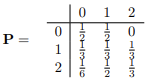
(a) Suppose Xo-0. Find the probability that X2 = 2.
(b) Find the stationary distribution of the Markov chain
Homework Answers

Add Answer to:
Consider the Markov chain with state space {0, 1,2} and transition matrix
5. Let Xo, X1,... be a Markov chain with state space S 1,2, 3} and transition...
 5. Let Xo, X1,... be a Markov chain with state space S 1,2, 3} and transition matrix 0 1/2 1/2 P-1 00 1/3 1/3 1/3/ and initial distribution a-(1/2,0,1/2). Find the following: (b) P(X 3, X2 1)
Suppose that {Xn} is a Markov chain with state space S = {1, 2}, transition matrix...
 Suppose that {Xn} is a Markov chain with state space S = {1, 2},
transition matrix (1/5 4/5 2/5 3/5), and initial distribution P (X0
= 1) = 3/4 and P (X0 = 2) = 1/4. Compute the following:
(a) P(X3 =1|X1 =2)
(b) P(X3 =1|X2 =1,X1 =1,X0 =2)
(c) P(X2 =2)
(d) P(X0 =1,X2 =1)
(15 points) Suppose that {Xn} is a Markov chain with state space S = 1,2), transition matrix and initial distribution P(X0-1-3/4 and P(Xo,-2-1/4. Compute...
Suppose that {Xn} is a Markov chain with state space S = {1, 2},
transition matrix (1/5 4/5 2/5 3/5), and initial distribution P (X0
= 1) = 3/4 and P (X0 = 2) = 1/4. Compute the following:
(a) P(X3 =1|X1 =2)
(b) P(X3 =1|X2 =1,X1 =1,X0 =2)
(c) P(X2 =2)
(d) P(X0 =1,X2 =1)
(15 points) Suppose that {Xn} is a Markov chain with state space S = 1,2), transition matrix and initial distribution P(X0-1-3/4 and P(Xo,-2-1/4. Compute...
P is the (one-step) transition probability matrix of a Markov chain with state space {0, 1, 2, 3,...
 P is the (one-step) transition probability matrix of a Markov chain with state space {0, 1, 2, 3, 4 0.5 0.0 0.5 0.0 0.0 0.25 0.5 0.25 0.0 0.0 P=10.5 0.0 0.5 0.0 0.0 0.0 0.0 0.0 0.5 0.5 0.0 0.0 0.0 0.5 0.5/ (a) Draw a transition diagram. (b) Suppose the chain starts at time 0 in state 2. That is, Xo 2. Find E Xi (c)Suppose the chain starts at time 0 in any of the states with...
Suppose Xn is a Markov chain on the state space S with transition probability p. Let...
Suppose Xn is a Markov chain on the state space S with transition probability p. Let Yn be an independent copy of the Markov chain with transition probability p, and define Zn := (Xn, Yn). a) Prove that Zn is a Markov chain on the state space S_hat := S × S with transition probability p_hat : S_hat × S_hat → [0, 1] given by p_hat((x1, y1), (x2, y2)) := p(x1, x2)p(y1, y2). b) Prove that if π is a...
Problem 7.4 (10 points) A Markov chain Xo, X1, X2,.. with state space S = {1,2,3,4} has the following transition graph...
 Problem 7.4 (10 points) A Markov chain Xo, X1, X2,.. with state space S = {1,2,3,4} has the following transition graph 0.5 0.5 0.5 0.5 0.5 0.5 2 0.5 0.5 (a) Provide the transition matrix for the Markov chain (b) Determine all recurrent and all transient states (c) Determine all communication classes. Is the Markov chain irreducible? (d) Find the stationary distribution (e) Can you say something about the limiting distribution of this Markov chain?
Problem 7.4 (10 points) A...
Problem 7.4 (10 points) A Markov chain Xo, X1, X2,.. with state space S = {1,2,3,4} has the following transition graph 0.5 0.5 0.5 0.5 0.5 0.5 2 0.5 0.5 (a) Provide the transition matrix for the Markov chain (b) Determine all recurrent and all transient states (c) Determine all communication classes. Is the Markov chain irreducible? (d) Find the stationary distribution (e) Can you say something about the limiting distribution of this Markov chain?
Problem 7.4 (10 points) A...
Consider the Markov chain X0,X1,X2,... on the state space S = {0,1} with transition matrix P=...
Consider the Markov chain X0,X1,X2,... on the state space S = {0,1} with transition matrix P= (a) Show that the process defined by the pair Zn := (Xn−1,Xn), n ≥ 1, is a Markov chain on the state space consisting of four (pair) states: (0,0),(0,1),(1,0),(1,1). (b) Determine the transition probability matrix for the process Zn, n ≥ 1.
Suppose that we have a finite irreducible Markov chain Xn with stationary distribution π on a...
 Suppose that we have a finite
irreducible Markov chain Xn with stationary distribution π on a
state space S. (a) Consider the sequence of neighboring pairs, (X0,
X1), (X1, X2), (X2, X3), . . . . Show that this is also a Markov
chain and find the transition probabilities. (The state space will
be S ×S = {(i,j) : i,j ∈ S} and the jumps are now of the form (i,
j) → (k, l).) (b) Find the stationary distribution...
Suppose that we have a finite
irreducible Markov chain Xn with stationary distribution π on a
state space S. (a) Consider the sequence of neighboring pairs, (X0,
X1), (X1, X2), (X2, X3), . . . . Show that this is also a Markov
chain and find the transition probabilities. (The state space will
be S ×S = {(i,j) : i,j ∈ S} and the jumps are now of the form (i,
j) → (k, l).) (b) Find the stationary distribution...
thank you Consider a Markov chain with state space S - {1,2), with transition matrix 0.2...
 thank you
Consider a Markov chain with state space S - {1,2), with transition matrix 0.2 0.8 0.6 0.4 and initial state 1 (so Xo - 1 with probability 1). Decide which of the following is a stopping time: (a) Ti mintn 27: Xn 1 12 min{n > 1 : Xn+1-1) (c) T - min^n 2 2 Xn-1 1 (d) T4 - minfn 2 10: Xn - Xn-1)
thank you
Consider a Markov chain with state space S - {1,2), with transition matrix 0.2 0.8 0.6 0.4 and initial state 1 (so Xo - 1 with probability 1). Decide which of the following is a stopping time: (a) Ti mintn 27: Xn 1 12 min{n > 1 : Xn+1-1) (c) T - min^n 2 2 Xn-1 1 (d) T4 - minfn 2 10: Xn - Xn-1)
1. A Markov chain {X,,n0 with state space S0,1,2 has transition probability matrix 0.1 0.3 0.6...
 1. A Markov chain {X,,n0 with state space S0,1,2 has transition probability matrix 0.1 0.3 0.6 P=10.5 0.2 0.3 0.4 0.2 0.4 If P(X0-0)-P(X0-1) evaluate P[X2< X4]. 0.4 and P 0-2) 0.2. find the distribution of X2 and
Consider a Markov chain with transition matrix where 0< a, b,c <1. Find the stationary distribution.
 Consider a Markov chain with transition matrix where 0< a, b,c <1. Find the stationary distribution.
 5. Let Xo, X1,... be a Markov chain with state space S 1,2, 3} and transition matrix 0 1/2 1/2 P-1 00 1/3 1/3 1/3/ and initial distribution a-(1/2,0,1/2). Find the following: (b) P(X 3, X2 1)
 Suppose that {Xn} is a Markov chain with state space S = {1, 2},
transition matrix (1/5 4/5 2/5 3/5), and initial distribution P (X0
= 1) = 3/4 and P (X0 = 2) = 1/4. Compute the following:
(a) P(X3 =1|X1 =2)
(b) P(X3 =1|X2 =1,X1 =1,X0 =2)
(c) P(X2 =2)
(d) P(X0 =1,X2 =1)
(15 points) Suppose that {Xn} is a Markov chain with state space S = 1,2), transition matrix and initial distribution P(X0-1-3/4 and P(Xo,-2-1/4. Compute...
Suppose that {Xn} is a Markov chain with state space S = {1, 2},
transition matrix (1/5 4/5 2/5 3/5), and initial distribution P (X0
= 1) = 3/4 and P (X0 = 2) = 1/4. Compute the following:
(a) P(X3 =1|X1 =2)
(b) P(X3 =1|X2 =1,X1 =1,X0 =2)
(c) P(X2 =2)
(d) P(X0 =1,X2 =1)
(15 points) Suppose that {Xn} is a Markov chain with state space S = 1,2), transition matrix and initial distribution P(X0-1-3/4 and P(Xo,-2-1/4. Compute...
 P is the (one-step) transition probability matrix of a Markov chain with state space {0, 1, 2, 3, 4 0.5 0.0 0.5 0.0 0.0 0.25 0.5 0.25 0.0 0.0 P=10.5 0.0 0.5 0.0 0.0 0.0 0.0 0.0 0.5 0.5 0.0 0.0 0.0 0.5 0.5/ (a) Draw a transition diagram. (b) Suppose the chain starts at time 0 in state 2. That is, Xo 2. Find E Xi (c)Suppose the chain starts at time 0 in any of the states with...
 Problem 7.4 (10 points) A Markov chain Xo, X1, X2,.. with state space S = {1,2,3,4} has the following transition graph 0.5 0.5 0.5 0.5 0.5 0.5 2 0.5 0.5 (a) Provide the transition matrix for the Markov chain (b) Determine all recurrent and all transient states (c) Determine all communication classes. Is the Markov chain irreducible? (d) Find the stationary distribution (e) Can you say something about the limiting distribution of this Markov chain?
Problem 7.4 (10 points) A...
Problem 7.4 (10 points) A Markov chain Xo, X1, X2,.. with state space S = {1,2,3,4} has the following transition graph 0.5 0.5 0.5 0.5 0.5 0.5 2 0.5 0.5 (a) Provide the transition matrix for the Markov chain (b) Determine all recurrent and all transient states (c) Determine all communication classes. Is the Markov chain irreducible? (d) Find the stationary distribution (e) Can you say something about the limiting distribution of this Markov chain?
Problem 7.4 (10 points) A...
 Suppose that we have a finite
irreducible Markov chain Xn with stationary distribution π on a
state space S. (a) Consider the sequence of neighboring pairs, (X0,
X1), (X1, X2), (X2, X3), . . . . Show that this is also a Markov
chain and find the transition probabilities. (The state space will
be S ×S = {(i,j) : i,j ∈ S} and the jumps are now of the form (i,
j) → (k, l).) (b) Find the stationary distribution...
Suppose that we have a finite
irreducible Markov chain Xn with stationary distribution π on a
state space S. (a) Consider the sequence of neighboring pairs, (X0,
X1), (X1, X2), (X2, X3), . . . . Show that this is also a Markov
chain and find the transition probabilities. (The state space will
be S ×S = {(i,j) : i,j ∈ S} and the jumps are now of the form (i,
j) → (k, l).) (b) Find the stationary distribution...
 thank you
Consider a Markov chain with state space S - {1,2), with transition matrix 0.2 0.8 0.6 0.4 and initial state 1 (so Xo - 1 with probability 1). Decide which of the following is a stopping time: (a) Ti mintn 27: Xn 1 12 min{n > 1 : Xn+1-1) (c) T - min^n 2 2 Xn-1 1 (d) T4 - minfn 2 10: Xn - Xn-1)
thank you
Consider a Markov chain with state space S - {1,2), with transition matrix 0.2 0.8 0.6 0.4 and initial state 1 (so Xo - 1 with probability 1). Decide which of the following is a stopping time: (a) Ti mintn 27: Xn 1 12 min{n > 1 : Xn+1-1) (c) T - min^n 2 2 Xn-1 1 (d) T4 - minfn 2 10: Xn - Xn-1)
 1. A Markov chain {X,,n0 with state space S0,1,2 has transition probability matrix 0.1 0.3 0.6 P=10.5 0.2 0.3 0.4 0.2 0.4 If P(X0-0)-P(X0-1) evaluate P[X2< X4]. 0.4 and P 0-2) 0.2. find the distribution of X2 and
 Consider a Markov chain with transition matrix where 0< a, b,c <1. Find the stationary distribution.
Most questions answered within 3 hours.
-
Where is the error in this code sequence?
String s1 = "Hello";
String s2 = "ello";...
asked 10 months ago -
Financial data for Joel de Paris, Inc., for last year
follow:
Joel de Paris, Inc.
Balance...
asked 10 months ago -
Consider this reaction:
Al2(SO4)3 (aq)+ BaCl3
(aq) Al2Cl6 (aq)- +
3BaSO4(s) . What is the...
asked 10 months ago -
Suppose that Savneet is considering increasing her
recent random sample from 20 car rentals to 40...
asked 10 months ago -
Trucks arrive at an unloading terminal at an average rate of 120
per hour.
Trucks arrive...
asked 10 months ago -
Why are methanol and ethanol completely soluble in water while
octanol is not very little soluble....
asked 10 months ago -
A facilities manager at a university reads in a research report
that the mean amount of...
asked 10 months ago -
When the CuSO4 is rehydrated by adding water to the anhydrous
compound, is this an endothermic...
asked 10 months ago -
A ray of sunlight is passing from diamond into crown glass; the
angle of incidence is...
asked 10 months ago -
A block of mass 0.249 kg is placed on top of a light, vertical
spring of...
asked 10 months ago -
how do the kidneys compensate in the presences of acidosis
a) trigger hyperventilate
b) reserve acid...
asked 10 months ago -
Question 501 pts
The rental rate of capital to the firm increases. Which of the
following...
asked 10 months ago