Please write legibly and show all work!
Homework Answers
Add Answer to:
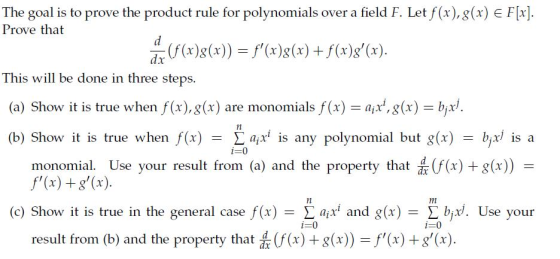
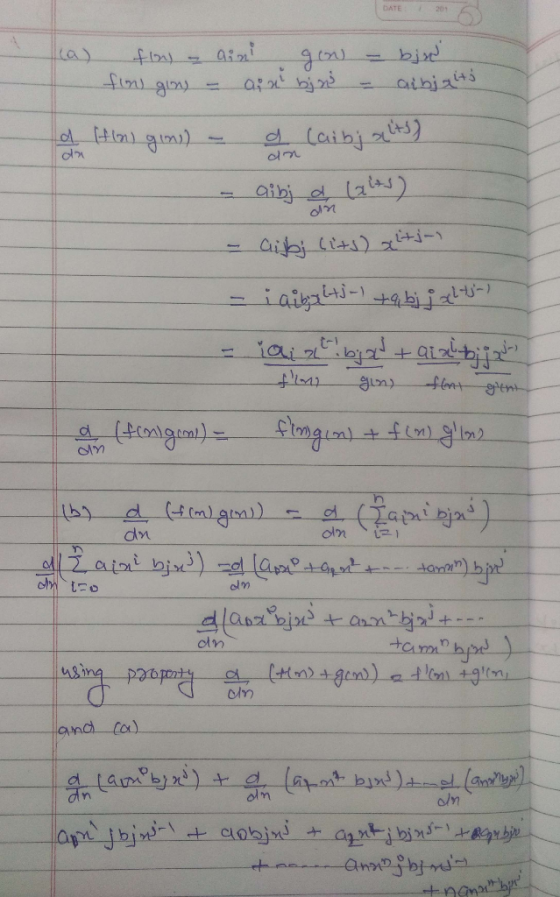
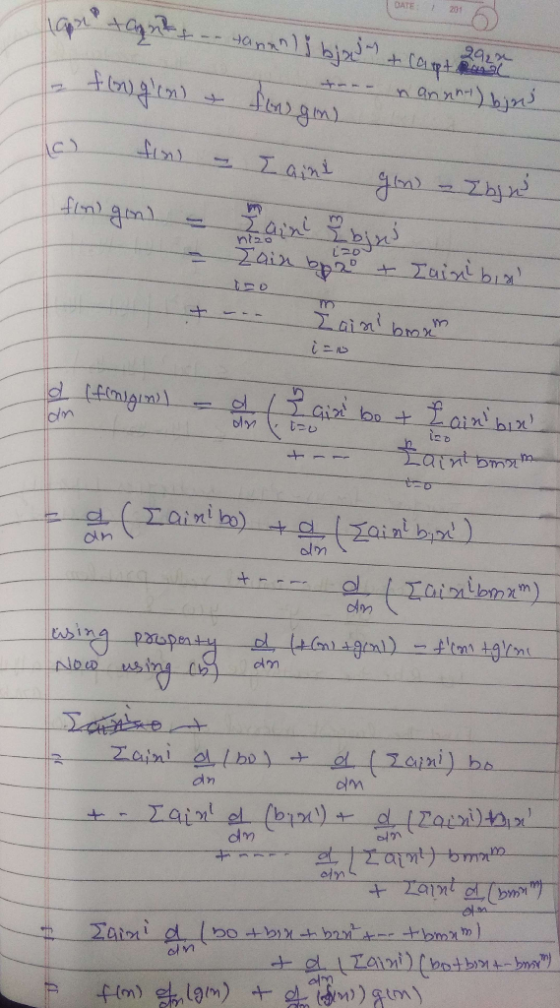
The goal is to prove the product rule for polynomials over a field F. Let f(x),g(x) E Fx. Prove t...
6. Let F be a field and a Fx] a nonconstant polynomial. Denote (that is, (a(x)) is the set of all polynomials in Flr] which are divisble by a()). Then (a) Prove that (a(x)) is a subgroup of the a...
 6. Let F be a field and a Fx] a nonconstant polynomial. Denote (that is, (a(x)) is the set of all polynomials in Flr] which are divisble by a()). Then (a) Prove that (a(x)) is a subgroup of the abelian group (Flx],. (b) consider the operation on F[r]/(a()) given by Prove that this operation is well-defined. (c) Prove that the quotient F]/(a(x) is a commutative ing with identity (d) What happens if the polynoial a() is constant?
6. Let F...
6. Let F be a field and a Fx] a nonconstant polynomial. Denote (that is, (a(x)) is the set of all polynomials in Flr] which are divisble by a()). Then (a) Prove that (a(x)) is a subgroup of the abelian group (Flx],. (b) consider the operation on F[r]/(a()) given by Prove that this operation is well-defined. (c) Prove that the quotient F]/(a(x) is a commutative ing with identity (d) What happens if the polynoial a() is constant?
6. Let F...
14. If f(a) and g(x) are polynomials over the field F, and h(x)-f(x) t gx), prove...
 14. If f(a) and g(x) are polynomials over the field F, and h(x)-f(x) t gx), prove that h(c)-f(c) + g(c) for all c in F. 15. If f(x) and g(x) are polynomials over the field F, and p(x)fx)g(x), prove that p(c) -f(c)g(c) for all c in F
Q 5. Let F be a field and consider the polynomial ring l (a) State the Division Algorithm for polynomials in Plrl. b) Let a e F. Prove that -a divides f(x) in Fix] if and only if (a)- (c) Prove t...
 Q 5. Let F be a field and consider the polynomial ring l (a) State the Division Algorithm for polynomials in Plrl. b) Let a e F. Prove that -a divides f(x) in Fix] if and only if (a)- (c) Prove that z-37 divides 42-1 in F43[z].
Q 5. Let F be a field and consider the polynomial ring l (a) State the Division Algorithm for polynomials in Plrl. b) Let a e F. Prove that -a divides f(x) in...
Q 5. Let F be a field and consider the polynomial ring l (a) State the Division Algorithm for polynomials in Plrl. b) Let a e F. Prove that -a divides f(x) in Fix] if and only if (a)- (c) Prove that z-37 divides 42-1 in F43[z].
Q 5. Let F be a field and consider the polynomial ring l (a) State the Division Algorithm for polynomials in Plrl. b) Let a e F. Prove that -a divides f(x) in...
Rings and fields- Abstract Algebra 2. (a) (6 points) Let f (x) be an n over a field F. Let irreducible polynomial of...
 Rings and fields- Abstract Algebra
2. (a) (6 points) Let f (x) be an n over a field F. Let irreducible polynomial of degree g() e Fx be any polynomial. Show that every irreducible factor of f(g()) E Flx] has degree divisible by n (b) (4 points) Prove that Q(2) is not a subfield of any cyclotomic field over Q.
2. (a) (6 points) Let f (x) be an n over a field F. Let irreducible polynomial of degree g()...
Rings and fields- Abstract Algebra
2. (a) (6 points) Let f (x) be an n over a field F. Let irreducible polynomial of degree g() e Fx be any polynomial. Show that every irreducible factor of f(g()) E Flx] has degree divisible by n (b) (4 points) Prove that Q(2) is not a subfield of any cyclotomic field over Q.
2. (a) (6 points) Let f (x) be an n over a field F. Let irreducible polynomial of degree g()...
Let E = F(a) be a (simple) extension of F. wherea E E is algebraic over F. Suppose the degree of ...
Let E = F(a) be a (simple) extension of F. wherea E E is algebraic over F. Suppose the degree of α over F is n Then every β E E can be expressed uniquely in the form β-bo-b10 + +b-1a-1 for some bi F. (a) Show every element can be written as f (a) for some polynomial f(x) E F (b) Let m(x) be the minimal polynomial of α over F. Write m(x) r" +an-11n-1+--+ n_1α α0. Use this...
2. (a) Prove the product rule for complex functions. More specifically, if f(z) and g(z) f(z)g(z) is also analytic, and...
 2. (a) Prove the product rule for complex functions. More specifically, if f(z) and g(z) f(z)g(z) is also analytic, and that analytic prove are that h(z) h'(z)f(z)9() f(z)g'(z) (You may use results from the multivariable part of the course without proof.) = nz"- for n e N = {1,2,3,...}. Your textbook establishes that S z"= dz (b) Let Sn be the statement is true. With the help of (a), show that if Sn is true, then Sn+1 is true. Why...
4. Let F be a field. Prove that for all polynonials f(x), g(x), h (z) є FI2], if f(x) divides g(x...
 4. Let F be a field. Prove that for all polynonials f(x), g(x), h (z) є FI2], if f(x) divides g(x) and f(z) divides h(r), then for all polynomials s(r),t() E Fr, f() divides s()g(r) +t(x)h(r).
4. Let F be a field. Prove that for all polynonials f(x), g(x), h (z) є FI2], if f(x) divides g(x) and f(z) divides h(r), then for all polynomials s(r),t() E Fr, f() divides s()g(r) +t(x)h(r).
4. Let F be a field. Prove that for all polynonials f(x), g(x), h (z) є FI2], if f(x) divides g(x) and f(z) divides h(r), then for all polynomials s(r),t() E Fr, f() divides s()g(r) +t(x)h(r).
Let f(x) = ||(x--ai) e Fx), where F is a field and a; E F for...
 Let f(x) = ||(x--ai) e Fx), where F is a field and a; E F for all i. Show that f(x) has no repeated roots (i.e., f(x) is not a multiple of (x – a)for any a € F] if and only if (f(x), f'(x)) = 1, where f'(x) is the derivative of f (x).
Polynomial over the Fields: a) If p(x) an element of F[x] is not irreducible, then there are at least two polynomials g(x) and h(x), neither which is a constant, such that p(x)=g(x)h(x). Explain b) U...
Polynomial over the Fields: a) If p(x) an element of F[x] is not irreducible, then there are at least two polynomials g(x) and h(x), neither which is a constant, such that p(x)=g(x)h(x). Explain b) Use problem a to prove: If p(x) is not irreducible, then p(x)=j(x)k(x), where both j(x) and k(x) are polynomials of lower degree than p(x).
6. Let p;(xi = 0,... , n}, with degp;(x) = i, be a set of orthogonal polynomials with respect to the inner product f f(...
 6. Let p;(xi = 0,... , n}, with degp;(x) = i, be a set of orthogonal polynomials with respect to the inner product f f(x)g(x) dx. Given a < b, let q(x) be the line mapping a to -1 and b to 1. Prove {p;(q(x))|i = 0,... , n} is a set of orthogonal polynomials with respect to the inner product f(x)g(x) dz, satisfying deg p;(q(x))= i -
6. Let p;(xi = 0,... , n}, with degp;(x) = i, be...
6. Let p;(xi = 0,... , n}, with degp;(x) = i, be a set of orthogonal polynomials with respect to the inner product f f(x)g(x) dx. Given a < b, let q(x) be the line mapping a to -1 and b to 1. Prove {p;(q(x))|i = 0,... , n} is a set of orthogonal polynomials with respect to the inner product f(x)g(x) dz, satisfying deg p;(q(x))= i -
6. Let p;(xi = 0,... , n}, with degp;(x) = i, be...
 6. Let F be a field and a Fx] a nonconstant polynomial. Denote (that is, (a(x)) is the set of all polynomials in Flr] which are divisble by a()). Then (a) Prove that (a(x)) is a subgroup of the abelian group (Flx],. (b) consider the operation on F[r]/(a()) given by Prove that this operation is well-defined. (c) Prove that the quotient F]/(a(x) is a commutative ing with identity (d) What happens if the polynoial a() is constant?
6. Let F...
6. Let F be a field and a Fx] a nonconstant polynomial. Denote (that is, (a(x)) is the set of all polynomials in Flr] which are divisble by a()). Then (a) Prove that (a(x)) is a subgroup of the abelian group (Flx],. (b) consider the operation on F[r]/(a()) given by Prove that this operation is well-defined. (c) Prove that the quotient F]/(a(x) is a commutative ing with identity (d) What happens if the polynoial a() is constant?
6. Let F...
 14. If f(a) and g(x) are polynomials over the field F, and h(x)-f(x) t gx), prove that h(c)-f(c) + g(c) for all c in F. 15. If f(x) and g(x) are polynomials over the field F, and p(x)fx)g(x), prove that p(c) -f(c)g(c) for all c in F
 Q 5. Let F be a field and consider the polynomial ring l (a) State the Division Algorithm for polynomials in Plrl. b) Let a e F. Prove that -a divides f(x) in Fix] if and only if (a)- (c) Prove that z-37 divides 42-1 in F43[z].
Q 5. Let F be a field and consider the polynomial ring l (a) State the Division Algorithm for polynomials in Plrl. b) Let a e F. Prove that -a divides f(x) in...
Q 5. Let F be a field and consider the polynomial ring l (a) State the Division Algorithm for polynomials in Plrl. b) Let a e F. Prove that -a divides f(x) in Fix] if and only if (a)- (c) Prove that z-37 divides 42-1 in F43[z].
Q 5. Let F be a field and consider the polynomial ring l (a) State the Division Algorithm for polynomials in Plrl. b) Let a e F. Prove that -a divides f(x) in...
 Rings and fields- Abstract Algebra
2. (a) (6 points) Let f (x) be an n over a field F. Let irreducible polynomial of degree g() e Fx be any polynomial. Show that every irreducible factor of f(g()) E Flx] has degree divisible by n (b) (4 points) Prove that Q(2) is not a subfield of any cyclotomic field over Q.
2. (a) (6 points) Let f (x) be an n over a field F. Let irreducible polynomial of degree g()...
Rings and fields- Abstract Algebra
2. (a) (6 points) Let f (x) be an n over a field F. Let irreducible polynomial of degree g() e Fx be any polynomial. Show that every irreducible factor of f(g()) E Flx] has degree divisible by n (b) (4 points) Prove that Q(2) is not a subfield of any cyclotomic field over Q.
2. (a) (6 points) Let f (x) be an n over a field F. Let irreducible polynomial of degree g()...
 2. (a) Prove the product rule for complex functions. More specifically, if f(z) and g(z) f(z)g(z) is also analytic, and that analytic prove are that h(z) h'(z)f(z)9() f(z)g'(z) (You may use results from the multivariable part of the course without proof.) = nz"- for n e N = {1,2,3,...}. Your textbook establishes that S z"= dz (b) Let Sn be the statement is true. With the help of (a), show that if Sn is true, then Sn+1 is true. Why...
 4. Let F be a field. Prove that for all polynonials f(x), g(x), h (z) є FI2], if f(x) divides g(x) and f(z) divides h(r), then for all polynomials s(r),t() E Fr, f() divides s()g(r) +t(x)h(r).
4. Let F be a field. Prove that for all polynonials f(x), g(x), h (z) є FI2], if f(x) divides g(x) and f(z) divides h(r), then for all polynomials s(r),t() E Fr, f() divides s()g(r) +t(x)h(r).
4. Let F be a field. Prove that for all polynonials f(x), g(x), h (z) є FI2], if f(x) divides g(x) and f(z) divides h(r), then for all polynomials s(r),t() E Fr, f() divides s()g(r) +t(x)h(r).
 Let f(x) = ||(x--ai) e Fx), where F is a field and a; E F for all i. Show that f(x) has no repeated roots (i.e., f(x) is not a multiple of (x – a)for any a € F] if and only if (f(x), f'(x)) = 1, where f'(x) is the derivative of f (x).
 6. Let p;(xi = 0,... , n}, with degp;(x) = i, be a set of orthogonal polynomials with respect to the inner product f f(x)g(x) dx. Given a < b, let q(x) be the line mapping a to -1 and b to 1. Prove {p;(q(x))|i = 0,... , n} is a set of orthogonal polynomials with respect to the inner product f(x)g(x) dz, satisfying deg p;(q(x))= i -
6. Let p;(xi = 0,... , n}, with degp;(x) = i, be...
6. Let p;(xi = 0,... , n}, with degp;(x) = i, be a set of orthogonal polynomials with respect to the inner product f f(x)g(x) dx. Given a < b, let q(x) be the line mapping a to -1 and b to 1. Prove {p;(q(x))|i = 0,... , n} is a set of orthogonal polynomials with respect to the inner product f(x)g(x) dz, satisfying deg p;(q(x))= i -
6. Let p;(xi = 0,... , n}, with degp;(x) = i, be...
Most questions answered within 3 hours.
-
Where is the error in this code sequence?
String s1 = "Hello";
String s2 = "ello";...
asked 11 months ago -
Financial data for Joel de Paris, Inc., for last year
follow:
Joel de Paris, Inc.
Balance...
asked 11 months ago -
Consider this reaction:
Al2(SO4)3 (aq)+ BaCl3
(aq) Al2Cl6 (aq)- +
3BaSO4(s) . What is the...
asked 11 months ago -
Suppose that Savneet is considering increasing her
recent random sample from 20 car rentals to 40...
asked 11 months ago -
Trucks arrive at an unloading terminal at an average rate of 120
per hour.
Trucks arrive...
asked 11 months ago -
Why are methanol and ethanol completely soluble in water while
octanol is not very little soluble....
asked 11 months ago -
A facilities manager at a university reads in a research report
that the mean amount of...
asked 11 months ago -
When the CuSO4 is rehydrated by adding water to the anhydrous
compound, is this an endothermic...
asked 11 months ago -
A ray of sunlight is passing from diamond into crown glass; the
angle of incidence is...
asked 11 months ago -
A block of mass 0.249 kg is placed on top of a light, vertical
spring of...
asked 11 months ago -
how do the kidneys compensate in the presences of acidosis
a) trigger hyperventilate
b) reserve acid...
asked 11 months ago -
Question 501 pts
The rental rate of capital to the firm increases. Which of the
following...
asked 11 months ago