Consider demand for medical services is as follows:Q= 200-3PP, wherePPis the out-of-pocket price ...
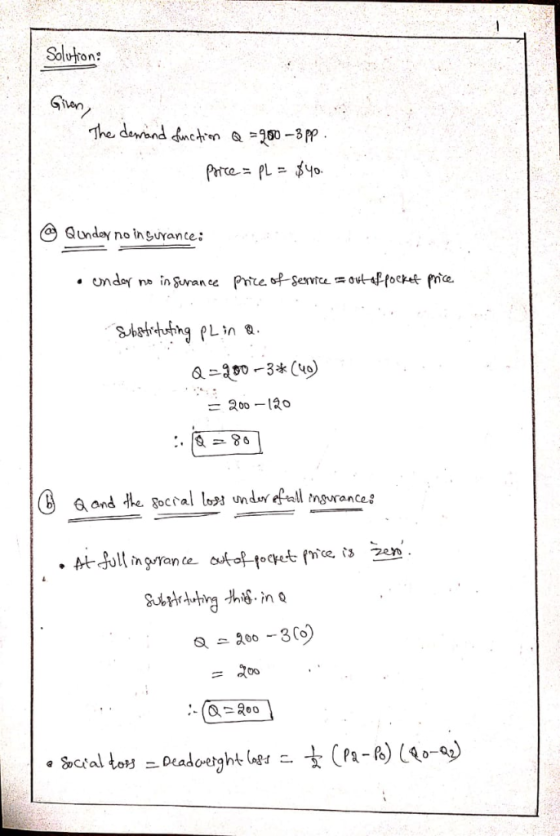
Consider demand for medical services is as follows:Q= 200-3PP, wherePPis the out-of-pocket price she actually faces. She is considering four different insurance options: No insurance; full insurance, a coinsurance plan; and a copayment plan. Assume this service has a list price ofPL= $40.
a. Calculate Q under no insurance.
b. Calculate Q and the soical loss loss under full insurance.
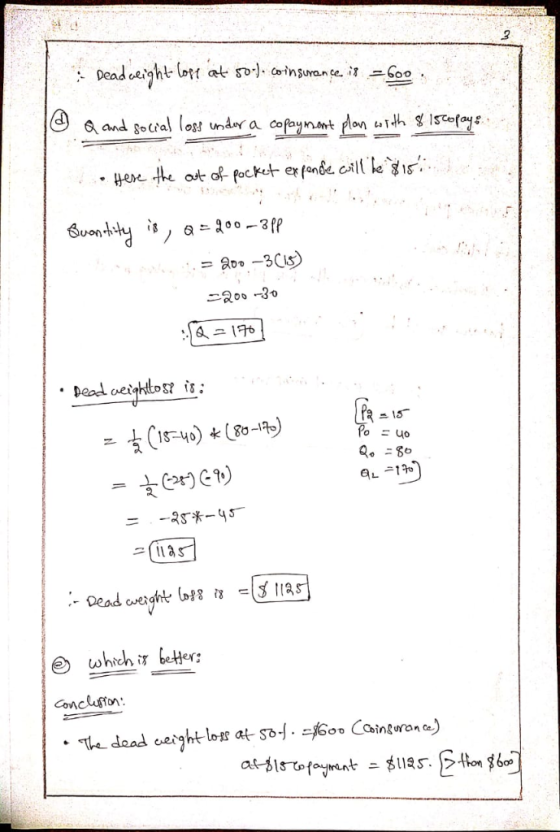
c. Calculate Q and the social loss under a 50% coinsurance plan.
d. Calculate Q and the social loss under a copayment plan with a $15 copay.
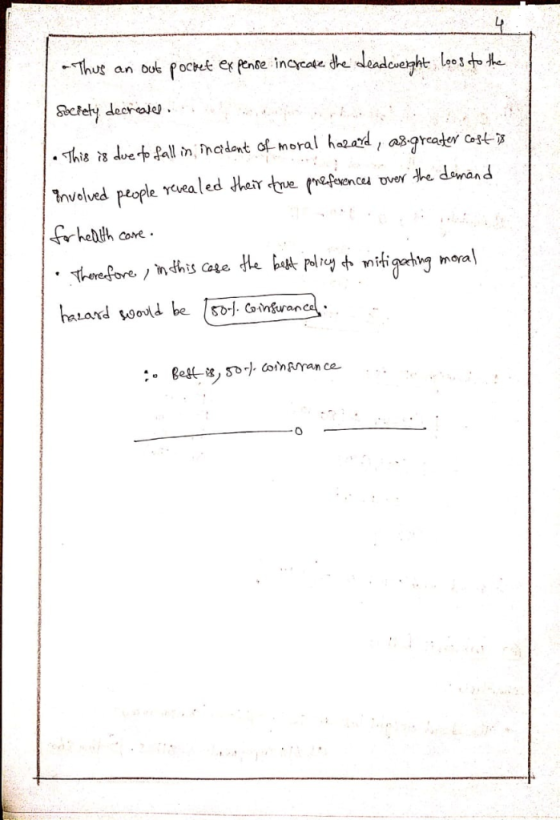
e. Would the coinsurance or the copayment plan be better at mitigating moral hazard? Why?
Homework Answers

Add Answer to:
Consider demand for medical services is as follows:Q= 200-3PP, wherePPis the out-of-pocket price ...
Moral Hazard Before we leave the subject of the impact of insurance on the demand for...
Moral Hazard Before we leave the subject of the impact of insurance on the demand for medical care, we need to introduce the concept of moral hazard. Moral hazard refers to the situation in which consumers alter their behavior when provided with health insurance. For example, health insurance may induce consumers to take fewer precautions to prevent illnesses or to shop very little for the best medical prices. In addition, insured consumers may purchase more medical care than they otherwise...
Suppose a doctor’s visit actually costs $100. Bob has demand for doctor’s visits given by the...
Suppose a doctor’s visit actually costs $100. Bob has demand for doctor’s visits given by the following equation where is the quantity demanded and P is the price that Bob pays for a doctor’s visit: Qd = 30 - .25P Use a supply-demand diagram to illustrate Bob’s demand curve How many times will Bob go to the doctor if he has no insurance (i.e. Bob has to pay full price)? How many times will Bob go to the doctor if...
RISK MANAGEMENT AND INSURANCE MULTIPLE CHOICE Mohamed signed on for group dental insurance when he joined...
RISK MANAGEMENT AND INSURANCE MULTIPLE CHOICE Mohamed signed on for group dental insurance when he joined his employer last year. At his latest check-up, the dentist noted that he needed crowns on three teeth and an implant for a fourth tooth that had been removed due to decay. Under his plan, if the cost of dental work will exceed $600, the dentist submits the treatment plan to the insurer to calculate what the plan will cover and what the employee...
Becky's comprehensive major medical health insurance plan at work has a deductible of $740. The policy...
 Becky's comprehensive major medical health insurance plan at work has a deductible of $740. The policy pays 65 percent of any amount above the deductible. While on a hiking trip, Becky contracted a rare bacterial disease. Her medical costs for treatment, including medicines, tests, and a five-day hospital stay, totaled $9,253. A friend told her that she would have paid less if she had a policy with a stop-loss feature that capped her out-of-pocket expenses at $4,800. a. Calculate the...
Becky’s comprehensive major medical health insurance plan at work has a deductible of $820. The policy...
Becky’s comprehensive major medical health insurance plan at work has a deductible of $820. The policy pays 80 percent of any amount above the deductible. While on a hiking trip, Becky contracted a rare bacterial disease. Her medical costs for treatment, including medicines, tests, and a nine-day hospital stay, totaled $9,033. A friend told her that she would have paid less if she had a policy with a stop-loss feature that capped her out-of-pocket expenses at $3,700. a. Calculate the...
Becky’s comprehensive major medical health insurance plan at work has a deductible of $720. The policy...
Becky’s comprehensive major medical health insurance plan at work has a deductible of $720. The policy pays 85 percent of any amount above the deductible. While on a hiking trip, Becky contracted a rare bacterial disease. Her medical costs for treatment, including medicines, tests, and a four-day hospital stay, totaled $9,213. A friend told her that she would have paid less if she had a policy with a stop-loss feature that capped her out-of-pocket expenses at $4,600. a. Calculate the...
Choose one option Question 1 The cross-price elasticity of demand for electric heaters with respect to...
Choose one option Question 1 The cross-price elasticity of demand for electric heaters with respect to price of electricity is most likely to be Question 1 options: A) Negative, indicating they a substitute goods. B) Positive, indicating they a complementary goods. C) Zero, indicating the goods are not related. D) Negative, indicating they a complementary goods. Question 2 (1.5 points) How are 'discouraged workers' classified by the Australian Bureau of Statistics (ABS)? Question 2 options: A) Not in the labour...
ecky's comprehensive major medical health insurance plan at work has a deductible of 760. The policy...
 ecky's comprehensive major medical health insurance plan at work has a deductible of 760. The policy pays 80 percent of any amount above the deductible. While on a hiking rip, Becky contracted a rare bacterial disease. Her medical costs for treatment, including medicines, tests, and a five-day hospital stay, totaled $8,913. A friend told her that she would have paid less if she had a policy with a stop-loss feature that capped her out-of- pocket expenses at $3,100. a. Calculate...
Help Save & Exit Submit Problem 9-3 (L09.2) Becky's comprehensive major medical health insurance plan at...
 Help Save & Exit Submit Problem 9-3 (L09.2) Becky's comprehensive major medical health insurance plan at work has a deductible of $820. The policy pays 80 percent of any amount above the deductible. While on a hiking trip. Becky contracted a rare bacterial disease. Her medical costs for treatment including medicines, tests, and a nine day hospital stay, totaled 59.033. A friend told her that she would have paid less if she had a policy with a stop-loss feature that...
69) A policy that pays you back for actual expenses is called A) An indemnity plan....
 69) A policy that pays you back for actual expenses is called A) An indemnity plan. B) A deductible plan. C) A reasonable and customary plan. D) A reimbursement plan. E) A coinsurance plan m The set amount that you must pay toward medical expenses before the insurance company pays benefits is called A) Deductible. B) Reimbursement C) Indemnity. D) Internal limit. E) Reasonable and customary charges. 71) Which of the following is a government health care program? A) Health...
 Becky's comprehensive major medical health insurance plan at work has a deductible of $740. The policy pays 65 percent of any amount above the deductible. While on a hiking trip, Becky contracted a rare bacterial disease. Her medical costs for treatment, including medicines, tests, and a five-day hospital stay, totaled $9,253. A friend told her that she would have paid less if she had a policy with a stop-loss feature that capped her out-of-pocket expenses at $4,800. a. Calculate the...
 ecky's comprehensive major medical health insurance plan at work has a deductible of 760. The policy pays 80 percent of any amount above the deductible. While on a hiking rip, Becky contracted a rare bacterial disease. Her medical costs for treatment, including medicines, tests, and a five-day hospital stay, totaled $8,913. A friend told her that she would have paid less if she had a policy with a stop-loss feature that capped her out-of- pocket expenses at $3,100. a. Calculate...
 Help Save & Exit Submit Problem 9-3 (L09.2) Becky's comprehensive major medical health insurance plan at work has a deductible of $820. The policy pays 80 percent of any amount above the deductible. While on a hiking trip. Becky contracted a rare bacterial disease. Her medical costs for treatment including medicines, tests, and a nine day hospital stay, totaled 59.033. A friend told her that she would have paid less if she had a policy with a stop-loss feature that...
 69) A policy that pays you back for actual expenses is called A) An indemnity plan. B) A deductible plan. C) A reasonable and customary plan. D) A reimbursement plan. E) A coinsurance plan m The set amount that you must pay toward medical expenses before the insurance company pays benefits is called A) Deductible. B) Reimbursement C) Indemnity. D) Internal limit. E) Reasonable and customary charges. 71) Which of the following is a government health care program? A) Health...
Most questions answered within 3 hours.
-
Where is the error in this code sequence?
String s1 = "Hello";
String s2 = "ello";...
asked 10 months ago -
Financial data for Joel de Paris, Inc., for last year
follow:
Joel de Paris, Inc.
Balance...
asked 10 months ago -
Consider this reaction:
Al2(SO4)3 (aq)+ BaCl3
(aq) Al2Cl6 (aq)- +
3BaSO4(s) . What is the...
asked 10 months ago -
Suppose that Savneet is considering increasing her
recent random sample from 20 car rentals to 40...
asked 10 months ago -
Trucks arrive at an unloading terminal at an average rate of 120
per hour.
Trucks arrive...
asked 10 months ago -
Why are methanol and ethanol completely soluble in water while
octanol is not very little soluble....
asked 10 months ago -
A facilities manager at a university reads in a research report
that the mean amount of...
asked 10 months ago -
When the CuSO4 is rehydrated by adding water to the anhydrous
compound, is this an endothermic...
asked 10 months ago -
A ray of sunlight is passing from diamond into crown glass; the
angle of incidence is...
asked 10 months ago -
A block of mass 0.249 kg is placed on top of a light, vertical
spring of...
asked 10 months ago -
how do the kidneys compensate in the presences of acidosis
a) trigger hyperventilate
b) reserve acid...
asked 10 months ago -
Question 501 pts
The rental rate of capital to the firm increases. Which of the
following...
asked 10 months ago