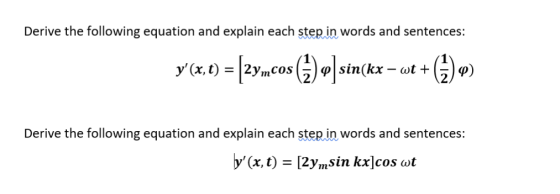
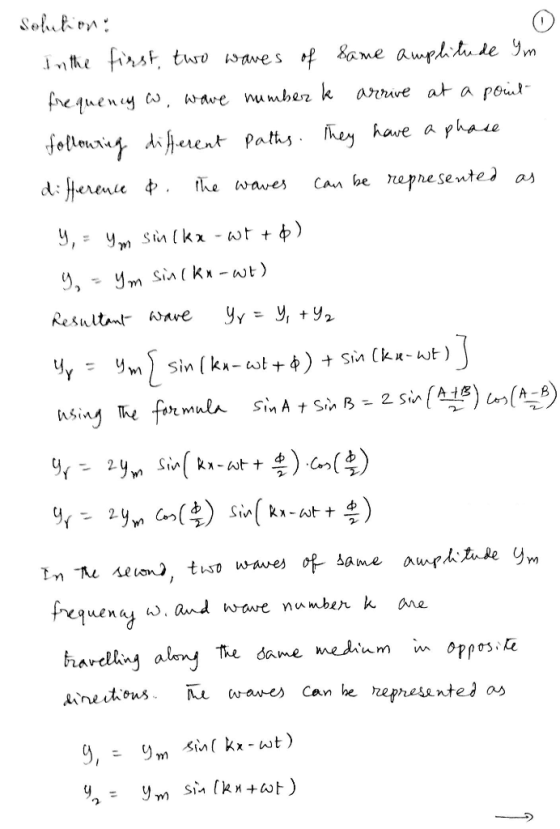
Derive the following equation and explain each step in words and sentences:
y'(x,t)=[2ymcos1/2phi]sin(kx-wt+1/2phi)
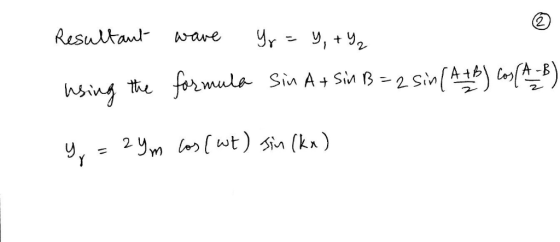
Derive the following equation and explain each step in words and sentences:
y'(x,t)=[2ymsinkx] cos(wt)
Homework Answers
Add Answer to:
Derive the following equation and explain each step in words and sentences: y'(x,t)=[2ymcos1/2phi...
Please do it step by step and explain it. If a wave y(x, t) =(6.0 mm)...
Please do it step by step and explain it. If a wave y(x, t) =(6.0 mm) sin(kx + (600 rad/s)t +phi) travels along a string, how much time does any given point on the string take to move between displacements y = + 2.0 mm and y= - 2.0 mm? Thank you!
Please show step-by-step solution and explain. Thanks! For each one of the following functions of t,...
 Please show step-by-step solution and explain. Thanks!
For each one of the following functions of t, indicate whether they are periodic or not. If periodic, indicate its period, and if not periodic, indicate why. Assume n is a positive integer. Sin (b) sin (xt) +cos (V3t) (c) sin ( 쭉 ) + cos (2nt) + sin ( 2F) + sin( (d) cos (2nt) (e) cos (xt) - cos (t) (f) sin (nt) cos (2nt) )
Please show step-by-step solution and explain. Thanks!
For each one of the following functions of t, indicate whether they are periodic or not. If periodic, indicate its period, and if not periodic, indicate why. Assume n is a positive integer. Sin (b) sin (xt) +cos (V3t) (c) sin ( 쭉 ) + cos (2nt) + sin ( 2F) + sin( (d) cos (2nt) (e) cos (xt) - cos (t) (f) sin (nt) cos (2nt) )
5. Consider Legendre equation for a function y(x) defined in the interval -1. Changing the variab...
 5. Consider Legendre equation for a function y(x) defined in the interval -1. Changing the variable y(cos θ) x cos θ in equation (1) derive the trigonometric form of Legendre equation for a function T (0) where 0 θ π: sin θ Then the general solution to (3) is T (0) y(cos θ) AP, (cos0) + BQ, (cos0).
5. Consider Legendre equation for a function y(x) defined in the interval -1. Changing the variable y(cos θ) x cos θ in...
5. Consider Legendre equation for a function y(x) defined in the interval -1. Changing the variable y(cos θ) x cos θ in equation (1) derive the trigonometric form of Legendre equation for a function T (0) where 0 θ π: sin θ Then the general solution to (3) is T (0) y(cos θ) AP, (cos0) + BQ, (cos0).
5. Consider Legendre equation for a function y(x) defined in the interval -1. Changing the variable y(cos θ) x cos θ in...
1. A common solution to the wave equation is E(x,t) = A Cos(kx-wt). On paper take...
1. A common solution to the wave equation is E(x,t) = A Cos(kx-wt). On paper take the needed derivatives and show that it actually is a solution. 2. A common solution to the wave equation is E(x,t) = A ei(kx+wt). On paper take the needed derivatives and show that it actually is a solution. Note that i is the square-root of -1
Question 21 (3 points) Saved day Which of the following is a solution to the wave...
 Question 21 (3 points) Saved day Which of the following is a solution to the wave equation, aly dt2 Oy = e-* sin (kx – wt) Oy = (cos kx) (sin t) Oy = e-* sin at y = esin x Oy = e-* cost Actually, all of these are solutions to the wave equation. Actually, none of the above is a solution to the wave equation.
ISLM-Model Y=C(Y-T)+I(r)+G How can I analytically (and step by step) derive from this equation th...
ISLM-Model Y=C(Y-T)+I(r)+G How can I analytically (and step by step) derive from this equation that the IS curve slopes downwards? Please explain thoroughly. TIA
The wave equation can be written as:∂^2 y/∂x^2 = 1/v^2 (∂^2 y /∂t^2) where y =...
The wave equation can be written as:∂^2 y/∂x^2 = 1/v^2 (∂^2 y /∂t^2) where y = y(x,t) has units of meters, x is also in meters, and t is in seconds. (a) Show explicitly that the function y(x,t) = ymsin(kx)cos(wt) satisfies the wave equation (6 points). (b) Is the function for y = y(x,t) describe a traveling wave? You must explain your answer to get full credit (2 points). 8. On a winter day with a temperature of Tc, the...
solve number 2 for me pls. Step (1) "Rules for Guessing": 1. If y(x) = ek...
 solve number 2 for me pls.
Step (1) "Rules for Guessing": 1. If y(x) = ek *. guess that yp(I) = Acts then find A 2. If g(x) = sin(kx), guess that y(x) = A cos(kt) + B sin(kt) then find A and B 3. If g(x) = cos(kx), guess that yp(x) = A cos(kt) + B sin(kt) then find A and B 4. If g(x) is a polyonomial of degree n, guess that ypa) Ao + AX + A₂x²...
solve number 2 for me pls.
Step (1) "Rules for Guessing": 1. If y(x) = ek *. guess that yp(I) = Acts then find A 2. If g(x) = sin(kx), guess that y(x) = A cos(kt) + B sin(kt) then find A and B 3. If g(x) = cos(kx), guess that yp(x) = A cos(kt) + B sin(kt) then find A and B 4. If g(x) is a polyonomial of degree n, guess that ypa) Ao + AX + A₂x²...
The following has you derive the ODE from the Application. For each part make sure you...
 The following has you derive the ODE from the Application. For each part make sure you type your answers in the text box using the equation editor and correct notation. rope of length L is attached to the ceiling and makes small vibrations. The displacement from the vertical at any point x is given by u(t, x). Consider a point that is a distance x from the ceiling. Explain why the weight of the cable below this point is given...
For f(x, y) 3xy X cos y 4x y find f,, f,, f fw and f...
 For f(x, y) 3xy X cos y 4x y find f,, f,, f fw and f (10 pts) 1. + - (10 pts) a2 sin(akt) sin(kx) satisfies the wave equation Determine if v(x, t) 2 = 0 (10 pts) Inx + y satisfies the harmonic equation Determine if f(x, y) + 3. ay2
 Please show step-by-step solution and explain. Thanks!
For each one of the following functions of t, indicate whether they are periodic or not. If periodic, indicate its period, and if not periodic, indicate why. Assume n is a positive integer. Sin (b) sin (xt) +cos (V3t) (c) sin ( 쭉 ) + cos (2nt) + sin ( 2F) + sin( (d) cos (2nt) (e) cos (xt) - cos (t) (f) sin (nt) cos (2nt) )
Please show step-by-step solution and explain. Thanks!
For each one of the following functions of t, indicate whether they are periodic or not. If periodic, indicate its period, and if not periodic, indicate why. Assume n is a positive integer. Sin (b) sin (xt) +cos (V3t) (c) sin ( 쭉 ) + cos (2nt) + sin ( 2F) + sin( (d) cos (2nt) (e) cos (xt) - cos (t) (f) sin (nt) cos (2nt) )
 5. Consider Legendre equation for a function y(x) defined in the interval -1. Changing the variable y(cos θ) x cos θ in equation (1) derive the trigonometric form of Legendre equation for a function T (0) where 0 θ π: sin θ Then the general solution to (3) is T (0) y(cos θ) AP, (cos0) + BQ, (cos0).
5. Consider Legendre equation for a function y(x) defined in the interval -1. Changing the variable y(cos θ) x cos θ in...
5. Consider Legendre equation for a function y(x) defined in the interval -1. Changing the variable y(cos θ) x cos θ in equation (1) derive the trigonometric form of Legendre equation for a function T (0) where 0 θ π: sin θ Then the general solution to (3) is T (0) y(cos θ) AP, (cos0) + BQ, (cos0).
5. Consider Legendre equation for a function y(x) defined in the interval -1. Changing the variable y(cos θ) x cos θ in...
 Question 21 (3 points) Saved day Which of the following is a solution to the wave equation, aly dt2 Oy = e-* sin (kx – wt) Oy = (cos kx) (sin t) Oy = e-* sin at y = esin x Oy = e-* cost Actually, all of these are solutions to the wave equation. Actually, none of the above is a solution to the wave equation.
 solve number 2 for me pls.
Step (1) "Rules for Guessing": 1. If y(x) = ek *. guess that yp(I) = Acts then find A 2. If g(x) = sin(kx), guess that y(x) = A cos(kt) + B sin(kt) then find A and B 3. If g(x) = cos(kx), guess that yp(x) = A cos(kt) + B sin(kt) then find A and B 4. If g(x) is a polyonomial of degree n, guess that ypa) Ao + AX + A₂x²...
solve number 2 for me pls.
Step (1) "Rules for Guessing": 1. If y(x) = ek *. guess that yp(I) = Acts then find A 2. If g(x) = sin(kx), guess that y(x) = A cos(kt) + B sin(kt) then find A and B 3. If g(x) = cos(kx), guess that yp(x) = A cos(kt) + B sin(kt) then find A and B 4. If g(x) is a polyonomial of degree n, guess that ypa) Ao + AX + A₂x²...
 The following has you derive the ODE from the Application. For each part make sure you type your answers in the text box using the equation editor and correct notation. rope of length L is attached to the ceiling and makes small vibrations. The displacement from the vertical at any point x is given by u(t, x). Consider a point that is a distance x from the ceiling. Explain why the weight of the cable below this point is given...
 For f(x, y) 3xy X cos y 4x y find f,, f,, f fw and f (10 pts) 1. + - (10 pts) a2 sin(akt) sin(kx) satisfies the wave equation Determine if v(x, t) 2 = 0 (10 pts) Inx + y satisfies the harmonic equation Determine if f(x, y) + 3. ay2
Most questions answered within 3 hours.
-
Where is the error in this code sequence?
String s1 = "Hello";
String s2 = "ello";...
asked 11 months ago -
Financial data for Joel de Paris, Inc., for last year
follow:
Joel de Paris, Inc.
Balance...
asked 11 months ago -
Consider this reaction:
Al2(SO4)3 (aq)+ BaCl3
(aq) Al2Cl6 (aq)- +
3BaSO4(s) . What is the...
asked 11 months ago -
Suppose that Savneet is considering increasing her
recent random sample from 20 car rentals to 40...
asked 11 months ago -
Trucks arrive at an unloading terminal at an average rate of 120
per hour.
Trucks arrive...
asked 11 months ago -
Why are methanol and ethanol completely soluble in water while
octanol is not very little soluble....
asked 11 months ago -
A facilities manager at a university reads in a research report
that the mean amount of...
asked 11 months ago -
When the CuSO4 is rehydrated by adding water to the anhydrous
compound, is this an endothermic...
asked 11 months ago -
A ray of sunlight is passing from diamond into crown glass; the
angle of incidence is...
asked 11 months ago -
A block of mass 0.249 kg is placed on top of a light, vertical
spring of...
asked 11 months ago -
how do the kidneys compensate in the presences of acidosis
a) trigger hyperventilate
b) reserve acid...
asked 11 months ago -
Question 501 pts
The rental rate of capital to the firm increases. Which of the
following...
asked 11 months ago