
Homework Answers
contractionary fiscal policy :
- contractionary fiscal policy and expansionary monetary policy will lead to achievement of this result, as when there is contractionary fiscal policy( like increased taxes), there will be a backward shift in IS curve thus decreasing interest rates and decreasing output, to compensate for the decreased output the central bank can increase money supply this will lead to rightward shift in LM curve thus further decreasing interest rates and stabilizing output, now as interest rates are the opportunity cost of investment so decreased interest rates will lead to higher investment in the economy.

What is the IS-LM Model:
- The IS-LM model, which stands for "investment-savings, liquidity-money," is a Keynesian macroeconomic model that shows how the market for economic goods (IS) interacts with the loanable funds market (LM) or money market. It is represented as a graph in which the IS and LM curve intersect to show the short-run equilibrium between interest rates and output.
- The IS-LM model appears as a graph that shows the intersection of goods and the money market. The IS stands for Investment and Savings. The LM stands for Liquidity and Money. On the vertical axis of the graph, ‘r’ represents the interest rate on government bonds. The IS-LM model attempts to explain a way to keep the economy in balance through an equilibrium of money supply versus interest rates.
Effect of Fiscal Policy:
- Let us first explain how IS-LM model shows the effect of expansionary fiscal policy of increase in Government expenditure on level of national income.
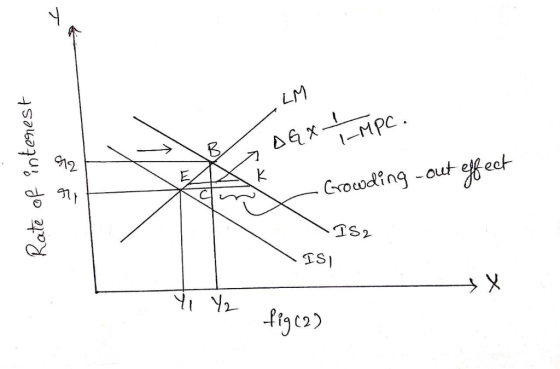
- This is illustrated in Fig. 2 Increase in Government expenditure which is of autonomous nature raises aggregate demand for goods and services and thereby causes an outward shift in IS curve, as is shown in Fig. 20.6 where increase in Government expenditure leads to the shift in IS curve from IS1 to IS2.
- Note that the horizontal distance between the two IS curves is equal to the increase in government expenditure times the government expenditure multiplier, that is, ΔG x 1/1-MPC which shows the increase in national income equal to the horizontal distance EK that occurs in Keynes’ multiplier model. However, in IS-LM model actual increase in national income is not equal to EK caused by the working of Keynesian multiplier.
- This is because with the rightward shift in IS curve rate of interest also rises which causes reduction in private investment. It will be seen from Fig. 20.6 that, with the LM curve remaining unchanged, the new IS2 curve intersects LM curve at point B. Thus, in IS-LM model with the increase in Government expenditure (ΔG), the equilibrium moves from point E to B and with this the rate of interest rises from r1 to r2 and income level from Y1 to Y2.
- Income equal to CK has been wiped out because of rise in interest causing a decline in private investment. Thus CK represents crowding-out effect of increase in government expenditure Thus, IS-LM model shows that expansionary fiscal policy of increase in Government expenditure raises both the level of income and rate of interest.
Add Answer to:
4. Suppose policymakers want to raise investment but keep output constant. In the IS-LM model, wh...
4. (25%) Suppose that policy makers want to raise investment but keep out- put and consumption...
 4. (25%) Suppose that policy makers want to raise investment but keep out- put and consumption unchanged. (a) Analyze whether - and if so, how - these targets can be achieved using a combination of fiscal and monetary policy. i. what must happen to interest rates to raise investment if output is unchanged? ii. what must happen to government spending and taxes to keep output and consumption unchanged if investment increases? (b) Illustrate the analysis using an IS-LM diagram
Suppose that policymakers want to decrease the fiscal deficit. 3. Suppose that policymakers want to decrease...
 Suppose that policymakers want to decrease the fiscal deficit.
3. Suppose that policymakers want to decrease the fiscal deficit A. Use an IS-LM graph to illustrate the effect on equilibrium GDP and interest rates if government spending is decreased, explaining briefly what happens. B. Use an IS-LM graph to illustrate the effect on equilibrium GDP and interest rates if taxes are increased, explaining briefly what happens. C. Suppose the policymakers want to reduce the fiscal deficit without decreasing GDP. Is...
Suppose that policymakers want to decrease the fiscal deficit.
3. Suppose that policymakers want to decrease the fiscal deficit A. Use an IS-LM graph to illustrate the effect on equilibrium GDP and interest rates if government spending is decreased, explaining briefly what happens. B. Use an IS-LM graph to illustrate the effect on equilibrium GDP and interest rates if taxes are increased, explaining briefly what happens. C. Suppose the policymakers want to reduce the fiscal deficit without decreasing GDP. Is...
Suppose that North Korea has a closed economy and that its government wants to raise investment...
Suppose that North Korea has a closed economy and that its government wants to raise investment but keep output constant (i.e. no change in Y but with a higher I). In the closed economy IS-LM model, what mix of monetary and fiscal policy will achieve this goal? Use a graph to support your answer.
Suppose policy makers want to increase net exports (NX) and keep output (Y) constant. Which of...
Suppose policy makers want to increase net exports (NX) and keep output (Y) constant. Which of the following policies would most likely achieve this? A. an increase in government spending B. a real depreciation C.an increase in government spending and a decrease in the real exchange rate D. a decrease in the real exchange rate and a tax increase
Suppose aggregate demand shifts to the left and policymakers want to stabilize output. What can they...
Suppose aggregate demand shifts to the left and policymakers want to stabilize output. What can they do? A repeal an investment tax credit or increase the money supply B repeal an investment tax credit or decrease the money supply C institute an investment tax credit or increase the money supply D institute an investment tax credit or decrease the money supply
Question 3: Using a policy mix Suppose that policymakers want to increase output (Y) while keeping...
 Question 3: Using a policy mix Suppose that policymakers want to increase output (Y) while keeping the interest rate constant. What mix of fiscal and monetary policy is needed to meet these objectives? Show a figure that supports your answer, and briefly explain your figure (which curves shift and why, and the effect on equilibrium GDP)
IS-LM What combination of policies would best reduce inflation? a) Increase taxes, sell government bonds b)...
 IS-LM What combination of policies would best reduce inflation? a) Increase taxes, sell government bonds b) Decrease taxes, buy government bonds c) Decrease taxes, lower the reserve ratio d) Decrease government spending, lower the discount rate e) Increase government spending, raise the discount rate Use the IS-LM model. Your policy instruments are: Taxes, Government Spending, and the Money Supply. Describe a policy or set of policies that achieve the following objectives. Your answer should include a diagram to show how...
1. Use the IS-LM model to show how an unexpected inflation could result in a higher...
1. Use the IS-LM model to show how an unexpected inflation could result in a higher short-run GDP. 2. Use the IS-LM model to show how an expected inflation could result in a higher short-run GDP. Explain using an IS-LM diagram. Make sure you explain in words what happens in your diagram. 3) Suppose a closed economy is initially in the long run equilibrium. Suppose the monetary base of this economy is $100 million, of which people carry $10 million...
1. A. Suppose in an economy, there is an exogenous fall in investment spending due to the burst of a housing bubble. Answer the following questions using the IS-LM-FX model. Which schedule shifts...
 1. A. Suppose in an economy, there is an exogenous fall in investment spending due to the burst of a housing bubble. Answer the following questions using the IS-LM-FX model. Which schedule shifts in the IS-LM model on impact? ii. i. What happens to the equilibrium output, interest rate, and exchange rate after this change? B. Suppose that following the decline in investment spending, the central bank decides to pursue an output stabilization policy. Answer the following questions comparing the...
2. (1,75 p.) Consider a closed economy with fixed prices and wages. Suppose the consumption function...
 2. (1,75 p.) Consider a closed economy with fixed prices and wages. Suppose the consumption function takes the form C-400 +0.2(Y-T), the invest function is I- 170-10i. Central Bank sets interest rates that results in the following LM curve i-0.02Y-10. Initially G T-100. Suppose that govemment controls both fiscal and monetary policy. The government wishes to increase output by 10% but to keep the budget in balance and investment unchanged. Describe in detail the combination of policies (specify the instruments...
 4. (25%) Suppose that policy makers want to raise investment but keep out- put and consumption unchanged. (a) Analyze whether - and if so, how - these targets can be achieved using a combination of fiscal and monetary policy. i. what must happen to interest rates to raise investment if output is unchanged? ii. what must happen to government spending and taxes to keep output and consumption unchanged if investment increases? (b) Illustrate the analysis using an IS-LM diagram
 Suppose that policymakers want to decrease the fiscal deficit.
3. Suppose that policymakers want to decrease the fiscal deficit A. Use an IS-LM graph to illustrate the effect on equilibrium GDP and interest rates if government spending is decreased, explaining briefly what happens. B. Use an IS-LM graph to illustrate the effect on equilibrium GDP and interest rates if taxes are increased, explaining briefly what happens. C. Suppose the policymakers want to reduce the fiscal deficit without decreasing GDP. Is...
Suppose that policymakers want to decrease the fiscal deficit.
3. Suppose that policymakers want to decrease the fiscal deficit A. Use an IS-LM graph to illustrate the effect on equilibrium GDP and interest rates if government spending is decreased, explaining briefly what happens. B. Use an IS-LM graph to illustrate the effect on equilibrium GDP and interest rates if taxes are increased, explaining briefly what happens. C. Suppose the policymakers want to reduce the fiscal deficit without decreasing GDP. Is...
 Question 3: Using a policy mix Suppose that policymakers want to increase output (Y) while keeping the interest rate constant. What mix of fiscal and monetary policy is needed to meet these objectives? Show a figure that supports your answer, and briefly explain your figure (which curves shift and why, and the effect on equilibrium GDP)
 IS-LM What combination of policies would best reduce inflation? a) Increase taxes, sell government bonds b) Decrease taxes, buy government bonds c) Decrease taxes, lower the reserve ratio d) Decrease government spending, lower the discount rate e) Increase government spending, raise the discount rate Use the IS-LM model. Your policy instruments are: Taxes, Government Spending, and the Money Supply. Describe a policy or set of policies that achieve the following objectives. Your answer should include a diagram to show how...
 1. A. Suppose in an economy, there is an exogenous fall in investment spending due to the burst of a housing bubble. Answer the following questions using the IS-LM-FX model. Which schedule shifts in the IS-LM model on impact? ii. i. What happens to the equilibrium output, interest rate, and exchange rate after this change? B. Suppose that following the decline in investment spending, the central bank decides to pursue an output stabilization policy. Answer the following questions comparing the...
 2. (1,75 p.) Consider a closed economy with fixed prices and wages. Suppose the consumption function takes the form C-400 +0.2(Y-T), the invest function is I- 170-10i. Central Bank sets interest rates that results in the following LM curve i-0.02Y-10. Initially G T-100. Suppose that govemment controls both fiscal and monetary policy. The government wishes to increase output by 10% but to keep the budget in balance and investment unchanged. Describe in detail the combination of policies (specify the instruments...
Most questions answered within 3 hours.
-
Where is the error in this code sequence?
String s1 = "Hello";
String s2 = "ello";...
asked 11 months ago -
Financial data for Joel de Paris, Inc., for last year
follow:
Joel de Paris, Inc.
Balance...
asked 11 months ago -
Consider this reaction:
Al2(SO4)3 (aq)+ BaCl3
(aq) Al2Cl6 (aq)- +
3BaSO4(s) . What is the...
asked 11 months ago -
Suppose that Savneet is considering increasing her
recent random sample from 20 car rentals to 40...
asked 11 months ago -
Trucks arrive at an unloading terminal at an average rate of 120
per hour.
Trucks arrive...
asked 11 months ago -
Why are methanol and ethanol completely soluble in water while
octanol is not very little soluble....
asked 11 months ago -
A facilities manager at a university reads in a research report
that the mean amount of...
asked 11 months ago -
When the CuSO4 is rehydrated by adding water to the anhydrous
compound, is this an endothermic...
asked 11 months ago -
A ray of sunlight is passing from diamond into crown glass; the
angle of incidence is...
asked 11 months ago -
A block of mass 0.249 kg is placed on top of a light, vertical
spring of...
asked 11 months ago -
how do the kidneys compensate in the presences of acidosis
a) trigger hyperventilate
b) reserve acid...
asked 11 months ago -
Question 501 pts
The rental rate of capital to the firm increases. Which of the
following...
asked 11 months ago