A button is connected to p1.0 and an LED is connected to P2.0. Write code with PWM so that if the...
A button is connected to p1.0 and an LED is connected to P2.0. Write code with PWM so that if the button is pressed the LED is on 70%, but if the button is not pressed the LED is on 10%
Homework Answers
![Semantic Network non-pressed BUTTON Iconnected to PIN Code int button-1 buttonStateLOW C should cause LED connected to ] PIN](http://img.homeworklib.com/images/418dfa76-1ef1-449f-9130-e0ef6ec094d4.png?x-oss-process=image/resize,w_560)
![pressed BUTTON .. [connected to ] PIN Code int button-1 buttonState HIGH Cshould cause CLED connected to PIN 2 ode Code int l](http://img.homeworklib.com/images/54d983cf-de25-4deb-afa9-850e77092d64.png?x-oss-process=image/resize,w_560)
int button = 1;
int led = 2;
int buttonState = 0;
int npressedBrightness = 25;
int pressedBrightness = 178;
void setup () {
pinMode(led,OUTPUT);
pinMode(button, INPUT) ;
}
void loop() {
buttonState = digitalRead(button);
if (buttonState == HIGH) {
analogWrite(led,
pressedBrightness);
}
else {
analogWrite(led,
npressedBrightness);
}
delay(30);
}
Add Answer to:
A button is connected to p1.0 and an LED is connected to P2.0. Write code with PWM so that if the...
By using Arduino write a code that connects two LEDs to two push-buttons. Each button controls...
By using Arduino write a code that connects two LEDs to two push-buttons. Each button controls the state of its connected LED. The LEDs can be in one of two states: Blink-mode or Off-mode. When a button-press event is detected, its connected LED will begin blinking (turning on and off) and when a button-press is detected, its connected LED will turn off. The application should blink one of the LEDs at a rate of 1 second, and the other LED...
A button connects pin 23 of an ATmega328 to 5V. A second button connects pin 24...
A button connects pin 23 of an ATmega328 to 5V. A second button connects pin 24 to 5V. External pull down resistors are used. Eight LEDs are connected to the Port D pins. Write a program that will turn on pins PD0-3 if the first button is pressed and pins PD4-7 if the second button is pressed. (Code should be in C).
write a code in C on RaspberryPi to have an LED light turn on and off...
write a code in C on RaspberryPi to have an LED light turn on and off using a push button
QUESTION TWO a) Given the circuit below where the button is connected to Port AO Write...
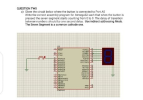 QUESTION TWO a) Given the circuit below where the button is connected to Port AO Write the correct assembly program for Atmega32 such that when the button is pressed the seven segment starts counting from 0 to 9. The delay of transition between numbers should be one second delay. Use indirect addressing Mode. The Seven Segment is a common cathode one. M 11-12
C CODE LANGUAGE. MSP430. #include <msp430fr6989.h> #define redLED BIT0 // Red LED at P1.0 #define greenLED...
 C CODE LANGUAGE. MSP430.
#include <msp430fr6989.h>
#define redLED BIT0 // Red LED at P1.0
#define greenLED BIT7 // Green LED at P9.7
#define BUT1 BIT1 // Button S1 at P1.1
#define BUT2 BIT2 // Button S2 at P1.2
void main(void) {
WDTCTL = WDTPW | WDTHOLD; // Stop the Watchdog timer
PM5CTL0 &= ~LOCKLPM5; // Enable the GPIO pins
// Configure and initialize LEDs
P1DIR |= redLED; // Direct pin as output
P9DIR |= greenLED; // Direct pin as output...
C CODE LANGUAGE. MSP430.
#include <msp430fr6989.h>
#define redLED BIT0 // Red LED at P1.0
#define greenLED BIT7 // Green LED at P9.7
#define BUT1 BIT1 // Button S1 at P1.1
#define BUT2 BIT2 // Button S2 at P1.2
void main(void) {
WDTCTL = WDTPW | WDTHOLD; // Stop the Watchdog timer
PM5CTL0 &= ~LOCKLPM5; // Enable the GPIO pins
// Configure and initialize LEDs
P1DIR |= redLED; // Direct pin as output
P9DIR |= greenLED; // Direct pin as output...
You are designing an LED dimmer that controls the light intensity through PWM. The LED circuit...
You are designing an LED dimmer that controls the light intensity through PWM. The LED circuit draws 500 mA when on at 12V. The normal operating condition is 60% duty cycle and switching at 10 kHz. You are between using the BCP56-16T1G BJT and MGSF1N03LT1G MOSFET (assume you are driving with 10V) as a low-side switch. Which device would be best to use from an efficiency perspective (accounting only for conduction and switching loss)? Why?
When designing an Analog to Digital System all of the range values for the system must be defined from input to output. This input will be used to drive a 3. PWM output signal to operate an LED. A...
 When designing an Analog to Digital System all of the range values for the system must be defined from input to output. This input will be used to drive a 3. PWM output signal to operate an LED. Assume the PWM is calibrated to read minimum to maximum based on the binary input range given. Potentiometer - 10 KS2 (0 degrees to 180 degrees) VDC for Potentiometer 12 V Analog Converter Module 10 bit, Vref 8 V PWM Module-8 bit,...
It's an Energia sketch using C language. We work with MSP430 Launchpad but you shouldn't need...
 It's an Energia sketch using C language. We
work with MSP430 Launchpad but you shouldn't need it to write the
code.
I'm really stuck :(
Problem 2 (50 points) One common method of outputting an "effective" analog signal is to use pulse width modulation or PWM. In this modulation scheme, a high frequency square wave is switched on and off with a duty cycle determined by the desired output intensity, where Duty Cycle = Time spend "on" Total period 50%...
It's an Energia sketch using C language. We
work with MSP430 Launchpad but you shouldn't need it to write the
code.
I'm really stuck :(
Problem 2 (50 points) One common method of outputting an "effective" analog signal is to use pulse width modulation or PWM. In this modulation scheme, a high frequency square wave is switched on and off with a duty cycle determined by the desired output intensity, where Duty Cycle = Time spend "on" Total period 50%...
We have a microcontroller (MCU) that operates at 3.3V. We want to connect a pushbutton switch to a digital input and a LED on a digital output. The pushbutton is normally open until pressed. The LED...
 We have a microcontroller (MCU) that operates at 3.3V. We want to connect a pushbutton switch to a digital input and a LED on a digital output. The pushbutton is normally open until pressed. The LED has a forward voltage of 2.3V at the operating current of 10mA. We want the input at the microcontroller to go high when the button is pressed. We want the LED to light up when the digital output is low Q5 Explain what two...
 QUESTION TWO a) Given the circuit below where the button is connected to Port AO Write the correct assembly program for Atmega32 such that when the button is pressed the seven segment starts counting from 0 to 9. The delay of transition between numbers should be one second delay. Use indirect addressing Mode. The Seven Segment is a common cathode one. M 11-12
 C CODE LANGUAGE. MSP430.
#include <msp430fr6989.h>
#define redLED BIT0 // Red LED at P1.0
#define greenLED BIT7 // Green LED at P9.7
#define BUT1 BIT1 // Button S1 at P1.1
#define BUT2 BIT2 // Button S2 at P1.2
void main(void) {
WDTCTL = WDTPW | WDTHOLD; // Stop the Watchdog timer
PM5CTL0 &= ~LOCKLPM5; // Enable the GPIO pins
// Configure and initialize LEDs
P1DIR |= redLED; // Direct pin as output
P9DIR |= greenLED; // Direct pin as output...
C CODE LANGUAGE. MSP430.
#include <msp430fr6989.h>
#define redLED BIT0 // Red LED at P1.0
#define greenLED BIT7 // Green LED at P9.7
#define BUT1 BIT1 // Button S1 at P1.1
#define BUT2 BIT2 // Button S2 at P1.2
void main(void) {
WDTCTL = WDTPW | WDTHOLD; // Stop the Watchdog timer
PM5CTL0 &= ~LOCKLPM5; // Enable the GPIO pins
// Configure and initialize LEDs
P1DIR |= redLED; // Direct pin as output
P9DIR |= greenLED; // Direct pin as output...
 When designing an Analog to Digital System all of the range values for the system must be defined from input to output. This input will be used to drive a 3. PWM output signal to operate an LED. Assume the PWM is calibrated to read minimum to maximum based on the binary input range given. Potentiometer - 10 KS2 (0 degrees to 180 degrees) VDC for Potentiometer 12 V Analog Converter Module 10 bit, Vref 8 V PWM Module-8 bit,...
 It's an Energia sketch using C language. We
work with MSP430 Launchpad but you shouldn't need it to write the
code.
I'm really stuck :(
Problem 2 (50 points) One common method of outputting an "effective" analog signal is to use pulse width modulation or PWM. In this modulation scheme, a high frequency square wave is switched on and off with a duty cycle determined by the desired output intensity, where Duty Cycle = Time spend "on" Total period 50%...
It's an Energia sketch using C language. We
work with MSP430 Launchpad but you shouldn't need it to write the
code.
I'm really stuck :(
Problem 2 (50 points) One common method of outputting an "effective" analog signal is to use pulse width modulation or PWM. In this modulation scheme, a high frequency square wave is switched on and off with a duty cycle determined by the desired output intensity, where Duty Cycle = Time spend "on" Total period 50%...
 We have a microcontroller (MCU) that operates at 3.3V. We want to connect a pushbutton switch to a digital input and a LED on a digital output. The pushbutton is normally open until pressed. The LED has a forward voltage of 2.3V at the operating current of 10mA. We want the input at the microcontroller to go high when the button is pressed. We want the LED to light up when the digital output is low Q5 Explain what two...
Most questions answered within 3 hours.
-
Where is the error in this code sequence?
String s1 = "Hello";
String s2 = "ello";...
asked 10 months ago -
Financial data for Joel de Paris, Inc., for last year
follow:
Joel de Paris, Inc.
Balance...
asked 10 months ago -
Consider this reaction:
Al2(SO4)3 (aq)+ BaCl3
(aq) Al2Cl6 (aq)- +
3BaSO4(s) . What is the...
asked 10 months ago -
Suppose that Savneet is considering increasing her
recent random sample from 20 car rentals to 40...
asked 10 months ago -
Trucks arrive at an unloading terminal at an average rate of 120
per hour.
Trucks arrive...
asked 10 months ago -
Why are methanol and ethanol completely soluble in water while
octanol is not very little soluble....
asked 10 months ago -
A facilities manager at a university reads in a research report
that the mean amount of...
asked 10 months ago -
When the CuSO4 is rehydrated by adding water to the anhydrous
compound, is this an endothermic...
asked 10 months ago -
A ray of sunlight is passing from diamond into crown glass; the
angle of incidence is...
asked 10 months ago -
A block of mass 0.249 kg is placed on top of a light, vertical
spring of...
asked 10 months ago -
how do the kidneys compensate in the presences of acidosis
a) trigger hyperventilate
b) reserve acid...
asked 10 months ago -
Question 501 pts
The rental rate of capital to the firm increases. Which of the
following...
asked 10 months ago