

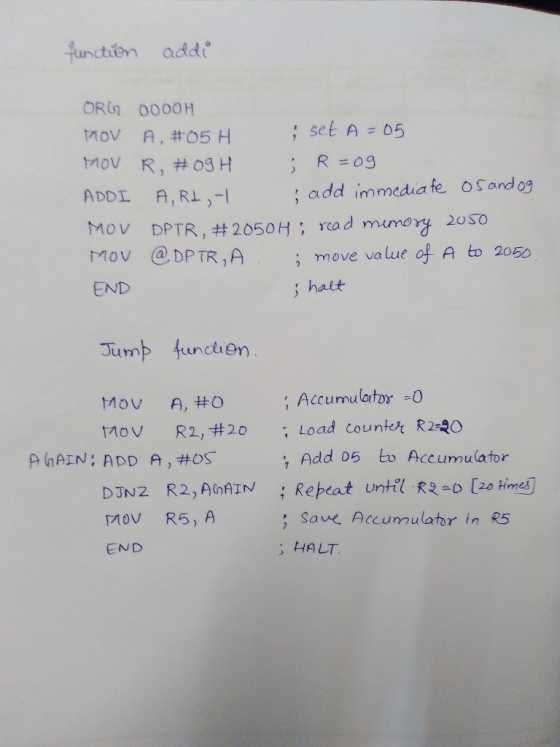
1. Write the necessary steps in RTL (Register Transfer Language), to fetch and execute (10 points) the instructions addi (add immediate), bne (branch not equal), and j Gump) on a multicycle MIPS machine. Stepl: (IF) Instruction Fetch Step2: (ID) Instruction Decode and Reg. Fetch Step 3: (EX) Execution Step4: (MEM) Memory Access Step5: (WB) Write Back
Homework Answers
Add Answer to:
The necessary steps in RTL (Register Transfer Languag fetch and execute to the instructions addi ...
A 5-Stage pipeline is composed of the following stages Instruction Fetch (IF), Decode (DE), Execute (EX), Memory Access...
 A 5-Stage pipeline is composed
of the following stages Instruction Fetch (IF), Decode (DE),
Execute (EX), Memory Access (ME) and Register Write-back (WB).
Assume the pipeline does not have a branch prediction unit, does
not have superscalar support and does not support out of order
execution. Assume that all memory accesses are in the L1 cache and
therefore do not introduce any stalls. Show a pipeline diagram that
shows the execution of each stage for the assembly code below. Also...
A 5-Stage pipeline is composed
of the following stages Instruction Fetch (IF), Decode (DE),
Execute (EX), Memory Access (ME) and Register Write-back (WB).
Assume the pipeline does not have a branch prediction unit, does
not have superscalar support and does not support out of order
execution. Assume that all memory accesses are in the L1 cache and
therefore do not introduce any stalls. Show a pipeline diagram that
shows the execution of each stage for the assembly code below. Also...
Consider the following MIPS assembly language instructions: addi $1, $2, 100 swr $1, 0($2): addi $rt,...
 Consider the following MIPS assembly language instructions: addi $1, $2, 100 swr $1, 0($2): addi $rt, $rs, immediate # add immediate swr $rt, immedi ate ($rs) # store word write register These instructions are I-format instructions similar to the load word and store word instructions. The addi and swr instructions store a computed value to the destina- tion register $rt. The instructions do not require any physical hardware changes to the datapath. The effect of each instruction is given below....
We found that the instruction fetch and memory stages are the critical path of our 5-stage...
 We found that the instruction fetch and memory stages are the
critical path of our 5-stage pipelined MIPS CPU. Therefore, we
changed the IF and MEM stages to take two cycles
while increasing the clock rate. You can assume that the register
file is written at the falling edge of the clock.
Assume that no pipelining optimizations have been made, and that
branch comparisons are made by the ALU. Here’s how our pipeline
looks when executing two add instructions:
Clock...
We found that the instruction fetch and memory stages are the
critical path of our 5-stage pipelined MIPS CPU. Therefore, we
changed the IF and MEM stages to take two cycles
while increasing the clock rate. You can assume that the register
file is written at the falling edge of the clock.
Assume that no pipelining optimizations have been made, and that
branch comparisons are made by the ALU. Here’s how our pipeline
looks when executing two add instructions:
Clock...
c. The classic five-stage pipeline MIPS architecture is used to execute the code fragments. Assume the...
c. The classic five-stage pipeline MIPS architecture is used to execute the code fragments. Assume the followings: Register write is done in the first half of the clock cycle; register read is performed in the second half of the clock cycle, Branches are resolved in the second stage of the pipeline and the architecture does not utilize any branch prediction mechanism Forwarding is fully supported Clock Cycle à 1 2 3 4 5 6 7 8 9 10 11 12...
Question 11 add sw addi bne The classic five-stage pipeline MIPS architecture is used to execute...
 Question 11 add sw addi bne The classic five-stage pipeline MIPS architecture is used to execute the code fragments in this problem. Assume the followings • The architecture fully supports forwarding, • Register write is done in the first half of the clock cycle; register read is performed in the second half of the clock cycle, • Branches are resolved in the third stage of the pipeline and the architecture does not utilize any branch prediction med • Register R4...
add SW addi bne The classic five-stage pipeline MIPS architecture is used to execute the code...
 add SW addi bne The classic five-stage pipeline MIPS architecture is used to execute the code fragments in this problem. Assume the followings: The architecture fully supports forwarding, • Register write is done in the first half of the clock cycle; register read is performed in the second half of the clock cycle, • Branches are resolved in the third stage of the pipeline and the architecture does not utilize any branch prediction mechanism, • Register R4 is initially 100....
4) Consider the following assembly language code: INSTRUCTIONS T01 T02 T03 T04 T05 T06 T07 T08...
4) Consider the following assembly language code: INSTRUCTIONS T01 T02 T03 T04 T05 T06 T07 T08 T09 T10 T11 T12 T13 T14 (as a table) Loop: sll $t1, $s3, 2 add $t1, $t1, $s6 lw $t0, 0($t1) beq $t0, $s5, Exit addi $s3, $s3, 1 j Loop Exit: Use a pipeline with forwarding, hazard detection, and 1 delay slot for branches. The pipeline is the typical 5-stage IF, ID, EX, MEM, WB MIPS design. For the above code, complete the...
computer analysis
Questions1. The function L is defined as L(1) = 2,L(2) = 1,L(3) = 3,L(4) = 4 and for n ≥ 4,L(n + 1) = L(n) + L(n − 1) + L(n − 2)L(n − 3)i.e., the (n + 1)-th value is given by the sum of the n-th, n − 1-th and n − 2-th values divided by the n − 3-th value.(a) Write an assembly program for computing the k-th value L(k), where k is an integer bigger than...
The Fibonacci sequence F is defined as F(1) = F(2) = 1 and for n>= 2,...
The Fibonacci sequence F is defined as F(1) = F(2) = 1 and for n>= 2, F(n + 1) = F(n) + F(n − 1) i.e., the (n + 1)th value is given by the sum of the nth value and the (n − 1)th value. 1. Write an assembly program typical of RISC machines for computing the kth value F(k), where k is a natural number greater than 2 loaded from a memory location M, and storing the result...
 A 5-Stage pipeline is composed
of the following stages Instruction Fetch (IF), Decode (DE),
Execute (EX), Memory Access (ME) and Register Write-back (WB).
Assume the pipeline does not have a branch prediction unit, does
not have superscalar support and does not support out of order
execution. Assume that all memory accesses are in the L1 cache and
therefore do not introduce any stalls. Show a pipeline diagram that
shows the execution of each stage for the assembly code below. Also...
A 5-Stage pipeline is composed
of the following stages Instruction Fetch (IF), Decode (DE),
Execute (EX), Memory Access (ME) and Register Write-back (WB).
Assume the pipeline does not have a branch prediction unit, does
not have superscalar support and does not support out of order
execution. Assume that all memory accesses are in the L1 cache and
therefore do not introduce any stalls. Show a pipeline diagram that
shows the execution of each stage for the assembly code below. Also...
 Consider the following MIPS assembly language instructions: addi $1, $2, 100 swr $1, 0($2): addi $rt, $rs, immediate # add immediate swr $rt, immedi ate ($rs) # store word write register These instructions are I-format instructions similar to the load word and store word instructions. The addi and swr instructions store a computed value to the destina- tion register $rt. The instructions do not require any physical hardware changes to the datapath. The effect of each instruction is given below....
 We found that the instruction fetch and memory stages are the
critical path of our 5-stage pipelined MIPS CPU. Therefore, we
changed the IF and MEM stages to take two cycles
while increasing the clock rate. You can assume that the register
file is written at the falling edge of the clock.
Assume that no pipelining optimizations have been made, and that
branch comparisons are made by the ALU. Here’s how our pipeline
looks when executing two add instructions:
Clock...
We found that the instruction fetch and memory stages are the
critical path of our 5-stage pipelined MIPS CPU. Therefore, we
changed the IF and MEM stages to take two cycles
while increasing the clock rate. You can assume that the register
file is written at the falling edge of the clock.
Assume that no pipelining optimizations have been made, and that
branch comparisons are made by the ALU. Here’s how our pipeline
looks when executing two add instructions:
Clock...
 Question 11 add sw addi bne The classic five-stage pipeline MIPS architecture is used to execute the code fragments in this problem. Assume the followings • The architecture fully supports forwarding, • Register write is done in the first half of the clock cycle; register read is performed in the second half of the clock cycle, • Branches are resolved in the third stage of the pipeline and the architecture does not utilize any branch prediction med • Register R4...
 add SW addi bne The classic five-stage pipeline MIPS architecture is used to execute the code fragments in this problem. Assume the followings: The architecture fully supports forwarding, • Register write is done in the first half of the clock cycle; register read is performed in the second half of the clock cycle, • Branches are resolved in the third stage of the pipeline and the architecture does not utilize any branch prediction mechanism, • Register R4 is initially 100....
Most questions answered within 3 hours.
-
Where is the error in this code sequence?
String s1 = "Hello";
String s2 = "ello";...
asked 10 months ago -
Financial data for Joel de Paris, Inc., for last year
follow:
Joel de Paris, Inc.
Balance...
asked 10 months ago -
Consider this reaction:
Al2(SO4)3 (aq)+ BaCl3
(aq) Al2Cl6 (aq)- +
3BaSO4(s) . What is the...
asked 10 months ago -
Suppose that Savneet is considering increasing her
recent random sample from 20 car rentals to 40...
asked 10 months ago -
Trucks arrive at an unloading terminal at an average rate of 120
per hour.
Trucks arrive...
asked 10 months ago -
Why are methanol and ethanol completely soluble in water while
octanol is not very little soluble....
asked 10 months ago -
A facilities manager at a university reads in a research report
that the mean amount of...
asked 10 months ago -
When the CuSO4 is rehydrated by adding water to the anhydrous
compound, is this an endothermic...
asked 10 months ago -
A ray of sunlight is passing from diamond into crown glass; the
angle of incidence is...
asked 10 months ago -
A block of mass 0.249 kg is placed on top of a light, vertical
spring of...
asked 10 months ago -
how do the kidneys compensate in the presences of acidosis
a) trigger hyperventilate
b) reserve acid...
asked 10 months ago -
Question 501 pts
The rental rate of capital to the firm increases. Which of the
following...
asked 10 months ago