
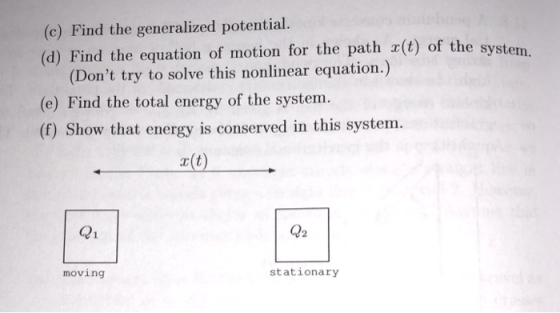
(c) Find the generalized potential. (d) Find the equation of motion for the path x(t) of the syst em (Don't try to solve this nonlinear equation.) (e) Find the total energy of the system (f) Show that energy is conserved in this system. t) Q2 stationary moving
Homework Answers

Add Answer to:
11.9. As shown in the figure, an object of charge Q, and mass m moves near a stationary object wi...
A charged particle with mass M and charge q moves in the x – y plane....
 A charged particle with mass M and charge q moves in the x – y plane. There is a magnetic field of magnitude B in the z-direction and an electric field E in the x-direction. (a) Find the Lagrangian in a form where there is an ignorable coordinate. (b) Find the energy function. Is it energy? Is it conserved? Explain why. (c) Find and solve the equations of motion.
Consider a system of three charges shown in (Figure 1). An object with charge q4 =...
 Consider a system of three charges shown in (Figure 1). An
object with charge q4 = +7.0×10⁻⁹C is moved to position C
from infinity (not shown in the figure). q1 = q2
= q3 = +10.0×10⁻⁸C.
A) Determine the initial electric potential energy of the system
consisting of all four charges. B) Determine the final electric
potential energy of the system consisting of all four charges. C)
Determine the work done on the system by moving the charge
q4 from...
Consider a system of three charges shown in (Figure 1). An
object with charge q4 = +7.0×10⁻⁹C is moved to position C
from infinity (not shown in the figure). q1 = q2
= q3 = +10.0×10⁻⁸C.
A) Determine the initial electric potential energy of the system
consisting of all four charges. B) Determine the final electric
potential energy of the system consisting of all four charges. C)
Determine the work done on the system by moving the charge
q4 from...
Consider a system of three charges shown in (Figure 1).An object with charge q4 = +6.0×10⁻⁹C...
 Consider a system of three charges shown in (Figure 1).An object
with charge q4 = +6.0×10⁻⁹C is moved to position C from infinity
(not shown in the figure). q1 = q2 = q3 = +10.0×10⁻⁸C. a.
Determine the initial electric potential energy of the system
consisting of all four charges. b.
Determine the final electric potential energy of the system
consisting of all four charges.
c. Determine the work done on the system by moving the charge q4
from infinity...
Consider a system of three charges shown in (Figure 1).An object
with charge q4 = +6.0×10⁻⁹C is moved to position C from infinity
(not shown in the figure). q1 = q2 = q3 = +10.0×10⁻⁸C. a.
Determine the initial electric potential energy of the system
consisting of all four charges. b.
Determine the final electric potential energy of the system
consisting of all four charges.
c. Determine the work done on the system by moving the charge q4
from infinity...
+A A d Gambarajah 3/Figure 3 Question 3 Two very long wires, carrying free charge, of...
 +A A d Gambarajah 3/Figure 3 Question 3 Two very long wires, carrying free charge, of equal but opposite charge densities, 2. of +0.4 nC/m, are placed parallel to each other (Figure 3). Each wire has a diameter of 2 mm and they are separated by a distance d, of 1.0 cm. The distance d is measured from the centre point of each wire. You may assume the charge distributions on the wires are the same as if they were...
A point charge of mass m = 9x10 ^ -31 kg and load + q =...
A point charge of mass m = 9x10 ^ -31 kg and load + q = 1.62 × 10 ^ -19C is released from rest in an electric field E generated by two plates, separated by a distance of 20 mm a) Draw the electric field lines b) Find the v (t) of the load + q c) Find the kinetic energy of + q d) Find the same result of the number c) using the work and energy theorem...
A 0.45 kg object rests on a frictionless horizontal surface, where it is attached to a...
 A 0.45 kg object rests on a frictionless horizontal surface, where it is attached to a massless spring whose k-value equals 24.0 N/m. Let x be the displacement, where x = o is the equilibrium position and x > 0 when the spring is stretched. The object is pushed, and the spring compressed, until хі =-4.00 cm. It then is released from rest and undergoes simple harmonic motion. (a) What is the object's maximum speed (in m/s) after it is...
2) In figure, a top view of a solid conducting cylinder with radius a - 1 em, whose center is at ...
 2) In figure, a top view of a solid conducting cylinder with radius a - 1 em, whose center is at the origin of the coordinate system and +z axis is towards out of page. It is concentric with a hollow cylindrical conductor of inner radius b 3 cm and outer radius c 5 cm. Both cylinders have L-5 m lengths which can be assumed to be infinitely long since L > c. The solid cylinder has total net charge...
A block having mass m and charge +Q is connected to an insulating spring having a force constant k.
 A block having mass m and charge +Q is connected to an insulating spring having a force constant k. The block lies on a frictionless, insulating, horizontal track, and the system is immersed In a uniform electric field of magnitude E directed as shown in the figure below. The block Is released from rest when the spring Is unstretched (at x = 0). We wish to show that the ensuing motion of the block is simple harmonic. (a) Consider the system...
A 0.45 kg object rests on a frictionless horizontal surface, where it is attached to a...
 A 0.45 kg object rests on a frictionless horizontal surface, where it is attached to a massless spring whose k-value equals 24.0 N/m. Let x be the displacement, where x = 0 is the equilibrium position and x > 0 when the spring is stretched. The object is pushed, and the spring compressed, until x, =-4.00 cm. It then is released from rest and undergoes simple harmonic motion. (a) What is the object's maximum speed (in m/s) after it is...
In the coordinate system shown at right, particle l with charge q1 = q where q = 5.6 μC, is located at coordinates (-a, 0) m, where a=7.4 m
 In the coordinate system shown at right, particle l with charge q1 = q where q = 5.6 μC, is located at coordinates (-a, 0) m, where a=7.4 m; particle 2 with charge q2 = 2q is located at coordinates (a, 0); particle 3 with charge q3=q is located at coordinates (0, a)Part (a) Enter an expression for the electric potential at the origin, V0, using the given symbolsPart (b) Solve for the numerical value of V0 in voltsPart (c)...
 A charged particle with mass M and charge q moves in the x – y plane. There is a magnetic field of magnitude B in the z-direction and an electric field E in the x-direction. (a) Find the Lagrangian in a form where there is an ignorable coordinate. (b) Find the energy function. Is it energy? Is it conserved? Explain why. (c) Find and solve the equations of motion.
 Consider a system of three charges shown in (Figure 1). An
object with charge q4 = +7.0×10⁻⁹C is moved to position C
from infinity (not shown in the figure). q1 = q2
= q3 = +10.0×10⁻⁸C.
A) Determine the initial electric potential energy of the system
consisting of all four charges. B) Determine the final electric
potential energy of the system consisting of all four charges. C)
Determine the work done on the system by moving the charge
q4 from...
Consider a system of three charges shown in (Figure 1). An
object with charge q4 = +7.0×10⁻⁹C is moved to position C
from infinity (not shown in the figure). q1 = q2
= q3 = +10.0×10⁻⁸C.
A) Determine the initial electric potential energy of the system
consisting of all four charges. B) Determine the final electric
potential energy of the system consisting of all four charges. C)
Determine the work done on the system by moving the charge
q4 from...
 Consider a system of three charges shown in (Figure 1).An object
with charge q4 = +6.0×10⁻⁹C is moved to position C from infinity
(not shown in the figure). q1 = q2 = q3 = +10.0×10⁻⁸C. a.
Determine the initial electric potential energy of the system
consisting of all four charges. b.
Determine the final electric potential energy of the system
consisting of all four charges.
c. Determine the work done on the system by moving the charge q4
from infinity...
Consider a system of three charges shown in (Figure 1).An object
with charge q4 = +6.0×10⁻⁹C is moved to position C from infinity
(not shown in the figure). q1 = q2 = q3 = +10.0×10⁻⁸C. a.
Determine the initial electric potential energy of the system
consisting of all four charges. b.
Determine the final electric potential energy of the system
consisting of all four charges.
c. Determine the work done on the system by moving the charge q4
from infinity...
 +A A d Gambarajah 3/Figure 3 Question 3 Two very long wires, carrying free charge, of equal but opposite charge densities, 2. of +0.4 nC/m, are placed parallel to each other (Figure 3). Each wire has a diameter of 2 mm and they are separated by a distance d, of 1.0 cm. The distance d is measured from the centre point of each wire. You may assume the charge distributions on the wires are the same as if they were...
 A 0.45 kg object rests on a frictionless horizontal surface, where it is attached to a massless spring whose k-value equals 24.0 N/m. Let x be the displacement, where x = o is the equilibrium position and x > 0 when the spring is stretched. The object is pushed, and the spring compressed, until хі =-4.00 cm. It then is released from rest and undergoes simple harmonic motion. (a) What is the object's maximum speed (in m/s) after it is...
 2) In figure, a top view of a solid conducting cylinder with radius a - 1 em, whose center is at the origin of the coordinate system and +z axis is towards out of page. It is concentric with a hollow cylindrical conductor of inner radius b 3 cm and outer radius c 5 cm. Both cylinders have L-5 m lengths which can be assumed to be infinitely long since L > c. The solid cylinder has total net charge...
 A 0.45 kg object rests on a frictionless horizontal surface, where it is attached to a massless spring whose k-value equals 24.0 N/m. Let x be the displacement, where x = 0 is the equilibrium position and x > 0 when the spring is stretched. The object is pushed, and the spring compressed, until x, =-4.00 cm. It then is released from rest and undergoes simple harmonic motion. (a) What is the object's maximum speed (in m/s) after it is...
Most questions answered within 3 hours.
-
Where is the error in this code sequence?
String s1 = "Hello";
String s2 = "ello";...
asked 11 months ago -
Financial data for Joel de Paris, Inc., for last year
follow:
Joel de Paris, Inc.
Balance...
asked 11 months ago -
Consider this reaction:
Al2(SO4)3 (aq)+ BaCl3
(aq) Al2Cl6 (aq)- +
3BaSO4(s) . What is the...
asked 11 months ago -
Suppose that Savneet is considering increasing her
recent random sample from 20 car rentals to 40...
asked 11 months ago -
Trucks arrive at an unloading terminal at an average rate of 120
per hour.
Trucks arrive...
asked 11 months ago -
Why are methanol and ethanol completely soluble in water while
octanol is not very little soluble....
asked 11 months ago -
A facilities manager at a university reads in a research report
that the mean amount of...
asked 11 months ago -
When the CuSO4 is rehydrated by adding water to the anhydrous
compound, is this an endothermic...
asked 11 months ago -
A ray of sunlight is passing from diamond into crown glass; the
angle of incidence is...
asked 11 months ago -
A block of mass 0.249 kg is placed on top of a light, vertical
spring of...
asked 11 months ago -
how do the kidneys compensate in the presences of acidosis
a) trigger hyperventilate
b) reserve acid...
asked 11 months ago -
Question 501 pts
The rental rate of capital to the firm increases. Which of the
following...
asked 11 months ago