
Homework Answers
Add Answer to:
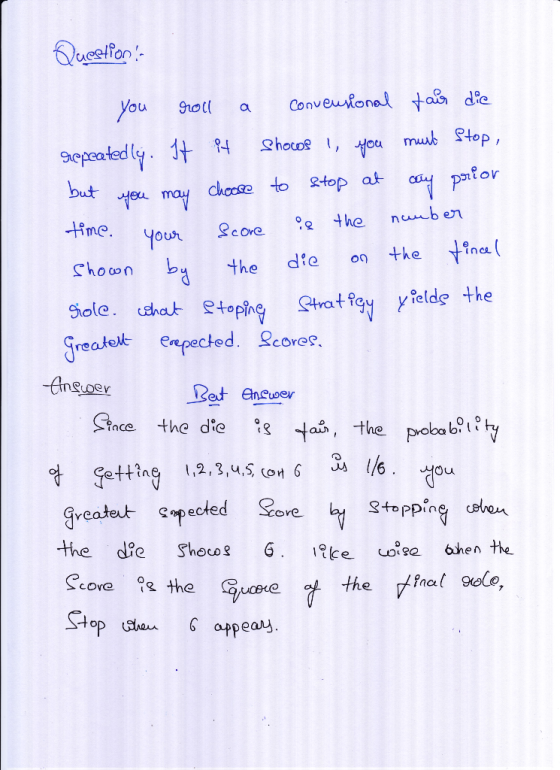
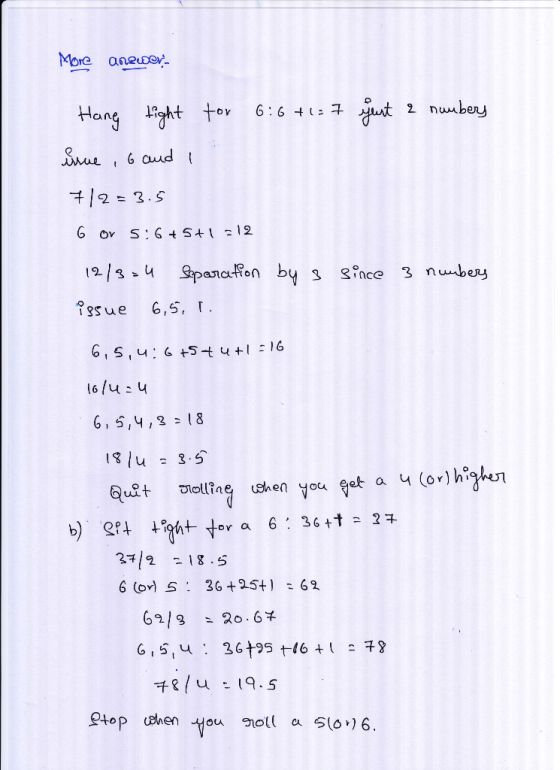
10. You roll a fair die repeatedly. If it shows 1, you must stop, but you may choose to stop at a...
A fair 20-sided die is rolled repeatedly, until a gambler decides to stop. The gambler pays...
A fair 20-sided die is rolled repeatedly, until a gambler decides to stop. The gambler pays $1 per roll, and receives the amount shown on the die when the gambler stops (e.g., if the die is rolled 7 times and the gambler decides to stop then, with an 18 as the value of the last roll, then the net payo↵ is $18 $7 = $11). Suppose the gambler uses the following strategy: keep rolling until a value of m or...
Suppose that in a certain game you roll a die, and get winnings equal to $100...
Suppose that in a certain game you roll a die, and get winnings equal to $100 times the amount shown on the die. If you want to, you can roll again up to a total of three times. However, each time you roll again, you forfeit your previous winnings. You decide to take the following strategy: choose a number i, and if you ever get i or above, stop and collect your winnings, otherwise roll again. What is the value...
suppose you only have one fair 6-sided die. We will say that a success is if you roll a 5 or a 6. You roll the die over...
suppose you only have one fair 6-sided die. We will say that a success is if you roll a 5 or a 6. You roll the die over and over until you roll two successes in a row. What is the the expected number of times you must roll before you stop?
In a game of repeated die rolls, a player is allowed to roll a standard die...
 In a game of repeated die rolls, a player is allowed to roll a
standard die up to n times, where n is determined prior to the
start of the game. On any roll except the last, the player may
choose to either keep that roll as their final score, or continue
rolling in hopes of a higher roll later on. If the player rolls all
n times, then after the nth roll, the player must keep that roll
as...
In a game of repeated die rolls, a player is allowed to roll a
standard die up to n times, where n is determined prior to the
start of the game. On any roll except the last, the player may
choose to either keep that roll as their final score, or continue
rolling in hopes of a higher roll later on. If the player rolls all
n times, then after the nth roll, the player must keep that roll
as...
Consider the setting where you first roll a fair 6-sided die, and then you flip a...
Consider the setting where you first roll a fair 6-sided die, and then you flip a fair coin the number of times shown by the die. Let D refer to the outcome of the die roll (i.e., number of coin flips) and let H refer to the number of heads observed after D coin flips. (a) Suppose the outcome of rolling the fair 6-sided die is d. Determine E[H|d] and Var(H|d). (b) Determine E[H] and Var(H).
Question 3 3 pts Matching problem [Choose] You roll a fair six-sided die 500 times and...
 Question 3 3 pts Matching problem [Choose] You roll a fair six-sided die 500 times and observe a 3 on 90 of the 500 rolls. You estimate the probability of rolling a 3 to be 0.18 Choose) You roll a fair six-sided die 10 times and observe a 3 on all 10 rolls. You bet the probability of rolling a 3 on the next rollis close to O since you have already had 10 3's in a row You assign...
The Die is Cast: Imagine a fair die with six faces numbered 1,2,3,4,5,6. You will get...
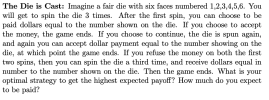 The Die is Cast: Imagine a fair die with six faces numbered 1,2,3,4,5,6. You will get to spin the die 3 times. After the first spin, you can choose to be paid dollars equal to the number shown on the die. If you choose to accept the money, the game ends. If you choose to continue, the die is spun again, and again you can accept dollar payment equal to the number showing on the die, at which point the...
Part 1 (3 points) Seet You have an eight-sided fair die. You can roll the die...
 Part 1 (3 points) Seet You have an eight-sided fair die. You can roll the die with a chance to win $100 if it lands on 1. The expected value of the gamble is $ Note: Round your answer to the nearest penny. Part 2 (3 points) See Hint Suppose that you're given a choice between a sure $7.50 and the gamble described in Part 1. Which of the following is most likely to be true? Choose one: O A....
You and your opponent both roll a fair die. If you both roll the same number,...
You and your opponent both roll a fair die. If you both roll the same number, the game is repeated, otherwise whoever rolls the larger number wins. Let N be the number of times the two dice have to be rolled before the game is decided. (d) Assume that you get paid $10 for winning in the first round, $1 for winning in any other round, and nothing otherwise. Compute your expected winnings. Answer: (d) You get paid $10 with...
(1 point) You are to roll a fair die n = 104 times, each time observing the number of dots appearing on the topside of...
 (1 point) You are to roll a fair die n = 104 times, each time observing the number of dots appearing on the topside of the die. The number of dots showing on the topside of toss i is a random variable represented by Xi, i = 1,2, ..., 104 (a) Consider the distribution of the random variable Xi. Find the mean and the standard deviation of the number of dots showing on the uppermost face of a single roll...
 In a game of repeated die rolls, a player is allowed to roll a
standard die up to n times, where n is determined prior to the
start of the game. On any roll except the last, the player may
choose to either keep that roll as their final score, or continue
rolling in hopes of a higher roll later on. If the player rolls all
n times, then after the nth roll, the player must keep that roll
as...
In a game of repeated die rolls, a player is allowed to roll a
standard die up to n times, where n is determined prior to the
start of the game. On any roll except the last, the player may
choose to either keep that roll as their final score, or continue
rolling in hopes of a higher roll later on. If the player rolls all
n times, then after the nth roll, the player must keep that roll
as...
 Question 3 3 pts Matching problem [Choose] You roll a fair six-sided die 500 times and observe a 3 on 90 of the 500 rolls. You estimate the probability of rolling a 3 to be 0.18 Choose) You roll a fair six-sided die 10 times and observe a 3 on all 10 rolls. You bet the probability of rolling a 3 on the next rollis close to O since you have already had 10 3's in a row You assign...
 The Die is Cast: Imagine a fair die with six faces numbered 1,2,3,4,5,6. You will get to spin the die 3 times. After the first spin, you can choose to be paid dollars equal to the number shown on the die. If you choose to accept the money, the game ends. If you choose to continue, the die is spun again, and again you can accept dollar payment equal to the number showing on the die, at which point the...
 Part 1 (3 points) Seet You have an eight-sided fair die. You can roll the die with a chance to win $100 if it lands on 1. The expected value of the gamble is $ Note: Round your answer to the nearest penny. Part 2 (3 points) See Hint Suppose that you're given a choice between a sure $7.50 and the gamble described in Part 1. Which of the following is most likely to be true? Choose one: O A....
 (1 point) You are to roll a fair die n = 104 times, each time observing the number of dots appearing on the topside of the die. The number of dots showing on the topside of toss i is a random variable represented by Xi, i = 1,2, ..., 104 (a) Consider the distribution of the random variable Xi. Find the mean and the standard deviation of the number of dots showing on the uppermost face of a single roll...
Most questions answered within 3 hours.
-
Where is the error in this code sequence?
String s1 = "Hello";
String s2 = "ello";...
asked 11 months ago -
Financial data for Joel de Paris, Inc., for last year
follow:
Joel de Paris, Inc.
Balance...
asked 11 months ago -
Consider this reaction:
Al2(SO4)3 (aq)+ BaCl3
(aq) Al2Cl6 (aq)- +
3BaSO4(s) . What is the...
asked 11 months ago -
Suppose that Savneet is considering increasing her
recent random sample from 20 car rentals to 40...
asked 11 months ago -
Trucks arrive at an unloading terminal at an average rate of 120
per hour.
Trucks arrive...
asked 11 months ago -
Why are methanol and ethanol completely soluble in water while
octanol is not very little soluble....
asked 11 months ago -
A facilities manager at a university reads in a research report
that the mean amount of...
asked 11 months ago -
When the CuSO4 is rehydrated by adding water to the anhydrous
compound, is this an endothermic...
asked 11 months ago -
A ray of sunlight is passing from diamond into crown glass; the
angle of incidence is...
asked 11 months ago -
A block of mass 0.249 kg is placed on top of a light, vertical
spring of...
asked 11 months ago -
how do the kidneys compensate in the presences of acidosis
a) trigger hyperventilate
b) reserve acid...
asked 11 months ago -
Question 501 pts
The rental rate of capital to the firm increases. Which of the
following...
asked 11 months ago