Please help with the following continuous and discreet problem! Thanks!

Homework Answers

Add Answer to:
6. Using the definition compute the inverse DTFT for the following signal (2m + 1)π NE
how to derive the underlying signal x(t) using the definition of the Inverse Fourier transform Inverse Fourier Transforms by Definition Plot the following spectra and using the definition of the i...
 how to derive the underlying signal x(t) using the
definition of the Inverse Fourier transform
Inverse Fourier Transforms by Definition Plot the following spectra and using the definition of the inverse Fourier transform, derive the underlying signal z(t). 1. Fał(w) w rect(w/wo) 2. Ffa) cos(w) rect (w/T)
Inverse Fourier Transforms by Definition Plot the following spectra and using the definition of the inverse Fourier transform, derive the underlying signal z(t). 1. Fał(w) w rect(w/wo) 2. Ffa) cos(w) rect (w/T)
how to derive the underlying signal x(t) using the
definition of the Inverse Fourier transform
Inverse Fourier Transforms by Definition Plot the following spectra and using the definition of the inverse Fourier transform, derive the underlying signal z(t). 1. Fał(w) w rect(w/wo) 2. Ffa) cos(w) rect (w/T)
Inverse Fourier Transforms by Definition Plot the following spectra and using the definition of the inverse Fourier transform, derive the underlying signal z(t). 1. Fał(w) w rect(w/wo) 2. Ffa) cos(w) rect (w/T)
Consider the signal f[k] illustrated below 3 2 1 (a) Using the definition, provide the DTFT of flk]. (b) Express f [kas a rect function. Use the DTFT pair to solve for the DTFT (it should look a lot...
 Consider the signal f[k] illustrated below 3 2 1 (a) Using the definition, provide the DTFT of flk]. (b) Express f [kas a rect function. Use the DTFT pair to solve for the DTFT (it should look a lot different from the previous solution) c) Verify that both of your solutions are, in actuality, the same by evaluating them at 0, T/2, T
Consider the signal f[k] illustrated below 3 2 1 (a) Using the definition, provide the DTFT of...
Consider the signal f[k] illustrated below 3 2 1 (a) Using the definition, provide the DTFT of flk]. (b) Express f [kas a rect function. Use the DTFT pair to solve for the DTFT (it should look a lot different from the previous solution) c) Verify that both of your solutions are, in actuality, the same by evaluating them at 0, T/2, T
Consider the signal f[k] illustrated below 3 2 1 (a) Using the definition, provide the DTFT of...
Using the course Matlab dtft function compute the magnitude, and phase for the following discrete-time signal...
 Using the course Matlab dtft function compute the magnitude, and phase for the following discrete-time signal а) x(п) -п(09)[«(п)-и (п-21)] F [(a) -и (п- 40)] b) x (п) - =coS n 10 4 u --
Using the course Matlab dtft function compute the magnitude, and phase for the following discrete-time signal а) x(п) -п(09)[«(п)-и (п-21)] F [(a) -и (п- 40)] b) x (п) - =coS n 10 4 u --
Using the course Matlab dtft function compute the magnitude, and phase for the following discrete-time signal а) x(п) -п(09)[«(п)-и (п-21)] F [(a) -и (п- 40)] b) x (п) - =coS n 10 4 u --
please solve (a) and (b) 10.2-1 For the following signals, find the DTFT directly, using the...
 please solve (a) and (b)
10.2-1 For the following signals, find the DTFT directly, using the definition in Eq. (10.31). (a) f(k] = 6{k] (b) 8[k – ko] (c) a*u[k – 1] lal<1 (d) f[k] = a*u[k + 1) |a| < 1. In each case, sketch the signal and its amplitude spectrum. Sketch phase spectra for parts (a) and (b) only. %3D
please solve (a) and (b)
10.2-1 For the following signals, find the DTFT directly, using the definition in Eq. (10.31). (a) f(k] = 6{k] (b) 8[k – ko] (c) a*u[k – 1] lal<1 (d) f[k] = a*u[k + 1) |a| < 1. In each case, sketch the signal and its amplitude spectrum. Sketch phase spectra for parts (a) and (b) only. %3D
Problem 4.1 Using the course Matlab dtft function compute the magnitude, and phase for the following...
 Problem 4.1 Using the course Matlab dtft function compute the magnitude, and phase for the following discrete-time signal: a) x(n)=n(0.9)" [u(n)-u(n–21)] b) x(n) = cosTo» - 4 ][(n) – u (n – 40)]
Problem 2: DTFT [25 points] Consider the following signal: an] - (0.4)1-uln-1+0.46n -2] a) Find the...
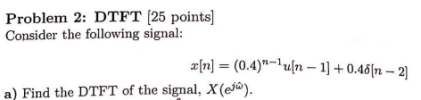 Problem 2: DTFT [25 points] Consider the following signal: an] - (0.4)1-uln-1+0.46n -2] a) Find the DTFT of the signal, X(eo
Problem 2 (40 points) Suppose that the modulating (message) signal is m(t)-500si ne(4000πt) and the carrier frequency is o20000x rad/s (see the definition of the sinc function at the bottom of the ne...
 Problem 2 (40 points) Suppose that the modulating (message) signal is m(t)-500si ne(4000πt) and the carrier frequency is o20000x rad/s (see the definition of the sinc function at the bottom of the next page). a) Write the mathematical expression of M(o) and sketch it (label the axes carefully). Let qDSB-Sc (t)-2m(t)cos.. Write the mathematical expression of φ)DSB-SC(w) and sketch it (label the axes carefully). b) c) Suppress the USB in the DSB-SC spectrum you sketched in (b) to find the...
Lab #2 Discrete-time Fourier Transform (DTFT) OBJECTIVES: • Explore the DTFT, its meanings and concepts. •...
Lab #2 Discrete-time Fourier Transform (DTFT) OBJECTIVES: • Explore the DTFT, its meanings and concepts. • Get acquainted with Matlab/Octave 1) Start MATLAB and change the “Current Directory” in the top of the window (or type) >> cd '' (example: >> cd 'C:\NIU\lab2') Alternatively, if you don't want to use MATLAB, you can open a web-browser and go to “octave-online.net”. 2) Download and execute LAB2forStudent_A.M with >> lab2forStudent_A and observe that it produces a Discrete-Time (DT) signal xVec. 3) TO...
(a) Determine the Fourier transform of x(t) 26(t-1)-6(t-3) (b) Compute the convolution sum of the following signals, (6%) [696] (c) The Fourier transform of a continuous-time signal a(t) is given bel...
 (a) Determine the Fourier transform of x(t) 26(t-1)-6(t-3) (b) Compute the convolution sum of the following signals, (6%) [696] (c) The Fourier transform of a continuous-time signal a(t) is given below. Determine the [696] total energy of (t) 4 sin w (d) Determine the DC value and the average power of the following periodic signal. (6%) 0.5 0.5 (e) Determine the Nyquist rate for the following signal. (6%) x(t) = [1-0.78 cos(50nt + π/4)]2. (f) Sketch the frequency spectrum of...
The given input signal for 2.7.2 is: x(t) = 3 cos(2 π t) + 6 sin(5 π t). Plz explain ...
 The given input signal for 2.7.2 is: x(t) = 3 cos(2
π t) + 6 sin(5 π t).Plz explain steps.Given a causal LTI system described by the differential equation find \(H(s),\) the \(\mathrm{ROC}\) of \(H(s),\) and the impulse response \(h(t)\) of the system. Classify the system as stable/unstable. List the poles of \(H(s) .\) You should the Matlab residue command for this problem.(a) \(y^{\prime \prime \prime}+3 y^{\prime \prime}+2 y^{\prime}=x^{\prime \prime}+6 x^{\prime}+6 x\)2.7.2 The signal \(x(t)\) in the previous problem is...
The given input signal for 2.7.2 is: x(t) = 3 cos(2
π t) + 6 sin(5 π t).Plz explain steps.Given a causal LTI system described by the differential equation find \(H(s),\) the \(\mathrm{ROC}\) of \(H(s),\) and the impulse response \(h(t)\) of the system. Classify the system as stable/unstable. List the poles of \(H(s) .\) You should the Matlab residue command for this problem.(a) \(y^{\prime \prime \prime}+3 y^{\prime \prime}+2 y^{\prime}=x^{\prime \prime}+6 x^{\prime}+6 x\)2.7.2 The signal \(x(t)\) in the previous problem is...
 how to derive the underlying signal x(t) using the
definition of the Inverse Fourier transform
Inverse Fourier Transforms by Definition Plot the following spectra and using the definition of the inverse Fourier transform, derive the underlying signal z(t). 1. Fał(w) w rect(w/wo) 2. Ffa) cos(w) rect (w/T)
Inverse Fourier Transforms by Definition Plot the following spectra and using the definition of the inverse Fourier transform, derive the underlying signal z(t). 1. Fał(w) w rect(w/wo) 2. Ffa) cos(w) rect (w/T)
how to derive the underlying signal x(t) using the
definition of the Inverse Fourier transform
Inverse Fourier Transforms by Definition Plot the following spectra and using the definition of the inverse Fourier transform, derive the underlying signal z(t). 1. Fał(w) w rect(w/wo) 2. Ffa) cos(w) rect (w/T)
Inverse Fourier Transforms by Definition Plot the following spectra and using the definition of the inverse Fourier transform, derive the underlying signal z(t). 1. Fał(w) w rect(w/wo) 2. Ffa) cos(w) rect (w/T)
 Consider the signal f[k] illustrated below 3 2 1 (a) Using the definition, provide the DTFT of flk]. (b) Express f [kas a rect function. Use the DTFT pair to solve for the DTFT (it should look a lot different from the previous solution) c) Verify that both of your solutions are, in actuality, the same by evaluating them at 0, T/2, T
Consider the signal f[k] illustrated below 3 2 1 (a) Using the definition, provide the DTFT of...
Consider the signal f[k] illustrated below 3 2 1 (a) Using the definition, provide the DTFT of flk]. (b) Express f [kas a rect function. Use the DTFT pair to solve for the DTFT (it should look a lot different from the previous solution) c) Verify that both of your solutions are, in actuality, the same by evaluating them at 0, T/2, T
Consider the signal f[k] illustrated below 3 2 1 (a) Using the definition, provide the DTFT of...
 Using the course Matlab dtft function compute the magnitude, and phase for the following discrete-time signal а) x(п) -п(09)[«(п)-и (п-21)] F [(a) -и (п- 40)] b) x (п) - =coS n 10 4 u --
Using the course Matlab dtft function compute the magnitude, and phase for the following discrete-time signal а) x(п) -п(09)[«(п)-и (п-21)] F [(a) -и (п- 40)] b) x (п) - =coS n 10 4 u --
Using the course Matlab dtft function compute the magnitude, and phase for the following discrete-time signal а) x(п) -п(09)[«(п)-и (п-21)] F [(a) -и (п- 40)] b) x (п) - =coS n 10 4 u --
 please solve (a) and (b)
10.2-1 For the following signals, find the DTFT directly, using the definition in Eq. (10.31). (a) f(k] = 6{k] (b) 8[k – ko] (c) a*u[k – 1] lal<1 (d) f[k] = a*u[k + 1) |a| < 1. In each case, sketch the signal and its amplitude spectrum. Sketch phase spectra for parts (a) and (b) only. %3D
please solve (a) and (b)
10.2-1 For the following signals, find the DTFT directly, using the definition in Eq. (10.31). (a) f(k] = 6{k] (b) 8[k – ko] (c) a*u[k – 1] lal<1 (d) f[k] = a*u[k + 1) |a| < 1. In each case, sketch the signal and its amplitude spectrum. Sketch phase spectra for parts (a) and (b) only. %3D
 Problem 4.1 Using the course Matlab dtft function compute the magnitude, and phase for the following discrete-time signal: a) x(n)=n(0.9)" [u(n)-u(n–21)] b) x(n) = cosTo» - 4 ][(n) – u (n – 40)]
 Problem 2: DTFT [25 points] Consider the following signal: an] - (0.4)1-uln-1+0.46n -2] a) Find the DTFT of the signal, X(eo
 Problem 2 (40 points) Suppose that the modulating (message) signal is m(t)-500si ne(4000πt) and the carrier frequency is o20000x rad/s (see the definition of the sinc function at the bottom of the next page). a) Write the mathematical expression of M(o) and sketch it (label the axes carefully). Let qDSB-Sc (t)-2m(t)cos.. Write the mathematical expression of φ)DSB-SC(w) and sketch it (label the axes carefully). b) c) Suppress the USB in the DSB-SC spectrum you sketched in (b) to find the...
 (a) Determine the Fourier transform of x(t) 26(t-1)-6(t-3) (b) Compute the convolution sum of the following signals, (6%) [696] (c) The Fourier transform of a continuous-time signal a(t) is given below. Determine the [696] total energy of (t) 4 sin w (d) Determine the DC value and the average power of the following periodic signal. (6%) 0.5 0.5 (e) Determine the Nyquist rate for the following signal. (6%) x(t) = [1-0.78 cos(50nt + π/4)]2. (f) Sketch the frequency spectrum of...
 The given input signal for 2.7.2 is: x(t) = 3 cos(2
π t) + 6 sin(5 π t).Plz explain steps.Given a causal LTI system described by the differential equation find \(H(s),\) the \(\mathrm{ROC}\) of \(H(s),\) and the impulse response \(h(t)\) of the system. Classify the system as stable/unstable. List the poles of \(H(s) .\) You should the Matlab residue command for this problem.(a) \(y^{\prime \prime \prime}+3 y^{\prime \prime}+2 y^{\prime}=x^{\prime \prime}+6 x^{\prime}+6 x\)2.7.2 The signal \(x(t)\) in the previous problem is...
The given input signal for 2.7.2 is: x(t) = 3 cos(2
π t) + 6 sin(5 π t).Plz explain steps.Given a causal LTI system described by the differential equation find \(H(s),\) the \(\mathrm{ROC}\) of \(H(s),\) and the impulse response \(h(t)\) of the system. Classify the system as stable/unstable. List the poles of \(H(s) .\) You should the Matlab residue command for this problem.(a) \(y^{\prime \prime \prime}+3 y^{\prime \prime}+2 y^{\prime}=x^{\prime \prime}+6 x^{\prime}+6 x\)2.7.2 The signal \(x(t)\) in the previous problem is...
Most questions answered within 3 hours.
-
Where is the error in this code sequence?
String s1 = "Hello";
String s2 = "ello";...
asked 10 months ago -
Financial data for Joel de Paris, Inc., for last year
follow:
Joel de Paris, Inc.
Balance...
asked 10 months ago -
Consider this reaction:
Al2(SO4)3 (aq)+ BaCl3
(aq) Al2Cl6 (aq)- +
3BaSO4(s) . What is the...
asked 10 months ago -
Suppose that Savneet is considering increasing her
recent random sample from 20 car rentals to 40...
asked 10 months ago -
Trucks arrive at an unloading terminal at an average rate of 120
per hour.
Trucks arrive...
asked 10 months ago -
Why are methanol and ethanol completely soluble in water while
octanol is not very little soluble....
asked 10 months ago -
A facilities manager at a university reads in a research report
that the mean amount of...
asked 10 months ago -
When the CuSO4 is rehydrated by adding water to the anhydrous
compound, is this an endothermic...
asked 10 months ago -
A ray of sunlight is passing from diamond into crown glass; the
angle of incidence is...
asked 10 months ago -
A block of mass 0.249 kg is placed on top of a light, vertical
spring of...
asked 10 months ago -
how do the kidneys compensate in the presences of acidosis
a) trigger hyperventilate
b) reserve acid...
asked 10 months ago -
Question 501 pts
The rental rate of capital to the firm increases. Which of the
following...
asked 10 months ago