

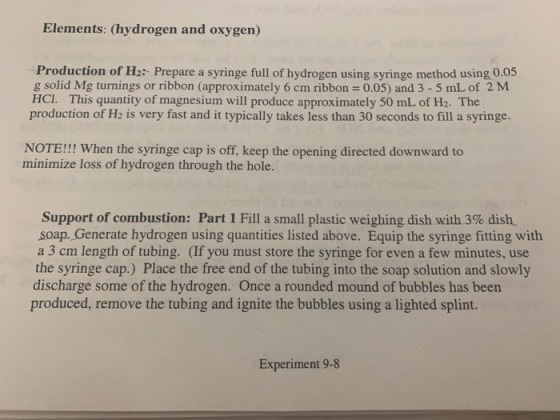
Hydride Degree of Effervescence Acid-Base Odor Support of Prepared NHs H2S Litmus Test Combustion n one No Rosia dous Support of Combustion Degree of Prepared Effervescence Color Oxide Acid-Base Litmus Test no odloNo low No change letu心sred CO2 SO2 oln No, and No neduun chlor ne adiee auidienone orine as prown Observations from lime water test Acid-Base Support of Litmus Test Combustion Odor Degree of Effervescence Element Prepared IlEne_ H hiah haん NO no 0aOUw | No Change Ind odow_ no odlaunJes No ChangeUrS
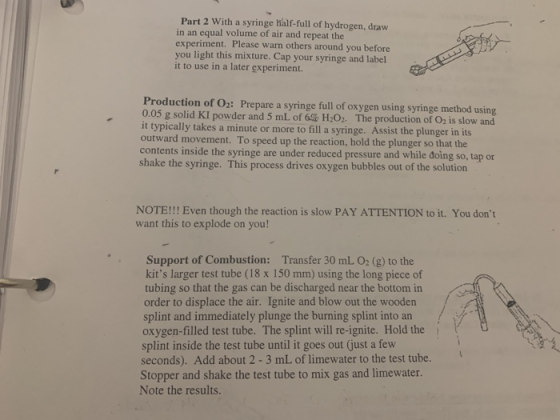
Part 2 With a syringe half-full of hydrogen, draw in an equal volume of air and repeat the experiment. Please warn others around you before you light this mixture. Cap your syringe and label it to use in a later experiment. Production of O2: Prepare a syringe full of oxygen using syringe method using 0.05 g solid KI powder and 5 mL of 6% H202. The production of O2 is slow and it typically takes a minute or more to fill a syringe. Assist the plunger in its outward movement. To speed up the reaction, hold the plunger so that the contents inside the syringe are under reduced pressure and while doing so, tap or shake the syringe. This process drives oxygen bubbles out of the solution NOTE!!! Even though the reaction is slow PAY ATTENTION to it. You don'v want this to explode on you! Support of Combustion: Transfer 30 mL O2 (g) to the kit's larger test tube (18 x 150 mm) using the long piece of tubing so that the gas can be discharged near the bottom in order to displace the air. Ignite and blow out the wooden splint and immediately plunge the burning splint into an oxygen-filled test tube. The splint will re-ignite. Hold the splint inside the test tube until it goes out (just a few seconds). Add about 2 -3 mL of limewater to the test tube. Stopper and shake the test tube to mix gas and limewater. Note the results.
Homework Answers
1) No candle cannot burn in carbon dioxide arhter it needs oxygen.Neither it burns nor it helps burning. It is a non combustible gas.
2) The flame go out in carbon dioxide environment, this is why can be used as fire extinguisher (as it neither burns nor help in burning rather)
3) Carbon dioxide is released to the bottom the cup, as it is heavier than air and hence is collected by upward displacement of air.
Add Answer to:
Suplementary Questions Carbon Dioxide Conclusions 1. Can a candle burn in carbon dioxide? Does ca...
Postlab Questions 1. The gas formed in the test tube by the reaction of hydrochloric acid...
Postlab Questions 1. The gas formed in the test tube by the reaction of hydrochloric acid and sodium sulfite was sulfur dioxide, SO2. The other products formed were water and NaCl(aq). Write a balanced equation for the reaction that produced SO2. a. What effect did this gas have on the acidity of the distilled water placed inside the plastic bag? Support your answer with data. b. Write a chemical equation that shows how "acid rain" was produced from SO2 inside...
(4 pts) (4 pts) (4 pts) (1 pts) 5. Calculations 6. Conclusions 7. Post lab Questions...
 (4 pts) (4 pts) (4 pts) (1 pts) 5. Calculations 6. Conclusions 7. Post lab Questions 8. TA signature POST LAB QUESTIONS: 1. Why do we add methanol to the reaction if we see a purple ring? 2. What reaction is occurring with the methanol (show reaction)? Does this reactior affect your product? 3. Why do you get a precipitate when adding the HCl to make the solution acidic? Exp 8-5 Experiment 8: Preparation of Adipic Acid from Cyclohexene Oxidation...
Create graphs for Figures 1-4 (circled on pages 111 & 114) based on the data given in Tables ...
 Create graphs for Figures 1-4 (circled on pages 111 & 114)
based on the data given in Tables 2 & 4.
Lab # 8 Cellular Respiration and Fermentation I. Goals and Objectives At the completion of this laboratory exercise, students will be able to: A Differentiate between the intermediates and products of fermentation versus acrobic cellular respiration in yeast. Relate rates of fermentation with sugar availability in yeast. Utilize a reduction-oxidation dye to determine the effect of varying yeast concentration...
Create graphs for Figures 1-4 (circled on pages 111 & 114)
based on the data given in Tables 2 & 4.
Lab # 8 Cellular Respiration and Fermentation I. Goals and Objectives At the completion of this laboratory exercise, students will be able to: A Differentiate between the intermediates and products of fermentation versus acrobic cellular respiration in yeast. Relate rates of fermentation with sugar availability in yeast. Utilize a reduction-oxidation dye to determine the effect of varying yeast concentration...
 (4 pts) (4 pts) (4 pts) (1 pts) 5. Calculations 6. Conclusions 7. Post lab Questions 8. TA signature POST LAB QUESTIONS: 1. Why do we add methanol to the reaction if we see a purple ring? 2. What reaction is occurring with the methanol (show reaction)? Does this reactior affect your product? 3. Why do you get a precipitate when adding the HCl to make the solution acidic? Exp 8-5 Experiment 8: Preparation of Adipic Acid from Cyclohexene Oxidation...
 Create graphs for Figures 1-4 (circled on pages 111 & 114)
based on the data given in Tables 2 & 4.
Lab # 8 Cellular Respiration and Fermentation I. Goals and Objectives At the completion of this laboratory exercise, students will be able to: A Differentiate between the intermediates and products of fermentation versus acrobic cellular respiration in yeast. Relate rates of fermentation with sugar availability in yeast. Utilize a reduction-oxidation dye to determine the effect of varying yeast concentration...
Create graphs for Figures 1-4 (circled on pages 111 & 114)
based on the data given in Tables 2 & 4.
Lab # 8 Cellular Respiration and Fermentation I. Goals and Objectives At the completion of this laboratory exercise, students will be able to: A Differentiate between the intermediates and products of fermentation versus acrobic cellular respiration in yeast. Relate rates of fermentation with sugar availability in yeast. Utilize a reduction-oxidation dye to determine the effect of varying yeast concentration...
Most questions answered within 3 hours.
-
Where is the error in this code sequence?
String s1 = "Hello";
String s2 = "ello";...
asked 11 months ago -
Financial data for Joel de Paris, Inc., for last year
follow:
Joel de Paris, Inc.
Balance...
asked 11 months ago -
Consider this reaction:
Al2(SO4)3 (aq)+ BaCl3
(aq) Al2Cl6 (aq)- +
3BaSO4(s) . What is the...
asked 11 months ago -
Suppose that Savneet is considering increasing her
recent random sample from 20 car rentals to 40...
asked 11 months ago -
Trucks arrive at an unloading terminal at an average rate of 120
per hour.
Trucks arrive...
asked 11 months ago -
Why are methanol and ethanol completely soluble in water while
octanol is not very little soluble....
asked 11 months ago -
A facilities manager at a university reads in a research report
that the mean amount of...
asked 11 months ago -
When the CuSO4 is rehydrated by adding water to the anhydrous
compound, is this an endothermic...
asked 11 months ago -
A ray of sunlight is passing from diamond into crown glass; the
angle of incidence is...
asked 11 months ago -
A block of mass 0.249 kg is placed on top of a light, vertical
spring of...
asked 11 months ago -
how do the kidneys compensate in the presences of acidosis
a) trigger hyperventilate
b) reserve acid...
asked 11 months ago -
Question 501 pts
The rental rate of capital to the firm increases. Which of the
following...
asked 11 months ago