
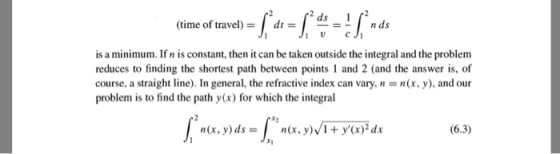
(time of traveldt- 1 U is a minimum. If n is constant, then it can be taken outside the integral and the problem reduces to finding the shortest path between points 1 and 2 (and the answer is, of course, a straight line). In general, the refractive index can vary, n = n(x, y), and our problem is to find the path y(x) for which the integral (6.3)
Homework Answers
Add Answer to:
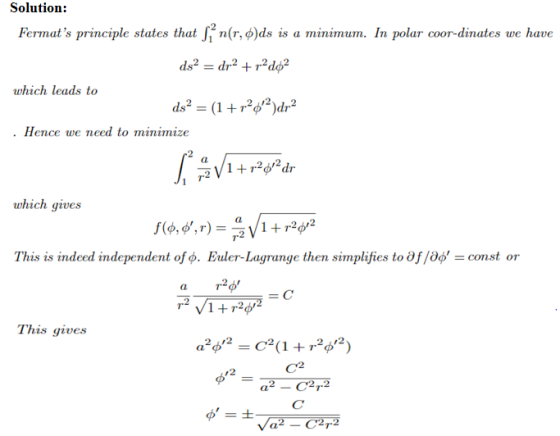
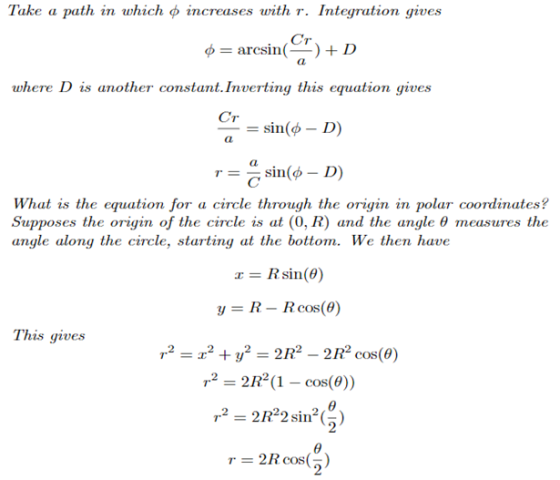
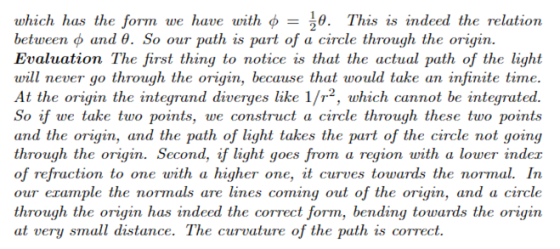
6.24Consider a medium in which the refractive index n is inversely proportional tor2: that is, n ...
[Polarizability and refractive index Questions] Please help! Explain each one. 1. The refractive index, n of...
 [Polarizability and refractive index Questions]
Please help! Explain each one.
1. The refractive index, n of a pure liquid
sample:
a) is the ratio of the speed of light in the vacuum and that of the
liquid medium
b) depends on the concentration of the substance
c) depends on temperature and density
d) varies with the wavelength of the radiation source
e) a, b, and c are correct
2. In graph n² vs. χ (molar fraction of 1
component) you...
[Polarizability and refractive index Questions]
Please help! Explain each one.
1. The refractive index, n of a pure liquid
sample:
a) is the ratio of the speed of light in the vacuum and that of the
liquid medium
b) depends on the concentration of the substance
c) depends on temperature and density
d) varies with the wavelength of the radiation source
e) a, b, and c are correct
2. In graph n² vs. χ (molar fraction of 1
component) you...
13. A thin glass plate with the refractive index n has to surfaces which are not...
 13. A thin glass plate with the refractive index n has to surfaces which are not exactly parallel. In the interference image obtained in the reflected light under nearly nor- mal incident angles the distance between the dark stripes is found to be Ar. The wavelength is . Find the angle a between the plate surfaces. (1p) 14. Total internal reflection is observed in glass (n=1.5) and in water (n=1.33) at identical incidence angles. In which case the penetration depth...
 [Polarizability and refractive index Questions]
Please help! Explain each one.
1. The refractive index, n of a pure liquid
sample:
a) is the ratio of the speed of light in the vacuum and that of the
liquid medium
b) depends on the concentration of the substance
c) depends on temperature and density
d) varies with the wavelength of the radiation source
e) a, b, and c are correct
2. In graph n² vs. χ (molar fraction of 1
component) you...
[Polarizability and refractive index Questions]
Please help! Explain each one.
1. The refractive index, n of a pure liquid
sample:
a) is the ratio of the speed of light in the vacuum and that of the
liquid medium
b) depends on the concentration of the substance
c) depends on temperature and density
d) varies with the wavelength of the radiation source
e) a, b, and c are correct
2. In graph n² vs. χ (molar fraction of 1
component) you...
 13. A thin glass plate with the refractive index n has to surfaces which are not exactly parallel. In the interference image obtained in the reflected light under nearly nor- mal incident angles the distance between the dark stripes is found to be Ar. The wavelength is . Find the angle a between the plate surfaces. (1p) 14. Total internal reflection is observed in glass (n=1.5) and in water (n=1.33) at identical incidence angles. In which case the penetration depth...
Most questions answered within 3 hours.
-
Where is the error in this code sequence?
String s1 = "Hello";
String s2 = "ello";...
asked 11 months ago -
Financial data for Joel de Paris, Inc., for last year
follow:
Joel de Paris, Inc.
Balance...
asked 11 months ago -
Consider this reaction:
Al2(SO4)3 (aq)+ BaCl3
(aq) Al2Cl6 (aq)- +
3BaSO4(s) . What is the...
asked 11 months ago -
Suppose that Savneet is considering increasing her
recent random sample from 20 car rentals to 40...
asked 11 months ago -
Trucks arrive at an unloading terminal at an average rate of 120
per hour.
Trucks arrive...
asked 11 months ago -
Why are methanol and ethanol completely soluble in water while
octanol is not very little soluble....
asked 11 months ago -
A facilities manager at a university reads in a research report
that the mean amount of...
asked 11 months ago -
When the CuSO4 is rehydrated by adding water to the anhydrous
compound, is this an endothermic...
asked 11 months ago -
A ray of sunlight is passing from diamond into crown glass; the
angle of incidence is...
asked 11 months ago -
A block of mass 0.249 kg is placed on top of a light, vertical
spring of...
asked 11 months ago -
how do the kidneys compensate in the presences of acidosis
a) trigger hyperventilate
b) reserve acid...
asked 11 months ago -
Question 501 pts
The rental rate of capital to the firm increases. Which of the
following...
asked 11 months ago