please show work that is easy to UNDERSTAND

Homework Answers
Solution:
Given
Initial investment = $70,000
Straight line depreciation in each year = (Investment – Salvage) ÷ Life
= ($70,000 - $10,000) ÷ 5
= $12,000
After tax cash flows for first five years = -$4,500 - (-$4,500 - $12,000) × (1-0.50)
= -$4,500 + $8,250
= $3,750
After tax cash flows for subsequent five years = -$4,500 – (-$4,500 × 0.50)
= -$2,250
Net present value (NPV) is the difference between the present values of after tax cash flows and the initial investments.
NPV = {($3,750 × 3.7908) + (-$2,250 × 2.3538) + ($10,000 × 0.3855)} - $70,000
= {$14,215.5 -$5,296.05 + $3,855} - $70,000
= -$57,225.55
Equivalent annual cost = MARR (NPV) [(1 + MARR)^year / {(1 + MARR)^year -1}]
= 0.1(-$57,225.55) [(1.1)^10 / (1.1)^10 -1]
= -9,313.29
The annual equivalent revenue requirement would be $9,313.29
Add Answer to:
3. A machine is purchased for S70,000. Life is 10 years with a S 10,000 salvage. MARR is 10%, and...
Machine A was purchased last year for $10,000 and had an estimated market value of $1,900...
 Machine A was purchased last year for $10,000 and had an estimated market value of $1,900 at the end of its 6-year life. Annual operating costs are $1,450. The machine will perform satisfactorily for the next five years. A salesman for another company is offering Machine B for $59,000 with an market value of $5,900 after 5 years. Annual operating costs will be $1,050. Machine A could be sold now for $16,000, and MARR is 50% per year. Using the...
10) You buy a machine now for $10,000. The machine can be depreciated using DDB depreciation with 5 years useful life and $2,000 salvage value. Three years later you sell the machine for $1,000....
 10) You buy a machine now for $10,000. The machine can be depreciated using DDB depreciation with 5 years useful life and $2,000 salvage value. Three years later you sell the machine for $1,000. The annual net benefit is $8000. The inflation rate is 5% per year. The acceptable real after-tax rate of return after taking inflation into consideration is 10%. Combined incremental tax rate is 50%. Calculate PW of this investment a) $4102 b) $3654 c) $3181 d) $2706...
XYZ Company’s machine was purchased 5 years ago for $55,000. It had an expected life of...
XYZ Company’s machine was purchased 5 years ago for $55,000. It had an expected life of 10 years when it was bought, and its remaining depreciation is $5,500 per year for each year of its remaining life and can be sold for $20,000 at the end of its useful life. A new machine can be purchased for $120,000, including the installation costs. During its 5-year life, it will reduce cash operating expenses by $30,000 per year. Sales revenue will not...
YZ Company’s machine was purchased 5 years ago for $55,000. It had an expected life of...
YZ Company’s machine was purchased 5 years ago for $55,000. It had an expected life of 10 years when it was bought, and its remaining depreciation is $5,500 per year for each year of its remaining life and can be sold for $20,000 at the end of its useful life. A new machine can be purchased for $120,000, including the installation costs. During its 5-year life, it will reduce cash operating expenses by $30,000 per year. Sales revenue will not...
machine 1: cost 76,000 salvage value 6,000 useful life 10 years purchased 7/1/16 machine 2: cost...
 machine 1:
cost 76,000
salvage value 6,000
useful life 10 years
purchased 7/1/16
machine 2:
cost 80,000
salvage value 10,000
useful life 8 years
purchased 1/1/13
machine 3:
cost 78,000
salvage value 6,000
useful life 6 years = 24,000 hours
purchased 1/1/18
Problem: In recent years, Hrubeck Company purchased three machines. Because of heavy turnover in the accounting department, a different accountant was in charge of selecting the depreciation method for each machine, and various methods were selected. Information concerning...
machine 1:
cost 76,000
salvage value 6,000
useful life 10 years
purchased 7/1/16
machine 2:
cost 80,000
salvage value 10,000
useful life 8 years
purchased 1/1/13
machine 3:
cost 78,000
salvage value 6,000
useful life 6 years = 24,000 hours
purchased 1/1/18
Problem: In recent years, Hrubeck Company purchased three machines. Because of heavy turnover in the accounting department, a different accountant was in charge of selecting the depreciation method for each machine, and various methods were selected. Information concerning...
A current asset (defender) is being evaluated for potential replacement. it was purchased 4 years ago...
A current asset (defender) is being evaluated for potential replacement. it was purchased 4 years ago at a cost of 62,000. it has been depreciated as a MACRS (GDS) 5 year property class asset. The corresponding depreciation rates are 20%,32%,19.2%,11.52%,11.5%,and 5.76%. The present MV of the defender is 15,000. Its remaining useful life is estimated to be 4 years, but it will require additional repair worknow(a one time 3,700 expense) to provide continuing service equivalent to the challenger. the current...
5. (20 Points) A company purchased a machine for $50,000 that has an estimated salvage value of $10,000 at the end...
 5. (20 Points) A company purchased a machine for $50,000 that has an estimated salvage value of $10,000 at the end of 8 year useful life. Compute the depreciation table by (a) Straight Line method (b) MACRS method (7-year property) (e) If you want to sell the machine in 4th year what book value you will use? (d) What book value you will use to pay tax to IRS in 4th year?
5. (20 Points) A company purchased a machine...
5. (20 Points) A company purchased a machine for $50,000 that has an estimated salvage value of $10,000 at the end of 8 year useful life. Compute the depreciation table by (a) Straight Line method (b) MACRS method (7-year property) (e) If you want to sell the machine in 4th year what book value you will use? (d) What book value you will use to pay tax to IRS in 4th year?
5. (20 Points) A company purchased a machine...
•Original Machine –Initial cost = 100,000 –Annual depreciation = 9,000 –Purchased 5 years ago –Book Value...
•Original Machine –Initial cost = 100,000 –Annual depreciation = 9,000 –Purchased 5 years ago –Book Value = 55,000 –Salvage today = 65,000 –Salvage in 5 years = 10,000 •New Machine –Initial cost = 150,000 –5-year life –Salvage in 5 years = 0 –Cost savings = 50,000 per year –3-year MACRS depreciation •Required return = 10% •Tax rate = 40% Based on this information calculate the cash flows generated by replacing the old machine with the new one and the IRR...
Problem 10-1 (algorithmic) Question Help A firm is considering purchasing a machine that costs $60,000. It...
 Problem 10-1 (algorithmic) Question Help A firm is considering purchasing a machine that costs $60,000. It will be used for six years, and the salvage value at that time is expected to be zero. The machine will save $35,000 per year in labor, but it will incur $13,000 in operating and maintenance costs each year. The machine will be depreciated according to five-year MACRS. The firm's tax rate is 40%, and its after-tax MARR is 15%. Should the machine be...
2. A small back-hoe is purchased for $12,000 and has an estimated salvage value of $2,000...
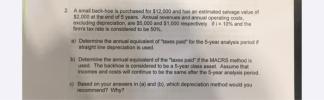 2. A small back-hoe is purchased for $12,000 and has an estimated salvage value of $2,000 at the end of 5 years. Annual revenues and annual operating costs, excluding depreciation, are $5,000 and $1,000 respectively. If i = 10% and the firm's tax rate is considered to be 50%, a) Determine the annual equivalent of "taxes paid" for the 5-year analysis period if straight line depreciation is used. b) Determine the annual equivalent of the "taxes paid" if the MACRS...
 Machine A was purchased last year for $10,000 and had an estimated market value of $1,900 at the end of its 6-year life. Annual operating costs are $1,450. The machine will perform satisfactorily for the next five years. A salesman for another company is offering Machine B for $59,000 with an market value of $5,900 after 5 years. Annual operating costs will be $1,050. Machine A could be sold now for $16,000, and MARR is 50% per year. Using the...
 10) You buy a machine now for $10,000. The machine can be depreciated using DDB depreciation with 5 years useful life and $2,000 salvage value. Three years later you sell the machine for $1,000. The annual net benefit is $8000. The inflation rate is 5% per year. The acceptable real after-tax rate of return after taking inflation into consideration is 10%. Combined incremental tax rate is 50%. Calculate PW of this investment a) $4102 b) $3654 c) $3181 d) $2706...
 machine 1:
cost 76,000
salvage value 6,000
useful life 10 years
purchased 7/1/16
machine 2:
cost 80,000
salvage value 10,000
useful life 8 years
purchased 1/1/13
machine 3:
cost 78,000
salvage value 6,000
useful life 6 years = 24,000 hours
purchased 1/1/18
Problem: In recent years, Hrubeck Company purchased three machines. Because of heavy turnover in the accounting department, a different accountant was in charge of selecting the depreciation method for each machine, and various methods were selected. Information concerning...
machine 1:
cost 76,000
salvage value 6,000
useful life 10 years
purchased 7/1/16
machine 2:
cost 80,000
salvage value 10,000
useful life 8 years
purchased 1/1/13
machine 3:
cost 78,000
salvage value 6,000
useful life 6 years = 24,000 hours
purchased 1/1/18
Problem: In recent years, Hrubeck Company purchased three machines. Because of heavy turnover in the accounting department, a different accountant was in charge of selecting the depreciation method for each machine, and various methods were selected. Information concerning...
 5. (20 Points) A company purchased a machine for $50,000 that has an estimated salvage value of $10,000 at the end of 8 year useful life. Compute the depreciation table by (a) Straight Line method (b) MACRS method (7-year property) (e) If you want to sell the machine in 4th year what book value you will use? (d) What book value you will use to pay tax to IRS in 4th year?
5. (20 Points) A company purchased a machine...
5. (20 Points) A company purchased a machine for $50,000 that has an estimated salvage value of $10,000 at the end of 8 year useful life. Compute the depreciation table by (a) Straight Line method (b) MACRS method (7-year property) (e) If you want to sell the machine in 4th year what book value you will use? (d) What book value you will use to pay tax to IRS in 4th year?
5. (20 Points) A company purchased a machine...
 Problem 10-1 (algorithmic) Question Help A firm is considering purchasing a machine that costs $60,000. It will be used for six years, and the salvage value at that time is expected to be zero. The machine will save $35,000 per year in labor, but it will incur $13,000 in operating and maintenance costs each year. The machine will be depreciated according to five-year MACRS. The firm's tax rate is 40%, and its after-tax MARR is 15%. Should the machine be...
 2. A small back-hoe is purchased for $12,000 and has an estimated salvage value of $2,000 at the end of 5 years. Annual revenues and annual operating costs, excluding depreciation, are $5,000 and $1,000 respectively. If i = 10% and the firm's tax rate is considered to be 50%, a) Determine the annual equivalent of "taxes paid" for the 5-year analysis period if straight line depreciation is used. b) Determine the annual equivalent of the "taxes paid" if the MACRS...
Most questions answered within 3 hours.
-
Where is the error in this code sequence?
String s1 = "Hello";
String s2 = "ello";...
asked 10 months ago -
Financial data for Joel de Paris, Inc., for last year
follow:
Joel de Paris, Inc.
Balance...
asked 10 months ago -
Consider this reaction:
Al2(SO4)3 (aq)+ BaCl3
(aq) Al2Cl6 (aq)- +
3BaSO4(s) . What is the...
asked 10 months ago -
Suppose that Savneet is considering increasing her
recent random sample from 20 car rentals to 40...
asked 10 months ago -
Trucks arrive at an unloading terminal at an average rate of 120
per hour.
Trucks arrive...
asked 10 months ago -
Why are methanol and ethanol completely soluble in water while
octanol is not very little soluble....
asked 10 months ago -
A facilities manager at a university reads in a research report
that the mean amount of...
asked 10 months ago -
When the CuSO4 is rehydrated by adding water to the anhydrous
compound, is this an endothermic...
asked 10 months ago -
A ray of sunlight is passing from diamond into crown glass; the
angle of incidence is...
asked 10 months ago -
A block of mass 0.249 kg is placed on top of a light, vertical
spring of...
asked 10 months ago -
how do the kidneys compensate in the presences of acidosis
a) trigger hyperventilate
b) reserve acid...
asked 10 months ago -
Question 501 pts
The rental rate of capital to the firm increases. Which of the
following...
asked 10 months ago