Hi can you help me solve the following Signals and Systems question on Forward and Inverse Fourier Transform. I have attached the answers for your reference. (Note: As the answers are in random order, only 2 out of the 5 are correct.) Thank you.


Cost2T7 +2.964), 2/m coS(T), 0, sinc(t/2), sinc2(/2) Answers: V1+(2)2
Homework Answers
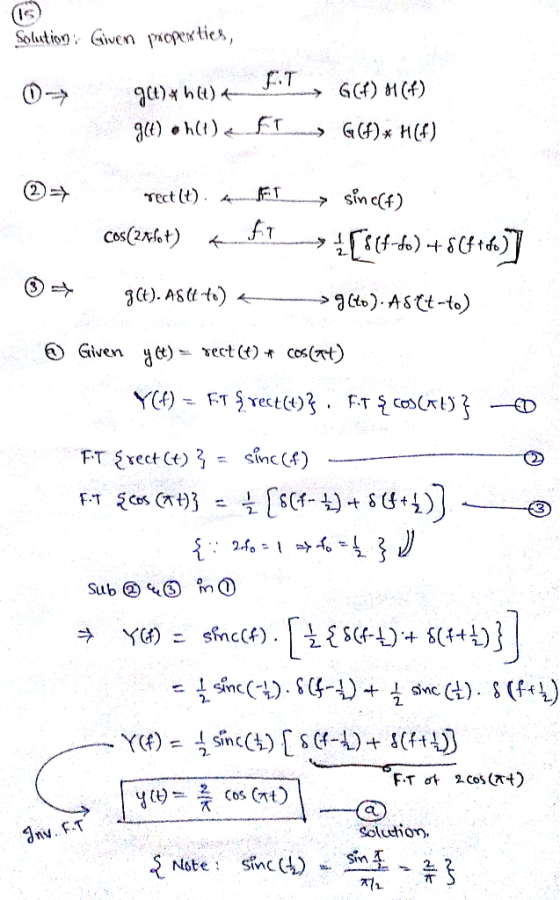
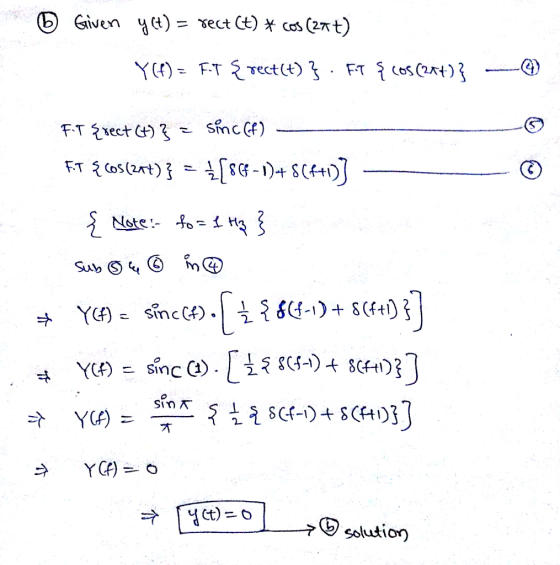
PLEASE DO COMMENTS BELOW TO KNOW WHETHER YOU'VE UNDERSTOOD OR NOT
IF YOU FOUND MY SOLUTION HELPFUL PLEASE GIVE ME A THUMBS UP
YOUR FEEDBACK GIVES ME LOT OF ENERGY TO SOLVE MORE AND MORE
THANK YOU
Add Answer to:
Hi can you help me solve the following Signals and Systems question on Forward and Inverse Fourie...
3) (Fourier Transforms Using Properties) - Given that the Fourier Transform of a signal x(t) is X(f) - rect(f/ 2), find the Fourier Transform of the following signals using properties of the Fourier...
 3) (Fourier Transforms Using Properties) - Given that the Fourier Transform of a signal x(t) is X(f) - rect(f/ 2), find the Fourier Transform of the following signals using properties of the Fourier Transform: (a) d(t) -x(t - 2) (d) h(t) = t x( t ) (e) p(t) = x( 2 t ) (f) g(t)-x( t ) cos(2π) (g) s(t) = x2(t ) (h)p()-x(1)* x(t) (convolution)
3) (Fourier Transforms Using Properties) - Given that the Fourier Transform of a signal...
3) (Fourier Transforms Using Properties) - Given that the Fourier Transform of a signal x(t) is X(f) - rect(f/ 2), find the Fourier Transform of the following signals using properties of the Fourier Transform: (a) d(t) -x(t - 2) (d) h(t) = t x( t ) (e) p(t) = x( 2 t ) (f) g(t)-x( t ) cos(2π) (g) s(t) = x2(t ) (h)p()-x(1)* x(t) (convolution)
3) (Fourier Transforms Using Properties) - Given that the Fourier Transform of a signal...
Please can you solve it using MATLAB. (1) Generate random signals [n] and hn, each of...
 Please can you solve it using MATLAB.
(1) Generate random signals [n] and hn, each of length N, and measure the time it takes to compute the linear convolution of r[n using the linear convolution definition and using the FFT method . Plot a graph of the results for N 104 to 10 in steps of 10. (2) Consider the signal x[n]-cos(0.3n),。£11S 100. Generate a plot of: ·The magnitude and phase of the DTFT of x[n] for 0 2π The...
Please can you solve it using MATLAB.
(1) Generate random signals [n] and hn, each of length N, and measure the time it takes to compute the linear convolution of r[n using the linear convolution definition and using the FFT method . Plot a graph of the results for N 104 to 10 in steps of 10. (2) Consider the signal x[n]-cos(0.3n),。£11S 100. Generate a plot of: ·The magnitude and phase of the DTFT of x[n] for 0 2π The...
Fourier transforms using Properties and Table 1·2(t) = tri(t), find X(w) w rect(w/uo), find x(t) 2....
 Fourier transforms using Properties and Table 1·2(t) = tri(t), find X(w) w rect(w/uo), find x(t) 2. X(w) 3, x(w) = cos(w) rect(w/π), find 2(t) X(w)=2n rect(w), find 2(t) 4. 5, x(w)=u(w), find x(t) Reference Tables Constraints rect(t) δ(t) sinc(u/(2m)) elunt cos(wot) sin(wot) u(t) e-ofu(t) e-afu(t) e-at sin(wot)u(t) e-at cos(wot)u(t) Re(a) >0 Re(a) >0 and n EN n+1 n!/(a + ju) sinc(t/(2m) IIITo (t) -t2/2 2π rect(w) with 40 2r/T) 2Te x(u) = F {r) (u) aXi(u) +X2() with a E...
4. X(c)-1 for lol < 5 and is zero elsewhere. Use the theorems to find and sketch the amplitude ve...
 4. X(c)-1 for lol < 5 and is zero elsewhere. Use the theorems to find and sketch the amplitude versus ω and the phase angle versus ω of the transforms of the following signals. (a) t0, (b, (e) x(2), and (e) x() expG10) dx(t) dt' TABLEme Selected Properties of the Fourier Transform X (o) 2. 3. x(-t) X (-o) 5. x(-o) x (at) la l 8. lx ()12 dr x(t)h(C) x (t) 9. 10. 2π X (ω-@g) d"X (0) 12....
Please answer the signals and systems question clearly :) Assume the following LTI system and the...
 Please answer the signals and systems question clearly :)
Assume the following LTI system and the input signal whose spectrum depicted below 2. x(t) Y(o) H(a) X(a) 2π 2π 3TT 3π Find x(t), Y(ω), and y(t) for each of the following filters. 3 2 0 2 f)
Please answer the signals and systems question clearly :)
Assume the following LTI system and the input signal whose spectrum depicted below 2. x(t) Y(o) H(a) X(a) 2π 2π 3TT 3π Find x(t), Y(ω), and y(t) for each of the following filters. 3 2 0 2 f)
4. X(c)-1 for lol < 5 and is zero elsewhere. Use the theorems to find and...
 4. X(c)-1 for lol < 5 and is zero elsewhere. Use the theorems to find and sketch the amplitude versus ω and the phase angle versus ω of the transforms of the following signals. (a) t0, (b, (e) x(2), and (e) x() expG10) dx(t) dt' TABLEme Selected Properties of the Fourier Transform X (o) 2. 3. x(-t) X (-o) 5. x(-o) x (at) la l 8. lx ()12 dr x(t)h(C) x (t) 9. 10. 2π X (ω-@g) d"X (0) 12....
Hello, Can anyone help me with these questions from signals and systems course? Thank you in...
 Hello,
Can anyone help me with these questions from signals and
systems course?
Thank you in advance??♀️
Problem 1 [25 points : Consider the following periodic signal x(t). Determine the Fourier series coefficients, ak nu Problem 2 [25 points : Determine the Fourier series coefficients, ax and the average power for the periodic signal x(t) shown. -2 -1 1 2 Problem 350 points: Let x(t) be the input signal to an LTI system with impulse response h(t) and let y(t)...
Hello,
Can anyone help me with these questions from signals and
systems course?
Thank you in advance??♀️
Problem 1 [25 points : Consider the following periodic signal x(t). Determine the Fourier series coefficients, ak nu Problem 2 [25 points : Determine the Fourier series coefficients, ax and the average power for the periodic signal x(t) shown. -2 -1 1 2 Problem 350 points: Let x(t) be the input signal to an LTI system with impulse response h(t) and let y(t)...
f. The amplitude of a cosine can be observed at the origin (t=0) when there is...
f. The amplitude of a cosine can be observed at the origin (t=0) when there is no phase shift. Find a simplified solution for the convolution integral below for t=0. +∞ output(t) = h(t)∗ s(t) = −∞ 3 rect(3x) cos(2π f0 (t − x)) dx Hint: Set t=0, sketch the situation to help set up the integral and remember the properties of odd and even functions to simply the calculation. g. The above result gives a general expression for the...
f. The amplitude of a cosine can be observed at the origin (t=0) when there is no phase shift. Find a simplified solutio...
f. The amplitude of a cosine can be observed at the origin (t=0) when there is no phase shift. Find a simplified solution for the convolution integral below for t=0. +∞ output(t) = h(t)∗ s(t) = −∞ 3 rect(3x) cos(2π f0 (t − x)) dx Hint: Set t=0, sketch the situation to help set up the integral and remember the properties of odd and even functions to simply the calculation. g. The above result gives a general expression for the...
Problem 4: Evaluation of the convolution integral too y(t) = (f * h)(t) = f(t)h(t –...
 Problem 4: Evaluation of the convolution integral too y(t) = (f * h)(t) = f(t)h(t – 7)dt is greatly simplified when either the input f(t) or impulse response h(t) is the sum of weighted impulse functions. This fact will be used later in the semester when we study the operation of communication systems using Fourier analysis methods. a) Use the convolution integral to prove that f(t) *8(t – T) = f(t – T) and 8(t – T) *h(t) = h(t...
 3) (Fourier Transforms Using Properties) - Given that the Fourier Transform of a signal x(t) is X(f) - rect(f/ 2), find the Fourier Transform of the following signals using properties of the Fourier Transform: (a) d(t) -x(t - 2) (d) h(t) = t x( t ) (e) p(t) = x( 2 t ) (f) g(t)-x( t ) cos(2π) (g) s(t) = x2(t ) (h)p()-x(1)* x(t) (convolution)
3) (Fourier Transforms Using Properties) - Given that the Fourier Transform of a signal...
3) (Fourier Transforms Using Properties) - Given that the Fourier Transform of a signal x(t) is X(f) - rect(f/ 2), find the Fourier Transform of the following signals using properties of the Fourier Transform: (a) d(t) -x(t - 2) (d) h(t) = t x( t ) (e) p(t) = x( 2 t ) (f) g(t)-x( t ) cos(2π) (g) s(t) = x2(t ) (h)p()-x(1)* x(t) (convolution)
3) (Fourier Transforms Using Properties) - Given that the Fourier Transform of a signal...
 Please can you solve it using MATLAB.
(1) Generate random signals [n] and hn, each of length N, and measure the time it takes to compute the linear convolution of r[n using the linear convolution definition and using the FFT method . Plot a graph of the results for N 104 to 10 in steps of 10. (2) Consider the signal x[n]-cos(0.3n),。£11S 100. Generate a plot of: ·The magnitude and phase of the DTFT of x[n] for 0 2π The...
Please can you solve it using MATLAB.
(1) Generate random signals [n] and hn, each of length N, and measure the time it takes to compute the linear convolution of r[n using the linear convolution definition and using the FFT method . Plot a graph of the results for N 104 to 10 in steps of 10. (2) Consider the signal x[n]-cos(0.3n),。£11S 100. Generate a plot of: ·The magnitude and phase of the DTFT of x[n] for 0 2π The...
 Fourier transforms using Properties and Table 1·2(t) = tri(t), find X(w) w rect(w/uo), find x(t) 2. X(w) 3, x(w) = cos(w) rect(w/π), find 2(t) X(w)=2n rect(w), find 2(t) 4. 5, x(w)=u(w), find x(t) Reference Tables Constraints rect(t) δ(t) sinc(u/(2m)) elunt cos(wot) sin(wot) u(t) e-ofu(t) e-afu(t) e-at sin(wot)u(t) e-at cos(wot)u(t) Re(a) >0 Re(a) >0 and n EN n+1 n!/(a + ju) sinc(t/(2m) IIITo (t) -t2/2 2π rect(w) with 40 2r/T) 2Te x(u) = F {r) (u) aXi(u) +X2() with a E...
 4. X(c)-1 for lol < 5 and is zero elsewhere. Use the theorems to find and sketch the amplitude versus ω and the phase angle versus ω of the transforms of the following signals. (a) t0, (b, (e) x(2), and (e) x() expG10) dx(t) dt' TABLEme Selected Properties of the Fourier Transform X (o) 2. 3. x(-t) X (-o) 5. x(-o) x (at) la l 8. lx ()12 dr x(t)h(C) x (t) 9. 10. 2π X (ω-@g) d"X (0) 12....
 Please answer the signals and systems question clearly :)
Assume the following LTI system and the input signal whose spectrum depicted below 2. x(t) Y(o) H(a) X(a) 2π 2π 3TT 3π Find x(t), Y(ω), and y(t) for each of the following filters. 3 2 0 2 f)
Please answer the signals and systems question clearly :)
Assume the following LTI system and the input signal whose spectrum depicted below 2. x(t) Y(o) H(a) X(a) 2π 2π 3TT 3π Find x(t), Y(ω), and y(t) for each of the following filters. 3 2 0 2 f)
 4. X(c)-1 for lol < 5 and is zero elsewhere. Use the theorems to find and sketch the amplitude versus ω and the phase angle versus ω of the transforms of the following signals. (a) t0, (b, (e) x(2), and (e) x() expG10) dx(t) dt' TABLEme Selected Properties of the Fourier Transform X (o) 2. 3. x(-t) X (-o) 5. x(-o) x (at) la l 8. lx ()12 dr x(t)h(C) x (t) 9. 10. 2π X (ω-@g) d"X (0) 12....
 Hello,
Can anyone help me with these questions from signals and
systems course?
Thank you in advance??♀️
Problem 1 [25 points : Consider the following periodic signal x(t). Determine the Fourier series coefficients, ak nu Problem 2 [25 points : Determine the Fourier series coefficients, ax and the average power for the periodic signal x(t) shown. -2 -1 1 2 Problem 350 points: Let x(t) be the input signal to an LTI system with impulse response h(t) and let y(t)...
Hello,
Can anyone help me with these questions from signals and
systems course?
Thank you in advance??♀️
Problem 1 [25 points : Consider the following periodic signal x(t). Determine the Fourier series coefficients, ak nu Problem 2 [25 points : Determine the Fourier series coefficients, ax and the average power for the periodic signal x(t) shown. -2 -1 1 2 Problem 350 points: Let x(t) be the input signal to an LTI system with impulse response h(t) and let y(t)...
 Problem 4: Evaluation of the convolution integral too y(t) = (f * h)(t) = f(t)h(t – 7)dt is greatly simplified when either the input f(t) or impulse response h(t) is the sum of weighted impulse functions. This fact will be used later in the semester when we study the operation of communication systems using Fourier analysis methods. a) Use the convolution integral to prove that f(t) *8(t – T) = f(t – T) and 8(t – T) *h(t) = h(t...
Most questions answered within 3 hours.
-
Where is the error in this code sequence?
String s1 = "Hello";
String s2 = "ello";...
asked 11 months ago -
Financial data for Joel de Paris, Inc., for last year
follow:
Joel de Paris, Inc.
Balance...
asked 11 months ago -
Consider this reaction:
Al2(SO4)3 (aq)+ BaCl3
(aq) Al2Cl6 (aq)- +
3BaSO4(s) . What is the...
asked 11 months ago -
Suppose that Savneet is considering increasing her
recent random sample from 20 car rentals to 40...
asked 11 months ago -
Trucks arrive at an unloading terminal at an average rate of 120
per hour.
Trucks arrive...
asked 11 months ago -
Why are methanol and ethanol completely soluble in water while
octanol is not very little soluble....
asked 11 months ago -
A facilities manager at a university reads in a research report
that the mean amount of...
asked 11 months ago -
When the CuSO4 is rehydrated by adding water to the anhydrous
compound, is this an endothermic...
asked 11 months ago -
A ray of sunlight is passing from diamond into crown glass; the
angle of incidence is...
asked 11 months ago -
A block of mass 0.249 kg is placed on top of a light, vertical
spring of...
asked 11 months ago -
how do the kidneys compensate in the presences of acidosis
a) trigger hyperventilate
b) reserve acid...
asked 11 months ago -
Question 501 pts
The rental rate of capital to the firm increases. Which of the
following...
asked 11 months ago