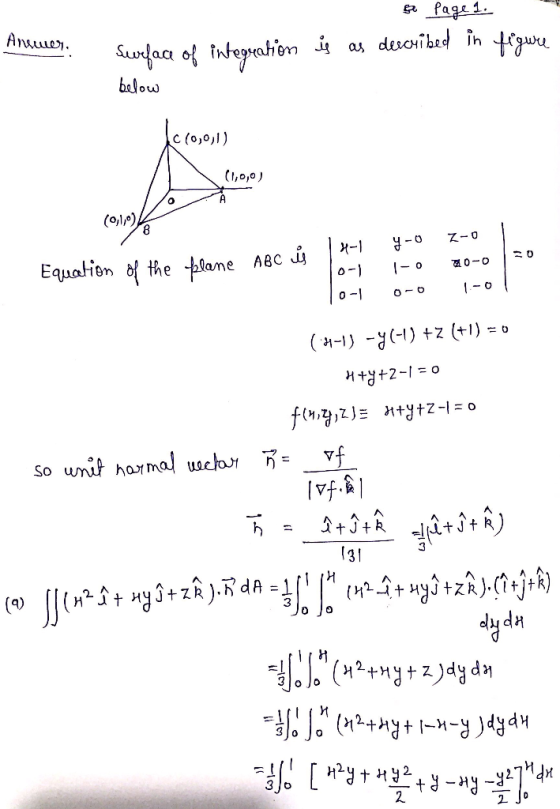
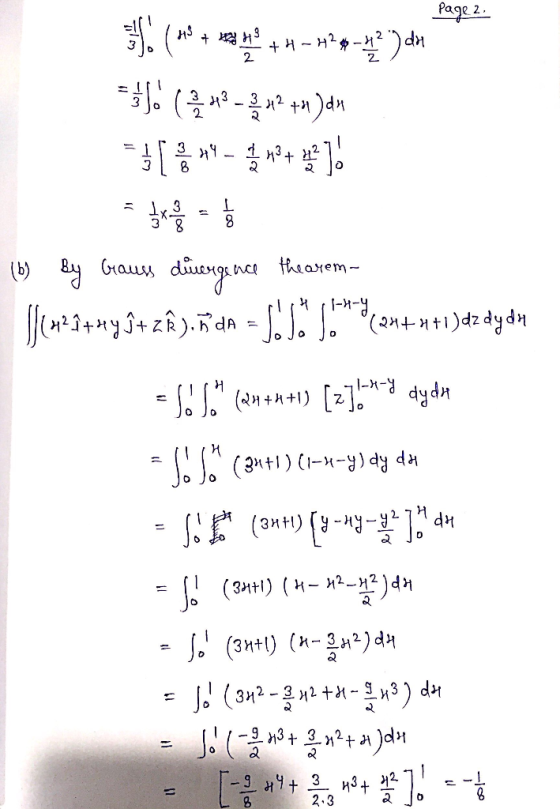
Evaluate ∫∫ (x2i + xyj + zk) . ndA over the closed surface bounded by 4 faces of the tetrahedral ...
Evaluate ∫∫ (x2i + xyj + zk) . ndA over the closed
surface bounded by 4 faces of
the tetrahedral solid with vertices A(1, 0, 0), B(0, 1, 0) C(0, 0,
1) and O(0, 0, 0)
(a) directly, (b) by the divergence theorem.
Homework Answers
Add Answer to:
Evaluate ∫∫ (x2i + xyj + zk) . ndA over the closed surface bounded by 4 faces of the tetrahedral ...
Evaluate ∫∫ (x2i+ xyj+ zk) ∙ ndA over the closed surface bounded by the paraboloid S: z = 4 − x2−...
Evaluate ∫∫ (x2i+ xyj+ zk) ∙ ndA over the closed surface bounded by the paraboloid S: z = 4 − x2−y2, on sides, and the bottom plane z = 0 (a) directly, (b) by the divergence theorem.
#4 please 3. (12 pts). (a) (8 pts) Directly compute the flux Ф of the vector field F-(x + y)1+ yj + zk over the closed surface S given by z 36-x2-y2 and z - 0. Keep in mind that N is the outward...
 #4 please
3. (12 pts). (a) (8 pts) Directly compute the flux Ф of the vector field F-(x + y)1+ yj + zk over the closed surface S given by z 36-x2-y2 and z - 0. Keep in mind that N is the outward normal to the surface. Do not use the Divergence Theorem. Hint: Don't forget the bottom! (b) (4 pts) Sketch the surface. ts). Use the Divergence Theorem to compute the flux Ф of Problem 3. Hint: The...
#4 please
3. (12 pts). (a) (8 pts) Directly compute the flux Ф of the vector field F-(x + y)1+ yj + zk over the closed surface S given by z 36-x2-y2 and z - 0. Keep in mind that N is the outward normal to the surface. Do not use the Divergence Theorem. Hint: Don't forget the bottom! (b) (4 pts) Sketch the surface. ts). Use the Divergence Theorem to compute the flux Ф of Problem 3. Hint: The...
Question 3. Let Q be the solid hemisphere bounded by x + y² + 2 =...
 Question 3. Let Q be the solid hemisphere bounded by x + y² + 2 = 1 for 2 > 0 and by the plane z = 0, and let F = xi+yi + zk be a vector field. Verify the divergence theorem for Q and F by answering parts (a) and (b) below. Part (a) (5 points). Find the value of the triple integral of the divergence of F over the solid hemisphere Q. Part (b) (10 points). Evaluate...
(1) Let P denote the solid bounded by the surface of the hemisphere zV1--y2 and the cone z-Vx2 + y2 and let n denote an...
 (1) Let P denote the solid bounded by the surface of the hemisphere zV1--y2 and the cone z-Vx2 + y2 and let n denote an outwardly directed unit normal vector. Define the vector field (a) Evaluate the surface integral F nds directly without using Gauss' Divergence T heorem (b) Evaluate thetriplengral IIdiv(F) dV directly without using Gauss Diver- gence Theorem. confirming the result of Gauss' Divergence Theorem for this particular example.
(1) Let P denote the solid bounded by the...
(1) Let P denote the solid bounded by the surface of the hemisphere zV1--y2 and the cone z-Vx2 + y2 and let n denote an outwardly directed unit normal vector. Define the vector field (a) Evaluate the surface integral F nds directly without using Gauss' Divergence T heorem (b) Evaluate thetriplengral IIdiv(F) dV directly without using Gauss Diver- gence Theorem. confirming the result of Gauss' Divergence Theorem for this particular example.
(1) Let P denote the solid bounded by the...
Let P denote the solid bounded by the surface of the hemisphere z -vl--g and the cone z-Vr2 + y2 and let n denote an outwardly directed unit normal vector Define the vector field (a) Evaluate the sur...
 Let P denote the solid bounded by the surface of the hemisphere z -vl--g and the cone z-Vr2 + y2 and let n denote an outwardly directed unit normal vector Define the vector field (a) Evaluate the surface inteFn dS directly without using Gauss' Divergence aP Theorem (b) Evaluate the triple integraldiv(F) dV directly without using Gauss' Diver gence Theorem. Note: You should obtain the same answer in (a) and (b) In this question you are confirming the result of...
9. Let Q be the solid bounded by the cylinder x2 + y2 = 1 and the planes z = 0 and z = 1 . Use the Divergence Theorem to calculate | | F . N dS where s is the surface of Q and F(x, y, z) = xi + yj +...
 9. Let Q be the solid bounded by the cylinder x2 + y2 = 1 and the planes z = 0 and z = 1 . Use the Divergence Theorem to calculate | | F . N dS where s is the surface of Q and F(x, y, z) = xi + yj + zk. (a) 67T (d) 0 (b) 1 (e) None of these (c) 3π
9. Let Q be the solid bounded by the cylinder x2 + y2...
9. Let Q be the solid bounded by the cylinder x2 + y2 = 1 and the planes z = 0 and z = 1 . Use the Divergence Theorem to calculate | | F . N dS where s is the surface of Q and F(x, y, z) = xi + yj + zk. (a) 67T (d) 0 (b) 1 (e) None of these (c) 3π
9. Let Q be the solid bounded by the cylinder x2 + y2...
(1) Let P denote the solid bounded by the surface of the hemisphere z -Vl-r-y? and the cone2y2 and let n denote an outw...
 (1) Let P denote the solid bounded by the surface of the hemisphere z -Vl-r-y? and the cone2y2 and let n denote an outwardly directed unit normal vector. Define the vector field F(x, y, z) = yi + zVJ + 21k. (a) Evaluate the surface integral F n dS directly without using Gauss' Divergence Theorem. (b) Evaluate the triple integral Ш div(F) dV directly without using Gauss' Diver- gence Theorem Note: You should obtain the same answer in (a) and...
4.8) a) Complete the statement of: The Divergence Theorem: Let D be a closed solid in...
 4.8) a) Complete the statement of: The Divergence Theorem: Let D be a closed solid in space bounded by a closed surface s oriented by an outwardly directed unit normal vector n. If F(x, y, z)=(M(x,y,z), N(x, y, z), P(x, y, z)) where M, N, and P have continuous partial derivatives in D, then: D b) Use the Divergence Theorem to write as an iterated integral the flux of F=(x",x’y,x?:) over the closed cylindrical surface whose sides are defined by...
Q1. Evaluate the line integral f (x2 + y2)dx + 2xydy by two methods a) directly,...
 Q1. Evaluate the line integral f (x2 + y2)dx + 2xydy by two methods a) directly, b) using Green's Theorem, where C consists of the arc of the parabola y = x2 from (0,0) to (2,4) and the line segments from (2,4) to (0,4) and from (0,4) to (0,0). [Answer: 0] Q2. Use Green's Theorem to evaluate the line integral $. F. dr or the work done by the force field F(x, y) = (3y - 4x)i +(4x - y)j...
ed Let S: x2 + y2 =9,05z57 be the surface of a closed cylinder bounding a...
 ed Let S: x2 + y2 =9,05z57 be the surface of a closed cylinder bounding a volume T. F=[y?, x?, 22). Use the Divergence theorem to evaluate the surface integral $ff.nda 2.00 on and answer the following questions: S 3. Choose the value of divF dxdydz: H. 144 T 1. 2025T Choose... J.441 TT K.5550 L 325T 2. Choose the value of divF: D. 2x+2y + 2z E. 2x F. 2y G. 2z Choose... 1. Choose the correct equation from...
 #4 please
3. (12 pts). (a) (8 pts) Directly compute the flux Ф of the vector field F-(x + y)1+ yj + zk over the closed surface S given by z 36-x2-y2 and z - 0. Keep in mind that N is the outward normal to the surface. Do not use the Divergence Theorem. Hint: Don't forget the bottom! (b) (4 pts) Sketch the surface. ts). Use the Divergence Theorem to compute the flux Ф of Problem 3. Hint: The...
#4 please
3. (12 pts). (a) (8 pts) Directly compute the flux Ф of the vector field F-(x + y)1+ yj + zk over the closed surface S given by z 36-x2-y2 and z - 0. Keep in mind that N is the outward normal to the surface. Do not use the Divergence Theorem. Hint: Don't forget the bottom! (b) (4 pts) Sketch the surface. ts). Use the Divergence Theorem to compute the flux Ф of Problem 3. Hint: The...
 Question 3. Let Q be the solid hemisphere bounded by x + y² + 2 = 1 for 2 > 0 and by the plane z = 0, and let F = xi+yi + zk be a vector field. Verify the divergence theorem for Q and F by answering parts (a) and (b) below. Part (a) (5 points). Find the value of the triple integral of the divergence of F over the solid hemisphere Q. Part (b) (10 points). Evaluate...
 (1) Let P denote the solid bounded by the surface of the hemisphere zV1--y2 and the cone z-Vx2 + y2 and let n denote an outwardly directed unit normal vector. Define the vector field (a) Evaluate the surface integral F nds directly without using Gauss' Divergence T heorem (b) Evaluate thetriplengral IIdiv(F) dV directly without using Gauss Diver- gence Theorem. confirming the result of Gauss' Divergence Theorem for this particular example.
(1) Let P denote the solid bounded by the...
(1) Let P denote the solid bounded by the surface of the hemisphere zV1--y2 and the cone z-Vx2 + y2 and let n denote an outwardly directed unit normal vector. Define the vector field (a) Evaluate the surface integral F nds directly without using Gauss' Divergence T heorem (b) Evaluate thetriplengral IIdiv(F) dV directly without using Gauss Diver- gence Theorem. confirming the result of Gauss' Divergence Theorem for this particular example.
(1) Let P denote the solid bounded by the...
 Let P denote the solid bounded by the surface of the hemisphere z -vl--g and the cone z-Vr2 + y2 and let n denote an outwardly directed unit normal vector Define the vector field (a) Evaluate the surface inteFn dS directly without using Gauss' Divergence aP Theorem (b) Evaluate the triple integraldiv(F) dV directly without using Gauss' Diver gence Theorem. Note: You should obtain the same answer in (a) and (b) In this question you are confirming the result of...
 9. Let Q be the solid bounded by the cylinder x2 + y2 = 1 and the planes z = 0 and z = 1 . Use the Divergence Theorem to calculate | | F . N dS where s is the surface of Q and F(x, y, z) = xi + yj + zk. (a) 67T (d) 0 (b) 1 (e) None of these (c) 3π
9. Let Q be the solid bounded by the cylinder x2 + y2...
9. Let Q be the solid bounded by the cylinder x2 + y2 = 1 and the planes z = 0 and z = 1 . Use the Divergence Theorem to calculate | | F . N dS where s is the surface of Q and F(x, y, z) = xi + yj + zk. (a) 67T (d) 0 (b) 1 (e) None of these (c) 3π
9. Let Q be the solid bounded by the cylinder x2 + y2...
 (1) Let P denote the solid bounded by the surface of the hemisphere z -Vl-r-y? and the cone2y2 and let n denote an outwardly directed unit normal vector. Define the vector field F(x, y, z) = yi + zVJ + 21k. (a) Evaluate the surface integral F n dS directly without using Gauss' Divergence Theorem. (b) Evaluate the triple integral Ш div(F) dV directly without using Gauss' Diver- gence Theorem Note: You should obtain the same answer in (a) and...
 4.8) a) Complete the statement of: The Divergence Theorem: Let D be a closed solid in space bounded by a closed surface s oriented by an outwardly directed unit normal vector n. If F(x, y, z)=(M(x,y,z), N(x, y, z), P(x, y, z)) where M, N, and P have continuous partial derivatives in D, then: D b) Use the Divergence Theorem to write as an iterated integral the flux of F=(x",x’y,x?:) over the closed cylindrical surface whose sides are defined by...
 Q1. Evaluate the line integral f (x2 + y2)dx + 2xydy by two methods a) directly, b) using Green's Theorem, where C consists of the arc of the parabola y = x2 from (0,0) to (2,4) and the line segments from (2,4) to (0,4) and from (0,4) to (0,0). [Answer: 0] Q2. Use Green's Theorem to evaluate the line integral $. F. dr or the work done by the force field F(x, y) = (3y - 4x)i +(4x - y)j...
 ed Let S: x2 + y2 =9,05z57 be the surface of a closed cylinder bounding a volume T. F=[y?, x?, 22). Use the Divergence theorem to evaluate the surface integral $ff.nda 2.00 on and answer the following questions: S 3. Choose the value of divF dxdydz: H. 144 T 1. 2025T Choose... J.441 TT K.5550 L 325T 2. Choose the value of divF: D. 2x+2y + 2z E. 2x F. 2y G. 2z Choose... 1. Choose the correct equation from...
Most questions answered within 3 hours.
-
Where is the error in this code sequence?
String s1 = "Hello";
String s2 = "ello";...
asked 10 months ago -
Financial data for Joel de Paris, Inc., for last year
follow:
Joel de Paris, Inc.
Balance...
asked 10 months ago -
Consider this reaction:
Al2(SO4)3 (aq)+ BaCl3
(aq) Al2Cl6 (aq)- +
3BaSO4(s) . What is the...
asked 10 months ago -
Suppose that Savneet is considering increasing her
recent random sample from 20 car rentals to 40...
asked 10 months ago -
Trucks arrive at an unloading terminal at an average rate of 120
per hour.
Trucks arrive...
asked 10 months ago -
Why are methanol and ethanol completely soluble in water while
octanol is not very little soluble....
asked 10 months ago -
A facilities manager at a university reads in a research report
that the mean amount of...
asked 10 months ago -
When the CuSO4 is rehydrated by adding water to the anhydrous
compound, is this an endothermic...
asked 10 months ago -
A ray of sunlight is passing from diamond into crown glass; the
angle of incidence is...
asked 10 months ago -
A block of mass 0.249 kg is placed on top of a light, vertical
spring of...
asked 10 months ago -
how do the kidneys compensate in the presences of acidosis
a) trigger hyperventilate
b) reserve acid...
asked 10 months ago -
Question 501 pts
The rental rate of capital to the firm increases. Which of the
following...
asked 10 months ago