
Homework Answers

Add Answer to:
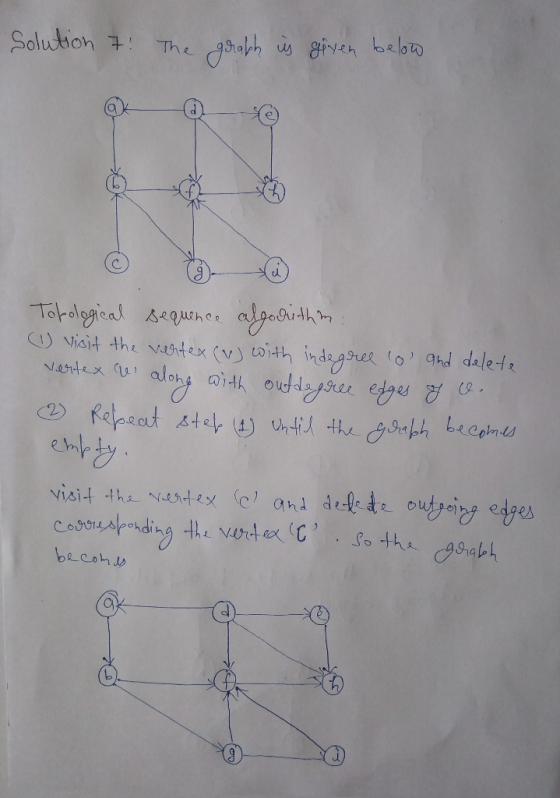
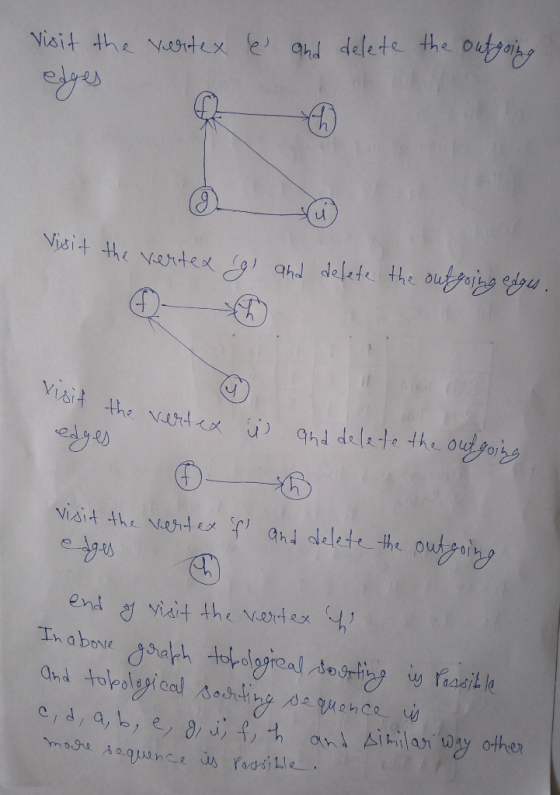
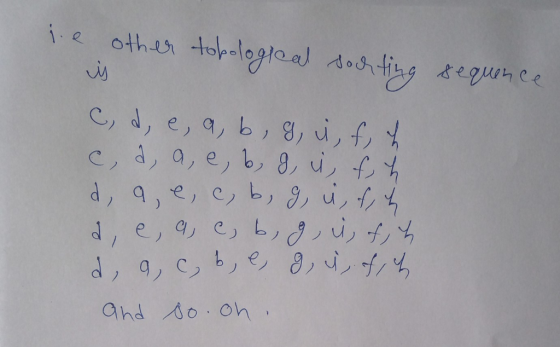
7. Can the following graph be topologically sorted? Justify your answer. If it can, use the algor...
Problem 2. Topologically sort the vertices of the following graph. Note that there may be multiple, equally-correct top...
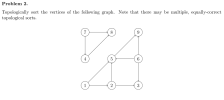 Problem 2. Topologically sort the vertices of the following graph. Note that there may be multiple, equally-correct topological sorts 9 6
Problem 2. Topologically sort the vertices of the following graph. Note that there may be multiple, equally-correct topological sorts 9 6
Problem 2. Topologically sort the vertices of the following graph. Note that there may be multiple, equally-correct topological sorts 9 6
3. Apply Topological sort algorithm on the following graph. Then, draw the sorted graph. 11 marvel
 3. Apply Topological sort algorithm on the following graph. Then, draw the sorted graph. 11 marvel
Make sure to answer part a and b. Consider the graph below. a. (5 points) Create...
 Make sure to answer part a and b. Consider the graph below. a. (5 points) Create an adjacency matrix. b. (5 points) Can this graph be topologically sorted? If so, what are the vertice topological order if you use the decrease-by-one (source) method to topologica sort and resolve ties in ascending order alphabetically? (В E С F D A
What is the running time of the DFS topological sort algorithm? Justify your answer. Does it...
What is the running time of the DFS topological sort algorithm? Justify your answer. Does it make sense to apply iterative deepening to A* search? Briefly explain why or why not
1. Use the following graph for the questions. Show all the steps (a) Draw the adjacency...
 1. Use the following graph for the questions. Show all the steps (a) Draw the adjacency matrix and the adjacency list (b) Using the Depth First Search algorithm learned in class, topologically sort the graph. 4 t5 64 (c) Use Dijstra's algorithm to determine the shortest path from node s to all other nodes. (d) Use Bellman-Ford's algorithm to determine the shortest path from node s to all other nodes.
(A) Consider the following algorithm for computing a topological sort of a DAG G: add the...
(A) Consider the following algorithm for computing a topological sort of a DAG G: add the vertices to an initially empty list in non-decreasing order of their indegrees. Either argue that the algorithm correctly computes a topological sort of G, or provide an example on which the algorithm fails. (B) Can the number of strongly connected components of a graph decrease if a new edge is added? Why or why not? Can it increase? Why or why not? (C) What...
Which of the following is TRUE about Topological Sorting? Topological Sort can be used as a...
Which of the following is TRUE about Topological Sorting? Topological Sort can be used as a subroutine to find shortest paths in a weighted DAG in time O(V+E); in particular, the time does not depend on the magnitudes of the weights on the edges, and the weights on the edges may be negative. A Topological Sort algorithm sorts the nodes of an arbitrary directed graph G in an order that is consistent with all the paths in G, that is...
Consider a directed acyclic graph G = (V, E) without edge lengths and a start vertex...
 Consider a directed acyclic graph G = (V, E) without edge lengths and a start vertex s E V. (Recall, the length of a path in an graph without edge lengths is given by the number of edges on that path). Someone claims that the following greedy algorithm will always find longest path in the graph G starting from s. path = [8] Ucurrent = s topologically sort the vertices V of G. forall v EV in topological order do...
Java We did in lecture, and explain your answer briefly. Problem 4: Sorting practice 14 points;...
 Java
We did in lecture, and explain your answer briefly. Problem 4: Sorting practice 14 points; 2 points for each part individual-only Important: When answering these questions, make sure to apply the versions of these algorithms that were discussed in lecture. The Java code for each algorithm can be found in our Sort class. Given the following array: {14, 7, 27, 13, 24, 20, 10, 33 1. If the array were sorted using selection sort, what would the array look...
Java
We did in lecture, and explain your answer briefly. Problem 4: Sorting practice 14 points; 2 points for each part individual-only Important: When answering these questions, make sure to apply the versions of these algorithms that were discussed in lecture. The Java code for each algorithm can be found in our Sort class. Given the following array: {14, 7, 27, 13, 24, 20, 10, 33 1. If the array were sorted using selection sort, what would the array look...
I want just the answer to the third task. to generate a report/graph. Thanks! 1 Problem...
 I want just the answer to the third task. to generate a
report/graph.
Thanks!
1 Problem Description Instructions. You are provided the skeleton code named Sort.java. The source file is available on Canvas in a folder named HW1. Please modify the skeleton code to solve the following tasks. . Task 1 (80 pts). Implement the Insertion Sort algorithm as discussed in Lecture 1. (Hint: use the function checked sorted to check if your output is indeed sorted.) . Task 3...
I want just the answer to the third task. to generate a
report/graph.
Thanks!
1 Problem Description Instructions. You are provided the skeleton code named Sort.java. The source file is available on Canvas in a folder named HW1. Please modify the skeleton code to solve the following tasks. . Task 1 (80 pts). Implement the Insertion Sort algorithm as discussed in Lecture 1. (Hint: use the function checked sorted to check if your output is indeed sorted.) . Task 3...
 Problem 2. Topologically sort the vertices of the following graph. Note that there may be multiple, equally-correct topological sorts 9 6
Problem 2. Topologically sort the vertices of the following graph. Note that there may be multiple, equally-correct topological sorts 9 6
Problem 2. Topologically sort the vertices of the following graph. Note that there may be multiple, equally-correct topological sorts 9 6
 3. Apply Topological sort algorithm on the following graph. Then, draw the sorted graph. 11 marvel
 Make sure to answer part a and b. Consider the graph below. a. (5 points) Create an adjacency matrix. b. (5 points) Can this graph be topologically sorted? If so, what are the vertice topological order if you use the decrease-by-one (source) method to topologica sort and resolve ties in ascending order alphabetically? (В E С F D A
 1. Use the following graph for the questions. Show all the steps (a) Draw the adjacency matrix and the adjacency list (b) Using the Depth First Search algorithm learned in class, topologically sort the graph. 4 t5 64 (c) Use Dijstra's algorithm to determine the shortest path from node s to all other nodes. (d) Use Bellman-Ford's algorithm to determine the shortest path from node s to all other nodes.
 Consider a directed acyclic graph G = (V, E) without edge lengths and a start vertex s E V. (Recall, the length of a path in an graph without edge lengths is given by the number of edges on that path). Someone claims that the following greedy algorithm will always find longest path in the graph G starting from s. path = [8] Ucurrent = s topologically sort the vertices V of G. forall v EV in topological order do...
 Java
We did in lecture, and explain your answer briefly. Problem 4: Sorting practice 14 points; 2 points for each part individual-only Important: When answering these questions, make sure to apply the versions of these algorithms that were discussed in lecture. The Java code for each algorithm can be found in our Sort class. Given the following array: {14, 7, 27, 13, 24, 20, 10, 33 1. If the array were sorted using selection sort, what would the array look...
Java
We did in lecture, and explain your answer briefly. Problem 4: Sorting practice 14 points; 2 points for each part individual-only Important: When answering these questions, make sure to apply the versions of these algorithms that were discussed in lecture. The Java code for each algorithm can be found in our Sort class. Given the following array: {14, 7, 27, 13, 24, 20, 10, 33 1. If the array were sorted using selection sort, what would the array look...
 I want just the answer to the third task. to generate a
report/graph.
Thanks!
1 Problem Description Instructions. You are provided the skeleton code named Sort.java. The source file is available on Canvas in a folder named HW1. Please modify the skeleton code to solve the following tasks. . Task 1 (80 pts). Implement the Insertion Sort algorithm as discussed in Lecture 1. (Hint: use the function checked sorted to check if your output is indeed sorted.) . Task 3...
I want just the answer to the third task. to generate a
report/graph.
Thanks!
1 Problem Description Instructions. You are provided the skeleton code named Sort.java. The source file is available on Canvas in a folder named HW1. Please modify the skeleton code to solve the following tasks. . Task 1 (80 pts). Implement the Insertion Sort algorithm as discussed in Lecture 1. (Hint: use the function checked sorted to check if your output is indeed sorted.) . Task 3...
Most questions answered within 3 hours.
-
Where is the error in this code sequence?
String s1 = "Hello";
String s2 = "ello";...
asked 11 months ago -
Financial data for Joel de Paris, Inc., for last year
follow:
Joel de Paris, Inc.
Balance...
asked 11 months ago -
Consider this reaction:
Al2(SO4)3 (aq)+ BaCl3
(aq) Al2Cl6 (aq)- +
3BaSO4(s) . What is the...
asked 11 months ago -
Suppose that Savneet is considering increasing her
recent random sample from 20 car rentals to 40...
asked 11 months ago -
Trucks arrive at an unloading terminal at an average rate of 120
per hour.
Trucks arrive...
asked 11 months ago -
Why are methanol and ethanol completely soluble in water while
octanol is not very little soluble....
asked 11 months ago -
A facilities manager at a university reads in a research report
that the mean amount of...
asked 11 months ago -
When the CuSO4 is rehydrated by adding water to the anhydrous
compound, is this an endothermic...
asked 11 months ago -
A ray of sunlight is passing from diamond into crown glass; the
angle of incidence is...
asked 11 months ago -
A block of mass 0.249 kg is placed on top of a light, vertical
spring of...
asked 11 months ago -
how do the kidneys compensate in the presences of acidosis
a) trigger hyperventilate
b) reserve acid...
asked 11 months ago -
Question 501 pts
The rental rate of capital to the firm increases. Which of the
following...
asked 11 months ago