
Homework Answers
Add Answer to:
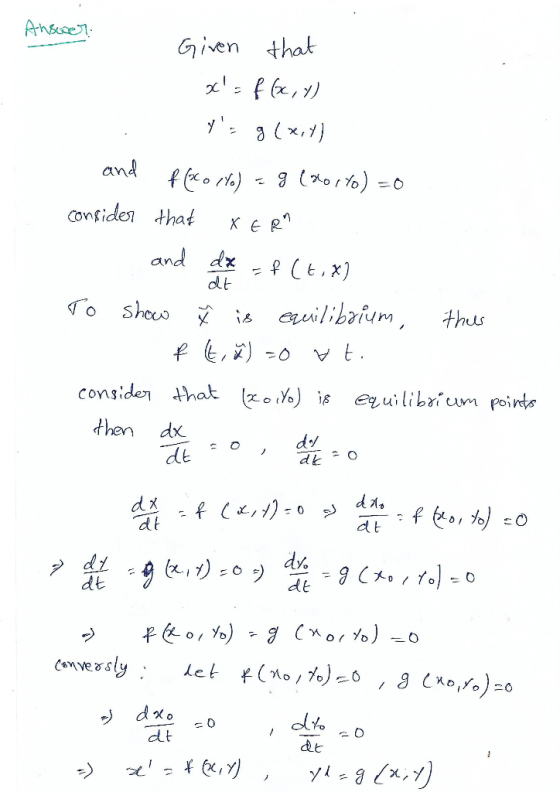
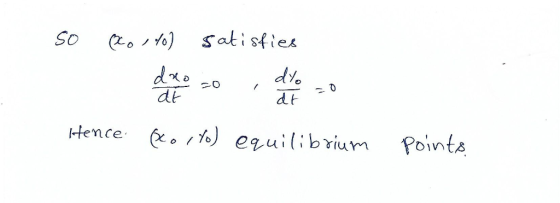
4. Consider a general planar system (might not be linear): Show that (o, yo) is an equilibrium po...
4. Consider the system ry(1 +) -(42 2) (a) Show that the origin is an equilibrium point and it is...
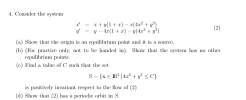 4. Consider the system ry(1 +) -(42 2) (a) Show that the origin is an equilibrium point and it is a source (b) (For practice only, not to be handed in). Show that the system has no other equilibrium points (c) Find a value of C such that the set is positively invariant respect to the flow of (2) (d) Show that (2) has a periodic orbit in S.
4. Consider the system ry(1 +) -(42 2) (a) Show that...
4. Consider the system ry(1 +) -(42 2) (a) Show that the origin is an equilibrium point and it is a source (b) (For practice only, not to be handed in). Show that the system has no other equilibrium points (c) Find a value of C such that the set is positively invariant respect to the flow of (2) (d) Show that (2) has a periodic orbit in S.
4. Consider the system ry(1 +) -(42 2) (a) Show that...
2 This system has an equilibrium point at the origin (you do not have to show this) For parts (d)-(e), consider the system This system also has an equilibrium point at the origin (you do not have to...
 2 This system has an equilibrium point at the origin (you do not have to show this) For parts (d)-(e), consider the system This system also has an equilibrium point at the origin (you do not have to show this). (d) (4 pts) Compute the linearization of this system, and conclude that the Jacobian yields no relevant infor- mation regarding the equilibrium at (0,0). (e) (3 pts) Sketch the nullcline diagram for this system. Conclude from the diagram that the...
1. Classify the stability type of the equilibrium point (0,0) of the following linear planar homogeneous...
 1. Classify the stability type of the equilibrium point (0,0) of the following linear planar homogeneous systems (same notation as in the previous homework). -(G3) 1 -3 2 -1 A-(25 4 -5
5. Consider the following first order system: (a) Find the equilibrium point (s). (b) Obtain linear...
 5. Consider the following first order system: (a) Find the equilibrium point (s). (b) Obtain linear functions that approximate the system for each equilibrium point. (c) Use Matlab to plot the original function(+22 -2) and the linear approx- imations all on the same plot. For the x axis limits on the plot use -2.5 to 2.5
Consider the linear system x′=Px where P is a 2×2 constant matrix. assume P has only...
 Consider the linear system x′=Px where P is a 2×2 constant
matrix. assume P has only one eigenpair
Consider the linear system x' = Px where P is a 2 x 2 constant matrix. Assume P has only one eigenpair Then the general solution of this system might have the form: (-20) 2 Ite (a) C 21 le-24 C[***]+O (b) c(-7*]+c=[e (6) c [**] +c[-e* (a) C[*]+c [64 le 21 (1+)e 24
Consider the linear system x′=Px where P is a 2×2 constant
matrix. assume P has only one eigenpair
Consider the linear system x' = Px where P is a 2 x 2 constant matrix. Assume P has only one eigenpair Then the general solution of this system might have the form: (-20) 2 Ite (a) C 21 le-24 C[***]+O (b) c(-7*]+c=[e (6) c [**] +c[-e* (a) C[*]+c [64 le 21 (1+)e 24
4 -9 a. Find the most general real-valued solution to the linear system of differential equations...
 4 -9 a. Find the most general real-valued solution to the linear system of differential equations a' = 31(t) . C1 + c2 22(t) b. In the phase plane, this system is best described as a source / unstable node sink / stable node O saddle O center point / ellipses spiral source O spiral sink O none of these
8) Assume the gaseous mercury(II) hydroxide molecular has a planar structure, with a linear O-Hg-...
 numbers 8 and 9
8) Assume the gaseous mercury(II) hydroxide molecular has a planar structure, with a linear O-Hg-O angle, but bent at both ends. Assume the O-Hg-O bonds are on the z-axis. This molecule belongs to the C2h point group. Using the character table for C2h, determine which irreducible representation the following Hg atomic orbitals belong to: a) an s orbital b) a p: orbital c) a px orbital d) a d-y? Orbital 9) Draw the three p orbitals...
numbers 8 and 9
8) Assume the gaseous mercury(II) hydroxide molecular has a planar structure, with a linear O-Hg-O angle, but bent at both ends. Assume the O-Hg-O bonds are on the z-axis. This molecule belongs to the C2h point group. Using the character table for C2h, determine which irreducible representation the following Hg atomic orbitals belong to: a) an s orbital b) a p: orbital c) a px orbital d) a d-y? Orbital 9) Draw the three p orbitals...
Exercise 5.5. Consider the linear system 2 as in (5.44) with A-4 0 C [1 0...
 Exercise 5.5. Consider the linear system 2 as in (5.44) with A-4 0 C [1 0 -1 4 1 a. Show that the system is not (internally) asymptotically stable b. Show that the system is both controllable and observable. c. Find matrices F e R1x2 and GE R2x1 such that o(A+ BF) C C_ and o (A GC) C C_ d. Find matrices (K, L, M, N) such that the feedback controller w(t) Kw(t) Ly(t) u(t) Mw(t)Ny(t) is internally stabilizing...
Part A {\rm CIO}_{4}^3} trigonal planar O bent trigonal pyramidal tetrahedral linear Submit Request Answer Part...
 Part A {\rm CIO}_{4}^3} trigonal planar O bent trigonal pyramidal tetrahedral linear Submit Request Answer Part B.
a Find the most general real-valued solution to the linear system of differential equations a' -3...
 a Find the most general real-valued solution to the linear system of differential equations a' -3 -4 -3 21(t) + 22(t) b. In the phase plane, this system is best described as a O source / unstable node O sink/stable node O saddle center point / ellipses spiral source spiral sink none of these
 4. Consider the system ry(1 +) -(42 2) (a) Show that the origin is an equilibrium point and it is a source (b) (For practice only, not to be handed in). Show that the system has no other equilibrium points (c) Find a value of C such that the set is positively invariant respect to the flow of (2) (d) Show that (2) has a periodic orbit in S.
4. Consider the system ry(1 +) -(42 2) (a) Show that...
4. Consider the system ry(1 +) -(42 2) (a) Show that the origin is an equilibrium point and it is a source (b) (For practice only, not to be handed in). Show that the system has no other equilibrium points (c) Find a value of C such that the set is positively invariant respect to the flow of (2) (d) Show that (2) has a periodic orbit in S.
4. Consider the system ry(1 +) -(42 2) (a) Show that...
 2 This system has an equilibrium point at the origin (you do not have to show this) For parts (d)-(e), consider the system This system also has an equilibrium point at the origin (you do not have to show this). (d) (4 pts) Compute the linearization of this system, and conclude that the Jacobian yields no relevant infor- mation regarding the equilibrium at (0,0). (e) (3 pts) Sketch the nullcline diagram for this system. Conclude from the diagram that the...
 1. Classify the stability type of the equilibrium point (0,0) of the following linear planar homogeneous systems (same notation as in the previous homework). -(G3) 1 -3 2 -1 A-(25 4 -5
 5. Consider the following first order system: (a) Find the equilibrium point (s). (b) Obtain linear functions that approximate the system for each equilibrium point. (c) Use Matlab to plot the original function(+22 -2) and the linear approx- imations all on the same plot. For the x axis limits on the plot use -2.5 to 2.5
 Consider the linear system x′=Px where P is a 2×2 constant
matrix. assume P has only one eigenpair
Consider the linear system x' = Px where P is a 2 x 2 constant matrix. Assume P has only one eigenpair Then the general solution of this system might have the form: (-20) 2 Ite (a) C 21 le-24 C[***]+O (b) c(-7*]+c=[e (6) c [**] +c[-e* (a) C[*]+c [64 le 21 (1+)e 24
Consider the linear system x′=Px where P is a 2×2 constant
matrix. assume P has only one eigenpair
Consider the linear system x' = Px where P is a 2 x 2 constant matrix. Assume P has only one eigenpair Then the general solution of this system might have the form: (-20) 2 Ite (a) C 21 le-24 C[***]+O (b) c(-7*]+c=[e (6) c [**] +c[-e* (a) C[*]+c [64 le 21 (1+)e 24
 4 -9 a. Find the most general real-valued solution to the linear system of differential equations a' = 31(t) . C1 + c2 22(t) b. In the phase plane, this system is best described as a source / unstable node sink / stable node O saddle O center point / ellipses spiral source O spiral sink O none of these
 numbers 8 and 9
8) Assume the gaseous mercury(II) hydroxide molecular has a planar structure, with a linear O-Hg-O angle, but bent at both ends. Assume the O-Hg-O bonds are on the z-axis. This molecule belongs to the C2h point group. Using the character table for C2h, determine which irreducible representation the following Hg atomic orbitals belong to: a) an s orbital b) a p: orbital c) a px orbital d) a d-y? Orbital 9) Draw the three p orbitals...
numbers 8 and 9
8) Assume the gaseous mercury(II) hydroxide molecular has a planar structure, with a linear O-Hg-O angle, but bent at both ends. Assume the O-Hg-O bonds are on the z-axis. This molecule belongs to the C2h point group. Using the character table for C2h, determine which irreducible representation the following Hg atomic orbitals belong to: a) an s orbital b) a p: orbital c) a px orbital d) a d-y? Orbital 9) Draw the three p orbitals...
 Exercise 5.5. Consider the linear system 2 as in (5.44) with A-4 0 C [1 0 -1 4 1 a. Show that the system is not (internally) asymptotically stable b. Show that the system is both controllable and observable. c. Find matrices F e R1x2 and GE R2x1 such that o(A+ BF) C C_ and o (A GC) C C_ d. Find matrices (K, L, M, N) such that the feedback controller w(t) Kw(t) Ly(t) u(t) Mw(t)Ny(t) is internally stabilizing...
 Part A {\rm CIO}_{4}^3} trigonal planar O bent trigonal pyramidal tetrahedral linear Submit Request Answer Part B.
 a Find the most general real-valued solution to the linear system of differential equations a' -3 -4 -3 21(t) + 22(t) b. In the phase plane, this system is best described as a O source / unstable node O sink/stable node O saddle center point / ellipses spiral source spiral sink none of these
Most questions answered within 3 hours.
-
Where is the error in this code sequence?
String s1 = "Hello";
String s2 = "ello";...
asked 11 months ago -
Financial data for Joel de Paris, Inc., for last year
follow:
Joel de Paris, Inc.
Balance...
asked 11 months ago -
Consider this reaction:
Al2(SO4)3 (aq)+ BaCl3
(aq) Al2Cl6 (aq)- +
3BaSO4(s) . What is the...
asked 11 months ago -
Suppose that Savneet is considering increasing her
recent random sample from 20 car rentals to 40...
asked 11 months ago -
Trucks arrive at an unloading terminal at an average rate of 120
per hour.
Trucks arrive...
asked 11 months ago -
Why are methanol and ethanol completely soluble in water while
octanol is not very little soluble....
asked 11 months ago -
A facilities manager at a university reads in a research report
that the mean amount of...
asked 11 months ago -
When the CuSO4 is rehydrated by adding water to the anhydrous
compound, is this an endothermic...
asked 11 months ago -
A ray of sunlight is passing from diamond into crown glass; the
angle of incidence is...
asked 11 months ago -
A block of mass 0.249 kg is placed on top of a light, vertical
spring of...
asked 11 months ago -
how do the kidneys compensate in the presences of acidosis
a) trigger hyperventilate
b) reserve acid...
asked 11 months ago -
Question 501 pts
The rental rate of capital to the firm increases. Which of the
following...
asked 11 months ago