
Homework Answers
Add Answer to:
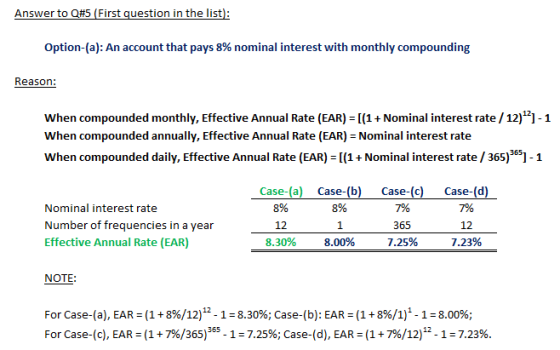
5. Which of the following bank accounts has the highest effective annual return (EAR)? An account...
Which of the following bank accounts has the highest effective annual return (ear)
Which of the following bank accounts has the highest effective annual return? a. An account that pays 8% nominal interest with monthly compounding. b. An account that pays 8% nominal interest with annual compounding. c. An account that pays 7% nominal interest with daily (365-day) compounding. d. An account that pays 7% nominal interest with monthly compounding. e. An account that pays 8% nominal interest with daily (365-day) compounding.
Question 4 Which of the following bank accounts has the LOWEST effective annual return? An account...
 Question 4 Which of the following bank accounts has the LOWEST effective annual return? An account that pays 12% nominal interest with monthly compounding. An account that pays 13% nominal interest with quarterly compounding. An account that pays 13% nominal interest with semiannual compounding. An account that pays 12% nominal interest with daily compounding
11) Which of the following typically has the lowest yield? A) 5-year AAA corporate bond B)...
 11) Which of the following typically has the lowest yield? A) 5-year AAA corporate bond B) 2-year U.S. Treasury note C) Fed Funds D) 3-month U.S. Treasury bill 12) Debt instruments are also called: A) adjustable notes B) credit instruments C) perpetual securities D) interest rate swaps 13) Which of the following characteristic is NOT fixed on a coupon bond? A) Current yield B) Coupon rate C) Maturity D) Par amount 14) If you purchased a U.S. Treasury at a...
Inflation is expected to increase steadily over the next 10 years, there is a positive maturity...
Inflation is expected to increase steadily over the next 10 years, there is a positive maturity risk premium on both Treasury and corporate bonds, and the real risk-free rate of interest is expected to remain constant. Which of the following statements is CORRECT? a. The yield on 7-year corporate bonds must exceed the yield on 10-year Treasury bonds. b. The stated conditions cannot all be true – they are internally inconsistent. c. The yield on any corporate bond must exceed...
4.Which of the following statements is (are) correct?(x)A 2-year Treasury security has a higher liquidity risk...
4.Which of the following statements is (are) correct?(x)A 2-year Treasury security has a higher liquidity risk premium than a 2-year corporate bond because the current White House administration is in the process of melting down (liquifying).(y)AAA corporate bonds have a lower interest rate than BBB corporate bonds because the default risk premium is higher on a BBB corporate bond than a AAA corporate bond.(z)The higher the default risk, the higher the interest rate that security buyers will demand. A.(x), (y)...
Which of the following statements is CORRECT? Select one: a. If inflation is expected to increase,...
Which of the following statements is CORRECT? Select one: a. If inflation is expected to increase, then the yield on a 2-year bond should exceed that on a 3-year bond. b. The real risk-free rate should increase if people expect inflation to increase. c. The yield on a 3-year corporate bond should always exceed the yield on a 2-year corporate bond. d. The yield on a 3-year Treasury bond should always exceed the yield on a 2-year Treasury bond. e....
2. Which of the following statements is CORRECT? a. If the maturity risk premium (MRP) is...
 2. Which of the following statements is CORRECT? a. If the maturity risk premium (MRP) is greater than zero, the Treasury bond yield curve must be upward sloping. b. If the maturity risk premium (MRP) equals zero, the Treasury bond yield curve must be flat. e. If inflation is expected to decrease in the future and the maturity risk premium (MRP) is greater than zero, the Treasury bond yield curve must be downward sloping d. If the expectations theory holds,...
drop down option the same for all questions Which tend to be more volatile, short- or...
 drop down option the same for all questions
Which tend to be more volatile, short- or long-term interest rates? Long-term interest rates Short-term interest rates If the inflation rate was 2.60% and the nominal interest rate was 6.00% over the last year, what was the real rate of interest over the last year? Disregard cross-product terms; that is, if averaging is required, use the arithmetic average. O 3.40% 3.91% 2.89% 4.25% Component Symbol Characteristic This is the rate for a...
drop down option the same for all questions
Which tend to be more volatile, short- or long-term interest rates? Long-term interest rates Short-term interest rates If the inflation rate was 2.60% and the nominal interest rate was 6.00% over the last year, what was the real rate of interest over the last year? Disregard cross-product terms; that is, if averaging is required, use the arithmetic average. O 3.40% 3.91% 2.89% 4.25% Component Symbol Characteristic This is the rate for a...
coupon bond that has a culle coupon bond that he Which of the following statement is...
 coupon bond that has a culle coupon bond that he Which of the following statement is correct for a 10 yield of 76? A) The bond's internal rate of return is 79 B) The bond's market value is higher than its face value C) The face value of the bond has decreased D) The bond's maturity value exceeds the bond's price. - interest will be earned in an account into which S1.000 is deposited for one year with continuous compounding...
The real risk-free rate of interest is expected to remain constant at 2.5% for the foreseeable...
The real risk-free rate of interest is expected to remain constant at 2.5% for the foreseeable future. However, inflation is expected to increase steadily over the next 30 years, so the Treasury yield curve has an upward slope. Assume that the pure expectations theory holds. You are also considering two corporate bonds, one with a 3-year maturity and one with a 5-year maturity. Both have the same default and liquidity risks. Given these assumptions, which of these statements is CORRECT?...
 Question 4 Which of the following bank accounts has the LOWEST effective annual return? An account that pays 12% nominal interest with monthly compounding. An account that pays 13% nominal interest with quarterly compounding. An account that pays 13% nominal interest with semiannual compounding. An account that pays 12% nominal interest with daily compounding
 11) Which of the following typically has the lowest yield? A) 5-year AAA corporate bond B) 2-year U.S. Treasury note C) Fed Funds D) 3-month U.S. Treasury bill 12) Debt instruments are also called: A) adjustable notes B) credit instruments C) perpetual securities D) interest rate swaps 13) Which of the following characteristic is NOT fixed on a coupon bond? A) Current yield B) Coupon rate C) Maturity D) Par amount 14) If you purchased a U.S. Treasury at a...
 2. Which of the following statements is CORRECT? a. If the maturity risk premium (MRP) is greater than zero, the Treasury bond yield curve must be upward sloping. b. If the maturity risk premium (MRP) equals zero, the Treasury bond yield curve must be flat. e. If inflation is expected to decrease in the future and the maturity risk premium (MRP) is greater than zero, the Treasury bond yield curve must be downward sloping d. If the expectations theory holds,...
 drop down option the same for all questions
Which tend to be more volatile, short- or long-term interest rates? Long-term interest rates Short-term interest rates If the inflation rate was 2.60% and the nominal interest rate was 6.00% over the last year, what was the real rate of interest over the last year? Disregard cross-product terms; that is, if averaging is required, use the arithmetic average. O 3.40% 3.91% 2.89% 4.25% Component Symbol Characteristic This is the rate for a...
drop down option the same for all questions
Which tend to be more volatile, short- or long-term interest rates? Long-term interest rates Short-term interest rates If the inflation rate was 2.60% and the nominal interest rate was 6.00% over the last year, what was the real rate of interest over the last year? Disregard cross-product terms; that is, if averaging is required, use the arithmetic average. O 3.40% 3.91% 2.89% 4.25% Component Symbol Characteristic This is the rate for a...
 coupon bond that has a culle coupon bond that he Which of the following statement is correct for a 10 yield of 76? A) The bond's internal rate of return is 79 B) The bond's market value is higher than its face value C) The face value of the bond has decreased D) The bond's maturity value exceeds the bond's price. - interest will be earned in an account into which S1.000 is deposited for one year with continuous compounding...
Most questions answered within 3 hours.
-
Where is the error in this code sequence?
String s1 = "Hello";
String s2 = "ello";...
asked 11 months ago -
Financial data for Joel de Paris, Inc., for last year
follow:
Joel de Paris, Inc.
Balance...
asked 11 months ago -
Consider this reaction:
Al2(SO4)3 (aq)+ BaCl3
(aq) Al2Cl6 (aq)- +
3BaSO4(s) . What is the...
asked 11 months ago -
Suppose that Savneet is considering increasing her
recent random sample from 20 car rentals to 40...
asked 11 months ago -
Trucks arrive at an unloading terminal at an average rate of 120
per hour.
Trucks arrive...
asked 11 months ago -
Why are methanol and ethanol completely soluble in water while
octanol is not very little soluble....
asked 11 months ago -
A facilities manager at a university reads in a research report
that the mean amount of...
asked 11 months ago -
When the CuSO4 is rehydrated by adding water to the anhydrous
compound, is this an endothermic...
asked 11 months ago -
A ray of sunlight is passing from diamond into crown glass; the
angle of incidence is...
asked 11 months ago -
A block of mass 0.249 kg is placed on top of a light, vertical
spring of...
asked 11 months ago -
how do the kidneys compensate in the presences of acidosis
a) trigger hyperventilate
b) reserve acid...
asked 11 months ago -
Question 501 pts
The rental rate of capital to the firm increases. Which of the
following...
asked 11 months ago