
Homework Answers
Answer:
Given that:
Add Answer to:
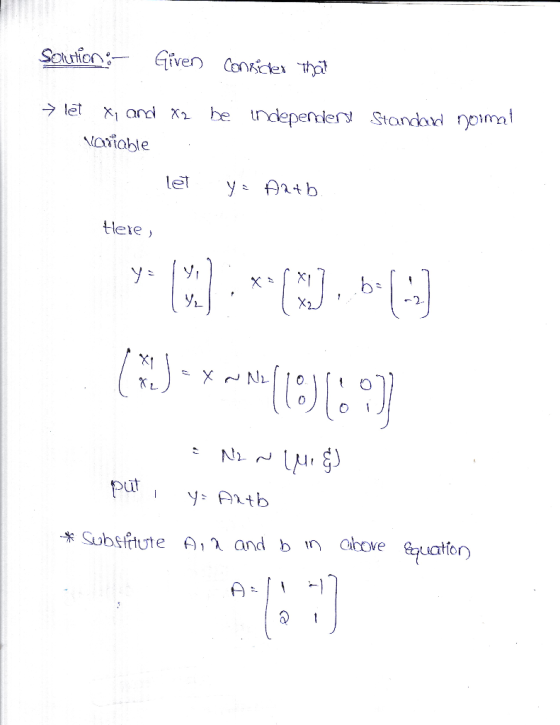
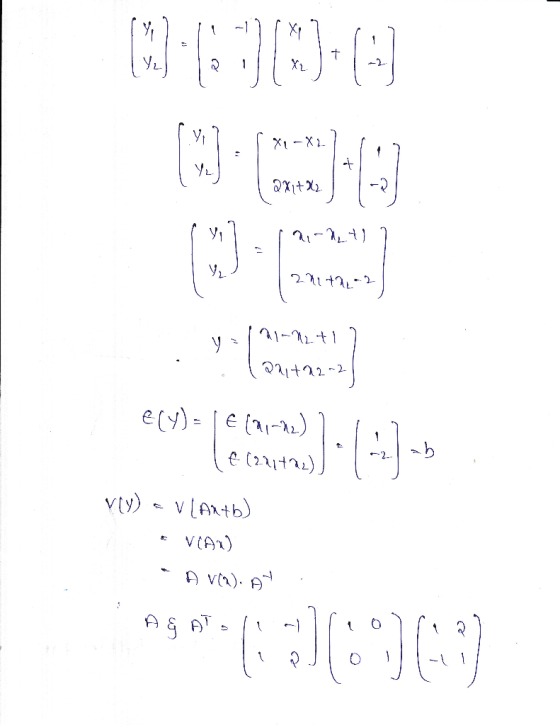
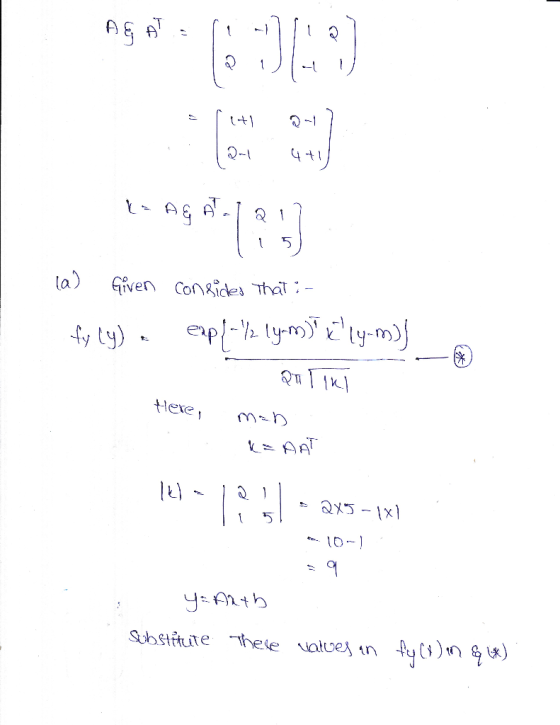
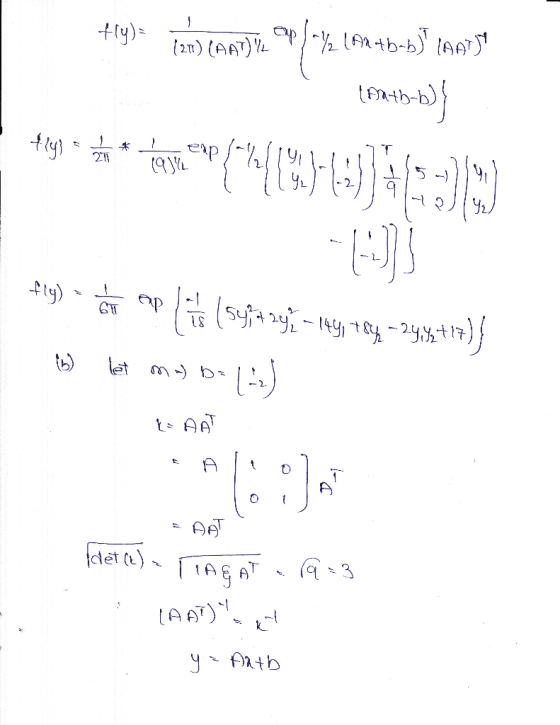
Let X1 and X2 be independent standard normal random vari ables, and let Y-AX-b, where Y-(y, Y)т, ...
Let X1, X2, ..., Xn be independent Exp(2) distributed random vari- ables, and set Y1 =...
 Let X1, X2, ..., Xn be independent Exp(2) distributed random vari- ables, and set Y1 = X(1), and Yk = X(k) – X(k-1), 2<k<n. Find the joint pdf of Yı,Y2, ...,Yn. Hint: Note that (Y1,Y2, ...,Yn) = g(X(1), X(2), ..., X(n)), where g is invertible and differentiable. Use the change of variable formula to derive the joint pdf of Y1, Y2, ...,Yn.
Question 6 [15 marks] Let X1, X2,..., Xn be independent and identically distributed random vari- ables...
 Question 6 [15 marks] Let X1, X2,..., Xn be independent and identically distributed random vari- ables with common probability function ()p(1-p) m m-a ; x 0,1,. ., m otherwise 0 where m is known and p is unknown (a) Obtain the Sequential Probability Ratio Test of Ho p = po versus HA p P, where pi > po, with significance level 0.01 and power 0.95. Describe the test precisely; (b) For the case where po 3/8,pı = 1/2, m =...
4. Let X1,..., Xn be independent, identically distributed random vari- ables with common density 2 log...
 4. Let X1,..., Xn be independent, identically distributed random vari- ables with common density 2 log c)? f(0; 1) = 0<<1, XCV21 (>0). : 212 (a) Find the form of the critical region C'* for the most powerful test of H:/= 1 vs. HQ: >1. (b) Suppose the n = 20 and a = .10. Find the specific value for the cutoff value) K from the critical region C* in part (a). (Hint: Show that Y = (log X/X) is...
(a) For this and the next problem, consider two independent normal random vari- ables Xi and...
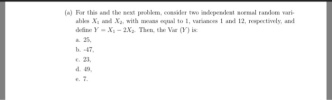 (a) For this and the next problem, consider two independent normal random vari- ables Xi and X2, with means equal to 1, variances 1 and 12, respectively, and define Y = X1-2X2. Then, the Var (Y) is: a. 25, b.-47 e. 23 d. 49 e. 7
Let X1~ exp(1) and X2 ~ exp(1) be independent and identically-distributed exponential random variables with rate...
Let X1~ exp(1) and X2 ~ exp(1) be independent and identically-distributed exponential random variables with rate 1. Let: Y = X1 + X2 , Z = X1 − X2 (a) What is the cdf of X1? (b) What is the joint pdf of (X1, X2)? (c) What is the joint pdf of (Y, Z)? (d) What is the marginal pdf of Z?
Let X1 d= R(0,1) and X2 d= Bernoulli(1/3) be two independent random variables, define Y :=...
Let X1 d= R(0,1) and X2 d= Bernoulli(1/3) be two independent random variables, define Y := X1 + X2 and U := X1X2. (a) Find the state space of Y and derive the cdf FY and pdf fY of Y . (You may wish to use {X2 = i}, i = 0,1, as a partition and apply the total probability formula.) (b) Compute the mean and variance of Y in two different ways, one is through the pdf of Y...
8. An important distribution in the multivariate setting is the multivariate normal distribution. Let X be...
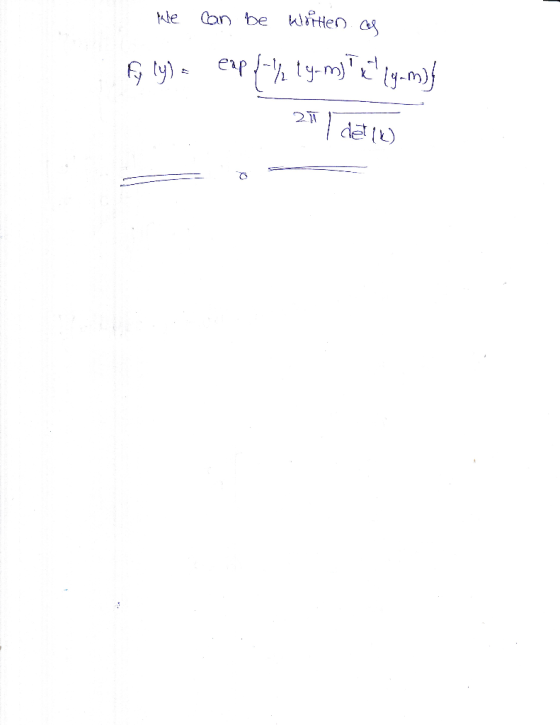
 8. An important distribution in the multivariate setting is the multivariate normal distribution. Let X be a random vector in Rk. That is Xk with X1, X2, ..., xk random variables. If X has a multivariate normal distribution, then its joint pdf is given by f(x) = {27}</2(det 2)1/2 exp {=} (x – u)?g="(x-1)} is the covariant matrix. Note with parameters u, a vector in R", and , a matrix in Rkxk that det is the determinant of matrix ....
4.) Let X1, X2 and X3 be independent uniform random variables on [0,1]. Write Y =...
 4.) Let X1, X2 and X3 be independent uniform random variables on [0,1]. Write Y = X1 + X, and Z X2 + X3 a.) Compute E[X, X,X3]. (5 points) b.) Compute Var(x1). (5 points) c.) Compute and draw a graph of the density function fy (15 points)
4 points) Let X1, X2 be independent random variables, with X1 uniform on (3,9) and X2...
 4 points) Let X1, X2 be independent random variables, with X1 uniform on (3,9) and X2 uniform on (3, 12). Find the joint density of Y = X/X2 and Z = Xi X2 on the support of Y, Z. f(y, z) =
Consider two independent random variables X1 and X2. (continuous) uniformly distributed over (0,1). Let Y by...
Consider two independent random variables X1 and X2. (continuous) uniformly distributed over (0,1). Let Y by the maximum of the two random variables with cumulative distribution function Fy(y). Find Fy (y) where y=0.9. Show all work solution = 0.81
 Let X1, X2, ..., Xn be independent Exp(2) distributed random vari- ables, and set Y1 = X(1), and Yk = X(k) – X(k-1), 2<k<n. Find the joint pdf of Yı,Y2, ...,Yn. Hint: Note that (Y1,Y2, ...,Yn) = g(X(1), X(2), ..., X(n)), where g is invertible and differentiable. Use the change of variable formula to derive the joint pdf of Y1, Y2, ...,Yn.
 Question 6 [15 marks] Let X1, X2,..., Xn be independent and identically distributed random vari- ables with common probability function ()p(1-p) m m-a ; x 0,1,. ., m otherwise 0 where m is known and p is unknown (a) Obtain the Sequential Probability Ratio Test of Ho p = po versus HA p P, where pi > po, with significance level 0.01 and power 0.95. Describe the test precisely; (b) For the case where po 3/8,pı = 1/2, m =...
 4. Let X1,..., Xn be independent, identically distributed random vari- ables with common density 2 log c)? f(0; 1) = 0<<1, XCV21 (>0). : 212 (a) Find the form of the critical region C'* for the most powerful test of H:/= 1 vs. HQ: >1. (b) Suppose the n = 20 and a = .10. Find the specific value for the cutoff value) K from the critical region C* in part (a). (Hint: Show that Y = (log X/X) is...
 (a) For this and the next problem, consider two independent normal random vari- ables Xi and X2, with means equal to 1, variances 1 and 12, respectively, and define Y = X1-2X2. Then, the Var (Y) is: a. 25, b.-47 e. 23 d. 49 e. 7
 8. An important distribution in the multivariate setting is the multivariate normal distribution. Let X be a random vector in Rk. That is Xk with X1, X2, ..., xk random variables. If X has a multivariate normal distribution, then its joint pdf is given by f(x) = {27}</2(det 2)1/2 exp {=} (x – u)?g="(x-1)} is the covariant matrix. Note with parameters u, a vector in R", and , a matrix in Rkxk that det is the determinant of matrix ....
 4.) Let X1, X2 and X3 be independent uniform random variables on [0,1]. Write Y = X1 + X, and Z X2 + X3 a.) Compute E[X, X,X3]. (5 points) b.) Compute Var(x1). (5 points) c.) Compute and draw a graph of the density function fy (15 points)
 4 points) Let X1, X2 be independent random variables, with X1 uniform on (3,9) and X2 uniform on (3, 12). Find the joint density of Y = X/X2 and Z = Xi X2 on the support of Y, Z. f(y, z) =
Most questions answered within 3 hours.
-
Where is the error in this code sequence?
String s1 = "Hello";
String s2 = "ello";...
asked 11 months ago -
Financial data for Joel de Paris, Inc., for last year
follow:
Joel de Paris, Inc.
Balance...
asked 11 months ago -
Consider this reaction:
Al2(SO4)3 (aq)+ BaCl3
(aq) Al2Cl6 (aq)- +
3BaSO4(s) . What is the...
asked 11 months ago -
Suppose that Savneet is considering increasing her
recent random sample from 20 car rentals to 40...
asked 11 months ago -
Trucks arrive at an unloading terminal at an average rate of 120
per hour.
Trucks arrive...
asked 11 months ago -
Why are methanol and ethanol completely soluble in water while
octanol is not very little soluble....
asked 11 months ago -
A facilities manager at a university reads in a research report
that the mean amount of...
asked 11 months ago -
When the CuSO4 is rehydrated by adding water to the anhydrous
compound, is this an endothermic...
asked 11 months ago -
A ray of sunlight is passing from diamond into crown glass; the
angle of incidence is...
asked 11 months ago -
A block of mass 0.249 kg is placed on top of a light, vertical
spring of...
asked 11 months ago -
how do the kidneys compensate in the presences of acidosis
a) trigger hyperventilate
b) reserve acid...
asked 11 months ago -
Question 501 pts
The rental rate of capital to the firm increases. Which of the
following...
asked 11 months ago