
Homework Answers
Add Answer to:
Problem 6: For the two systems shown below, separately, identify the degrees of freedom and then ...
Problem 5: For the system shown below, write the differential equations for small motions of the ...
 Problem 5: For the system shown below, write the differential equations for small motions of the system, in terms of the degrees of freedom (x(t),() Mass of the bar is m, and mass of the block is also m. System is set into motion through suitable initial conditions. Once you find the equations of motion in terms of the respective degrees of freedom, write out the natural frequency and the damping ratio for each sub-system, respectively.
Problem 5: For the...
Problem 5: For the system shown below, write the differential equations for small motions of the system, in terms of the degrees of freedom (x(t),() Mass of the bar is m, and mass of the block is also m. System is set into motion through suitable initial conditions. Once you find the equations of motion in terms of the respective degrees of freedom, write out the natural frequency and the damping ratio for each sub-system, respectively.
Problem 5: For the...
4. problem 4. The mass m is hanging from a cord attached to the circular homogeneous...
 4. problem 4. The mass m is hanging from a cord attached to the circular homogeneous disc of mass M and radius R ft, and is supported by a damper with damping constant c. Excitation force Focos(ot) applies to the block. The disc is restrained from rotation by a spring attached at radius r ft from the center. If the mass is displaced downward from the rest position, determine equation of motion, natural frequency and steady-state response for small vibration...
For the system shown in Figure 6, a. How many degrees of freedom is this system and why? b. Write the equations of moti...
 For the system shown in Figure 6, a. How many degrees of freedom is this system and why? b. Write the equations of motion. For the remainder parts, assume alll the dampers are removed: c. If Ki=K3 and mim3, set the necessary matrix to find the natural frequencies and mode shapes d. For part c above, determine and explain how to get the natural frequencies. m1 Ty Absorber тз k1 С1 k3 m2 C2
For the system shown in Figure...
For the system shown in Figure 6, a. How many degrees of freedom is this system and why? b. Write the equations of motion. For the remainder parts, assume alll the dampers are removed: c. If Ki=K3 and mim3, set the necessary matrix to find the natural frequencies and mode shapes d. For part c above, determine and explain how to get the natural frequencies. m1 Ty Absorber тз k1 С1 k3 m2 C2
For the system shown in Figure...
09. For the two degrees of freedom system shown in Figure 4, determine the steady state response ...
 09. For the two degrees of freedom system shown in Figure 4, determine the steady state response of the system due to a sinusoidal force Fi() 10sin10r applied to the mass block whose displacement isn. Given m = 10 kg, k = 1000N rn and the equations of motion of the system are -지 3m
09. For the two degrees of freedom system shown in Figure 4, determine the steady state response of the system due to a sinusoidal force...
09. For the two degrees of freedom system shown in Figure 4, determine the steady state response of the system due to a sinusoidal force Fi() 10sin10r applied to the mass block whose displacement isn. Given m = 10 kg, k = 1000N rn and the equations of motion of the system are -지 3m
09. For the two degrees of freedom system shown in Figure 4, determine the steady state response of the system due to a sinusoidal force...
Problem 5 (20%) For the system shown in Figure 5, a. How many degrees of freedom is this system and why? (5) b. If x3 0...
 Problem 5 (20%) For the system shown in Figure 5, a. How many degrees of freedom is this system and why? (5) b. If x3 0 (the upper end is fixed and K1 and K2=K Write the equations of motion. Set the necessary matrix to find the natural frequencies and mode shapes (5) (5) (5) 1. 2. 3. Determine and explain how to get the natural frequencies. m2 Figure 5 www
Problem 5 (20%) For the system shown in Figure...
Problem 5 (20%) For the system shown in Figure 5, a. How many degrees of freedom is this system and why? (5) b. If x3 0 (the upper end is fixed and K1 and K2=K Write the equations of motion. Set the necessary matrix to find the natural frequencies and mode shapes (5) (5) (5) 1. 2. 3. Determine and explain how to get the natural frequencies. m2 Figure 5 www
Problem 5 (20%) For the system shown in Figure...
PROBLEM -2 An Inertia J of radius r attached to a fixed axis of rotation A as shown below. The inertia is in contac...
 PROBLEM -2 An Inertia J of radius r attached to a fixed axis of rotation A as shown below. The inertia is in contact with a mass M attached via aspring of stiffness K to a fixed wall. The inertla- mass contact is subject to viscous friction of coefficient f. The motion of the mass with respect to the horlzontal floor is subject to the same viscous friction coefficient f..The system input is a horizontal force f(t) on the mass...
Modelling of mechanical dynamic systems Exercice 1 An disc of an inertia J and radius r...
 Modelling of mechanical dynamic systems Exercice 1 An disc of an inertia J and radius r is attached to a fixed axis of rotation A as shown below. The disc is in contact with a mass M attached via a spring of stiffness K to a fixed wall. The inertia-mass contact is subject to viscous friction of coefficientſ. The motion of the mass with respect to the horizontal floor is subject to the same viscous friction coefficient f.. The system...
Problem 7: Consider the two-degrees of freedom system shown in the figure below, where each disk...
 Problem 7: Consider the two-degrees of freedom system shown in the figure below, where each disk is pivoted at its mass center. The inputs are the torques τι and T2 applied to the pivot points. At t = 0, θί-B2 = τι-T2-0, and each linear spring is at its free length (undeformed). Find the equivalent inertia (la) and stiffness (K matrix T1 T2 02 J2, r2
Test Consider a two-degrees-of-freedom system shown below. ド. PN What is the amplitude of vibration (particular solution only) of mass 2 (at the input frequency)? The answer must be positive. Ke...
 Test Consider a two-degrees-of-freedom system shown below. ド. PN What is the amplitude of vibration (particular solution only) of mass 2 (at the input frequency)? The answer must be positive. Keep 3 significant figures, and omit units. Use m1 2 kg m2 4 kg k1 147 N/m k2 146 N/m K3 192 N/m F1 # 411 cos(0.50 N Note that the system is not damped. The homogeneous response does not decay to zero. The masses vibrates at three different frequencies...
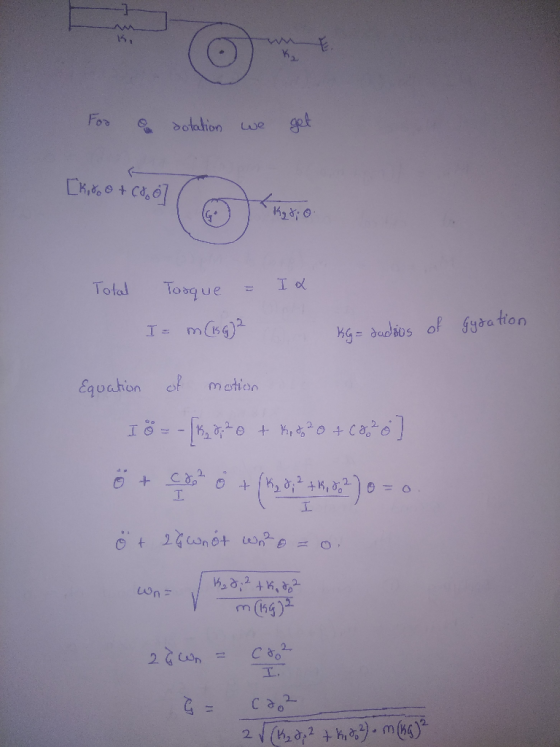
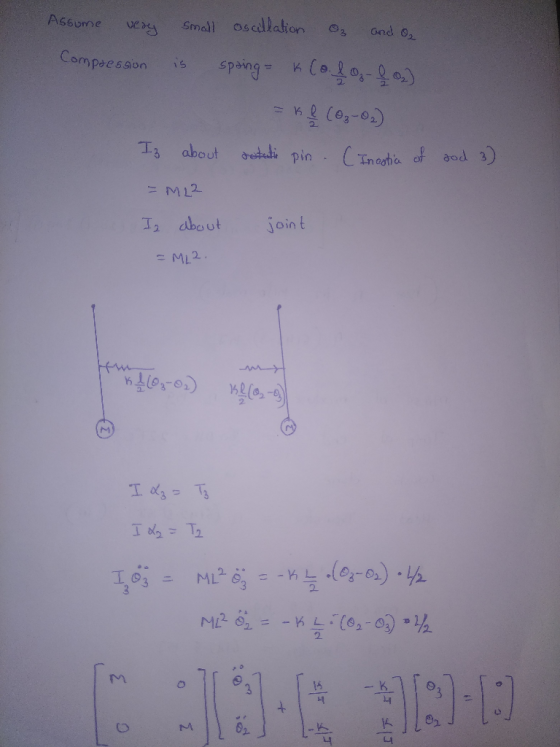
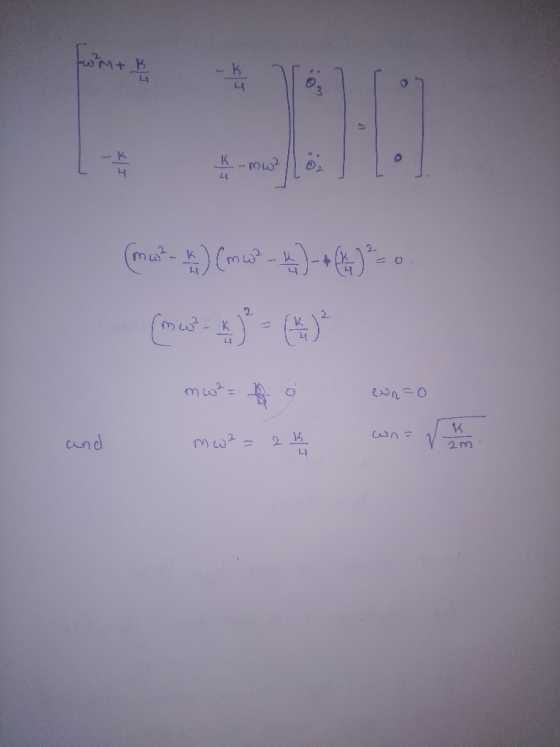
Problem 4: , 03-37 The pendulum shown in the figure oscillates about the pivot at point...
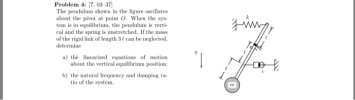 Problem 4: , 03-37 The pendulum shown in the figure oscillates about the pivot at point O. When the sys tem is in equilibrium, the pendulum is verti cal and the spring is unstretched. If the mass of the rigid link of length 3 can be neglected, determine a) the iniz equations of motion about the vertical equilibrium position; 따-E b) the natural frequency and damping ra- tio of the system
 Problem 5: For the system shown below, write the differential equations for small motions of the system, in terms of the degrees of freedom (x(t),() Mass of the bar is m, and mass of the block is also m. System is set into motion through suitable initial conditions. Once you find the equations of motion in terms of the respective degrees of freedom, write out the natural frequency and the damping ratio for each sub-system, respectively.
Problem 5: For the...
Problem 5: For the system shown below, write the differential equations for small motions of the system, in terms of the degrees of freedom (x(t),() Mass of the bar is m, and mass of the block is also m. System is set into motion through suitable initial conditions. Once you find the equations of motion in terms of the respective degrees of freedom, write out the natural frequency and the damping ratio for each sub-system, respectively.
Problem 5: For the...
 4. problem 4. The mass m is hanging from a cord attached to the circular homogeneous disc of mass M and radius R ft, and is supported by a damper with damping constant c. Excitation force Focos(ot) applies to the block. The disc is restrained from rotation by a spring attached at radius r ft from the center. If the mass is displaced downward from the rest position, determine equation of motion, natural frequency and steady-state response for small vibration...
 For the system shown in Figure 6, a. How many degrees of freedom is this system and why? b. Write the equations of motion. For the remainder parts, assume alll the dampers are removed: c. If Ki=K3 and mim3, set the necessary matrix to find the natural frequencies and mode shapes d. For part c above, determine and explain how to get the natural frequencies. m1 Ty Absorber тз k1 С1 k3 m2 C2
For the system shown in Figure...
For the system shown in Figure 6, a. How many degrees of freedom is this system and why? b. Write the equations of motion. For the remainder parts, assume alll the dampers are removed: c. If Ki=K3 and mim3, set the necessary matrix to find the natural frequencies and mode shapes d. For part c above, determine and explain how to get the natural frequencies. m1 Ty Absorber тз k1 С1 k3 m2 C2
For the system shown in Figure...
 09. For the two degrees of freedom system shown in Figure 4, determine the steady state response of the system due to a sinusoidal force Fi() 10sin10r applied to the mass block whose displacement isn. Given m = 10 kg, k = 1000N rn and the equations of motion of the system are -지 3m
09. For the two degrees of freedom system shown in Figure 4, determine the steady state response of the system due to a sinusoidal force...
09. For the two degrees of freedom system shown in Figure 4, determine the steady state response of the system due to a sinusoidal force Fi() 10sin10r applied to the mass block whose displacement isn. Given m = 10 kg, k = 1000N rn and the equations of motion of the system are -지 3m
09. For the two degrees of freedom system shown in Figure 4, determine the steady state response of the system due to a sinusoidal force...
 Problem 5 (20%) For the system shown in Figure 5, a. How many degrees of freedom is this system and why? (5) b. If x3 0 (the upper end is fixed and K1 and K2=K Write the equations of motion. Set the necessary matrix to find the natural frequencies and mode shapes (5) (5) (5) 1. 2. 3. Determine and explain how to get the natural frequencies. m2 Figure 5 www
Problem 5 (20%) For the system shown in Figure...
Problem 5 (20%) For the system shown in Figure 5, a. How many degrees of freedom is this system and why? (5) b. If x3 0 (the upper end is fixed and K1 and K2=K Write the equations of motion. Set the necessary matrix to find the natural frequencies and mode shapes (5) (5) (5) 1. 2. 3. Determine and explain how to get the natural frequencies. m2 Figure 5 www
Problem 5 (20%) For the system shown in Figure...
 PROBLEM -2 An Inertia J of radius r attached to a fixed axis of rotation A as shown below. The inertia is in contact with a mass M attached via aspring of stiffness K to a fixed wall. The inertla- mass contact is subject to viscous friction of coefficient f. The motion of the mass with respect to the horlzontal floor is subject to the same viscous friction coefficient f..The system input is a horizontal force f(t) on the mass...
 Modelling of mechanical dynamic systems Exercice 1 An disc of an inertia J and radius r is attached to a fixed axis of rotation A as shown below. The disc is in contact with a mass M attached via a spring of stiffness K to a fixed wall. The inertia-mass contact is subject to viscous friction of coefficientſ. The motion of the mass with respect to the horizontal floor is subject to the same viscous friction coefficient f.. The system...
 Problem 7: Consider the two-degrees of freedom system shown in the figure below, where each disk is pivoted at its mass center. The inputs are the torques τι and T2 applied to the pivot points. At t = 0, θί-B2 = τι-T2-0, and each linear spring is at its free length (undeformed). Find the equivalent inertia (la) and stiffness (K matrix T1 T2 02 J2, r2
 Test Consider a two-degrees-of-freedom system shown below. ド. PN What is the amplitude of vibration (particular solution only) of mass 2 (at the input frequency)? The answer must be positive. Keep 3 significant figures, and omit units. Use m1 2 kg m2 4 kg k1 147 N/m k2 146 N/m K3 192 N/m F1 # 411 cos(0.50 N Note that the system is not damped. The homogeneous response does not decay to zero. The masses vibrates at three different frequencies...
 Problem 4: , 03-37 The pendulum shown in the figure oscillates about the pivot at point O. When the sys tem is in equilibrium, the pendulum is verti cal and the spring is unstretched. If the mass of the rigid link of length 3 can be neglected, determine a) the iniz equations of motion about the vertical equilibrium position; 따-E b) the natural frequency and damping ra- tio of the system
Most questions answered within 3 hours.
-
Where is the error in this code sequence?
String s1 = "Hello";
String s2 = "ello";...
asked 11 months ago -
Financial data for Joel de Paris, Inc., for last year
follow:
Joel de Paris, Inc.
Balance...
asked 11 months ago -
Consider this reaction:
Al2(SO4)3 (aq)+ BaCl3
(aq) Al2Cl6 (aq)- +
3BaSO4(s) . What is the...
asked 11 months ago -
Suppose that Savneet is considering increasing her
recent random sample from 20 car rentals to 40...
asked 11 months ago -
Trucks arrive at an unloading terminal at an average rate of 120
per hour.
Trucks arrive...
asked 11 months ago -
Why are methanol and ethanol completely soluble in water while
octanol is not very little soluble....
asked 11 months ago -
A facilities manager at a university reads in a research report
that the mean amount of...
asked 11 months ago -
When the CuSO4 is rehydrated by adding water to the anhydrous
compound, is this an endothermic...
asked 11 months ago -
A ray of sunlight is passing from diamond into crown glass; the
angle of incidence is...
asked 11 months ago -
A block of mass 0.249 kg is placed on top of a light, vertical
spring of...
asked 11 months ago -
how do the kidneys compensate in the presences of acidosis
a) trigger hyperventilate
b) reserve acid...
asked 11 months ago -
Question 501 pts
The rental rate of capital to the firm increases. Which of the
following...
asked 11 months ago