Linear System
Time-invariant, impulse response function

Homework Answers
Add Answer to:
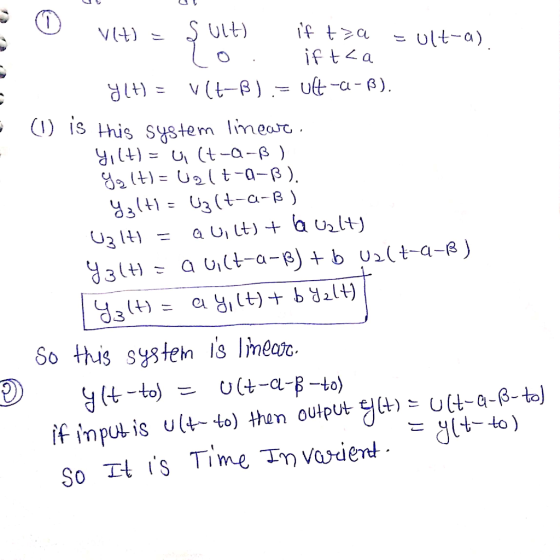
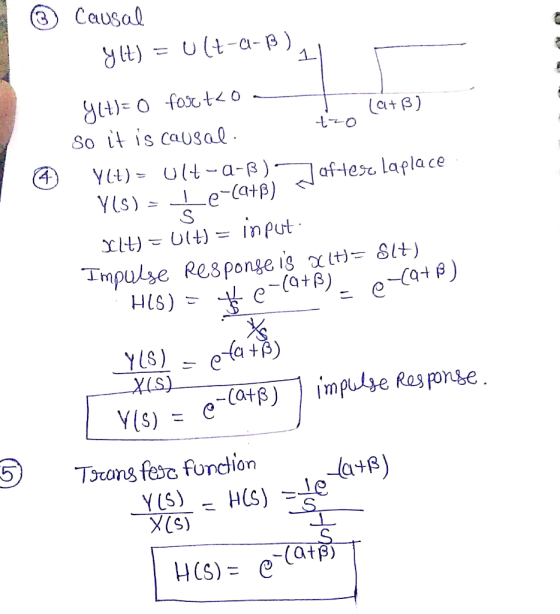
1. Consider a system R(α, β) which can be represented by operators P,, Qß. R(α, β) Here P is a tr...
2. Consider a linear time-invariant system with transfer function H(s)Find the (s + α)(s + β) impulse response, h(t), of the system 2. Consider a linear time-invariant system with transfer f...
 2. Consider a linear time-invariant system with transfer function H(s)Find the (s + α)(s + β) impulse response, h(t), of the system
2. Consider a linear time-invariant system with transfer function H(s)Find the (s + α)(s + β) impulse response, h(t), of the system
2. Consider a linear time-invariant system with transfer function H(s)Find the (s + α)(s + β) impulse response, h(t), of the system
1. Suppose that Y ∼ Gamma(α, β) and c > 0 is a constant. (a) Derive the density function of U ...
 1. Suppose that Y ∼ Gamma(α, β) and c > 0 is a constant. (a)
Derive the density function of U = cY. (b) Identify the
distribution of U as a standard distribution. Be sure to identify
any parameter values. (c) Can you find the distribution of U using
MGF method also?
I. Suppose that Y ~ Gamma(α, β) and c > 0 is a constant. (a) Derive the density function of U cY. (b) Identify the distribution of U...
1. Suppose that Y ∼ Gamma(α, β) and c > 0 is a constant. (a)
Derive the density function of U = cY. (b) Identify the
distribution of U as a standard distribution. Be sure to identify
any parameter values. (c) Can you find the distribution of U using
MGF method also?
I. Suppose that Y ~ Gamma(α, β) and c > 0 is a constant. (a) Derive the density function of U cY. (b) Identify the distribution of U...
1. Problems on unitary operators. For a function f(r) that can be expanded in a Taylor...
 1. Problems on unitary operators. For a function f(r) that can be expanded in a Taylor series, show that Here a is a constant, and pis the momentum operator. The exponential of an operator is defined as ea_ ??? i,O" Verify that the unitary operator elo/h can be constructed as follows (Hint: Notice that f(x +a) (al) and eohf())) e Prove that Here is the position operator. (Hint: You may work in the momentum space, in which p = p...
P2.19 A linear and time-invariant system is described by the difference equation y(n) 0.5y(n 10.25y(n 2)-x(n)...
 P2.19 A linear and time-invariant system is described by the difference equation y(n) 0.5y(n 10.25y(n 2)-x(n) + 2r(n - 1) + r(n -3) 1. Using the filter function, compute and plot the impulse response of the system over 0n100. 2. Determine the stability of the system from this impulse response. 3. If the input to this system is r(n) 5 3 cos(0.2Tm) 4sin(0.6Tn)] u(n), determine the 200 using the filter function response y(n) over 0 n
Problem 4. Given the input/output system represented by t-1 y(t) = 2 ( x(y - 3)...
 Problem 4. Given the input/output system represented by t-1 y(t) = 2 ( x(y - 3) dy where x(t) is the input and y(t) is the output, a) Determine whether the system is linear or non-linear. b) Determine the impulse response h(t, to) of the system by setting x(t)= 8(t–to). c) Determine whether the system is time invariant or time variant. d) Determine whether the system is causal or non-causal.
(L43*) Spin can be represented by matrices. Show that all three spin matrices l 0 2 0 -1 0),"2=2 1 have eigenval...
 (L43*) Spin can be represented by matrices. Show that all three spin matrices l 0 2 0 -1 0),"2=2 1 have eigenvalues of +1/2h and -1/2h. Calculate the corresponding eigenfunctions which we will denote as α-and β-eigenfunctions corresponding to spin l/2 particles. Show that Sj can be determined by the commutation of the other two matrices sn and sm, n, maj. Prove that the (2×2) matrix sz-s' +ss+s, commutes with all spin matrices, ie. s2s,-sis-. Calculate the eigenvalues of s2....
4. Let G : P(R) → P2(R) be a linear map given by G(u)(x) = (x...
 4. Let G : P(R) → P2(R) be a linear map given by G(u)(x) = (x + 1)u'r) - ur). Is G diagonalizable? If it is, find a basis of P(R) in which G is represented by a diagonal matrix 5. Let V = P2(C). Show that the operator (.) given by (u, v) = u(0) v(0) + u(1) v(1) + u(2) v(2) Vu, v E V is an inner product on V.
The diagram in Fig. 1 depicts a cascade connection of two linear time-invariant systems; i.e., the...
 The diagram in Fig. 1 depicts a cascade connection of two linear time-invariant systems; i.e., the output of the first system is the input to the second system, and the overall output is the output of the second system. LTI System #1 hi[n] LTI System #2 h21n] r[n] iIn] yInl Figure 1: Cascade connection of two LTI systems (a) Suppose that System #l is a blurring filter described by the impulse response 0 "=0.1.2.3.4.5 n>5 and System #2 is described...
3. (20 pts) Consider a periodic signal x(t) which can be represented by the first K Fourier Serie...
 3. (20 pts) Consider a periodic signal x(t) which can be represented by the first K Fourier Series coefficients. Determine the impulse response of the system that can yield x(t) when it is contaminated by a noise r(t) (i.e., the input to the system is x(t)r(t) and the output is r(t)), assuming that r(t) is composed of only very high-frequency components (namely, Ffr(t)) Rjw)-0 for lul < K2π/T, where T is the period of x(t))
3. (20 pts) Consider a...
3. (20 pts) Consider a periodic signal x(t) which can be represented by the first K Fourier Series coefficients. Determine the impulse response of the system that can yield x(t) when it is contaminated by a noise r(t) (i.e., the input to the system is x(t)r(t) and the output is r(t)), assuming that r(t) is composed of only very high-frequency components (namely, Ffr(t)) Rjw)-0 for lul < K2π/T, where T is the period of x(t))
3. (20 pts) Consider a...
2. The ladder operators can be used to determine the lowest eigenstate (ground state) of the...
 2. The ladder operators can be used to determine the lowest eigenstate (ground state) of the harmonic oscillator by using the following relation of the annihilation operator, à alo) - 0 This equation is fundamental to ladder operators and implies that it is not possible to step down further in energy than the ground state. Determine the ground state wave function h(x (i.e. [0) using the relation above and the following information The annihilation operator is defined as: ) ·The...
 2. Consider a linear time-invariant system with transfer function H(s)Find the (s + α)(s + β) impulse response, h(t), of the system
2. Consider a linear time-invariant system with transfer function H(s)Find the (s + α)(s + β) impulse response, h(t), of the system
2. Consider a linear time-invariant system with transfer function H(s)Find the (s + α)(s + β) impulse response, h(t), of the system
 1. Suppose that Y ∼ Gamma(α, β) and c > 0 is a constant. (a)
Derive the density function of U = cY. (b) Identify the
distribution of U as a standard distribution. Be sure to identify
any parameter values. (c) Can you find the distribution of U using
MGF method also?
I. Suppose that Y ~ Gamma(α, β) and c > 0 is a constant. (a) Derive the density function of U cY. (b) Identify the distribution of U...
1. Suppose that Y ∼ Gamma(α, β) and c > 0 is a constant. (a)
Derive the density function of U = cY. (b) Identify the
distribution of U as a standard distribution. Be sure to identify
any parameter values. (c) Can you find the distribution of U using
MGF method also?
I. Suppose that Y ~ Gamma(α, β) and c > 0 is a constant. (a) Derive the density function of U cY. (b) Identify the distribution of U...
 1. Problems on unitary operators. For a function f(r) that can be expanded in a Taylor series, show that Here a is a constant, and pis the momentum operator. The exponential of an operator is defined as ea_ ??? i,O" Verify that the unitary operator elo/h can be constructed as follows (Hint: Notice that f(x +a) (al) and eohf())) e Prove that Here is the position operator. (Hint: You may work in the momentum space, in which p = p...
 P2.19 A linear and time-invariant system is described by the difference equation y(n) 0.5y(n 10.25y(n 2)-x(n) + 2r(n - 1) + r(n -3) 1. Using the filter function, compute and plot the impulse response of the system over 0n100. 2. Determine the stability of the system from this impulse response. 3. If the input to this system is r(n) 5 3 cos(0.2Tm) 4sin(0.6Tn)] u(n), determine the 200 using the filter function response y(n) over 0 n
 Problem 4. Given the input/output system represented by t-1 y(t) = 2 ( x(y - 3) dy where x(t) is the input and y(t) is the output, a) Determine whether the system is linear or non-linear. b) Determine the impulse response h(t, to) of the system by setting x(t)= 8(t–to). c) Determine whether the system is time invariant or time variant. d) Determine whether the system is causal or non-causal.
 (L43*) Spin can be represented by matrices. Show that all three spin matrices l 0 2 0 -1 0),"2=2 1 have eigenvalues of +1/2h and -1/2h. Calculate the corresponding eigenfunctions which we will denote as α-and β-eigenfunctions corresponding to spin l/2 particles. Show that Sj can be determined by the commutation of the other two matrices sn and sm, n, maj. Prove that the (2×2) matrix sz-s' +ss+s, commutes with all spin matrices, ie. s2s,-sis-. Calculate the eigenvalues of s2....
 4. Let G : P(R) → P2(R) be a linear map given by G(u)(x) = (x + 1)u'r) - ur). Is G diagonalizable? If it is, find a basis of P(R) in which G is represented by a diagonal matrix 5. Let V = P2(C). Show that the operator (.) given by (u, v) = u(0) v(0) + u(1) v(1) + u(2) v(2) Vu, v E V is an inner product on V.
 The diagram in Fig. 1 depicts a cascade connection of two linear time-invariant systems; i.e., the output of the first system is the input to the second system, and the overall output is the output of the second system. LTI System #1 hi[n] LTI System #2 h21n] r[n] iIn] yInl Figure 1: Cascade connection of two LTI systems (a) Suppose that System #l is a blurring filter described by the impulse response 0 "=0.1.2.3.4.5 n>5 and System #2 is described...
 3. (20 pts) Consider a periodic signal x(t) which can be represented by the first K Fourier Series coefficients. Determine the impulse response of the system that can yield x(t) when it is contaminated by a noise r(t) (i.e., the input to the system is x(t)r(t) and the output is r(t)), assuming that r(t) is composed of only very high-frequency components (namely, Ffr(t)) Rjw)-0 for lul < K2π/T, where T is the period of x(t))
3. (20 pts) Consider a...
3. (20 pts) Consider a periodic signal x(t) which can be represented by the first K Fourier Series coefficients. Determine the impulse response of the system that can yield x(t) when it is contaminated by a noise r(t) (i.e., the input to the system is x(t)r(t) and the output is r(t)), assuming that r(t) is composed of only very high-frequency components (namely, Ffr(t)) Rjw)-0 for lul < K2π/T, where T is the period of x(t))
3. (20 pts) Consider a...
 2. The ladder operators can be used to determine the lowest eigenstate (ground state) of the harmonic oscillator by using the following relation of the annihilation operator, à alo) - 0 This equation is fundamental to ladder operators and implies that it is not possible to step down further in energy than the ground state. Determine the ground state wave function h(x (i.e. [0) using the relation above and the following information The annihilation operator is defined as: ) ·The...
Most questions answered within 3 hours.
-
Where is the error in this code sequence?
String s1 = "Hello";
String s2 = "ello";...
asked 11 months ago -
Financial data for Joel de Paris, Inc., for last year
follow:
Joel de Paris, Inc.
Balance...
asked 11 months ago -
Consider this reaction:
Al2(SO4)3 (aq)+ BaCl3
(aq) Al2Cl6 (aq)- +
3BaSO4(s) . What is the...
asked 11 months ago -
Suppose that Savneet is considering increasing her
recent random sample from 20 car rentals to 40...
asked 11 months ago -
Trucks arrive at an unloading terminal at an average rate of 120
per hour.
Trucks arrive...
asked 11 months ago -
Why are methanol and ethanol completely soluble in water while
octanol is not very little soluble....
asked 11 months ago -
A facilities manager at a university reads in a research report
that the mean amount of...
asked 11 months ago -
When the CuSO4 is rehydrated by adding water to the anhydrous
compound, is this an endothermic...
asked 11 months ago -
A ray of sunlight is passing from diamond into crown glass; the
angle of incidence is...
asked 11 months ago -
A block of mass 0.249 kg is placed on top of a light, vertical
spring of...
asked 11 months ago -
how do the kidneys compensate in the presences of acidosis
a) trigger hyperventilate
b) reserve acid...
asked 11 months ago -
Question 501 pts
The rental rate of capital to the firm increases. Which of the
following...
asked 11 months ago