
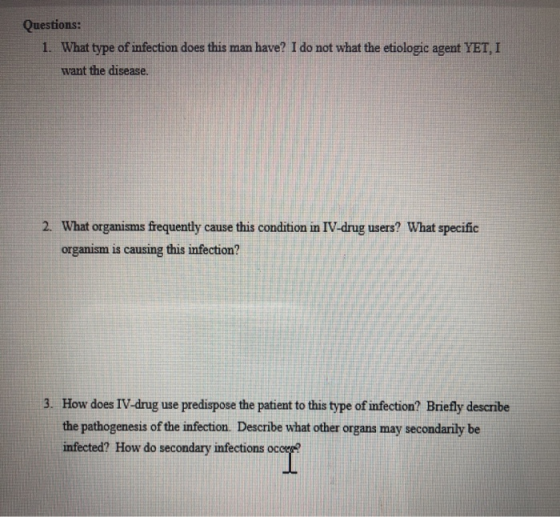
Questions: 1. What type of infection does this man have? I do not what the etiologic agent YET, I want the disease. 2. What organisms frequently cause this condition in IV-drug users? What specific organism is causing this infection? How does IV-drug use predispose the patient to this type of infection? Briefly describe the pathogenesis of the infection. Describe what other organs may secondarily be infected? How do secondary infections oc 3.
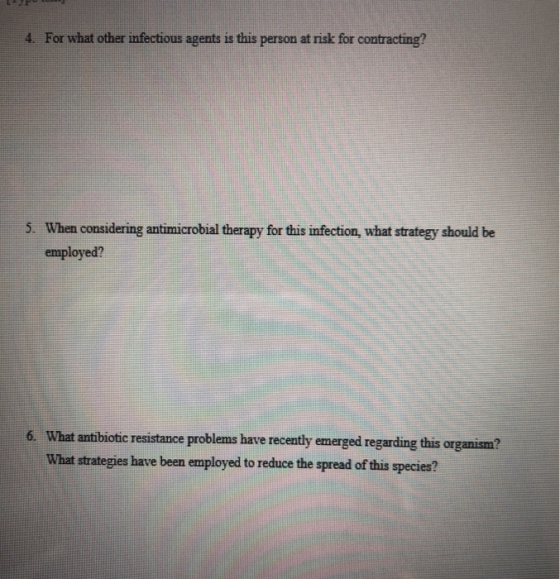
For what other infectious agents is this person at risk for contracting? 4. 5. When considering antimicrobial therapy for this infection, what strategy should be employed? 6. What antibiotic resistance problems have recently emerged regarding this organism? What strategies have been employed to reduce the spread of this species?
Homework Answers
1.The signs and symptoms typically suggest the patient is having a bacterial infection.He has infective endocarditis
2.The organism which usually causes this infection belongs to Staphyllococcus aureus or Streptococci group or cat glass negative staphyllococcus.
Catalyse negative staphyllococcus is the specific organism ca using this disease
3.The main predisposing factor is the infected or unsterile needle used in injection. The use of same needle by multiple persons.
When a individual (IV drug users)inject the drug via vein>>enters the blood stream>>reaches the circulatory system >>enters the heart to disperse and multiply>>valves are affected >>vegetative state of the valves>>called as vascular vegetation >>infective endocarditis (bacterial growth,vegetation and poor immune response)
It may affect the kidney causing kidney failure and brain leading to stroke.This occurs because the infected heart with bacterial growth reaches the main organs via circulation and causing damage to other organs
4.The person is at risk of contracting human immunodeficiency virus due to the use of IV drugs.
Add Answer to:
Ch. 18-Cardiovascular Infections A 39 year-old intravenous heroin user (who was also actively usi...
Ch. 18-Cardiovascular Infections A 39 year-old intravenous heroin user (who was also actively using cocaine on...
 Ch. 18-Cardiovascular Infections A 39 year-old intravenous heroin user (who was also actively using cocaine on the date of admission) was admitted with cellulitis on the right arm after experiencing fevers for several weeks. He had been treated with outpatient antibiotics without relief of either associated chills or dizziness. Two sets of blood were obtained upon admission. A trans-thoracic echocardiogram demonstrated a 1 cm vegetation on the ventral surface of the aortic valve. The patient left the hospital against medical...
Ch. 18-Cardiovascular Infections A 39 year-old intravenous heroin user (who was also actively using cocaine on...
 Ch. 18-Cardiovascular Infections A 39 year-old intravenous heroin user (who was also actively using cocaine on the date of admission) was admitted with cellulitis on the right arm after experiencing fevers for several weeks. He had been treated with outpatient antibiotics without relief of either associated chills or dizziness. Two sets of blood were obtained upon admission. A trans-thoracic echocardiogram demonstrated a 1 cm vegetation on the ventral surface of the aortic valve. The patient left the hospital against medical...
When considering antimicrobial therapy for this infection, what strategy should be employed? What antibiotic resistance problems...
 When considering antimicrobial therapy for this infection,
what strategy should be employed?
What antibiotic resistance problems have recently emerged
regarding this organism? What strategies have been employed to
reduce the spread of this species?
Ch. 18-Cardiovascular Infections A 39 year-old intravenous heroin user (who was also actively using cocaine on the date of admission) was admitted with cellulitis on the right arm after experiencing fevers for several weeks. He had been treated with outpatient antibiotics without relief of either associated...
When considering antimicrobial therapy for this infection,
what strategy should be employed?
What antibiotic resistance problems have recently emerged
regarding this organism? What strategies have been employed to
reduce the spread of this species?
Ch. 18-Cardiovascular Infections A 39 year-old intravenous heroin user (who was also actively using cocaine on the date of admission) was admitted with cellulitis on the right arm after experiencing fevers for several weeks. He had been treated with outpatient antibiotics without relief of either associated...
BIOL 2267 Ch. 21- Genitourinary Tract Infections The patient was a 15 year-old male who was...
 BIOL 2267 Ch. 21- Genitourinary Tract Infections The patient was a 15 year-old male who was brought to the emergency room by his sister. He gave a 24-hour history of dysuria and noted some "pus-like" discharge in his underwear and from the tip of the penis. His urine appeared to be clear, and a urine culture was negative, although urinalysis was positive for leukocyte esterase and multiple WBC upon microscopic examination of the urine sample. He gave a history of...
BIOL 2267 Ch. 19-Respiratory Infections The patient was a 55-year-old male with a 2-month history of...
 BIOL 2267 Ch. 19-Respiratory Infections The patient was a 55-year-old male with a 2-month history of fevers, night sweats, increased cough with sputum production, and a 25 pound weight loss. The patient denied IV drug use. The patient claims to have had multiple heterosexual sexual encounters over the past several months, and "sips" a pint of gin daily. He was jailed two years ago in Chicago and has a history of multiple gunshot and stab wounds. His physical examination was...
An 83-year-old woman was admitted to the hospital following a fever and hypotensive episode while at...
An 83-year-old woman was admitted to the hospital following a fever and hypotensive episode while at a nursing home. The patient had a clinical history of rheumatoid arthritis, hypertension, atrioventricular block, gastroesophageal reflux disease, deep vein thrombosis with pulmonary embolism, and depression. The patient also had a history of recurrent prosthetic left knee joint infections subsequent to the total knee arthroplasty 2 years earlier. Vancomycin-resistant enterococcus (VRE), Enterococcus faecium, was the predominate organism isolated from synovial fluid taken from her...
need help with 7-9 questions A 48 y/o man had a long history of alcoholism (including...
 need help with 7-9 questions
A 48 y/o man had a long history of alcoholism (including alcoholic hepatitis and hallucinosis) and was admitted to the intensive care unit with profound hypotension and gastrointestinal bleeding. He was intubated and given intravenous fluids and transfused with packed red blood cells. He remained intubated and ventilator dependent for several weeks. He developed fevers and was treated with broad-spectrum antibiotics. Culture of his tracheal aspirate initially showed Staphylococcus aureus. After further antibiotic therapy, Gram...
need help with 7-9 questions
A 48 y/o man had a long history of alcoholism (including alcoholic hepatitis and hallucinosis) and was admitted to the intensive care unit with profound hypotension and gastrointestinal bleeding. He was intubated and given intravenous fluids and transfused with packed red blood cells. He remained intubated and ventilator dependent for several weeks. He developed fevers and was treated with broad-spectrum antibiotics. Culture of his tracheal aspirate initially showed Staphylococcus aureus. After further antibiotic therapy, Gram...
A 45-year-old homeless man who abuses alcohol presents to the emergency department with fever and cough...
 A 45-year-old homeless man who abuses alcohol presents to the emergency department with fever and cough of 4-day duration. The cough is productive with thick, bloody phlegm. He complains of pain in the right side of his chest with coughing or taking a deep breath. He denies any other medical history and says he cannot remember the last time he saw a doctor. He does not smoke cigarettes but says he drinks a pint of whiskey whenever he can get...
Ch. 20- Gastrointestinal Infections The patient is a 4-year-old male who presented to the emergency room...
 Ch. 20- Gastrointestinal Infections The patient is a 4-year-old male who presented to the emergency room with a 2 hour history of vomiting, diarrhea, fever, iritability, and lethargy. The child had gone to sleep on the living room couch at 23:00. His grandmother found him on the floor at 03:00 covered with feces. When she picked him up to carry hin to the bath tub, she noticed he was febrile (showing signs of fever). She bathed him, and brought him...
A 34 y/o male with a history of tobacco and alcohol abuse (12 cans of beer...
 A 34 y/o male with a history of tobacco and alcohol abuse (12 cans of beer per day) was admitted to the hospital. Two months prior to admissi have a necrotic in his right upper lobe. He was PPD (purified protein derivative) negative and three sputum cultures were negative for acid fast Mycobacterium spp. He had no risk factors for hum on he was seen at an outside hospital, where he was found to Four weeks prior to admission, he...
 Ch. 18-Cardiovascular Infections A 39 year-old intravenous heroin user (who was also actively using cocaine on the date of admission) was admitted with cellulitis on the right arm after experiencing fevers for several weeks. He had been treated with outpatient antibiotics without relief of either associated chills or dizziness. Two sets of blood were obtained upon admission. A trans-thoracic echocardiogram demonstrated a 1 cm vegetation on the ventral surface of the aortic valve. The patient left the hospital against medical...
 Ch. 18-Cardiovascular Infections A 39 year-old intravenous heroin user (who was also actively using cocaine on the date of admission) was admitted with cellulitis on the right arm after experiencing fevers for several weeks. He had been treated with outpatient antibiotics without relief of either associated chills or dizziness. Two sets of blood were obtained upon admission. A trans-thoracic echocardiogram demonstrated a 1 cm vegetation on the ventral surface of the aortic valve. The patient left the hospital against medical...
 When considering antimicrobial therapy for this infection,
what strategy should be employed?
What antibiotic resistance problems have recently emerged
regarding this organism? What strategies have been employed to
reduce the spread of this species?
Ch. 18-Cardiovascular Infections A 39 year-old intravenous heroin user (who was also actively using cocaine on the date of admission) was admitted with cellulitis on the right arm after experiencing fevers for several weeks. He had been treated with outpatient antibiotics without relief of either associated...
When considering antimicrobial therapy for this infection,
what strategy should be employed?
What antibiotic resistance problems have recently emerged
regarding this organism? What strategies have been employed to
reduce the spread of this species?
Ch. 18-Cardiovascular Infections A 39 year-old intravenous heroin user (who was also actively using cocaine on the date of admission) was admitted with cellulitis on the right arm after experiencing fevers for several weeks. He had been treated with outpatient antibiotics without relief of either associated...
 BIOL 2267 Ch. 21- Genitourinary Tract Infections The patient was a 15 year-old male who was brought to the emergency room by his sister. He gave a 24-hour history of dysuria and noted some "pus-like" discharge in his underwear and from the tip of the penis. His urine appeared to be clear, and a urine culture was negative, although urinalysis was positive for leukocyte esterase and multiple WBC upon microscopic examination of the urine sample. He gave a history of...
 BIOL 2267 Ch. 19-Respiratory Infections The patient was a 55-year-old male with a 2-month history of fevers, night sweats, increased cough with sputum production, and a 25 pound weight loss. The patient denied IV drug use. The patient claims to have had multiple heterosexual sexual encounters over the past several months, and "sips" a pint of gin daily. He was jailed two years ago in Chicago and has a history of multiple gunshot and stab wounds. His physical examination was...
 need help with 7-9 questions
A 48 y/o man had a long history of alcoholism (including alcoholic hepatitis and hallucinosis) and was admitted to the intensive care unit with profound hypotension and gastrointestinal bleeding. He was intubated and given intravenous fluids and transfused with packed red blood cells. He remained intubated and ventilator dependent for several weeks. He developed fevers and was treated with broad-spectrum antibiotics. Culture of his tracheal aspirate initially showed Staphylococcus aureus. After further antibiotic therapy, Gram...
need help with 7-9 questions
A 48 y/o man had a long history of alcoholism (including alcoholic hepatitis and hallucinosis) and was admitted to the intensive care unit with profound hypotension and gastrointestinal bleeding. He was intubated and given intravenous fluids and transfused with packed red blood cells. He remained intubated and ventilator dependent for several weeks. He developed fevers and was treated with broad-spectrum antibiotics. Culture of his tracheal aspirate initially showed Staphylococcus aureus. After further antibiotic therapy, Gram...
 A 45-year-old homeless man who abuses alcohol presents to the emergency department with fever and cough of 4-day duration. The cough is productive with thick, bloody phlegm. He complains of pain in the right side of his chest with coughing or taking a deep breath. He denies any other medical history and says he cannot remember the last time he saw a doctor. He does not smoke cigarettes but says he drinks a pint of whiskey whenever he can get...
 Ch. 20- Gastrointestinal Infections The patient is a 4-year-old male who presented to the emergency room with a 2 hour history of vomiting, diarrhea, fever, iritability, and lethargy. The child had gone to sleep on the living room couch at 23:00. His grandmother found him on the floor at 03:00 covered with feces. When she picked him up to carry hin to the bath tub, she noticed he was febrile (showing signs of fever). She bathed him, and brought him...
 A 34 y/o male with a history of tobacco and alcohol abuse (12 cans of beer per day) was admitted to the hospital. Two months prior to admissi have a necrotic in his right upper lobe. He was PPD (purified protein derivative) negative and three sputum cultures were negative for acid fast Mycobacterium spp. He had no risk factors for hum on he was seen at an outside hospital, where he was found to Four weeks prior to admission, he...
Most questions answered within 3 hours.
-
Where is the error in this code sequence?
String s1 = "Hello";
String s2 = "ello";...
asked 10 months ago -
Financial data for Joel de Paris, Inc., for last year
follow:
Joel de Paris, Inc.
Balance...
asked 10 months ago -
Consider this reaction:
Al2(SO4)3 (aq)+ BaCl3
(aq) Al2Cl6 (aq)- +
3BaSO4(s) . What is the...
asked 10 months ago -
Suppose that Savneet is considering increasing her
recent random sample from 20 car rentals to 40...
asked 10 months ago -
Trucks arrive at an unloading terminal at an average rate of 120
per hour.
Trucks arrive...
asked 10 months ago -
Why are methanol and ethanol completely soluble in water while
octanol is not very little soluble....
asked 10 months ago -
A facilities manager at a university reads in a research report
that the mean amount of...
asked 10 months ago -
When the CuSO4 is rehydrated by adding water to the anhydrous
compound, is this an endothermic...
asked 10 months ago -
A ray of sunlight is passing from diamond into crown glass; the
angle of incidence is...
asked 10 months ago -
A block of mass 0.249 kg is placed on top of a light, vertical
spring of...
asked 10 months ago -
how do the kidneys compensate in the presences of acidosis
a) trigger hyperventilate
b) reserve acid...
asked 10 months ago -
Question 501 pts
The rental rate of capital to the firm increases. Which of the
following...
asked 10 months ago