
Homework Answers
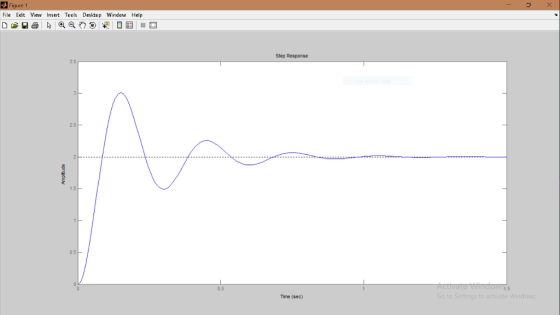
From the step response plot, the peak overshoot defined as

Also, the relationship between Mp and damping
ratio 
in terms of ζ:


Also, from the step response plot, the damped natural frequency is approx. 3.33 Hz or 20.92 rad/sec. The relationship with the undamped natural frequency is:

the time constant of exponential decay is

the gain

A standard second-order transfer function has the form:

so our transfer function is

VERIFYING
the plot is done in Matlab
IF YOU GOT ANY DOUBTS ASK IN COMMENTS SECTION
IF YOU LIKED MY ANSWER PLEASE PROVIDE POSITIVE FEEDBACK
Add Answer to:
Unit Step Response .A plant has the response, c(), to a unit step, as shown. 3.5 a. From the grap...
Question three The figure below shows a unit step response of a second order system. From...
 Question three The figure below shows a unit step response of a second order system. From the graph of response find: 1- The rise timet, 2- The peak timet, 3- The maximum overshoot Mp 4- The damped natural frequency w 5. The transfer function. Hence find the damping ratio ζ and the natural frequency ah-Find also the transfer function of the system. r 4 02 15 25 35 45 Question Four For the control system shown in the figure below,...
Do only parts C and D 1. A second-order system has the following transfer function that...
 Do only parts C and D
1. A second-order system has the following transfer function that describes its response: F(s)- s2 +as + 9 A. For a -3, calculate the following performance specifications of the system: Natural frequency (on) Damping ratio( Estimated rise time and settling time with ±5% change (tr, ts) Estimated overshoot (MP) . B. Label (a) ±5% range of steady state, (b) tr, (c) ts, and (d) MP on the step response curve below (You may also...
Do only parts C and D
1. A second-order system has the following transfer function that describes its response: F(s)- s2 +as + 9 A. For a -3, calculate the following performance specifications of the system: Natural frequency (on) Damping ratio( Estimated rise time and settling time with ±5% change (tr, ts) Estimated overshoot (MP) . B. Label (a) ±5% range of steady state, (b) tr, (c) ts, and (d) MP on the step response curve below (You may also...
Not all second-order systems are designed to give a standard 2"d order response. Consider the pow...
 Not all second-order systems are designed to give a standard 2"d order response. Consider the power steering for an automobile. The feedback system can be modeled as the block diagram shown in the figure below. For a unit step input A(s), find values of K1 and K2 for which the response w(t) is critically damped and has a steady-state gain of 0.4 unit. Repeat for a damping ratio of 0.7 and a steady-state gain of 0.2 unit. 7) Control Steering...
I required to design a PID controller that has overshoot less than 10% with minimise rise...
 I required to design a PID controller that has overshoot less
than 10% with minimise rise time, settling time, peak time and
steady-state error.
The transfer function of the plant is shown below:
and the step response of the open loop system by using unit-step
is shown below:
Then I have designed my PID controller by referring to the
example from Modern Control Engineering 5th Edition by Katsuhiko
Ogata page 572 by using Ziegler Nichols 2nd Method.
I get Kcr...
I required to design a PID controller that has overshoot less
than 10% with minimise rise time, settling time, peak time and
steady-state error.
The transfer function of the plant is shown below:
and the step response of the open loop system by using unit-step
is shown below:
Then I have designed my PID controller by referring to the
example from Modern Control Engineering 5th Edition by Katsuhiko
Ogata page 572 by using Ziegler Nichols 2nd Method.
I get Kcr...
Slep Response 10 0. 0 1.5 2 Tme (seconds) 05 2.5 35 Question three The figure...
 Slep Response 10 0. 0 1.5 2 Tme (seconds) 05 2.5 35 Question three The figure below shows a unit step response of a second order system. Prom the graph of response find 1- The rise timet, 2- The peak timet 3- The maximum overshoot M 4 The damped natural frequency w S. The transfer function Hence find the damping ratio ζ and the natural frequency the system Find also the transfer function of
6.Assuming De) 0 in the plant given in Fig: 3 with Gs. design a PD controller that drives y(1) to asymptotically follow a unit-step input command i(t) with a percent overshoot equal to 10% and e setl...
 6.Assuming De) 0 in the plant given in Fig: 3 with Gs. design a PD controller that drives y(1) to asymptotically follow a unit-step input command i(t) with a percent overshoot equal to 10% and e setling time equal to 0.5 se. Identify the pşak time and the damped frequency of the transient response () Carefully sketch the transient response. Assuming Ds)-, find a steady state error due to this disturbance s(s +5) (0 pts) DS) Ris) E(s) Y(s) g....
Problem1 The response of an underdamped second order system to a step input can be expressed as a...
 Problem1 The response of an underdamped second order system to a step input can be expressed as a) Plot the system's response and from this response, explain how you would determine the rise time and settling time of the system (define these terms) b) If the experimentally observed damped period of oscillation of the system is 0.577ms and, from a logarithmic decrement analysis, the damping ratio is found to be is the damped circular frequency of the system? the natural...
The unit step response of a second order system is 2- The unit step response of a second order system is Ste Consider the following statements: i) The under damped natural frequency is ii) The da...
 The unit step response of a second order system is
2- The unit step response of a second order system is Ste Consider the following statements: i) The under damped natural frequency is ii) The damping ratio is iii) The impulse response is
2- The unit step response of a second order system is Ste Consider the following statements: i) The under damped natural frequency is ii) The damping ratio is iii) The impulse response is
The unit step response of a second order system is
2- The unit step response of a second order system is Ste Consider the following statements: i) The under damped natural frequency is ii) The damping ratio is iii) The impulse response is
2- The unit step response of a second order system is Ste Consider the following statements: i) The under damped natural frequency is ii) The damping ratio is iii) The impulse response is
only b and c please 1 Consider the system whose transfer function is given by: G(S)...
 only b and c please
1 Consider the system whose transfer function is given by: G(S) == (2s +1)(s+3) unction is given by: G(s) - (a) Use the root-locus design methodology to design a lead compensator that will provide a closed-loop damping 5 =0.4 and a natural frequency on =9 rad/sec. The general transfer function for lead compensation is given by D(5)=K (977), p>z, 2=2 (b) Use MATLAB to plot the root locus of the feed-forward transfer function, D(s)*G(s), and...
only b and c please
1 Consider the system whose transfer function is given by: G(S) == (2s +1)(s+3) unction is given by: G(s) - (a) Use the root-locus design methodology to design a lead compensator that will provide a closed-loop damping 5 =0.4 and a natural frequency on =9 rad/sec. The general transfer function for lead compensation is given by D(5)=K (977), p>z, 2=2 (b) Use MATLAB to plot the root locus of the feed-forward transfer function, D(s)*G(s), and...
Problem The response of an underdamped second order system to a step input can be expressed as ...
 Problem The response of an underdamped second order system to a step input can be expressed as S lf the espenmentally observed damped period of oscillation of the system is 0577ms and, from a logarithmic decrement analysis, the damping ratio is found to be 0.8, what is the damped circular frequency of the system? the natural frequency of the system
Problem The response of an underdamped second order system to a step input can be expressed as
S lf the...
Problem The response of an underdamped second order system to a step input can be expressed as S lf the espenmentally observed damped period of oscillation of the system is 0577ms and, from a logarithmic decrement analysis, the damping ratio is found to be 0.8, what is the damped circular frequency of the system? the natural frequency of the system
Problem The response of an underdamped second order system to a step input can be expressed as
S lf the...
 Question three The figure below shows a unit step response of a second order system. From the graph of response find: 1- The rise timet, 2- The peak timet, 3- The maximum overshoot Mp 4- The damped natural frequency w 5. The transfer function. Hence find the damping ratio ζ and the natural frequency ah-Find also the transfer function of the system. r 4 02 15 25 35 45 Question Four For the control system shown in the figure below,...
 Do only parts C and D
1. A second-order system has the following transfer function that describes its response: F(s)- s2 +as + 9 A. For a -3, calculate the following performance specifications of the system: Natural frequency (on) Damping ratio( Estimated rise time and settling time with ±5% change (tr, ts) Estimated overshoot (MP) . B. Label (a) ±5% range of steady state, (b) tr, (c) ts, and (d) MP on the step response curve below (You may also...
Do only parts C and D
1. A second-order system has the following transfer function that describes its response: F(s)- s2 +as + 9 A. For a -3, calculate the following performance specifications of the system: Natural frequency (on) Damping ratio( Estimated rise time and settling time with ±5% change (tr, ts) Estimated overshoot (MP) . B. Label (a) ±5% range of steady state, (b) tr, (c) ts, and (d) MP on the step response curve below (You may also...
 Not all second-order systems are designed to give a standard 2"d order response. Consider the power steering for an automobile. The feedback system can be modeled as the block diagram shown in the figure below. For a unit step input A(s), find values of K1 and K2 for which the response w(t) is critically damped and has a steady-state gain of 0.4 unit. Repeat for a damping ratio of 0.7 and a steady-state gain of 0.2 unit. 7) Control Steering...
 I required to design a PID controller that has overshoot less
than 10% with minimise rise time, settling time, peak time and
steady-state error.
The transfer function of the plant is shown below:
and the step response of the open loop system by using unit-step
is shown below:
Then I have designed my PID controller by referring to the
example from Modern Control Engineering 5th Edition by Katsuhiko
Ogata page 572 by using Ziegler Nichols 2nd Method.
I get Kcr...
I required to design a PID controller that has overshoot less
than 10% with minimise rise time, settling time, peak time and
steady-state error.
The transfer function of the plant is shown below:
and the step response of the open loop system by using unit-step
is shown below:
Then I have designed my PID controller by referring to the
example from Modern Control Engineering 5th Edition by Katsuhiko
Ogata page 572 by using Ziegler Nichols 2nd Method.
I get Kcr...
 Slep Response 10 0. 0 1.5 2 Tme (seconds) 05 2.5 35 Question three The figure below shows a unit step response of a second order system. Prom the graph of response find 1- The rise timet, 2- The peak timet 3- The maximum overshoot M 4 The damped natural frequency w S. The transfer function Hence find the damping ratio ζ and the natural frequency the system Find also the transfer function of
 6.Assuming De) 0 in the plant given in Fig: 3 with Gs. design a PD controller that drives y(1) to asymptotically follow a unit-step input command i(t) with a percent overshoot equal to 10% and e setling time equal to 0.5 se. Identify the pşak time and the damped frequency of the transient response () Carefully sketch the transient response. Assuming Ds)-, find a steady state error due to this disturbance s(s +5) (0 pts) DS) Ris) E(s) Y(s) g....
 Problem1 The response of an underdamped second order system to a step input can be expressed as a) Plot the system's response and from this response, explain how you would determine the rise time and settling time of the system (define these terms) b) If the experimentally observed damped period of oscillation of the system is 0.577ms and, from a logarithmic decrement analysis, the damping ratio is found to be is the damped circular frequency of the system? the natural...
 The unit step response of a second order system is
2- The unit step response of a second order system is Ste Consider the following statements: i) The under damped natural frequency is ii) The damping ratio is iii) The impulse response is
2- The unit step response of a second order system is Ste Consider the following statements: i) The under damped natural frequency is ii) The damping ratio is iii) The impulse response is
The unit step response of a second order system is
2- The unit step response of a second order system is Ste Consider the following statements: i) The under damped natural frequency is ii) The damping ratio is iii) The impulse response is
2- The unit step response of a second order system is Ste Consider the following statements: i) The under damped natural frequency is ii) The damping ratio is iii) The impulse response is
 only b and c please
1 Consider the system whose transfer function is given by: G(S) == (2s +1)(s+3) unction is given by: G(s) - (a) Use the root-locus design methodology to design a lead compensator that will provide a closed-loop damping 5 =0.4 and a natural frequency on =9 rad/sec. The general transfer function for lead compensation is given by D(5)=K (977), p>z, 2=2 (b) Use MATLAB to plot the root locus of the feed-forward transfer function, D(s)*G(s), and...
only b and c please
1 Consider the system whose transfer function is given by: G(S) == (2s +1)(s+3) unction is given by: G(s) - (a) Use the root-locus design methodology to design a lead compensator that will provide a closed-loop damping 5 =0.4 and a natural frequency on =9 rad/sec. The general transfer function for lead compensation is given by D(5)=K (977), p>z, 2=2 (b) Use MATLAB to plot the root locus of the feed-forward transfer function, D(s)*G(s), and...
 Problem The response of an underdamped second order system to a step input can be expressed as S lf the espenmentally observed damped period of oscillation of the system is 0577ms and, from a logarithmic decrement analysis, the damping ratio is found to be 0.8, what is the damped circular frequency of the system? the natural frequency of the system
Problem The response of an underdamped second order system to a step input can be expressed as
S lf the...
Problem The response of an underdamped second order system to a step input can be expressed as S lf the espenmentally observed damped period of oscillation of the system is 0577ms and, from a logarithmic decrement analysis, the damping ratio is found to be 0.8, what is the damped circular frequency of the system? the natural frequency of the system
Problem The response of an underdamped second order system to a step input can be expressed as
S lf the...
Most questions answered within 3 hours.
-
Where is the error in this code sequence?
String s1 = "Hello";
String s2 = "ello";...
asked 11 months ago -
Financial data for Joel de Paris, Inc., for last year
follow:
Joel de Paris, Inc.
Balance...
asked 11 months ago -
Consider this reaction:
Al2(SO4)3 (aq)+ BaCl3
(aq) Al2Cl6 (aq)- +
3BaSO4(s) . What is the...
asked 11 months ago -
Suppose that Savneet is considering increasing her
recent random sample from 20 car rentals to 40...
asked 11 months ago -
Trucks arrive at an unloading terminal at an average rate of 120
per hour.
Trucks arrive...
asked 11 months ago -
Why are methanol and ethanol completely soluble in water while
octanol is not very little soluble....
asked 11 months ago -
A facilities manager at a university reads in a research report
that the mean amount of...
asked 11 months ago -
When the CuSO4 is rehydrated by adding water to the anhydrous
compound, is this an endothermic...
asked 11 months ago -
A ray of sunlight is passing from diamond into crown glass; the
angle of incidence is...
asked 11 months ago -
A block of mass 0.249 kg is placed on top of a light, vertical
spring of...
asked 11 months ago -
how do the kidneys compensate in the presences of acidosis
a) trigger hyperventilate
b) reserve acid...
asked 11 months ago -
Question 501 pts
The rental rate of capital to the firm increases. Which of the
following...
asked 11 months ago