
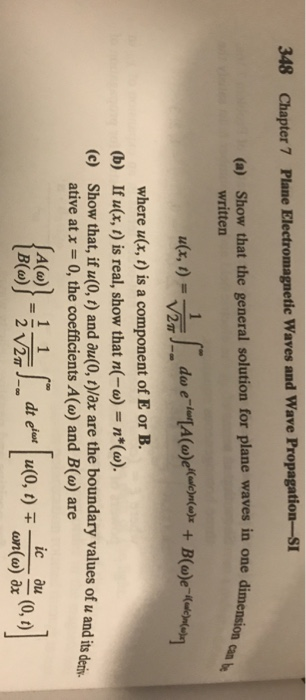
348 Chapter 7 Plane Electromagnetic Waves and Wave Propagation-SI (a) Show that the general solution for plane waves in one dimension written where u(r, t) is a component of E or B. (b) If u(x, 1) is real, show that n(-ω-n*(e). (e) Show that, if u(0, t) and au(O, t)/ax are the boundary values of u and its deri ative at x - 0, the coefficients A(u) and B(a) are A( 1 1 a() ar 0, )
Homework Answers
Add Answer to:
20 A homogeneous, isotropic, nonpermeable dielectric is characterized by an index of refraction n...
6. (12 points) The simplest (homogeneous, isotropic) 'Ohmic' materials are characterized by J=oE, where o is...
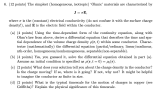 6. (12 points) The simplest (homogeneous, isotropic) 'Ohmic' materials are characterized by J=oE, where o is the constant) electrical conductivity (do not confuse it with the surface charge density!), and E is the electric field within the conductor. (a) (4 points Using the time-dependent form of the continuity equation, along with Ohm's law from above, derive a differential equation that describes the time and spa- tial dependence of the volume charge density par, t) within some conductor. Charac- terize (mathematically)...
Homogeneous Poisson process N(t) counts events occurring in a time interval and is characterized by Ņ(0)-0...
 Homogeneous Poisson process N(t) counts events occurring in a time interval and is characterized by Ņ(0)-0 and (t + τ)-N(k) ~ Poisson(λτ), where τ is the length of the interval (a) Show that the interarrival times to next event are independent and exponentially distributed random variables (b) A random variable X is said to be memoryless if P(X 〉 s+ t | X 〉 t) = P(X 〉 s) y s,t〉0. that this property applies for the interarrival times if...
Let A be an m × n matrix, let x Rn and let 0 be the zero vector in Rm. (a) Let u, v є Rn be any two solutions of Ax 0,...
 Let A be an m × n matrix, let x Rn and let 0 be the zero vector in Rm. (a) Let u, v є Rn be any two solutions of Ax 0, and let c E R. Use the properties of matrix-vector multiplication to show that u+v and cu are also solutions of Ax O. (b) Extend the result of (a) to show that the linear combination cu + dv is a solution of Ax 0 for any c,d...
(1 point) Solve the heat problem with non-homogeneous boundary conditions ∂u∂t(x,t)=∂2u∂x2(x,t), 0<x<3, t>0∂u∂t(x,t)=∂2u∂x2(x,t), 0<x<3, t>0 u(0,t)=0, u(3,t)=2, t>0,
 (1 point) Solve the heat problem with non-homogeneous boundary
conditions
∂u∂t(x,t)=∂2u∂x2(x,t), 0<x<3, t>0∂u∂t(x,t)=∂2u∂x2(x,t), 0<x<3, t>0
u(0,t)=0, u(3,t)=2, t>0,u(0,t)=0, u(3,t)=2, t>0,
u(x,0)=23x, 0<x<3.u(x,0)=23x, 0<x<3.
Recall that we find h(x)h(x), set
v(x,t)=u(x,t)−h(x)v(x,t)=u(x,t)−h(x), solve a heat problem for
v(x,t)v(x,t) and write u(x,t)=v(x,t)+h(x)u(x,t)=v(x,t)+h(x).
Find h(x)h(x)
h(x)=h(x)=
The solution u(x,t)u(x,t) can be written as
u(x,t)=h(x)+v(x,t),u(x,t)=h(x)+v(x,t),
where
v(x,t)=∑n=1∞aneλntϕn(x)v(x,t)=∑n=1∞aneλntϕn(x)
v(x,t)=∑n=1∞v(x,t)=∑n=1∞
Finally, find
limt→∞u(x,t)=limt→∞u(x,t)=
Please show all work.
(1 point) Solve the heat problem with non-homogeneous boundary conditions au ди (x, t) at (2, t), 0<x<3, t> 0 ar2 u(0,t) = 0, u(3, t) = 2, t>0, u(t,0)...
(1 point) Solve the heat problem with non-homogeneous boundary
conditions
∂u∂t(x,t)=∂2u∂x2(x,t), 0<x<3, t>0∂u∂t(x,t)=∂2u∂x2(x,t), 0<x<3, t>0
u(0,t)=0, u(3,t)=2, t>0,u(0,t)=0, u(3,t)=2, t>0,
u(x,0)=23x, 0<x<3.u(x,0)=23x, 0<x<3.
Recall that we find h(x)h(x), set
v(x,t)=u(x,t)−h(x)v(x,t)=u(x,t)−h(x), solve a heat problem for
v(x,t)v(x,t) and write u(x,t)=v(x,t)+h(x)u(x,t)=v(x,t)+h(x).
Find h(x)h(x)
h(x)=h(x)=
The solution u(x,t)u(x,t) can be written as
u(x,t)=h(x)+v(x,t),u(x,t)=h(x)+v(x,t),
where
v(x,t)=∑n=1∞aneλntϕn(x)v(x,t)=∑n=1∞aneλntϕn(x)
v(x,t)=∑n=1∞v(x,t)=∑n=1∞
Finally, find
limt→∞u(x,t)=limt→∞u(x,t)=
Please show all work.
(1 point) Solve the heat problem with non-homogeneous boundary conditions au ди (x, t) at (2, t), 0<x<3, t> 0 ar2 u(0,t) = 0, u(3, t) = 2, t>0, u(t,0)...
Problem 2. (15 points) Solve the following Laplace's equation in a cube as outlined below. au...
 Problem 2. (15 points) Solve the following Laplace's equation in a cube as outlined below. au au au 2,2 + a2 + a2 = 0, on 0<x<1, 0<y<1, 0<?<1, (0, y, z) = (1, y, z) = 0, (x, 0, 2) = u(x, 1, ) = 0, (x, y,0) = 0, u(x,y, 1) = x. (a) Seek a solution of the form u(x, y, z) = F(x) G(v) H(-). Show that with the appropriate choice of separation constants, you can...
HW 4 Submission date: 10/01/2018 before 12:00 AM, bring to my office. Answer to the following...
 HW 4 Submission date: 10/01/2018 before 12:00 AM, bring to my office. Answer to the following questions. Give mathematical expressions and physical explanations if it is necessary What is polarization of light? (Electromagnetic formulations should be given) What is the difference between polarized light and nonpolarized light? How can polarized light be created? (Explain in detail the physical background) Polarization states: Linear, Circular and Elliptic (Give mathematical formulations and draw graphics) TM and TE polarizations: Reflection and Refraction (Mathematical formulations)...
Rotational Dynamics Assignment (200 Points) • Due Friday, July 31 at 5:00 pm Equations are in...
 Rotational Dynamics Assignment (200 Points) • Due Friday, July 31 at 5:00 pm Equations are in a separate document entitled “Equations for Rotational Dynamics Assignment” • Moments of inertia formulas are provided on the last page of this document • Show all of your work when solving equations. It is not sufficient to merely have a correct numerical answer. You need to have used legitimate equations and algebra. You also need to have correctly used the data. • Units must...
please answer all prelab questions, 1-4. This is the prelab manual, just in case you need...
 please answer all prelab questions, 1-4.
This is the prelab manual, just in case you need background
information to answer the questions. The prelab questions are in
the 3rd photo.
this where we put in the answers, just to give you an
idea.
Lab Manual Lab 9: Simple Harmonic Oscillation Before the lab, read the theory in Sections 1-3 and answer questions on Pre-lab Submit your Pre-lab at the beginning of the lab. During the lab, read Section 4 and...
please answer all prelab questions, 1-4.
This is the prelab manual, just in case you need background
information to answer the questions. The prelab questions are in
the 3rd photo.
this where we put in the answers, just to give you an
idea.
Lab Manual Lab 9: Simple Harmonic Oscillation Before the lab, read the theory in Sections 1-3 and answer questions on Pre-lab Submit your Pre-lab at the beginning of the lab. During the lab, read Section 4 and...
 6. (12 points) The simplest (homogeneous, isotropic) 'Ohmic' materials are characterized by J=oE, where o is the constant) electrical conductivity (do not confuse it with the surface charge density!), and E is the electric field within the conductor. (a) (4 points Using the time-dependent form of the continuity equation, along with Ohm's law from above, derive a differential equation that describes the time and spa- tial dependence of the volume charge density par, t) within some conductor. Charac- terize (mathematically)...
 Homogeneous Poisson process N(t) counts events occurring in a time interval and is characterized by Ņ(0)-0 and (t + τ)-N(k) ~ Poisson(λτ), where τ is the length of the interval (a) Show that the interarrival times to next event are independent and exponentially distributed random variables (b) A random variable X is said to be memoryless if P(X 〉 s+ t | X 〉 t) = P(X 〉 s) y s,t〉0. that this property applies for the interarrival times if...
 Let A be an m × n matrix, let x Rn and let 0 be the zero vector in Rm. (a) Let u, v є Rn be any two solutions of Ax 0, and let c E R. Use the properties of matrix-vector multiplication to show that u+v and cu are also solutions of Ax O. (b) Extend the result of (a) to show that the linear combination cu + dv is a solution of Ax 0 for any c,d...
 (1 point) Solve the heat problem with non-homogeneous boundary
conditions
∂u∂t(x,t)=∂2u∂x2(x,t), 0<x<3, t>0∂u∂t(x,t)=∂2u∂x2(x,t), 0<x<3, t>0
u(0,t)=0, u(3,t)=2, t>0,u(0,t)=0, u(3,t)=2, t>0,
u(x,0)=23x, 0<x<3.u(x,0)=23x, 0<x<3.
Recall that we find h(x)h(x), set
v(x,t)=u(x,t)−h(x)v(x,t)=u(x,t)−h(x), solve a heat problem for
v(x,t)v(x,t) and write u(x,t)=v(x,t)+h(x)u(x,t)=v(x,t)+h(x).
Find h(x)h(x)
h(x)=h(x)=
The solution u(x,t)u(x,t) can be written as
u(x,t)=h(x)+v(x,t),u(x,t)=h(x)+v(x,t),
where
v(x,t)=∑n=1∞aneλntϕn(x)v(x,t)=∑n=1∞aneλntϕn(x)
v(x,t)=∑n=1∞v(x,t)=∑n=1∞
Finally, find
limt→∞u(x,t)=limt→∞u(x,t)=
Please show all work.
(1 point) Solve the heat problem with non-homogeneous boundary conditions au ди (x, t) at (2, t), 0<x<3, t> 0 ar2 u(0,t) = 0, u(3, t) = 2, t>0, u(t,0)...
(1 point) Solve the heat problem with non-homogeneous boundary
conditions
∂u∂t(x,t)=∂2u∂x2(x,t), 0<x<3, t>0∂u∂t(x,t)=∂2u∂x2(x,t), 0<x<3, t>0
u(0,t)=0, u(3,t)=2, t>0,u(0,t)=0, u(3,t)=2, t>0,
u(x,0)=23x, 0<x<3.u(x,0)=23x, 0<x<3.
Recall that we find h(x)h(x), set
v(x,t)=u(x,t)−h(x)v(x,t)=u(x,t)−h(x), solve a heat problem for
v(x,t)v(x,t) and write u(x,t)=v(x,t)+h(x)u(x,t)=v(x,t)+h(x).
Find h(x)h(x)
h(x)=h(x)=
The solution u(x,t)u(x,t) can be written as
u(x,t)=h(x)+v(x,t),u(x,t)=h(x)+v(x,t),
where
v(x,t)=∑n=1∞aneλntϕn(x)v(x,t)=∑n=1∞aneλntϕn(x)
v(x,t)=∑n=1∞v(x,t)=∑n=1∞
Finally, find
limt→∞u(x,t)=limt→∞u(x,t)=
Please show all work.
(1 point) Solve the heat problem with non-homogeneous boundary conditions au ди (x, t) at (2, t), 0<x<3, t> 0 ar2 u(0,t) = 0, u(3, t) = 2, t>0, u(t,0)...
 Problem 2. (15 points) Solve the following Laplace's equation in a cube as outlined below. au au au 2,2 + a2 + a2 = 0, on 0<x<1, 0<y<1, 0<?<1, (0, y, z) = (1, y, z) = 0, (x, 0, 2) = u(x, 1, ) = 0, (x, y,0) = 0, u(x,y, 1) = x. (a) Seek a solution of the form u(x, y, z) = F(x) G(v) H(-). Show that with the appropriate choice of separation constants, you can...
 HW 4 Submission date: 10/01/2018 before 12:00 AM, bring to my office. Answer to the following questions. Give mathematical expressions and physical explanations if it is necessary What is polarization of light? (Electromagnetic formulations should be given) What is the difference between polarized light and nonpolarized light? How can polarized light be created? (Explain in detail the physical background) Polarization states: Linear, Circular and Elliptic (Give mathematical formulations and draw graphics) TM and TE polarizations: Reflection and Refraction (Mathematical formulations)...
 Rotational Dynamics Assignment (200 Points) • Due Friday, July 31 at 5:00 pm Equations are in a separate document entitled “Equations for Rotational Dynamics Assignment” • Moments of inertia formulas are provided on the last page of this document • Show all of your work when solving equations. It is not sufficient to merely have a correct numerical answer. You need to have used legitimate equations and algebra. You also need to have correctly used the data. • Units must...
 please answer all prelab questions, 1-4.
This is the prelab manual, just in case you need background
information to answer the questions. The prelab questions are in
the 3rd photo.
this where we put in the answers, just to give you an
idea.
Lab Manual Lab 9: Simple Harmonic Oscillation Before the lab, read the theory in Sections 1-3 and answer questions on Pre-lab Submit your Pre-lab at the beginning of the lab. During the lab, read Section 4 and...
please answer all prelab questions, 1-4.
This is the prelab manual, just in case you need background
information to answer the questions. The prelab questions are in
the 3rd photo.
this where we put in the answers, just to give you an
idea.
Lab Manual Lab 9: Simple Harmonic Oscillation Before the lab, read the theory in Sections 1-3 and answer questions on Pre-lab Submit your Pre-lab at the beginning of the lab. During the lab, read Section 4 and...
Most questions answered within 3 hours.
-
Where is the error in this code sequence?
String s1 = "Hello";
String s2 = "ello";...
asked 11 months ago -
Financial data for Joel de Paris, Inc., for last year
follow:
Joel de Paris, Inc.
Balance...
asked 11 months ago -
Consider this reaction:
Al2(SO4)3 (aq)+ BaCl3
(aq) Al2Cl6 (aq)- +
3BaSO4(s) . What is the...
asked 11 months ago -
Suppose that Savneet is considering increasing her
recent random sample from 20 car rentals to 40...
asked 11 months ago -
Trucks arrive at an unloading terminal at an average rate of 120
per hour.
Trucks arrive...
asked 11 months ago -
Why are methanol and ethanol completely soluble in water while
octanol is not very little soluble....
asked 11 months ago -
A facilities manager at a university reads in a research report
that the mean amount of...
asked 11 months ago -
When the CuSO4 is rehydrated by adding water to the anhydrous
compound, is this an endothermic...
asked 11 months ago -
A ray of sunlight is passing from diamond into crown glass; the
angle of incidence is...
asked 11 months ago -
A block of mass 0.249 kg is placed on top of a light, vertical
spring of...
asked 11 months ago -
how do the kidneys compensate in the presences of acidosis
a) trigger hyperventilate
b) reserve acid...
asked 11 months ago -
Question 501 pts
The rental rate of capital to the firm increases. Which of the
following...
asked 11 months ago