
Homework Answers
Add Answer to:
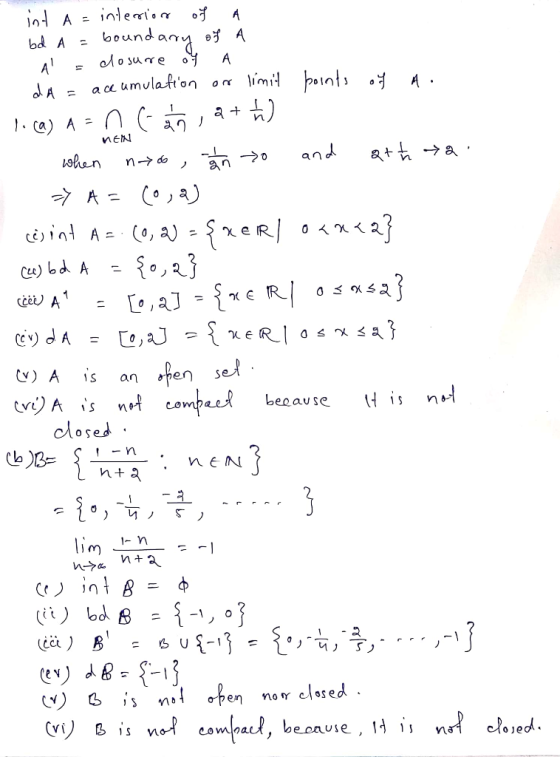
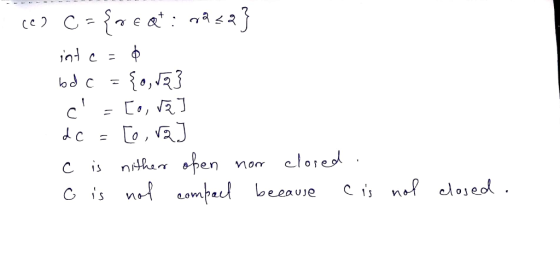
1. Find the boundary and the interior for the following sets. Find the set of all accumulation po...
Ctr 6. (20 pts.) For each of the following sets, determine the interior points, the boundary poin...
 Ctr 6. (20 pts.) For each of the following sets, determine the interior points, the boundary points, the accumulation points and the isolated points.Also deter- mine whether the set is open, closed, or neither (Justify your answer). s= (10,3) n (1,41) u {-1,5}
Ctr 6. (20 pts.) For each of the following sets, determine the interior points, the boundary points, the accumulation points and the isolated points.Also deter- mine whether the set is open, closed, or neither (Justify your answer)....
Ctr 6. (20 pts.) For each of the following sets, determine the interior points, the boundary points, the accumulation points and the isolated points.Also deter- mine whether the set is open, closed, or neither (Justify your answer). s= (10,3) n (1,41) u {-1,5}
Ctr 6. (20 pts.) For each of the following sets, determine the interior points, the boundary points, the accumulation points and the isolated points.Also deter- mine whether the set is open, closed, or neither (Justify your answer)....
1. Draw the given sets. Find their interior, exterior and boundary and also sketch them. Moreover,...
 1. Draw the given sets. Find their interior, exterior and boundary and also sketch them. Moreover, study whether these are open, closed, bounded and/or compact. (0) A = (3.7]{0,1} E R. (ii) B = {(x,y) ERO SysIn... ISIS 2). (iii) C = {(x,y) E R' + ly <l},
1. Let (Q, d) be the metric space consisting of the set Q of rational numbers...
 1. Let (Q, d) be the metric space consisting of the set Q of rational numbers with the standard metric d(x, y) = (x – yl. Show that the Heine-Borel theorem fails for (Q, d). In other words, show that (Q, d) has a subset SCQ that is closed and bounded, but not compact (8 points).
real analysis questions Find the interior of the following sets. (1): {1/n: neN}: (2): (0,5) (5,...
 real analysis questions
Find the interior of the following sets. (1): {1/n: neN}: (2): (0,5) (5, 7); (3): {re Q:0<r <2}. Classify each of the following sets as open, closed, or neither. (1): {: | - 51 < 1}; (2): {x: (x-3) > 1}; (3): {:13 -4)<4}.
real analysis questions
Find the interior of the following sets. (1): {1/n: neN}: (2): (0,5) (5, 7); (3): {re Q:0<r <2}. Classify each of the following sets as open, closed, or neither. (1): {: | - 51 < 1}; (2): {x: (x-3) > 1}; (3): {:13 -4)<4}.
be the set of all points a + bi, where a, b E Q and which...
 be the set of all points a + bi, where a, b E Q and which lie inside the shaded square shown (a) Is bounded? (b) What are the limit points of , if any? |(c) Is closed? (d) What are its interior and boundary points? (e) Is open? (f) Is connected? (g) Is a region? (h) What is the closure of 0? (i) Is compact? (i) Is the closure of 2 compact? 8. Let
would you be able to prove theorm 6 using the definitons provided. if at all possible...
 would you be able to prove theorm 6 using the definitons provided.
if at all possible - you can do it in contridition. These are
topology questions.
Theorem 6. If W is the collection of all open sets, then (i) S is in W; (ii) the empty set is in W; (iii) if G is a nonempty subcollection of W, then UG belongs to W: (iv) if G is a finite nonempty subcollection of W, then nG belongs to W....
would you be able to prove theorm 6 using the definitons provided.
if at all possible - you can do it in contridition. These are
topology questions.
Theorem 6. If W is the collection of all open sets, then (i) S is in W; (ii) the empty set is in W; (iii) if G is a nonempty subcollection of W, then UG belongs to W: (iv) if G is a finite nonempty subcollection of W, then nG belongs to W....
Real Analysis II Please do it without using Heine-Borel's theorem and do it only if you're sure Problem: Let E be a closed bounded subset of En and r be any function mapping E to (0,∞). Then t...
 Real Analysis II
Please do it without using Heine-Borel's theorem
and do it only if you're sure
Problem: Let E be a closed bounded subset of
En and r be any function mapping E to
(0,∞). Then there exists finitely many points yi ∈ E, i
= 1,...,N such that
Here Br(yi)(yi) is the open ball
(neighborhood) of radius r(yi) centered at
yi.
Also, following definitions & theorems should help
that
E CUBy Definition. A subset S of a topological...
Real Analysis II
Please do it without using Heine-Borel's theorem
and do it only if you're sure
Problem: Let E be a closed bounded subset of
En and r be any function mapping E to
(0,∞). Then there exists finitely many points yi ∈ E, i
= 1,...,N such that
Here Br(yi)(yi) is the open ball
(neighborhood) of radius r(yi) centered at
yi.
Also, following definitions & theorems should help
that
E CUBy Definition. A subset S of a topological...
(5) For each set, figure out whether it is open, closed or neither, and find its...
 (5) For each set, figure out whether it is open, closed or neither, and find its interior, boundary and limit points (a) S [3, 4) (b) T 2-n e N} (c) the Cantor set
Wow.. I spend 5hous to understand these problems but cant.. anyone help me? Can anyone solve...
 Wow.. I spend 5hous to understand these problems but cant..
anyone help me?
Can anyone solve these question and explain why the answer is
open or closed or connected or interior boundary?
I have all the answers but I dont understand why.. it is open..
so can anyone explain WHY? Thx!!
For each of the sets in Exercises 1 to 8, (a) describe the interior and the boundary, (b) state whether the set is open or closed or neither open...
Wow.. I spend 5hous to understand these problems but cant..
anyone help me?
Can anyone solve these question and explain why the answer is
open or closed or connected or interior boundary?
I have all the answers but I dont understand why.. it is open..
so can anyone explain WHY? Thx!!
For each of the sets in Exercises 1 to 8, (a) describe the interior and the boundary, (b) state whether the set is open or closed or neither open...
Definition 7.13. X is a Baire space if the intersection of each countable family of dense open se...
 topology class
want proof for theorem 7.14 using definition 7.13
please explain well.
Definition 7.13. X is a Baire space if the intersection of each countable family of dense open sets is dense. A set A c X is nowhere dense in X if (T)0-0, A set A C X is first category in X if A-Un=1 An, where each An is nowhere dense in X. If a set is not first category, it is called second category. (Topologically, seoond...
topology class
want proof for theorem 7.14 using definition 7.13
please explain well.
Definition 7.13. X is a Baire space if the intersection of each countable family of dense open sets is dense. A set A c X is nowhere dense in X if (T)0-0, A set A C X is first category in X if A-Un=1 An, where each An is nowhere dense in X. If a set is not first category, it is called second category. (Topologically, seoond...
 Ctr 6. (20 pts.) For each of the following sets, determine the interior points, the boundary points, the accumulation points and the isolated points.Also deter- mine whether the set is open, closed, or neither (Justify your answer). s= (10,3) n (1,41) u {-1,5}
Ctr 6. (20 pts.) For each of the following sets, determine the interior points, the boundary points, the accumulation points and the isolated points.Also deter- mine whether the set is open, closed, or neither (Justify your answer)....
Ctr 6. (20 pts.) For each of the following sets, determine the interior points, the boundary points, the accumulation points and the isolated points.Also deter- mine whether the set is open, closed, or neither (Justify your answer). s= (10,3) n (1,41) u {-1,5}
Ctr 6. (20 pts.) For each of the following sets, determine the interior points, the boundary points, the accumulation points and the isolated points.Also deter- mine whether the set is open, closed, or neither (Justify your answer)....
 1. Draw the given sets. Find their interior, exterior and boundary and also sketch them. Moreover, study whether these are open, closed, bounded and/or compact. (0) A = (3.7]{0,1} E R. (ii) B = {(x,y) ERO SysIn... ISIS 2). (iii) C = {(x,y) E R' + ly <l},
 1. Let (Q, d) be the metric space consisting of the set Q of rational numbers with the standard metric d(x, y) = (x – yl. Show that the Heine-Borel theorem fails for (Q, d). In other words, show that (Q, d) has a subset SCQ that is closed and bounded, but not compact (8 points).
 real analysis questions
Find the interior of the following sets. (1): {1/n: neN}: (2): (0,5) (5, 7); (3): {re Q:0<r <2}. Classify each of the following sets as open, closed, or neither. (1): {: | - 51 < 1}; (2): {x: (x-3) > 1}; (3): {:13 -4)<4}.
real analysis questions
Find the interior of the following sets. (1): {1/n: neN}: (2): (0,5) (5, 7); (3): {re Q:0<r <2}. Classify each of the following sets as open, closed, or neither. (1): {: | - 51 < 1}; (2): {x: (x-3) > 1}; (3): {:13 -4)<4}.
 be the set of all points a + bi, where a, b E Q and which lie inside the shaded square shown (a) Is bounded? (b) What are the limit points of , if any? |(c) Is closed? (d) What are its interior and boundary points? (e) Is open? (f) Is connected? (g) Is a region? (h) What is the closure of 0? (i) Is compact? (i) Is the closure of 2 compact? 8. Let
 would you be able to prove theorm 6 using the definitons provided.
if at all possible - you can do it in contridition. These are
topology questions.
Theorem 6. If W is the collection of all open sets, then (i) S is in W; (ii) the empty set is in W; (iii) if G is a nonempty subcollection of W, then UG belongs to W: (iv) if G is a finite nonempty subcollection of W, then nG belongs to W....
would you be able to prove theorm 6 using the definitons provided.
if at all possible - you can do it in contridition. These are
topology questions.
Theorem 6. If W is the collection of all open sets, then (i) S is in W; (ii) the empty set is in W; (iii) if G is a nonempty subcollection of W, then UG belongs to W: (iv) if G is a finite nonempty subcollection of W, then nG belongs to W....
 Real Analysis II
Please do it without using Heine-Borel's theorem
and do it only if you're sure
Problem: Let E be a closed bounded subset of
En and r be any function mapping E to
(0,∞). Then there exists finitely many points yi ∈ E, i
= 1,...,N such that
Here Br(yi)(yi) is the open ball
(neighborhood) of radius r(yi) centered at
yi.
Also, following definitions & theorems should help
that
E CUBy Definition. A subset S of a topological...
Real Analysis II
Please do it without using Heine-Borel's theorem
and do it only if you're sure
Problem: Let E be a closed bounded subset of
En and r be any function mapping E to
(0,∞). Then there exists finitely many points yi ∈ E, i
= 1,...,N such that
Here Br(yi)(yi) is the open ball
(neighborhood) of radius r(yi) centered at
yi.
Also, following definitions & theorems should help
that
E CUBy Definition. A subset S of a topological...
 (5) For each set, figure out whether it is open, closed or neither, and find its interior, boundary and limit points (a) S [3, 4) (b) T 2-n e N} (c) the Cantor set
 Wow.. I spend 5hous to understand these problems but cant..
anyone help me?
Can anyone solve these question and explain why the answer is
open or closed or connected or interior boundary?
I have all the answers but I dont understand why.. it is open..
so can anyone explain WHY? Thx!!
For each of the sets in Exercises 1 to 8, (a) describe the interior and the boundary, (b) state whether the set is open or closed or neither open...
Wow.. I spend 5hous to understand these problems but cant..
anyone help me?
Can anyone solve these question and explain why the answer is
open or closed or connected or interior boundary?
I have all the answers but I dont understand why.. it is open..
so can anyone explain WHY? Thx!!
For each of the sets in Exercises 1 to 8, (a) describe the interior and the boundary, (b) state whether the set is open or closed or neither open...
 topology class
want proof for theorem 7.14 using definition 7.13
please explain well.
Definition 7.13. X is a Baire space if the intersection of each countable family of dense open sets is dense. A set A c X is nowhere dense in X if (T)0-0, A set A C X is first category in X if A-Un=1 An, where each An is nowhere dense in X. If a set is not first category, it is called second category. (Topologically, seoond...
topology class
want proof for theorem 7.14 using definition 7.13
please explain well.
Definition 7.13. X is a Baire space if the intersection of each countable family of dense open sets is dense. A set A c X is nowhere dense in X if (T)0-0, A set A C X is first category in X if A-Un=1 An, where each An is nowhere dense in X. If a set is not first category, it is called second category. (Topologically, seoond...
Most questions answered within 3 hours.
-
Where is the error in this code sequence?
String s1 = "Hello";
String s2 = "ello";...
asked 11 months ago -
Financial data for Joel de Paris, Inc., for last year
follow:
Joel de Paris, Inc.
Balance...
asked 11 months ago -
Consider this reaction:
Al2(SO4)3 (aq)+ BaCl3
(aq) Al2Cl6 (aq)- +
3BaSO4(s) . What is the...
asked 11 months ago -
Suppose that Savneet is considering increasing her
recent random sample from 20 car rentals to 40...
asked 11 months ago -
Trucks arrive at an unloading terminal at an average rate of 120
per hour.
Trucks arrive...
asked 11 months ago -
Why are methanol and ethanol completely soluble in water while
octanol is not very little soluble....
asked 11 months ago -
A facilities manager at a university reads in a research report
that the mean amount of...
asked 11 months ago -
When the CuSO4 is rehydrated by adding water to the anhydrous
compound, is this an endothermic...
asked 11 months ago -
A ray of sunlight is passing from diamond into crown glass; the
angle of incidence is...
asked 11 months ago -
A block of mass 0.249 kg is placed on top of a light, vertical
spring of...
asked 11 months ago -
how do the kidneys compensate in the presences of acidosis
a) trigger hyperventilate
b) reserve acid...
asked 11 months ago -
Question 501 pts
The rental rate of capital to the firm increases. Which of the
following...
asked 11 months ago