Given the following half cells: Fe2+/Fe0 and Pd/Pd2+, determine; a) what is the anode and what is...
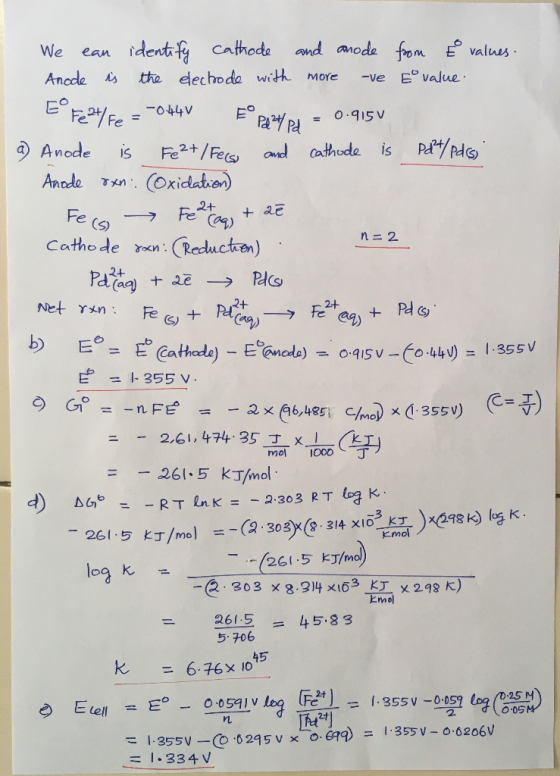
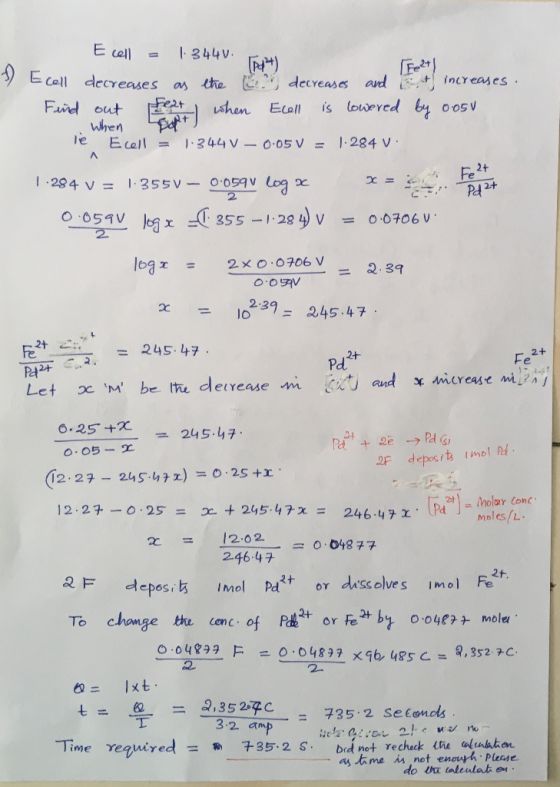
Given the following half cells: Fe2+/Fe0 and Pd/Pd2+, determine; a) what is the anode and what is the cathode, b) what is Eo, c)what is Go and k? Using the following concentrations, determine E value for your cell. Fe2+ [.25], Pd2+ [.05]. How long would you have to run this battery at 3.2 amps to lower the E by .05 volts?
Homework Answers
Add Answer to:
Given the following half cells: Fe2+/Fe0 and Pd/Pd2+, determine; a) what is the anode and what is...
Given the half-cells: Ni/Ni+2 and Fe/Fe+2 Chose the anode and cathode. Calculate E° and ΔG° for...
Given the half-cells: Ni/Ni+2 and Fe/Fe+2 Chose the anode and cathode. Calculate E° and ΔG° for this reaction. Calculate what the new cell potential (E) would be if the concentrations were [Ni+2] = 0.40 M and [Fe+2] = 0.30 M. Calculate how long you would have to run the battery at 6 amps to make the E drop by 0.03 volts, and calculate how many grams of anode you lose by that time. Using the equations: ΔG° = -nFE° ln...
Separate galvanic cells are made from the following half-cells: cell 1: H+(aq)/H2(g) and Pb2+(aq)/Pb(s) cell 2:...
 Separate galvanic cells are made from the following half-cells: cell 1: H+(aq)/H2(g) and Pb2+(aq)/Pb(s) cell 2: Fe2+(aq)/Fe(s) and Zn2+(aq)/Zn(s) Which of the following is correct for the working cells? Standard reduction potentials, 298 K, Aqueous Solution (pH = 0): Cl2(g) + 2e --> 2C1-(aq); E° = +1.36 V Fe3+(aq) + e --> Fe2+(aq); E° = +0.77 V Cu2+(aq) + 2e --> Cu(s); E° = +0.34 V 2H+(aq) + 2e --> H2(g); E° = 0.00 V Pb2+(aq) + 2e --> Pb(s);...
Consider an electrochemical cell constructed from the following half cells, linked by a KCl salt bridge....
Consider an electrochemical cell constructed from the following half cells, linked by a KCl salt bridge. a Fe electrode in 1.0 M FeCl2 solution a Sn electrode in 1.0 M Sn(NO3)2 solution Fe2+ + 2e- → Fe Eo = -0.44 V Sn2+ + 2e- → Sn Eo = -0.14 V When the cell is running spontaneously, which choice includes only true statements and no false ones? Select one: a. The iron electrode gains mass and the iron electrode is the...
question 16.46 UU 15 - UU UL ut tu uve- 16.46 The half-cells Fe2+ (aq)|Fe(s) and...
 question 16.46
UU 15 - UU UL ut tu uve- 16.46 The half-cells Fe2+ (aq)|Fe(s) and O2(g)|H2O (in acid solution) are linked to create a voltaic cell. (a) Write equations for the oxidation and reduction half- reactions and for the overall cell reaction. (b) Which half-reaction occurs in the anode compart- ment and which occurs in the cathode compartment? (c) Complete the following sentences: Electrons in the external circuit flow from the — electrode to the electrode. Negative ions move...
question 16.46
UU 15 - UU UL ut tu uve- 16.46 The half-cells Fe2+ (aq)|Fe(s) and O2(g)|H2O (in acid solution) are linked to create a voltaic cell. (a) Write equations for the oxidation and reduction half- reactions and for the overall cell reaction. (b) Which half-reaction occurs in the anode compart- ment and which occurs in the cathode compartment? (c) Complete the following sentences: Electrons in the external circuit flow from the — electrode to the electrode. Negative ions move...
Show all steps please :) A galvanic cell is prepared using the following two half-cells: (i)...
 Show all steps please :)
A galvanic cell is prepared using the following two half-cells: (i) MnO4 (0.273 M), Mn2+ (0.167 M), and H+ (1.0 M), and (ii) Fe2+ (0.247 M) and Fe3+ (0.389 M). The standard reduction potentials for the two half cells are: Mnoa + 8H+ + 5e – Mn2+ + 4H20 E° = 1.507 V Fe3+ + e- Fe2+ E° = 0.770 V a) Calculate the voltage for this galvanic cell. b) Write the balanced equation for...
Show all steps please :)
A galvanic cell is prepared using the following two half-cells: (i) MnO4 (0.273 M), Mn2+ (0.167 M), and H+ (1.0 M), and (ii) Fe2+ (0.247 M) and Fe3+ (0.389 M). The standard reduction potentials for the two half cells are: Mnoa + 8H+ + 5e – Mn2+ + 4H20 E° = 1.507 V Fe3+ + e- Fe2+ E° = 0.770 V a) Calculate the voltage for this galvanic cell. b) Write the balanced equation for...
79. Two half-cells, PtlFe3+(aq, 0.50 M), Fe2 +(aq, 1.0 x 10⁻⁵ M) and Hg (aq, 0.020...
 79. Two half-cells, PtlFe3+(aq, 0.50 M), Fe2 +(aq, 1.0 x 10⁻⁵ M) and Hg (aq, 0.020 M)IHg, are constructed and then linked together to form a voltaic cell. Which electrode is the anode? What will be the potential of the voltaic cell at 298 K:
5. Consider the following set of half reactions Ag (aq)Ag (s) Cu2(a)2 e- Cu (s) Ai...
 5. Consider the following set of half reactions Ag (aq)Ag (s) Cu2(a)2 e- Cu (s) Ai (aq)3eAl (s) Eo0.7996 V E0.342 V Eo-1.6632 V i. Which pair of half reactions would make the battery with the largest E cell? i. Identify the cathode and the anode for this battery, and calculate the value of E cell. i. Write the overall redox reaction that would take place in the battery above.
Consider the following electrochemical cell (battery): Mg(s) │ Mg2+(aq) ║ Cl- (aq) │ Cl2 (g) │...
Consider the following electrochemical cell (battery): Mg(s) │ Mg2+(aq) ║ Cl- (aq) │ Cl2 (g) │ Pt(s) all gases 1 atm, all solutions 1.0 M a. Write the respective reduction half-reactions occurring on each side of the salt bridg, and from some reference, get the half-cell potential (in volts) for each. b. Determine what reaction occurs overall, and calculate the Eo cell for this electrochemical cell. c. Make a drawing of this cell, and label the ANODE and the CATHODE....
4. Calculate the cell potential for the half cells Fe3+/Fe2+ and MnO4- /Mn2+, where the Mn...
4. Calculate the cell potential for the half cells Fe3+/Fe2+ and MnO4- /Mn2+, where the Mn process occurs at the cathode, under the following conditions and predict whether the reaction is spontaneous: [Fe3+] = 1.0 M, [Fe2+] = 0.1 M, [MnO4 - ] = 0.01 M [Mn2+] = 1 x 10⁻⁴ M [H+ ] = 1 x 10⁻³ M Fe3+ + e− → Fe2+ +0.700 V MnO4 − (aq) + 8 H+ (aq)+ 5e− → Mn2+ (aq) + 4 H2O(l)...
Given the following two half reactions with their standard reduction potentials: Rh3+(aq) + 3e− → Rh(s)...
Given the following two half reactions with their standard reduction potentials: Rh3+(aq) + 3e− → Rh(s) E° = 0.76 V Au+(aq) + e− → Au(s) E° = 1.69 V What is the cell potential (E, in Volts) for a cell at 298.15 K whose anode consists of [Rh3+] = 0.40 M and Rh(s), and whose cathode consists of [Au+] = 0.10 M and Au(s)?
 Separate galvanic cells are made from the following half-cells: cell 1: H+(aq)/H2(g) and Pb2+(aq)/Pb(s) cell 2: Fe2+(aq)/Fe(s) and Zn2+(aq)/Zn(s) Which of the following is correct for the working cells? Standard reduction potentials, 298 K, Aqueous Solution (pH = 0): Cl2(g) + 2e --> 2C1-(aq); E° = +1.36 V Fe3+(aq) + e --> Fe2+(aq); E° = +0.77 V Cu2+(aq) + 2e --> Cu(s); E° = +0.34 V 2H+(aq) + 2e --> H2(g); E° = 0.00 V Pb2+(aq) + 2e --> Pb(s);...
 question 16.46
UU 15 - UU UL ut tu uve- 16.46 The half-cells Fe2+ (aq)|Fe(s) and O2(g)|H2O (in acid solution) are linked to create a voltaic cell. (a) Write equations for the oxidation and reduction half- reactions and for the overall cell reaction. (b) Which half-reaction occurs in the anode compart- ment and which occurs in the cathode compartment? (c) Complete the following sentences: Electrons in the external circuit flow from the — electrode to the electrode. Negative ions move...
question 16.46
UU 15 - UU UL ut tu uve- 16.46 The half-cells Fe2+ (aq)|Fe(s) and O2(g)|H2O (in acid solution) are linked to create a voltaic cell. (a) Write equations for the oxidation and reduction half- reactions and for the overall cell reaction. (b) Which half-reaction occurs in the anode compart- ment and which occurs in the cathode compartment? (c) Complete the following sentences: Electrons in the external circuit flow from the — electrode to the electrode. Negative ions move...
 Show all steps please :)
A galvanic cell is prepared using the following two half-cells: (i) MnO4 (0.273 M), Mn2+ (0.167 M), and H+ (1.0 M), and (ii) Fe2+ (0.247 M) and Fe3+ (0.389 M). The standard reduction potentials for the two half cells are: Mnoa + 8H+ + 5e – Mn2+ + 4H20 E° = 1.507 V Fe3+ + e- Fe2+ E° = 0.770 V a) Calculate the voltage for this galvanic cell. b) Write the balanced equation for...
Show all steps please :)
A galvanic cell is prepared using the following two half-cells: (i) MnO4 (0.273 M), Mn2+ (0.167 M), and H+ (1.0 M), and (ii) Fe2+ (0.247 M) and Fe3+ (0.389 M). The standard reduction potentials for the two half cells are: Mnoa + 8H+ + 5e – Mn2+ + 4H20 E° = 1.507 V Fe3+ + e- Fe2+ E° = 0.770 V a) Calculate the voltage for this galvanic cell. b) Write the balanced equation for...
 79. Two half-cells, PtlFe3+(aq, 0.50 M), Fe2 +(aq, 1.0 x 10⁻⁵ M) and Hg (aq, 0.020 M)IHg, are constructed and then linked together to form a voltaic cell. Which electrode is the anode? What will be the potential of the voltaic cell at 298 K:
 5. Consider the following set of half reactions Ag (aq)Ag (s) Cu2(a)2 e- Cu (s) Ai (aq)3eAl (s) Eo0.7996 V E0.342 V Eo-1.6632 V i. Which pair of half reactions would make the battery with the largest E cell? i. Identify the cathode and the anode for this battery, and calculate the value of E cell. i. Write the overall redox reaction that would take place in the battery above.
Most questions answered within 3 hours.
-
Where is the error in this code sequence?
String s1 = "Hello";
String s2 = "ello";...
asked 11 months ago -
Financial data for Joel de Paris, Inc., for last year
follow:
Joel de Paris, Inc.
Balance...
asked 11 months ago -
Consider this reaction:
Al2(SO4)3 (aq)+ BaCl3
(aq) Al2Cl6 (aq)- +
3BaSO4(s) . What is the...
asked 11 months ago -
Suppose that Savneet is considering increasing her
recent random sample from 20 car rentals to 40...
asked 11 months ago -
Trucks arrive at an unloading terminal at an average rate of 120
per hour.
Trucks arrive...
asked 11 months ago -
Why are methanol and ethanol completely soluble in water while
octanol is not very little soluble....
asked 11 months ago -
A facilities manager at a university reads in a research report
that the mean amount of...
asked 11 months ago -
When the CuSO4 is rehydrated by adding water to the anhydrous
compound, is this an endothermic...
asked 11 months ago -
A ray of sunlight is passing from diamond into crown glass; the
angle of incidence is...
asked 11 months ago -
A block of mass 0.249 kg is placed on top of a light, vertical
spring of...
asked 11 months ago -
how do the kidneys compensate in the presences of acidosis
a) trigger hyperventilate
b) reserve acid...
asked 11 months ago -
Question 501 pts
The rental rate of capital to the firm increases. Which of the
following...
asked 11 months ago