
Homework Answers
Add Answer to:
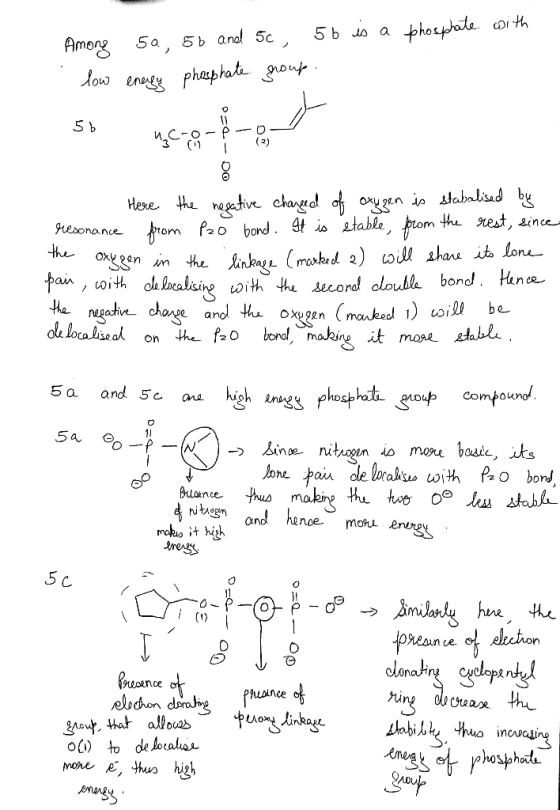
. For each phosphate group below indicate if that phosphate is considered a high energy phosphate...
What makes “high-energy bonds” “high-energy”? Give some examples of phosphate groups with a high group-transfer potential...
What makes “high-energy bonds” “high-energy”? Give some examples of phosphate groups with a high group-transfer potential and explain how they differ from phosphate groups with a low group-transfer potential. Why do thioester bonds have a high group-transfer potential?
______________: catalyzes the transfer of phosphoryl groups from high-energy, phosphate-donating molecules to specific substrates. Group of...
______________: catalyzes the transfer of phosphoryl groups from high-energy, phosphate-donating molecules to specific substrates. Group of answer choices kinase phosphatase mutase ATP
Problem 7. (ATP) In the human body, hydrolysis of ATP molecules (shown below) releases energy. During...
 Problem 7. (ATP) In the human body, hydrolysis of ATP molecules (shown below) releases energy. During hydrolysis one of the three phosphate groups is broken off to give ADP, and a phosphate group, with the release of energy. Organisms make use of this energy to perform various biological functions. Adening High-energy bonds o-o-o -o -o 6 Ribose Phosphate Adenosine Adenosine monophosphate (AMP) Adenosine diphosphate (ADP) Adenosine triphosphate (ATP) A. An O - P bond in ATP is referred to as...
Below are several research scenarios. Indicate which set of statistical analyses (e.g., ANOVA, independent samples t...
Below are several research scenarios. Indicate which set of statistical analyses (e.g., ANOVA, independent samples t test, correlated samples t test, correlation, chi-square, regression) should be used to analyze the data collected in study, and explain why that statistical test should be used (2 points each; 8 points total). A researcher developed a video designed to enhance creative writing. Fifty high school students were asked to participate in the study. Twenty-five were randomly assigned to group A and the other...
Directions: Circle the word in each group that is least similar to the others. Indicate the...
Directions: Circle the word in each group that is least similar to the others. Indicate the similarity of the three words on the line below each question. 1. mitral SA node tricuspid pulmonic semilunar 2. AV node His-Purkinje precordium pacemaker 3. atrium ventricle pumping chamber pericardium 4. epi- endo- vaso- myo- 5. aorta venae cavae right atrium pulmonary veins 6. tricuspid AV valve mitral precordium 7. P wave S1,S2 QRS complex P-R...
For the two situations mentioned below, select if the group mentioned is to be considered a...
 For the two situations mentioned below, select if the group mentioned is to be considered a MAIN stakeholder or not: (Hint: in each situation, one of the five groups has to be responsible for the financial management of the organization) (1) A public university that considers expanding campus: Students: Customers: Community: . Employees: Society: Government: Professors: Researchers: Owners: Chamber of Commerce: (2) A private chemical processing firm that is planning on adding a duplicate polyethylene plant at another location. Students:...
Question 21 (3 points) This image is an example of the following Na Phosphate group PP2...
 Question 21 (3 points) This image is an example of the following Na Phosphate group PP2 ADP Phosphate group P- P7 ADP Oa) Phosphorylation Ob) Confirmational change O c) Dephosphorylation O d) A and B Oe) B and C The atom that loses electrons is oxidized, whereas, the atom that gains electrons is reduced a) True b) False Question 23 (3 points) In the image, oxygen becomes O a) oxidized Ob) electron altered Oc) reduced d) none of the above...
Use the figure below to answer the following question about glycolysis. Where did the phosphate group...
 Use the figure below to answer the following question about glycolysis. Where did the phosphate group come from to create the second molecule shown? GLYCOLYSIS: Energy Investment Phase ATP Glucose сн,он Glucose 6-phosphate CH,OẠP Fructose 6-phosphate CH,O 2 CH2OH ADP он Кон WAO HO он HOOH OH Hexokinase VOH OH HO KOH Phosphogluco- isomerase но н ADP ATP Glycolysis Glucose Hexokinase
1) Label the acidic functional groups 2) For each acidic site, indicate if it has been...
 1) Label the acidic functional groups
2) For each acidic site, indicate if it has been drawn in the
protonated form or not
9/1/16 Name: Worksheet 2 Below is a partial structure of Humic Acid, Circle AND name SEVEN different functional groups on the molecule НООС HOOC сно нс-он COOH --0 он НО. но-сн НО он ( ОН нс-он COOH о HC-OH с=0 o- НО но оноо ОН HN NH
1) Label the acidic functional groups
2) For each acidic site, indicate if it has been drawn in the
protonated form or not
9/1/16 Name: Worksheet 2 Below is a partial structure of Humic Acid, Circle AND name SEVEN different functional groups on the molecule НООС HOOC сно нс-он COOH --0 он НО. но-сн НО он ( ОН нс-он COOH о HC-OH с=0 o- НО но оноо ОН HN NH
6. Draw a Molecular Orbital Energy Diagram for the compound below. Your diagram should clearly indicate...
 6. Draw a Molecular Orbital Energy Diagram for the compound below. Your diagram should clearly indicate how many o, , o, . and non-bonding orbitals are present, the relative energy of these orbitals, and the total number of electrons in each of these orbitials. (10 pt) N-H
 Problem 7. (ATP) In the human body, hydrolysis of ATP molecules (shown below) releases energy. During hydrolysis one of the three phosphate groups is broken off to give ADP, and a phosphate group, with the release of energy. Organisms make use of this energy to perform various biological functions. Adening High-energy bonds o-o-o -o -o 6 Ribose Phosphate Adenosine Adenosine monophosphate (AMP) Adenosine diphosphate (ADP) Adenosine triphosphate (ATP) A. An O - P bond in ATP is referred to as...
 For the two situations mentioned below, select if the group mentioned is to be considered a MAIN stakeholder or not: (Hint: in each situation, one of the five groups has to be responsible for the financial management of the organization) (1) A public university that considers expanding campus: Students: Customers: Community: . Employees: Society: Government: Professors: Researchers: Owners: Chamber of Commerce: (2) A private chemical processing firm that is planning on adding a duplicate polyethylene plant at another location. Students:...
 Question 21 (3 points) This image is an example of the following Na Phosphate group PP2 ADP Phosphate group P- P7 ADP Oa) Phosphorylation Ob) Confirmational change O c) Dephosphorylation O d) A and B Oe) B and C The atom that loses electrons is oxidized, whereas, the atom that gains electrons is reduced a) True b) False Question 23 (3 points) In the image, oxygen becomes O a) oxidized Ob) electron altered Oc) reduced d) none of the above...
 Use the figure below to answer the following question about glycolysis. Where did the phosphate group come from to create the second molecule shown? GLYCOLYSIS: Energy Investment Phase ATP Glucose сн,он Glucose 6-phosphate CH,OẠP Fructose 6-phosphate CH,O 2 CH2OH ADP он Кон WAO HO он HOOH OH Hexokinase VOH OH HO KOH Phosphogluco- isomerase но н ADP ATP Glycolysis Glucose Hexokinase
 1) Label the acidic functional groups
2) For each acidic site, indicate if it has been drawn in the
protonated form or not
9/1/16 Name: Worksheet 2 Below is a partial structure of Humic Acid, Circle AND name SEVEN different functional groups on the molecule НООС HOOC сно нс-он COOH --0 он НО. но-сн НО он ( ОН нс-он COOH о HC-OH с=0 o- НО но оноо ОН HN NH
1) Label the acidic functional groups
2) For each acidic site, indicate if it has been drawn in the
protonated form or not
9/1/16 Name: Worksheet 2 Below is a partial structure of Humic Acid, Circle AND name SEVEN different functional groups on the molecule НООС HOOC сно нс-он COOH --0 он НО. но-сн НО он ( ОН нс-он COOH о HC-OH с=0 o- НО но оноо ОН HN NH
 6. Draw a Molecular Orbital Energy Diagram for the compound below. Your diagram should clearly indicate how many o, , o, . and non-bonding orbitals are present, the relative energy of these orbitals, and the total number of electrons in each of these orbitials. (10 pt) N-H
Most questions answered within 3 hours.
-
Where is the error in this code sequence?
String s1 = "Hello";
String s2 = "ello";...
asked 10 months ago -
Financial data for Joel de Paris, Inc., for last year
follow:
Joel de Paris, Inc.
Balance...
asked 10 months ago -
Consider this reaction:
Al2(SO4)3 (aq)+ BaCl3
(aq) Al2Cl6 (aq)- +
3BaSO4(s) . What is the...
asked 10 months ago -
Suppose that Savneet is considering increasing her
recent random sample from 20 car rentals to 40...
asked 10 months ago -
Trucks arrive at an unloading terminal at an average rate of 120
per hour.
Trucks arrive...
asked 10 months ago -
Why are methanol and ethanol completely soluble in water while
octanol is not very little soluble....
asked 10 months ago -
A facilities manager at a university reads in a research report
that the mean amount of...
asked 10 months ago -
When the CuSO4 is rehydrated by adding water to the anhydrous
compound, is this an endothermic...
asked 10 months ago -
A ray of sunlight is passing from diamond into crown glass; the
angle of incidence is...
asked 10 months ago -
A block of mass 0.249 kg is placed on top of a light, vertical
spring of...
asked 10 months ago -
how do the kidneys compensate in the presences of acidosis
a) trigger hyperventilate
b) reserve acid...
asked 10 months ago -
Question 501 pts
The rental rate of capital to the firm increases. Which of the
following...
asked 10 months ago