
Homework Answers
MATLAB Script:
%%
clear
clc
%% Parameters
global m c k omega
m = 1;
k = 1;
zeta = [0 0.5 1.5];
omega_n = sqrt(k/m);
omega_vals = [0.1 0.25 0.5 0.75 1 1.25 1.5 1.75 2 2.25].*omega_n;
%% Simulating all cases
for i=1:length(zeta)
c = zeta(i)*2*sqrt(m*k);
for j=1:length(omega_vals)
omega = omega_vals(j);
[t,X] = ode45('eom',[0 100],[0; 0]);
SS(i,j) = X(end,1);
end
end
%% Plot of Steady State Value vs Omega
plot(omega_vals,abs(SS(1,:)))
hold on
plot(omega_vals,abs(SS(2,:)))
hold on
plot(omega_vals,abs(SS(3,:)))
xlabel 'Omega (rad/s)'
ylabel 'Magnitude of Steady State Value'
legend 'zeta = 0' 'zeta = 0.5' 'zeta = 1.5'
grid on
Function 'eom' (save as new script)
function X_dot = eom (t,x0)
global m c k omega
x1 = x0(1);
x2 = x0(2);
y = sin(omega*t);
x1_d = x2;
x2_d = -(k/m)*x1 -(c/m)*x2 + y;
X_dot = [x1_d;x2_d];
end
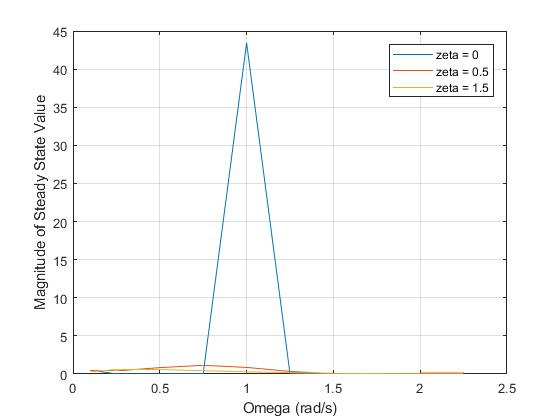
Graph of Steady State value vs Omega
Add Answer to:
Frequency Response of a mass-spring-dashpot system Consider a mass-spring-dashpot system driven b...
Problem 2.31: An underdamped mass-spring-dashpot system is subject to a periodic force F(t) of a ...
 Problem 2.31: Please complete all of the following
Problem 2.31: An underdamped mass-spring-dashpot system is subject to a periodic force F(t) of a period T and a saw-tooth form, as shown in Fig. P2.31. Assume ζ 0.1. AF(t) T" 2T 3T Figure P2.31 Periodic loading of saw-tooth shape (a) Obtain the Fourier series expansion for the force. (b) Find the Fourier series expansion of the system's steady-state response. (c) For T/T, = 0.5, where T, is the natural period of...
Problem 2.31: Please complete all of the following
Problem 2.31: An underdamped mass-spring-dashpot system is subject to a periodic force F(t) of a period T and a saw-tooth form, as shown in Fig. P2.31. Assume ζ 0.1. AF(t) T" 2T 3T Figure P2.31 Periodic loading of saw-tooth shape (a) Obtain the Fourier series expansion for the force. (b) Find the Fourier series expansion of the system's steady-state response. (c) For T/T, = 0.5, where T, is the natural period of...
A vibratory system can be modeled as a mass spring dashpot system as shown in Figure. In a free vibration test, the mas...
 A vibratory system can be modeled as a mass spring dashpot system as shown in Figure. In a free vibration test, the mass is disturbed from its equilibrium position. The corresponding time history plot is given as shown by the plot. Determine the following characteristics of the system: a) The natural frequency of the system b) The effective spring stifness c) The viscous damping coefficient c E 2 20kg 1.5 time (s)
A vibratory system can be modeled as a...
A vibratory system can be modeled as a mass spring dashpot system as shown in Figure. In a free vibration test, the mass is disturbed from its equilibrium position. The corresponding time history plot is given as shown by the plot. Determine the following characteristics of the system: a) The natural frequency of the system b) The effective spring stifness c) The viscous damping coefficient c E 2 20kg 1.5 time (s)
A vibratory system can be modeled as a...
Question B A machine on a viscoelastic foundation (Figure 31.1), modelled as a spring mass-damper system...
 Question B A machine on a viscoelastic foundation (Figure 31.1), modelled as a spring mass-damper system is acted upon by a force modelled as a harmonic force: F(t) = 0.2 sin(wt) Force is given in N and time in seconds. W Figure 31.1 Nos Given numerical values: m = 10 kg C=5 M k = 1000 = 1) draw the correct Free-Body-Diagram and determine the equation of motion [2 marks) 2) determine the natural frequency and the damping ratio of...
Problem 2.31: Please complete all of the following Problem 2.31: An underdamped mass-spring-dashpot system is subject...
 Problem 2.31: Please complete all of the following
Problem 2.31: An underdamped mass-spring-dashpot system is subject to a periodic force F(t) of a period T and a saw-tooth form, as shown in Fig. P2.31. Assume ζ 0.1. AF(t) T" 2T 3T Figure P2.31 Periodic loading of saw-tooth shape (a) Obtain the Fourier series expansion for the force. (b) Find the Fourier series expansion of the system's steady-state response. (c) For T/T, = 0.5, where T, is the natural period of...
Problem 2.31: Please complete all of the following
Problem 2.31: An underdamped mass-spring-dashpot system is subject to a periodic force F(t) of a period T and a saw-tooth form, as shown in Fig. P2.31. Assume ζ 0.1. AF(t) T" 2T 3T Figure P2.31 Periodic loading of saw-tooth shape (a) Obtain the Fourier series expansion for the force. (b) Find the Fourier series expansion of the system's steady-state response. (c) For T/T, = 0.5, where T, is the natural period of...
For the given parameters for a forced mass-spring-dashpot system with equation mx"+ cx' + kx =...
 For the given parameters for a forced mass-spring-dashpot system with equation mx"+ cx' + kx = Fo cos ot. Investigate the possibility of practical resonance of this system. In particular, find the amplitude C(a) and find the practical resonance frequency o (if any). m 1, c 5, k 40, Fo = 50
Consider a driven oscialting spring-mass system modeled by my' + by' + ky = Fo cos(wt)....
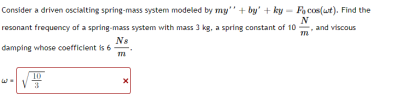 Consider a driven oscialting spring-mass system modeled by my' + by' + ky = Fo cos(wt). Find the N resonant frequency of a spring-mass system with mass 3 kg, a spring constant of 10 , and viscous Ns damping whose coefficient is 6 m wolv
Solve it with matlab 25.16 The motion of a damped spring-mass system (Fig. P25.16) is described...
 Solve it with matlab
25.16 The motion of a damped spring-mass system (Fig. P25.16) is described by the following ordinary differential equation: d’x dx ++ kx = 0 m dr dt where x = displacement from equilibrium position (m), t = time (s), m 20-kg mass, and c = the damping coefficient (N · s/m). The damping coefficient c takes on three values of 5 (under- damped), 40 (critically damped), and 200 (overdamped). The spring constant k = 20 N/m....
Solve it with matlab
25.16 The motion of a damped spring-mass system (Fig. P25.16) is described by the following ordinary differential equation: d’x dx ++ kx = 0 m dr dt where x = displacement from equilibrium position (m), t = time (s), m 20-kg mass, and c = the damping coefficient (N · s/m). The damping coefficient c takes on three values of 5 (under- damped), 40 (critically damped), and 200 (overdamped). The spring constant k = 20 N/m....
Question (b) Ans : root(7/2) , 16/((5)^(1/2)) 9. Consider a mass-spring system as shown in the...
 Question (b)
Ans : root(7/2) , 16/((5)^(1/2))
9. Consider a mass-spring system as shown in the figure with a body of mass m, a spring and a dashpot. Let k, c and r(t) be the spring constant, the damping constant and driving force, respectively Let y(t) be the displacementMass of the body from the equilibrium with downward direction as positive. b) [7pts] Let m=1, c=1, k=4, and r(t) 8cosut. Determine w such that you get the steady-state vibration of maximum...
Question (b)
Ans : root(7/2) , 16/((5)^(1/2))
9. Consider a mass-spring system as shown in the figure with a body of mass m, a spring and a dashpot. Let k, c and r(t) be the spring constant, the damping constant and driving force, respectively Let y(t) be the displacementMass of the body from the equilibrium with downward direction as positive. b) [7pts] Let m=1, c=1, k=4, and r(t) 8cosut. Determine w such that you get the steady-state vibration of maximum...
A mass-spring-dashpot system is described by (1) 2 cos (wt) 0.801y"+1.25y+97.1y (a) Given the initial value...
 A mass-spring-dashpot system is described by (1) 2 cos (wt) 0.801y"+1.25y+97.1y (a) Given the initial value y(0) 0.1, (0) = 0, solve Eq. (1), where w will be given by your instructor. Round to three significant figures. 0.2 (b) From your particular solution, which is of the form p=A cos wt +Bsin wt. calculate the amplitude, which is VAB
A second order mechanical system of a mass connected to a spring and a damper is subjected to a s...
 A second order mechanical system of a mass connected to a spring and a damper is subjected to a sinusoidal input force mx+cx + kx = A sin(at) The mass is m-5 kg, the damping constant is c = 1 N-sec/m, the spring stiffness is 2 N/m, and the amplitude of the input force is A- 3 N. For this system give explicit numerical values for the damping factor 5 and the un-damped natural frequency Using the given formulas for...
 Problem 2.31: Please complete all of the following
Problem 2.31: An underdamped mass-spring-dashpot system is subject to a periodic force F(t) of a period T and a saw-tooth form, as shown in Fig. P2.31. Assume ζ 0.1. AF(t) T" 2T 3T Figure P2.31 Periodic loading of saw-tooth shape (a) Obtain the Fourier series expansion for the force. (b) Find the Fourier series expansion of the system's steady-state response. (c) For T/T, = 0.5, where T, is the natural period of...
Problem 2.31: Please complete all of the following
Problem 2.31: An underdamped mass-spring-dashpot system is subject to a periodic force F(t) of a period T and a saw-tooth form, as shown in Fig. P2.31. Assume ζ 0.1. AF(t) T" 2T 3T Figure P2.31 Periodic loading of saw-tooth shape (a) Obtain the Fourier series expansion for the force. (b) Find the Fourier series expansion of the system's steady-state response. (c) For T/T, = 0.5, where T, is the natural period of...
 A vibratory system can be modeled as a mass spring dashpot system as shown in Figure. In a free vibration test, the mass is disturbed from its equilibrium position. The corresponding time history plot is given as shown by the plot. Determine the following characteristics of the system: a) The natural frequency of the system b) The effective spring stifness c) The viscous damping coefficient c E 2 20kg 1.5 time (s)
A vibratory system can be modeled as a...
A vibratory system can be modeled as a mass spring dashpot system as shown in Figure. In a free vibration test, the mass is disturbed from its equilibrium position. The corresponding time history plot is given as shown by the plot. Determine the following characteristics of the system: a) The natural frequency of the system b) The effective spring stifness c) The viscous damping coefficient c E 2 20kg 1.5 time (s)
A vibratory system can be modeled as a...
 Question B A machine on a viscoelastic foundation (Figure 31.1), modelled as a spring mass-damper system is acted upon by a force modelled as a harmonic force: F(t) = 0.2 sin(wt) Force is given in N and time in seconds. W Figure 31.1 Nos Given numerical values: m = 10 kg C=5 M k = 1000 = 1) draw the correct Free-Body-Diagram and determine the equation of motion [2 marks) 2) determine the natural frequency and the damping ratio of...
 Problem 2.31: Please complete all of the following
Problem 2.31: An underdamped mass-spring-dashpot system is subject to a periodic force F(t) of a period T and a saw-tooth form, as shown in Fig. P2.31. Assume ζ 0.1. AF(t) T" 2T 3T Figure P2.31 Periodic loading of saw-tooth shape (a) Obtain the Fourier series expansion for the force. (b) Find the Fourier series expansion of the system's steady-state response. (c) For T/T, = 0.5, where T, is the natural period of...
Problem 2.31: Please complete all of the following
Problem 2.31: An underdamped mass-spring-dashpot system is subject to a periodic force F(t) of a period T and a saw-tooth form, as shown in Fig. P2.31. Assume ζ 0.1. AF(t) T" 2T 3T Figure P2.31 Periodic loading of saw-tooth shape (a) Obtain the Fourier series expansion for the force. (b) Find the Fourier series expansion of the system's steady-state response. (c) For T/T, = 0.5, where T, is the natural period of...
 For the given parameters for a forced mass-spring-dashpot system with equation mx"+ cx' + kx = Fo cos ot. Investigate the possibility of practical resonance of this system. In particular, find the amplitude C(a) and find the practical resonance frequency o (if any). m 1, c 5, k 40, Fo = 50
 Consider a driven oscialting spring-mass system modeled by my' + by' + ky = Fo cos(wt). Find the N resonant frequency of a spring-mass system with mass 3 kg, a spring constant of 10 , and viscous Ns damping whose coefficient is 6 m wolv
 Solve it with matlab
25.16 The motion of a damped spring-mass system (Fig. P25.16) is described by the following ordinary differential equation: d’x dx ++ kx = 0 m dr dt where x = displacement from equilibrium position (m), t = time (s), m 20-kg mass, and c = the damping coefficient (N · s/m). The damping coefficient c takes on three values of 5 (under- damped), 40 (critically damped), and 200 (overdamped). The spring constant k = 20 N/m....
Solve it with matlab
25.16 The motion of a damped spring-mass system (Fig. P25.16) is described by the following ordinary differential equation: d’x dx ++ kx = 0 m dr dt where x = displacement from equilibrium position (m), t = time (s), m 20-kg mass, and c = the damping coefficient (N · s/m). The damping coefficient c takes on three values of 5 (under- damped), 40 (critically damped), and 200 (overdamped). The spring constant k = 20 N/m....
 Question (b)
Ans : root(7/2) , 16/((5)^(1/2))
9. Consider a mass-spring system as shown in the figure with a body of mass m, a spring and a dashpot. Let k, c and r(t) be the spring constant, the damping constant and driving force, respectively Let y(t) be the displacementMass of the body from the equilibrium with downward direction as positive. b) [7pts] Let m=1, c=1, k=4, and r(t) 8cosut. Determine w such that you get the steady-state vibration of maximum...
Question (b)
Ans : root(7/2) , 16/((5)^(1/2))
9. Consider a mass-spring system as shown in the figure with a body of mass m, a spring and a dashpot. Let k, c and r(t) be the spring constant, the damping constant and driving force, respectively Let y(t) be the displacementMass of the body from the equilibrium with downward direction as positive. b) [7pts] Let m=1, c=1, k=4, and r(t) 8cosut. Determine w such that you get the steady-state vibration of maximum...
 A mass-spring-dashpot system is described by (1) 2 cos (wt) 0.801y"+1.25y+97.1y (a) Given the initial value y(0) 0.1, (0) = 0, solve Eq. (1), where w will be given by your instructor. Round to three significant figures. 0.2 (b) From your particular solution, which is of the form p=A cos wt +Bsin wt. calculate the amplitude, which is VAB
 A second order mechanical system of a mass connected to a spring and a damper is subjected to a sinusoidal input force mx+cx + kx = A sin(at) The mass is m-5 kg, the damping constant is c = 1 N-sec/m, the spring stiffness is 2 N/m, and the amplitude of the input force is A- 3 N. For this system give explicit numerical values for the damping factor 5 and the un-damped natural frequency Using the given formulas for...
Most questions answered within 3 hours.
-
Where is the error in this code sequence?
String s1 = "Hello";
String s2 = "ello";...
asked 11 months ago -
Financial data for Joel de Paris, Inc., for last year
follow:
Joel de Paris, Inc.
Balance...
asked 11 months ago -
Consider this reaction:
Al2(SO4)3 (aq)+ BaCl3
(aq) Al2Cl6 (aq)- +
3BaSO4(s) . What is the...
asked 11 months ago -
Suppose that Savneet is considering increasing her
recent random sample from 20 car rentals to 40...
asked 11 months ago -
Trucks arrive at an unloading terminal at an average rate of 120
per hour.
Trucks arrive...
asked 11 months ago -
Why are methanol and ethanol completely soluble in water while
octanol is not very little soluble....
asked 11 months ago -
A facilities manager at a university reads in a research report
that the mean amount of...
asked 11 months ago -
When the CuSO4 is rehydrated by adding water to the anhydrous
compound, is this an endothermic...
asked 11 months ago -
A ray of sunlight is passing from diamond into crown glass; the
angle of incidence is...
asked 11 months ago -
A block of mass 0.249 kg is placed on top of a light, vertical
spring of...
asked 11 months ago -
how do the kidneys compensate in the presences of acidosis
a) trigger hyperventilate
b) reserve acid...
asked 11 months ago -
Question 501 pts
The rental rate of capital to the firm increases. Which of the
following...
asked 11 months ago