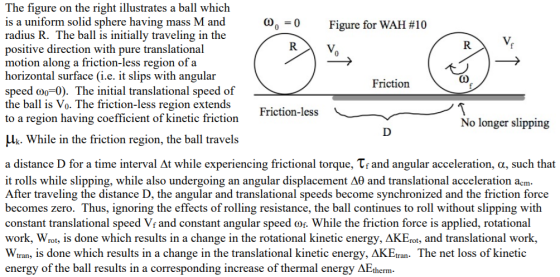
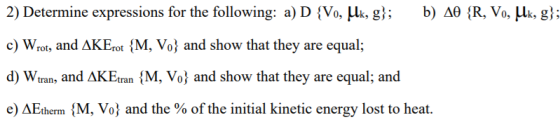
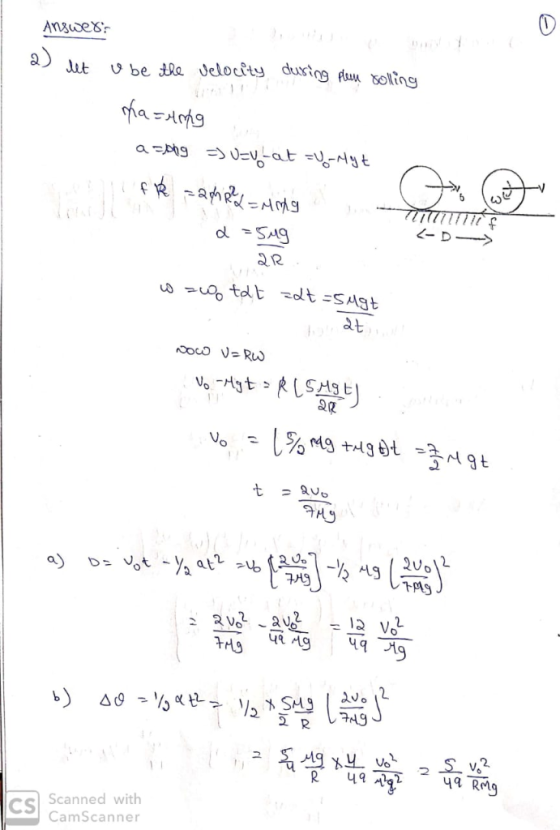
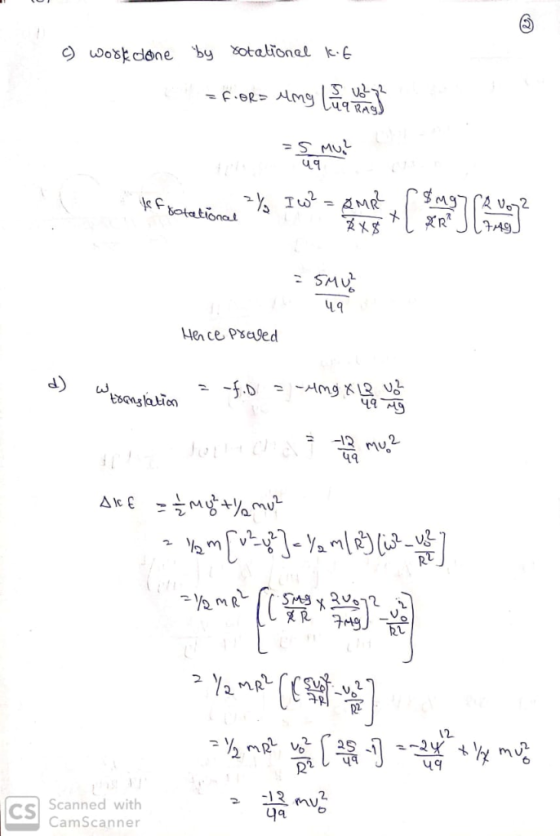
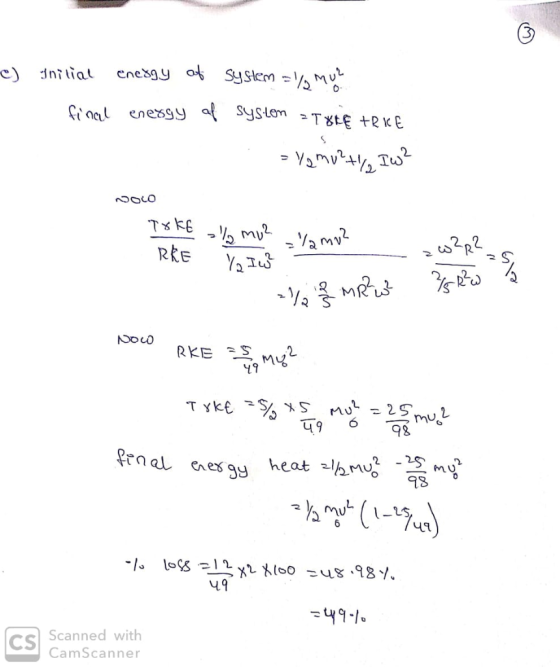
2) Determine expressions for the following: a) D {ν, μ, g); c) Wrot, and ΔΚΕ,ot M, Vo) and show that they are equal; d) Wtran, and AKEtran M, Vo} and show that they d e) ΔΕtherm M, Vo) and the % of the initial kinetic energy lost to heat. b) Δθ { R, Vo, μ, g); are equal: an
Homework Answers
Add Answer to:
The figure on the right illustrates a ball which is a uniform solid sphere having mass M and radi...
A spherical bowling ball with mass m = 3.3 kg and radius R = 0.111 m...
A spherical bowling ball with mass m = 3.3 kg and radius R = 0.111 m is thrown down the lane with an initial speed of v = 8.9 m/s. The coefficient of kinetic friction between the sliding ball and the ground is μ = 0.29. Once the ball begins to roll without slipping it moves with a constant velocity down the lane. 1)What is the magnitude of the angular acceleration of the bowling ball as it slides down the...
A spherical bowling ball with mass m = 4 kg and radius R = 0.114 m...
 A spherical bowling ball with mass m = 4 kg and radius R = 0.114
m is thrown down the lane with an initial speed of v = 8.7 m/s. The
coefficient of kinetic friction between the sliding ball and the
ground is ? = 0.32. Once the ball begins to roll without slipping
it moves with a constant velocity down the lane.
1)
What is the magnitude of the angular acceleration of the bowling
ball as it slides down...
A spherical bowling ball with mass m = 4 kg and radius R = 0.114
m is thrown down the lane with an initial speed of v = 8.7 m/s. The
coefficient of kinetic friction between the sliding ball and the
ground is ? = 0.32. Once the ball begins to roll without slipping
it moves with a constant velocity down the lane.
1)
What is the magnitude of the angular acceleration of the bowling
ball as it slides down...
A sphere of radius r =34.5 cm and mass m = 1.80 kg starts from rest and rolls without slipping down a 30.0° incline that is 10.0 m long.
A sphere of radius r =34.5 cm and mass m = 1.80 kg starts from rest and rolls without slipping down a 30.0° incline that is 10.0 m long.A) Calculate its translational speed when it reaches the bottom.B) Calculate its rotational speed when it reaches the bottom. C) What is the ratio of translational to rotational kinetic energy at the bottom? D) Avoid putting in numbers until the end so you can answer: do your...
A uniform solid sphere with a mass M = 2.0 kg and a radius R =...
A uniform solid sphere with a mass M = 2.0 kg and a radius R = 0.10 m is set into motion with an angular speed ωo = 70 rad/s. At t = 0 the sphere is dropped a short distance (without bouncing) onto a horizontal surface. There is friction between the sphere and the surface. Find (a) the angular speed of rotation when the sphere finally rolls without slipping at time t = T and (b) the amount of...
A sphere of radius r =34.5 cm and mass m = 1.80 kg starts from rest...
A sphere of radius r =34.5 cm and mass m = 1.80 kg starts from rest and rolls without slipping down a 30.0? incline that is 10.0m long. Part A Calculate its translational speed when it reaches the bottom. v= Part B Calculate its rotational speed when it reaches the bottom. Express your answer using three significant figures and include the appropriate units. w = Part C What is the ratio of translational to rotational kinetic energy at the bottom?...
A 305-N solid sphere of radius 0.4 m is released from rest and rolls without slipping...
 A 305-N solid sphere of radius 0.4 m is released from rest and rolls without slipping from the top to the bottom of a ramp of length 5 m that is inclined at an angle of 25 degrees with the horizontal as shown in the figure below. a. What type(s) of energy does the object have when it is released? Gravitational Potential Energy (GPE) Rotational Kinetic Energy (KE) Translational Kinetic Energy (KE) Both KE and KE, GPE, KE, and KE,...
Problem 4 A uniform solid spherical ball of mass M and radius R rests on a horizontal surface. Assume a constant coeffi...
 Problem 4 A uniform solid spherical ball of mass M and radius R rests on a horizontal surface. Assume a constant coefficient of friction (this means that the frictional force is equal to the normal force multiplied by u). The acceleration due to gravity is g. At time t 0, the bal is struck impulsively on center, causing it to go instantaneously from rest to initial rotation horizontal speed vo with a no (a) Find the horizontal speed, and the...
A sphere of radius r = 34.5 cm and mass m = 1.80 kg starts from...
 A sphere of radius r = 34.5 cm and mass m = 1.80 kg starts from rest and rolls without slipping down a 30.0° incline that is 10.0 m long. Part A Calculate its translational speed when it reaches the bottom. Express your answer using three significant figures and include the appropriate units. A Value Units Submit Request Answer Part B Part B Calculate its rotational speed when it reaches the bottom. Express your answer using three significant figures and...
1.A solid uniform sphere of mass 3.7 kg and radius 0.051 m rotates with angular velocity...
1.A solid uniform sphere of mass 3.7 kg and radius 0.051 m rotates with angular velocity 7.3 rad/s about an axis through its center. Find the sphere’s rotational kinetic energy. 2.A certain pulley is a uniform disk of mass 2.7 kg and radius 0.25 m. A rope applies a constant torque to the pulley, which is free to rotate without friction, resulting in an angular acceleration of 0.12 rad/s2. The pulley starts at rest at time t = 0 s....
A solid sphere rolls in released from rest and rolls down an incline plane, which is...
A solid sphere rolls in released from rest and rolls down an incline plane, which is 2.0 m long and inclined at a 30° angle from the horizontal. (a) Find its speed at the bottom of the incline. (Remember that the kinetic energy in rolling motion is the translational kinetic energy ½ Mv2 of the center, plus the rotational K.E. ½ Iω2 about the center. Also remember that v = ωr if the sphere rolls without slipping.) (b) Find the...
 A spherical bowling ball with mass m = 4 kg and radius R = 0.114
m is thrown down the lane with an initial speed of v = 8.7 m/s. The
coefficient of kinetic friction between the sliding ball and the
ground is ? = 0.32. Once the ball begins to roll without slipping
it moves with a constant velocity down the lane.
1)
What is the magnitude of the angular acceleration of the bowling
ball as it slides down...
A spherical bowling ball with mass m = 4 kg and radius R = 0.114
m is thrown down the lane with an initial speed of v = 8.7 m/s. The
coefficient of kinetic friction between the sliding ball and the
ground is ? = 0.32. Once the ball begins to roll without slipping
it moves with a constant velocity down the lane.
1)
What is the magnitude of the angular acceleration of the bowling
ball as it slides down...
 A 305-N solid sphere of radius 0.4 m is released from rest and rolls without slipping from the top to the bottom of a ramp of length 5 m that is inclined at an angle of 25 degrees with the horizontal as shown in the figure below. a. What type(s) of energy does the object have when it is released? Gravitational Potential Energy (GPE) Rotational Kinetic Energy (KE) Translational Kinetic Energy (KE) Both KE and KE, GPE, KE, and KE,...
 Problem 4 A uniform solid spherical ball of mass M and radius R rests on a horizontal surface. Assume a constant coefficient of friction (this means that the frictional force is equal to the normal force multiplied by u). The acceleration due to gravity is g. At time t 0, the bal is struck impulsively on center, causing it to go instantaneously from rest to initial rotation horizontal speed vo with a no (a) Find the horizontal speed, and the...
 A sphere of radius r = 34.5 cm and mass m = 1.80 kg starts from rest and rolls without slipping down a 30.0° incline that is 10.0 m long. Part A Calculate its translational speed when it reaches the bottom. Express your answer using three significant figures and include the appropriate units. A Value Units Submit Request Answer Part B Part B Calculate its rotational speed when it reaches the bottom. Express your answer using three significant figures and...
Most questions answered within 3 hours.
-
Where is the error in this code sequence?
String s1 = "Hello";
String s2 = "ello";...
asked 10 months ago -
Financial data for Joel de Paris, Inc., for last year
follow:
Joel de Paris, Inc.
Balance...
asked 10 months ago -
Consider this reaction:
Al2(SO4)3 (aq)+ BaCl3
(aq) Al2Cl6 (aq)- +
3BaSO4(s) . What is the...
asked 10 months ago -
Suppose that Savneet is considering increasing her
recent random sample from 20 car rentals to 40...
asked 10 months ago -
Trucks arrive at an unloading terminal at an average rate of 120
per hour.
Trucks arrive...
asked 10 months ago -
Why are methanol and ethanol completely soluble in water while
octanol is not very little soluble....
asked 10 months ago -
A facilities manager at a university reads in a research report
that the mean amount of...
asked 10 months ago -
When the CuSO4 is rehydrated by adding water to the anhydrous
compound, is this an endothermic...
asked 10 months ago -
A ray of sunlight is passing from diamond into crown glass; the
angle of incidence is...
asked 10 months ago -
A block of mass 0.249 kg is placed on top of a light, vertical
spring of...
asked 10 months ago -
how do the kidneys compensate in the presences of acidosis
a) trigger hyperventilate
b) reserve acid...
asked 10 months ago -
Question 501 pts
The rental rate of capital to the firm increases. Which of the
following...
asked 10 months ago