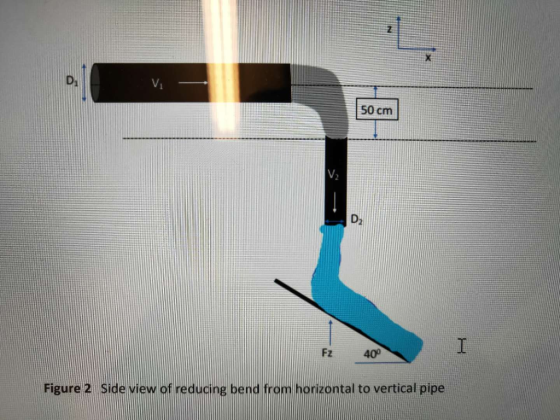
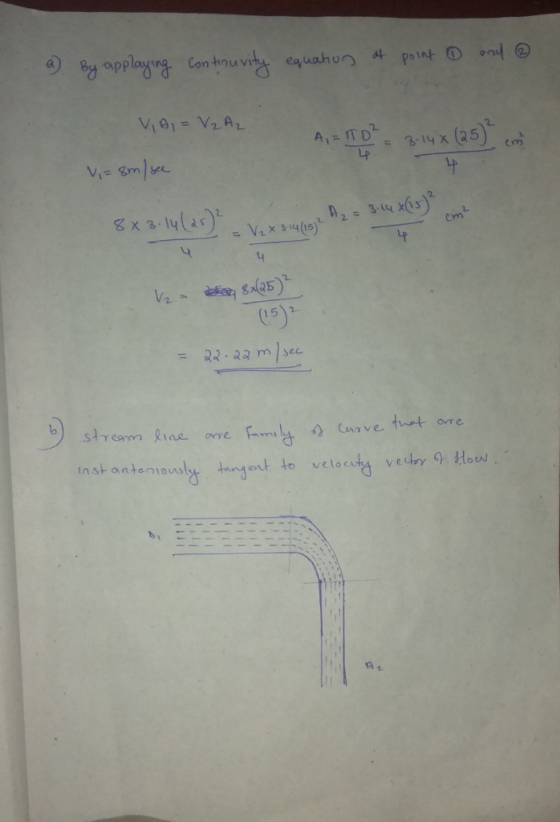
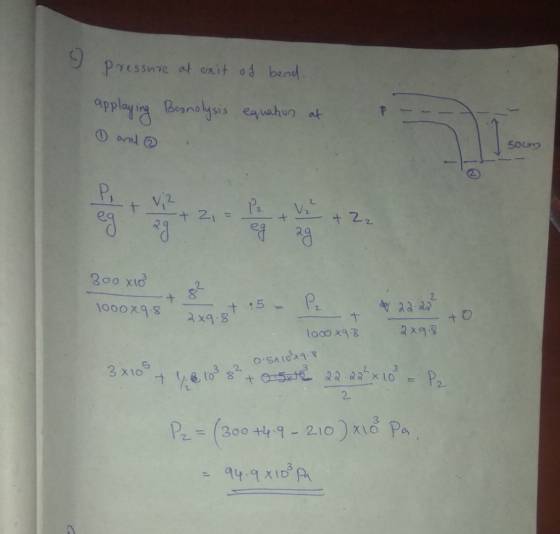
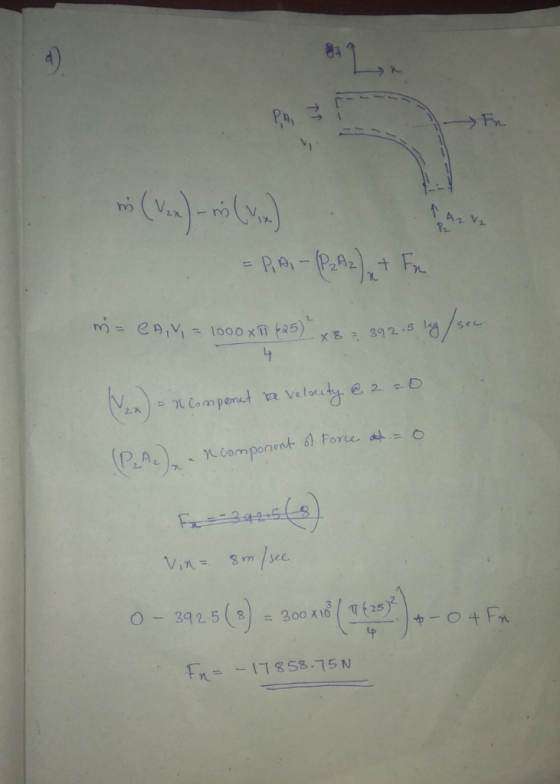
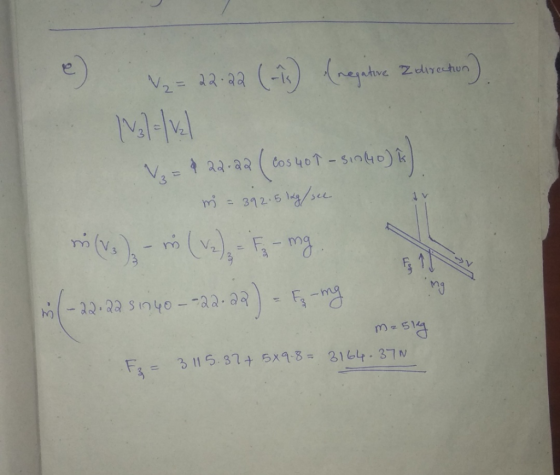
Water is flowing through a horizontal pipe with diameter, D1, at a velocity, V1, and under a pressure, P1. It enters a 900 reducing bend (Shown in grey in Fig 2) that connects to a vertical pipe of diameter, D2. The inlet of the bend is 50 cm above the exit of the bend (as shown in Fig 2). Axes for positive directions of x and z coordinates are provided. Figure 2 Side view of reducing bend from horizontal to vertical pipe The following dimensions apply: D1 = 25 cm; D2 = 15 cm; V1 = 8 m/s; P1 = 300 kPa The flow is steady and incompressible. Frictional effects are negligible in the calculation of the pressure drop as well as any local losses. The weight of the elbow and the water in it can be disregarded since the gravitational effects are negligible. In your exam booklet determine the following: a) What is the velocity, V2, of the vertical pipe? [2 marks] b) Draw the streamline that you will use to solve the problem [2 marks]. c) What is the pressure, P2, at the exit of the bend? [3 marks] d) What is the Horizontal force, Fx, of the 900 reducing bend on the water (make sure to include the correct sign and/or indicate direction and note what is asked for). To guide your answer, draw the control volume you will use to solve the problem. Label all the forces acting on the control volume. [10 marks]. e) If the water exits the pipe and then hits an incline plane (40 degree incline), what is the vertical force required to hold the plane in place. The mass of the plate is 5kg. (make sure to include the correct sign and/or indicate direction and note what is asked for). [8 marks]
Homework Answers
Add Answer to:
Water is flowing through a horizontal pipe with diameter, D1, at a velocity, V1, and under a pres...
also need direction of resultant force FIGURE P6-37 6-38 Water flowing in a horizontal 25-cm-diameter pipe...
 also need direction of resultant force
FIGURE P6-37 6-38 Water flowing in a horizontal 25-cm-diameter pipe at 8 m/s and 300 kPa gage enters a 90 bend reducing section, which connects to a 15-cm-diameter vertical pipe. The inlet of the bend is 50 cm above the exit. Neglecting any frictional and gravitational effects, determine the net resultant force exerted on the reducer by the water. Take the momentum- flux correction factor to be 1.04. 6 30 A horizontal 4-cm-diameter water...
also need direction of resultant force
FIGURE P6-37 6-38 Water flowing in a horizontal 25-cm-diameter pipe at 8 m/s and 300 kPa gage enters a 90 bend reducing section, which connects to a 15-cm-diameter vertical pipe. The inlet of the bend is 50 cm above the exit. Neglecting any frictional and gravitational effects, determine the net resultant force exerted on the reducer by the water. Take the momentum- flux correction factor to be 1.04. 6 30 A horizontal 4-cm-diameter water...
Water flow in a pipe and then exit through a bended nozzle as shown in Figure...
 Water flow in a pipe and then exit through a bended nozzle as shown in Figure 3. The nozzle is connected to the main pipe using a flanged joint at (1). The diameter of the pipe is D1 10 cm and is constant, whilst the diameter at the outlet section of the nozzle (2) is D2 3 em. The flowrate of the water is Q = 15 liter/s and the water pressure at the flange is Pi 230 kPa. By...
Review A water filled pipe has water flowing at v1= 6.20 m/s in a section of...
Review A water filled pipe has water flowing at v1= 6.20 m/s in a section of pipe where the diameter is d1= 19.2 cm and the pressure is known to be P1= 7.00×10⁴ N/m2 above atmospheric pressure. 1- If the pipe carries the water 3.5 meters up hill without any change in diameter, what is the new absolute pressure within the pipe? 2- After flowing up the hill described above, the pipe narrows to 80% of its original radius, what...
In the figure, water flows through a horizontal pipe and then out into the atmosphere at...
 In the figure, water flows through a horizontal pipe and then
out into the atmosphere at a speed v1 = 16.0
m/s. The diameters of the left and right sections of the pipe are
5.20 cm and 3.00 cm. (a) What volume of water
flows into the atmosphere during a 10 min period? In the left
section of the pipe, what are (b) the speed
v2 and (c) the gauge
pressure?
Question 1 In the figure, water flows through a...
In the figure, water flows through a horizontal pipe and then
out into the atmosphere at a speed v1 = 16.0
m/s. The diameters of the left and right sections of the pipe are
5.20 cm and 3.00 cm. (a) What volume of water
flows into the atmosphere during a 10 min period? In the left
section of the pipe, what are (b) the speed
v2 and (c) the gauge
pressure?
Question 1 In the figure, water flows through a...
Water flows through a 30° pipe bend at a rate of 200 gpm. The diameter of...
 Water flows through a 30° pipe bend at a rate of 200 gpm. The diameter of the entrance to the bend is 2.5 in. and that of the exit is 3 in. The pressure in the pipe is 30 psig, and the pressure drop in the bend is negligible. What is the total force (magnitude and direction) exerted by the fluid on the pipe bend?
Water flowing out of a horizontal pipe emerges through a nozzle. The radius of the pipe...
Water flowing out of a horizontal pipe emerges through a nozzle. The radius of the pipe is 2.0 cm, and the radius of the nozzle is 0.59 cm. The speed of the water in the pipe is 0.73 m/s. Treat the water as an ideal fluid, and determine the absolute pressure of the water in the pipe. P1 =
Water flows at speed of 6 m/s through a horizontal pipe of diameter 3.5 cm. The...
 Water flows at speed of 6 m/s through a horizontal pipe of
diameter 3.5 cm. The gauge pressure P1 of the water in the pipe is
1.7 atm. A short segment of the pipe is constricted to a smaller
diameter of 2.4 cm .
What is the gauge pressure of the water flowing through the
constricted segment? Atmospheric pressure is 1.013 × 10^5 Pa. The
density of water is 1000 kg/m^3 . The viscosity of water is
negligible. Answer in...
Water flows at speed of 6 m/s through a horizontal pipe of
diameter 3.5 cm. The gauge pressure P1 of the water in the pipe is
1.7 atm. A short segment of the pipe is constricted to a smaller
diameter of 2.4 cm .
What is the gauge pressure of the water flowing through the
constricted segment? Atmospheric pressure is 1.013 × 10^5 Pa. The
density of water is 1000 kg/m^3 . The viscosity of water is
negligible. Answer in...
In the figure, water flows through a horizontal pipe and then out into the atmosphere at...
In the figure, water flows through a horizontal pipe and then out into the atmosphere at a speed v1 = 14.0 m/s. The diameters of the left and right sections of the pipe are 4.90 cm and 3.20 cm. (a) What volume of water flows into the atmosphere during a 10 min period? In the left section of the pipe, what are (b) the speed v2 and (c) the gauge pressure?
In the figure, water flows through a horizontal pipe and then out into the atmosphere at...
 In the figure, water flows through a horizontal pipe and then out into the atmosphere at a speed vi-14.0 m/s. The diameters of the left and right sections of the pipe are 4.80 cm and 2.70 cm. (a) What volume of water flows into the atmosphere during a 10 min period? In the left section of the pipe, what are (b) the speed v2 and (c) the gauge pressure? da
Water is flowing through a horizontal pipe with an inside diameter of 8.00cm. The pipe narrows...
 Water is flowing through a horizontal pipe with an inside diameter of 8.00cm. The pipe narrows to an inside diameter of 3.75cm. Assume the water is an ideal incompressible fluid. What is the velocity of the fluid initially, v_1 (when It is flowing in the 8.00cm diameter section) if the velocity of the water in the narrow part of the pipe is measured at V_2 = 27m/s? If the initial pressure is known to be 670 kPa what is the...
 also need direction of resultant force
FIGURE P6-37 6-38 Water flowing in a horizontal 25-cm-diameter pipe at 8 m/s and 300 kPa gage enters a 90 bend reducing section, which connects to a 15-cm-diameter vertical pipe. The inlet of the bend is 50 cm above the exit. Neglecting any frictional and gravitational effects, determine the net resultant force exerted on the reducer by the water. Take the momentum- flux correction factor to be 1.04. 6 30 A horizontal 4-cm-diameter water...
also need direction of resultant force
FIGURE P6-37 6-38 Water flowing in a horizontal 25-cm-diameter pipe at 8 m/s and 300 kPa gage enters a 90 bend reducing section, which connects to a 15-cm-diameter vertical pipe. The inlet of the bend is 50 cm above the exit. Neglecting any frictional and gravitational effects, determine the net resultant force exerted on the reducer by the water. Take the momentum- flux correction factor to be 1.04. 6 30 A horizontal 4-cm-diameter water...
 Water flow in a pipe and then exit through a bended nozzle as shown in Figure 3. The nozzle is connected to the main pipe using a flanged joint at (1). The diameter of the pipe is D1 10 cm and is constant, whilst the diameter at the outlet section of the nozzle (2) is D2 3 em. The flowrate of the water is Q = 15 liter/s and the water pressure at the flange is Pi 230 kPa. By...
 In the figure, water flows through a horizontal pipe and then
out into the atmosphere at a speed v1 = 16.0
m/s. The diameters of the left and right sections of the pipe are
5.20 cm and 3.00 cm. (a) What volume of water
flows into the atmosphere during a 10 min period? In the left
section of the pipe, what are (b) the speed
v2 and (c) the gauge
pressure?
Question 1 In the figure, water flows through a...
In the figure, water flows through a horizontal pipe and then
out into the atmosphere at a speed v1 = 16.0
m/s. The diameters of the left and right sections of the pipe are
5.20 cm and 3.00 cm. (a) What volume of water
flows into the atmosphere during a 10 min period? In the left
section of the pipe, what are (b) the speed
v2 and (c) the gauge
pressure?
Question 1 In the figure, water flows through a...
 Water flows through a 30° pipe bend at a rate of 200 gpm. The diameter of the entrance to the bend is 2.5 in. and that of the exit is 3 in. The pressure in the pipe is 30 psig, and the pressure drop in the bend is negligible. What is the total force (magnitude and direction) exerted by the fluid on the pipe bend?
 Water flows at speed of 6 m/s through a horizontal pipe of
diameter 3.5 cm. The gauge pressure P1 of the water in the pipe is
1.7 atm. A short segment of the pipe is constricted to a smaller
diameter of 2.4 cm .
What is the gauge pressure of the water flowing through the
constricted segment? Atmospheric pressure is 1.013 × 10^5 Pa. The
density of water is 1000 kg/m^3 . The viscosity of water is
negligible. Answer in...
Water flows at speed of 6 m/s through a horizontal pipe of
diameter 3.5 cm. The gauge pressure P1 of the water in the pipe is
1.7 atm. A short segment of the pipe is constricted to a smaller
diameter of 2.4 cm .
What is the gauge pressure of the water flowing through the
constricted segment? Atmospheric pressure is 1.013 × 10^5 Pa. The
density of water is 1000 kg/m^3 . The viscosity of water is
negligible. Answer in...
 In the figure, water flows through a horizontal pipe and then out into the atmosphere at a speed vi-14.0 m/s. The diameters of the left and right sections of the pipe are 4.80 cm and 2.70 cm. (a) What volume of water flows into the atmosphere during a 10 min period? In the left section of the pipe, what are (b) the speed v2 and (c) the gauge pressure? da
 Water is flowing through a horizontal pipe with an inside diameter of 8.00cm. The pipe narrows to an inside diameter of 3.75cm. Assume the water is an ideal incompressible fluid. What is the velocity of the fluid initially, v_1 (when It is flowing in the 8.00cm diameter section) if the velocity of the water in the narrow part of the pipe is measured at V_2 = 27m/s? If the initial pressure is known to be 670 kPa what is the...
Most questions answered within 3 hours.
-
Where is the error in this code sequence?
String s1 = "Hello";
String s2 = "ello";...
asked 11 months ago -
Financial data for Joel de Paris, Inc., for last year
follow:
Joel de Paris, Inc.
Balance...
asked 11 months ago -
Consider this reaction:
Al2(SO4)3 (aq)+ BaCl3
(aq) Al2Cl6 (aq)- +
3BaSO4(s) . What is the...
asked 11 months ago -
Suppose that Savneet is considering increasing her
recent random sample from 20 car rentals to 40...
asked 11 months ago -
Trucks arrive at an unloading terminal at an average rate of 120
per hour.
Trucks arrive...
asked 11 months ago -
Why are methanol and ethanol completely soluble in water while
octanol is not very little soluble....
asked 11 months ago -
A facilities manager at a university reads in a research report
that the mean amount of...
asked 11 months ago -
When the CuSO4 is rehydrated by adding water to the anhydrous
compound, is this an endothermic...
asked 11 months ago -
A ray of sunlight is passing from diamond into crown glass; the
angle of incidence is...
asked 11 months ago -
A block of mass 0.249 kg is placed on top of a light, vertical
spring of...
asked 11 months ago -
how do the kidneys compensate in the presences of acidosis
a) trigger hyperventilate
b) reserve acid...
asked 11 months ago -
Question 501 pts
The rental rate of capital to the firm increases. Which of the
following...
asked 11 months ago