
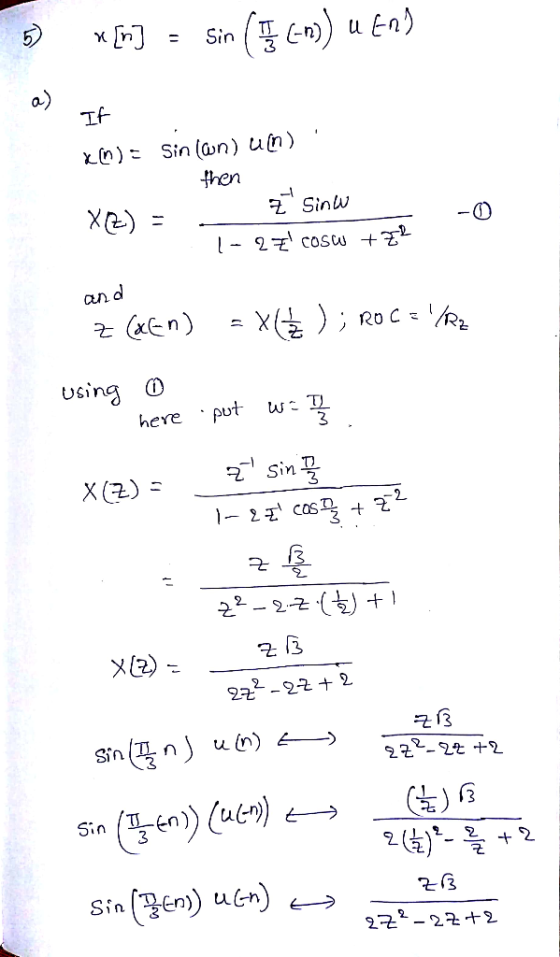
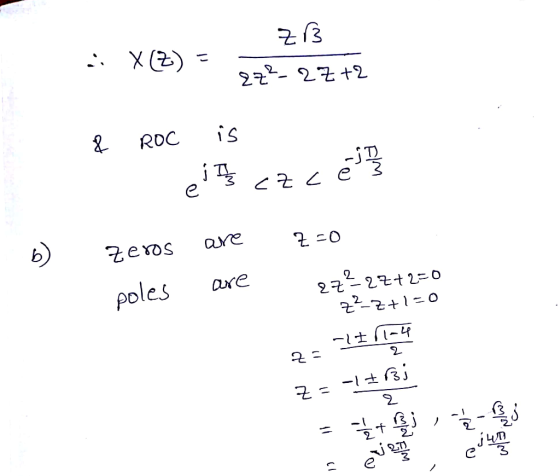
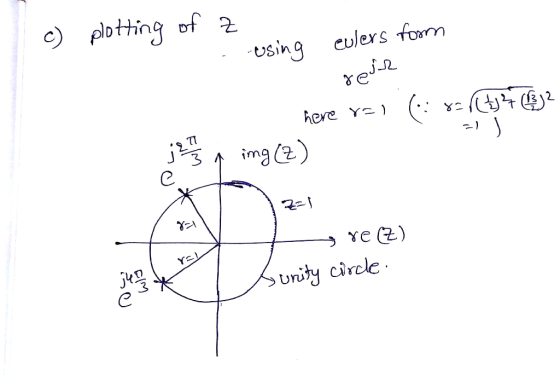
![sin ( (-n))u-n]. (Hints: cos(π/3) (5) x1n] , 1/2, sin(π/3)-V3/2) ,](http://img.homeworklib.com/images/1cf545b6-deca-439b-bfa4-f9c155b07977.png?x-oss-process=image/resize,w_560)
sin ( (-n))u-n]. (Hints: cos(π/3) (5) x1n] , 1/2, sin(π/3)-V3/2) ,"
Homework Answers
Add Answer to:
For each signal x(n) in Problems #(1)-(5), use Z Transform Tables to do the following: (a) Write ...
The pole -zero diagram in figure 1 corresponds to the Z-transform [X(z)] of a causal sequence...
 The pole -zero diagram in figure 1 corresponds to the Z-transform [X(z)] of a causal sequence (xIn]). Sketch the pole-zero diagram of Y(z), where y[n]-x-n5]. Also, determine the region of convergence for Y (z). 2. a. (15 Marks) rm z-plane Figure 1 b. Discuss any six applications of Multirate Digital Signal processing or explain the need of Multirate Signal Processing with suitable Example. (10 Marks)
Problem #1. Topics: Z Transform Find the Z transform of: x[n]=-(0.9 )n-2u-n+5] X(Z) Problem #2. T...
 Problem #1. Topics: Z Transform Find the Z transform of: x[n]=-(0.9 )n-2u-n+5] X(Z) Problem #2. Topics: Filter Design, Effective Time Constant Design a causal 2nd order, normalized, stable Peak Filter centered at fo 1000Hz. Use only two conjugate poles and two zeros at the origin. The system is to be sampled at Fs- 8000Hz. The duration of the transient should be as close as possible to teft 7.5 ms. The transient is assumed to end when the largest pole elevated...
2+z-1 1. The Z-transform of a signal x[n] is given as X(z) = }</21 < a)...
 2+z-1 1. The Z-transform of a signal x[n] is given as X(z) = }</21 < a) Find the signal x[n] [7] b) Draw the pole – zero plot of the z-transform .[3] c) Is x[n] causal or not? Justify your answer [2]
Given the following difference equation that describes the input output relationship, (a) Express Y(z), the z-transform...
 Given the following difference equation that describes the input output relationship, (a) Express Y(z), the z-transform of the output, in terms of X(z), the z-transform of the input. (b) Find the system function H(z). (c) Identify the zeros and poles. Sketch the zero-pole plot. (d) For an input rn]- cos (n), find the output yn] (e) Use the zero-pole plot to explain what you obtain in d)
For x[n]-(0.3). 1. a. (2 pts) Find the z-transform, X(z b. (3 pts) Sketch the pole-zero...
 For x[n]-(0.3). 1. a. (2 pts) Find the z-transform, X(z b. (3 pts) Sketch the pole-zero plot. c. (3 pts) Find the region of convergence of the transform. Sketch it in the z-plane. d. (3 pts) Use your answer in part a to write down the DTFT of x,[n]=(0.3)"u[n]. Why is it necessary to multiply by the unit step function to get the DTFT?
2-Use tables and properties to determine z-transform of the following signal x[n] = (+)*u[n] – (3)...
 2-Use tables and properties to determine z-transform of the following signal x[n] = (+)*u[n] – (3) "u[n]
5. (22+2=4") Topic: The z-transform, z-transform properties Use the z-transform properties to determine the z-transform the...
 5. (22+2=4") Topic: The z-transform, z-transform properties Use the z-transform properties to determine the z-transform the following signal and specify the region of convergence. x[n]=(1)"u[n]*2":[-n-1]+)?[n-2]
Problem 5. Determine the z-transform of the signal x[n] :=(-1)"nu[n]. You may use already known z-transforms,...
 Problem 5. Determine the z-transform of the signal x[n] :=(-1)"nu[n]. You may use already known z-transforms, such as those listed in Table 5.1 (page 492) of the textbook, and properties of the z-transform. Moreover, notice that -1 = ejt. TABLE 5.1 Select (Unilateral) Z-Transform Pairs x[n] X[z] 8[n-k] ? 2-1 ոս[ո] (z - 1) z(z+1) (2-1)3 nºu[n] nu[n] z(z? + 4z +1) (2-1) Yºu[n] yn-u[n- 1] z-y 12 ny"u[n] (z-7) yz(z+y) (z-7)3 ny"u[n] n(n - 1)(n-2) (n-m+1) ym! lyl" cos...
Consider the signal x(n-õn-4] + 2õn-5] + õn_6]. (a) Find X(el the discrete-time Fourier transform of...
 Consider the signal x(n-õn-4] + 2õn-5] + õn_6]. (a) Find X(el the discrete-time Fourier transform of xin]. Write expressions for the magnitude and phase of X(elu), and sketch these functions (b) Find all values of N for which the N-point DFT is a set of real numbers (c) Can you find a three-point causal signal x1n i.e., x1In] 0 for n <0 and n > 2) for which the three-point DFT of x (n] is: xn[nl (ie, xiin] O for...
3. For each of the following discrete-time sequences: (i) Find the Z-transform (ZT), if it exists,...
 3. For each of the following discrete-time sequences: (i) Find the Z-transform (ZT), if it exists, and plot the region of convergence (ROC) in the Z-plane (ii) Find the poles and zeros and plot them in the 2-plane (iii) Determine whether the DTFT of the sequence exists (a) x[n] = 8[n – 1] + 28[n – 3] (b) [n] = (0.9e-j*)" u[n + 2] – 2-ul-n - 1] (c) x[n] = 2-" un + 1]
 The pole -zero diagram in figure 1 corresponds to the Z-transform [X(z)] of a causal sequence (xIn]). Sketch the pole-zero diagram of Y(z), where y[n]-x-n5]. Also, determine the region of convergence for Y (z). 2. a. (15 Marks) rm z-plane Figure 1 b. Discuss any six applications of Multirate Digital Signal processing or explain the need of Multirate Signal Processing with suitable Example. (10 Marks)
 Problem #1. Topics: Z Transform Find the Z transform of: x[n]=-(0.9 )n-2u-n+5] X(Z) Problem #2. Topics: Filter Design, Effective Time Constant Design a causal 2nd order, normalized, stable Peak Filter centered at fo 1000Hz. Use only two conjugate poles and two zeros at the origin. The system is to be sampled at Fs- 8000Hz. The duration of the transient should be as close as possible to teft 7.5 ms. The transient is assumed to end when the largest pole elevated...
 2+z-1 1. The Z-transform of a signal x[n] is given as X(z) = }</21 < a) Find the signal x[n] [7] b) Draw the pole – zero plot of the z-transform .[3] c) Is x[n] causal or not? Justify your answer [2]
 Given the following difference equation that describes the input output relationship, (a) Express Y(z), the z-transform of the output, in terms of X(z), the z-transform of the input. (b) Find the system function H(z). (c) Identify the zeros and poles. Sketch the zero-pole plot. (d) For an input rn]- cos (n), find the output yn] (e) Use the zero-pole plot to explain what you obtain in d)
 For x[n]-(0.3). 1. a. (2 pts) Find the z-transform, X(z b. (3 pts) Sketch the pole-zero plot. c. (3 pts) Find the region of convergence of the transform. Sketch it in the z-plane. d. (3 pts) Use your answer in part a to write down the DTFT of x,[n]=(0.3)"u[n]. Why is it necessary to multiply by the unit step function to get the DTFT?
 2-Use tables and properties to determine z-transform of the following signal x[n] = (+)*u[n] – (3) "u[n]
 5. (22+2=4") Topic: The z-transform, z-transform properties Use the z-transform properties to determine the z-transform the following signal and specify the region of convergence. x[n]=(1)"u[n]*2":[-n-1]+)?[n-2]
 Problem 5. Determine the z-transform of the signal x[n] :=(-1)"nu[n]. You may use already known z-transforms, such as those listed in Table 5.1 (page 492) of the textbook, and properties of the z-transform. Moreover, notice that -1 = ejt. TABLE 5.1 Select (Unilateral) Z-Transform Pairs x[n] X[z] 8[n-k] ? 2-1 ոս[ո] (z - 1) z(z+1) (2-1)3 nºu[n] nu[n] z(z? + 4z +1) (2-1) Yºu[n] yn-u[n- 1] z-y 12 ny"u[n] (z-7) yz(z+y) (z-7)3 ny"u[n] n(n - 1)(n-2) (n-m+1) ym! lyl" cos...
 Consider the signal x(n-õn-4] + 2õn-5] + õn_6]. (a) Find X(el the discrete-time Fourier transform of xin]. Write expressions for the magnitude and phase of X(elu), and sketch these functions (b) Find all values of N for which the N-point DFT is a set of real numbers (c) Can you find a three-point causal signal x1n i.e., x1In] 0 for n <0 and n > 2) for which the three-point DFT of x (n] is: xn[nl (ie, xiin] O for...
 3. For each of the following discrete-time sequences: (i) Find the Z-transform (ZT), if it exists, and plot the region of convergence (ROC) in the Z-plane (ii) Find the poles and zeros and plot them in the 2-plane (iii) Determine whether the DTFT of the sequence exists (a) x[n] = 8[n – 1] + 28[n – 3] (b) [n] = (0.9e-j*)" u[n + 2] – 2-ul-n - 1] (c) x[n] = 2-" un + 1]
Most questions answered within 3 hours.
-
Where is the error in this code sequence?
String s1 = "Hello";
String s2 = "ello";...
asked 10 months ago -
Financial data for Joel de Paris, Inc., for last year
follow:
Joel de Paris, Inc.
Balance...
asked 10 months ago -
Consider this reaction:
Al2(SO4)3 (aq)+ BaCl3
(aq) Al2Cl6 (aq)- +
3BaSO4(s) . What is the...
asked 10 months ago -
Suppose that Savneet is considering increasing her
recent random sample from 20 car rentals to 40...
asked 10 months ago -
Trucks arrive at an unloading terminal at an average rate of 120
per hour.
Trucks arrive...
asked 10 months ago -
Why are methanol and ethanol completely soluble in water while
octanol is not very little soluble....
asked 10 months ago -
A facilities manager at a university reads in a research report
that the mean amount of...
asked 10 months ago -
When the CuSO4 is rehydrated by adding water to the anhydrous
compound, is this an endothermic...
asked 10 months ago -
A ray of sunlight is passing from diamond into crown glass; the
angle of incidence is...
asked 10 months ago -
A block of mass 0.249 kg is placed on top of a light, vertical
spring of...
asked 10 months ago -
how do the kidneys compensate in the presences of acidosis
a) trigger hyperventilate
b) reserve acid...
asked 10 months ago -
Question 501 pts
The rental rate of capital to the firm increases. Which of the
following...
asked 10 months ago