
Homework Answers
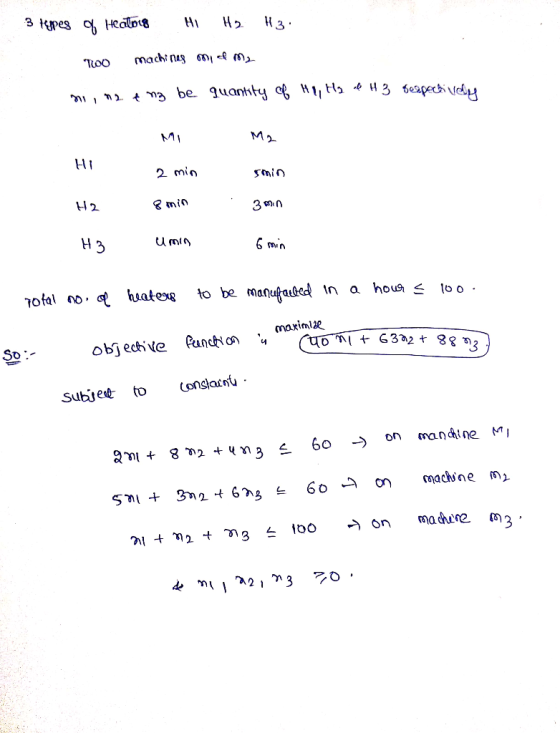
Solution:
Problem is
|
|||||||||||||||||||||||||||||||||
| subject to | |||||||||||||||||||||||||||||||||
|
|||||||||||||||||||||||||||||||||
| and x1,x2,x3≥0; |
The problem is converted to canonical form by adding slack, surplus
and artificial variables as appropiate
1. As the constraint-1 is of type '≤' we should add slack variable
S1
2. As the constraint-2 is of type '≤' we should add slack variable
S2
3. As the constraint-3 is of type '≤' we should add slack variable
S3
After introducing slack variables
|
||||||||||||||||||||||||||||||||||||||||||||||||||||||||||||
| subject to | ||||||||||||||||||||||||||||||||||||||||||||||||||||||||||||
|
||||||||||||||||||||||||||||||||||||||||||||||||||||||||||||
| and x1,x2,x3,S1,S2,S3≥0 |
| Iteration-1 | Cj | 40 | 63 | 88 | 0 | 0 | 0 | ||
| B | CB | XB | x1 | x2 | x3 | S1 | S2 | S3 | MinRatio XB/x3 |
| S1 | 0 | 60 | 2 | 8 | 4 | 1 | 0 | 0 | 60/4=15 |
| S2 | 0 | 60 | 5 | 3 | (6) | 0 | 1 | 0 | 60/6=10→ |
| S3 | 0 | 100 | 1 | 1 | 1 | 0 | 0 | 1 | 100/1=100 |
| Z=0 | Zj | 0 | 0 | 0 | 0 | 0 | 0 | ||
| Zj-Cj | -40 | -63 | -88↑ | 0 | 0 | 0 |
Negative minimum Zj-Cj is -88
and its column index is 3. So, the entering variable is
x3.
Minimum ratio is 10 and its row index is 2. So, the leaving basis
variable is S2.
∴ The pivot element is 6.
Entering =x3, Departing =S2, Key Element
=6
R2(new)=R2(old)÷6
R1(new)=R1(old) - 4R2(new)
R3(new)=R3(old) - R2(new)
| Iteration-2 | Cj | 40 | 63 | 88 | 0 | 0 | 0 | ||
| B | CB | XB | x1 | x2 | x3 | S1 | S2 | S3 | MinRatio XB/x2 |
| S1 | 0 | 20 | -4/3 | (6) | 0 | 1 | -2/3 | 0 | 20/6=3.3333→ |
| x3 | 88 | 10 | 5/6 | 1/2 | 1 | 0 | 1/6 | 0 | 10/(1/2)=20 |
| S3 | 0 | 90 | 1/6 | 1/2 | 0 | 0 | -1/6 | 1 | 90/(1/2)=180 |
| Z=880 | Zj | 220/3 | 44 | 88 | 0 | 44/3 | 0 | ||
| Zj-Cj | 100/3 | -19↑ | 0 | 0 | 44/3 | 0 |
Negative minimum Zj-Cj is -19
and its column index is 2. So, the entering variable is
x2.
Minimum ratio is 3.3333 and its row index is 1. So, the leaving
basis variable is S1.
∴ The pivot element is 6.
Entering =x2, Departing =S1, Key Element
=6
R1(new)=R1(old)÷6
R2(new)=R2(old) - 1/2 R1(new)
R3(new)=R3(old) - 1/2 R1(new)
| Iteration-3 | Cj | 40 | 63 | 88 | 0 | 0 | 0 | ||
| B | CB | XB | x1 | x2 | x3 | S1 | S2 | S3 | MinRatio |
| x2 | 63 | 10/3 | -2/9 | 1 | 0 | 1/6 | -1/9 | 0 | |
| x3 | 88 | 25/3 | 17/18 | 0 | 1 | -1/12 | 2/9 | 0 | |
| S3 | 0 | 265/3 | 5/18 | 0 | 0 | -1/12 | -1/9 | 1 | |
| Z=2830/3 | Zj | 622/9 | 63 | 88 | 19/6 | 113/9 | 0 | ||
| Zj-Cj | 262/9 | 0 | 0 | 19/6 | 113/9 | 0 |
Since all Zj-Cj≥0
Hence, optimal solution is arrived with value of variables as
:
x1=0, x2=10/3, x3=25/3
So zero H1 heaters, approximately 4 H2 heaters and 9 H3
heaters
Max Z=2830/3
Basic variables : 2 they are x2 and x3
Non basic variables: 1 and it is x1
Add Answer to:
Problem 4 company manufactures three types of heaters, Hi, Ha, and Hs, using two ra, and ts, respectively, that can be manufactured per hour in order to machines, M and M2. The price charged for...
Most questions answered within 3 hours.
-
Where is the error in this code sequence?
String s1 = "Hello";
String s2 = "ello";...
asked 11 months ago -
Financial data for Joel de Paris, Inc., for last year
follow:
Joel de Paris, Inc.
Balance...
asked 11 months ago -
Consider this reaction:
Al2(SO4)3 (aq)+ BaCl3
(aq) Al2Cl6 (aq)- +
3BaSO4(s) . What is the...
asked 11 months ago -
Suppose that Savneet is considering increasing her
recent random sample from 20 car rentals to 40...
asked 11 months ago -
Trucks arrive at an unloading terminal at an average rate of 120
per hour.
Trucks arrive...
asked 11 months ago -
Why are methanol and ethanol completely soluble in water while
octanol is not very little soluble....
asked 11 months ago -
A facilities manager at a university reads in a research report
that the mean amount of...
asked 11 months ago -
When the CuSO4 is rehydrated by adding water to the anhydrous
compound, is this an endothermic...
asked 11 months ago -
A ray of sunlight is passing from diamond into crown glass; the
angle of incidence is...
asked 11 months ago -
A block of mass 0.249 kg is placed on top of a light, vertical
spring of...
asked 11 months ago -
how do the kidneys compensate in the presences of acidosis
a) trigger hyperventilate
b) reserve acid...
asked 11 months ago -
Question 501 pts
The rental rate of capital to the firm increases. Which of the
following...
asked 11 months ago