
Homework Answers
In this solution some basic concepts and formulas of Vibration Mechanics are used. For more information, refer to any standard textbook or drop a comment below. Please give a Thumbs Up, if solution is helpful.
Solution :
NOTE : Feel free to ask
further queries. Your positive rating would be appreciated and
motivate me !
Add Answer to:
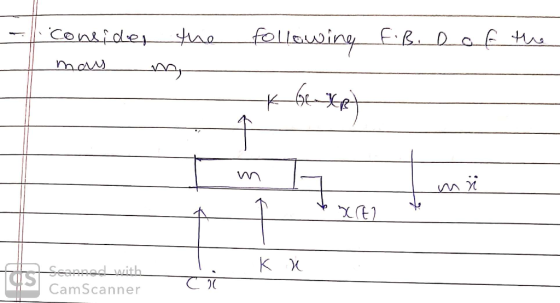
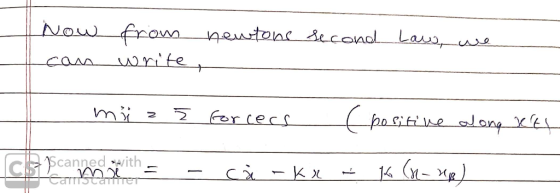
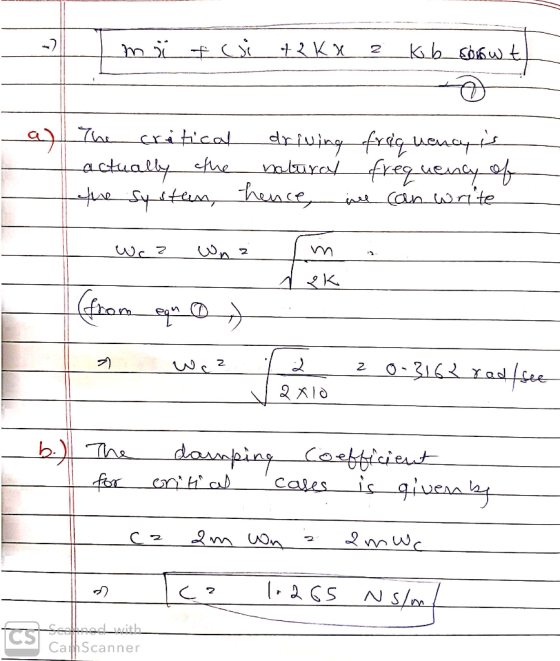
Problem 1: For the system in figure (1-a), the spring attachment point B is given a horizontal motion Xp-b cos cut from the equilibrium position. The two springs have the same stiffness k 10 N/m and...
2 with spring stiffness k 1000 N/m, Consider a mass-spring-damper system shown in Figure mass m...
 2 with spring stiffness k 1000 N/m, Consider a mass-spring-damper system shown in Figure mass m = 10 kg, and damping constant c-150 N-s/m. If the initial displacement is xo-o and the initial velocity is 10 m/s (1) Find the damping ratio. (2) Is the system underdamped or overdamped? Why? (3) Calculate the damped natural frequency (4) Determine the free vibration response of the system.
63 Figure P6.3 shows a mass-damper system (no stiffness, Problem 2.3). Displacement x is measured...
 63 Figure P6.3 shows a mass-damper system (no stiffness, Problem 2.3). Displacement x is measured from an equilibrium position where the damper is at the "neutral" position. The external force () is a short-duration pulse function: f(!)-5N for 0SS002 s, and f,() = 0 for t > 0.02 s. The system parameters are mass m-0.5kg and viscous friction coefficient b 3 N-s/m and the system is initially at rest. Usc Simulink to determine the system response and plot displacement xit)...
1. A suspension system shown in the figure is modified by adding two additional springs each with a spring constant of k, kN/m in addition to the other existing three springs with k 90 kN/m each....
 1. A suspension system shown in the figure is modified by adding two additional springs each with a spring constant of k, kN/m in addition to the other existing three springs with k 90 kN/m each. The design also adds two additional dampers in addition to the two existing dampers each with the same viscous damping coefficient c (= 4000 Ns/m). The viscous damping ratiofor the underdamped system, 7 is 0.95. The mass of the system, m = 150 kg....
Figure 1 shows a system comprising a bar with mass m=12 kg and the length of...
 Figure 1 shows a system comprising a bar with mass m=12 kg and
the length of the bar L=2 m, two springs with stiffness k_t=1000
N-m/rad and k=2000 N/m, one damper with damping coefficient c=50
N-s/m and two additive masses at the end of the bar, where each
mass (M) is equal to 50 kg. The rotation about the hinge A,
measured with respect to the static equilibrium position of the
system is θ(t). The system is excited by force...
Figure 1 shows a system comprising a bar with mass m=12 kg and
the length of the bar L=2 m, two springs with stiffness k_t=1000
N-m/rad and k=2000 N/m, one damper with damping coefficient c=50
N-s/m and two additive masses at the end of the bar, where each
mass (M) is equal to 50 kg. The rotation about the hinge A,
measured with respect to the static equilibrium position of the
system is θ(t). The system is excited by force...
A 1-kg mass is attached to a spring with stiffness 45N/m. The damping constant for the system is 6 N-sec/m. The mass is pulled 1 m to the right of the equilibrium position and released. Find the...
 A 1-kg mass is attached to a spring with stiffness 45N/m. The damping constant for the system is 6 N-sec/m. The mass is pulled 1 m to the right of the equilibrium position and released. Find the equation of motion in phase-shift form. When will the mass first return to its equilibriom position, and at what velocity?
A 1-kg mass is attached to a spring with stiffness 45N/m. The damping constant for the system is 6 N-sec/m. The mass is...
A 1-kg mass is attached to a spring with stiffness 45N/m. The damping constant for the system is 6 N-sec/m. The mass is pulled 1 m to the right of the equilibrium position and released. Find the equation of motion in phase-shift form. When will the mass first return to its equilibriom position, and at what velocity?
A 1-kg mass is attached to a spring with stiffness 45N/m. The damping constant for the system is 6 N-sec/m. The mass is...
 2 with spring stiffness k 1000 N/m, Consider a mass-spring-damper system shown in Figure mass m = 10 kg, and damping constant c-150 N-s/m. If the initial displacement is xo-o and the initial velocity is 10 m/s (1) Find the damping ratio. (2) Is the system underdamped or overdamped? Why? (3) Calculate the damped natural frequency (4) Determine the free vibration response of the system.
 63 Figure P6.3 shows a mass-damper system (no stiffness, Problem 2.3). Displacement x is measured from an equilibrium position where the damper is at the "neutral" position. The external force () is a short-duration pulse function: f(!)-5N for 0SS002 s, and f,() = 0 for t > 0.02 s. The system parameters are mass m-0.5kg and viscous friction coefficient b 3 N-s/m and the system is initially at rest. Usc Simulink to determine the system response and plot displacement xit)...
 1. A suspension system shown in the figure is modified by adding two additional springs each with a spring constant of k, kN/m in addition to the other existing three springs with k 90 kN/m each. The design also adds two additional dampers in addition to the two existing dampers each with the same viscous damping coefficient c (= 4000 Ns/m). The viscous damping ratiofor the underdamped system, 7 is 0.95. The mass of the system, m = 150 kg....
 Figure 1 shows a system comprising a bar with mass m=12 kg and
the length of the bar L=2 m, two springs with stiffness k_t=1000
N-m/rad and k=2000 N/m, one damper with damping coefficient c=50
N-s/m and two additive masses at the end of the bar, where each
mass (M) is equal to 50 kg. The rotation about the hinge A,
measured with respect to the static equilibrium position of the
system is θ(t). The system is excited by force...
Figure 1 shows a system comprising a bar with mass m=12 kg and
the length of the bar L=2 m, two springs with stiffness k_t=1000
N-m/rad and k=2000 N/m, one damper with damping coefficient c=50
N-s/m and two additive masses at the end of the bar, where each
mass (M) is equal to 50 kg. The rotation about the hinge A,
measured with respect to the static equilibrium position of the
system is θ(t). The system is excited by force...
 A 1-kg mass is attached to a spring with stiffness 45N/m. The damping constant for the system is 6 N-sec/m. The mass is pulled 1 m to the right of the equilibrium position and released. Find the equation of motion in phase-shift form. When will the mass first return to its equilibriom position, and at what velocity?
A 1-kg mass is attached to a spring with stiffness 45N/m. The damping constant for the system is 6 N-sec/m. The mass is...
A 1-kg mass is attached to a spring with stiffness 45N/m. The damping constant for the system is 6 N-sec/m. The mass is pulled 1 m to the right of the equilibrium position and released. Find the equation of motion in phase-shift form. When will the mass first return to its equilibriom position, and at what velocity?
A 1-kg mass is attached to a spring with stiffness 45N/m. The damping constant for the system is 6 N-sec/m. The mass is...
Most questions answered within 3 hours.
-
Where is the error in this code sequence?
String s1 = "Hello";
String s2 = "ello";...
asked 10 months ago -
Financial data for Joel de Paris, Inc., for last year
follow:
Joel de Paris, Inc.
Balance...
asked 10 months ago -
Consider this reaction:
Al2(SO4)3 (aq)+ BaCl3
(aq) Al2Cl6 (aq)- +
3BaSO4(s) . What is the...
asked 10 months ago -
Suppose that Savneet is considering increasing her
recent random sample from 20 car rentals to 40...
asked 10 months ago -
Trucks arrive at an unloading terminal at an average rate of 120
per hour.
Trucks arrive...
asked 10 months ago -
Why are methanol and ethanol completely soluble in water while
octanol is not very little soluble....
asked 10 months ago -
A facilities manager at a university reads in a research report
that the mean amount of...
asked 10 months ago -
When the CuSO4 is rehydrated by adding water to the anhydrous
compound, is this an endothermic...
asked 10 months ago -
A ray of sunlight is passing from diamond into crown glass; the
angle of incidence is...
asked 10 months ago -
A block of mass 0.249 kg is placed on top of a light, vertical
spring of...
asked 10 months ago -
how do the kidneys compensate in the presences of acidosis
a) trigger hyperventilate
b) reserve acid...
asked 10 months ago -
Question 501 pts
The rental rate of capital to the firm increases. Which of the
following...
asked 10 months ago