
Homework Answers
Pl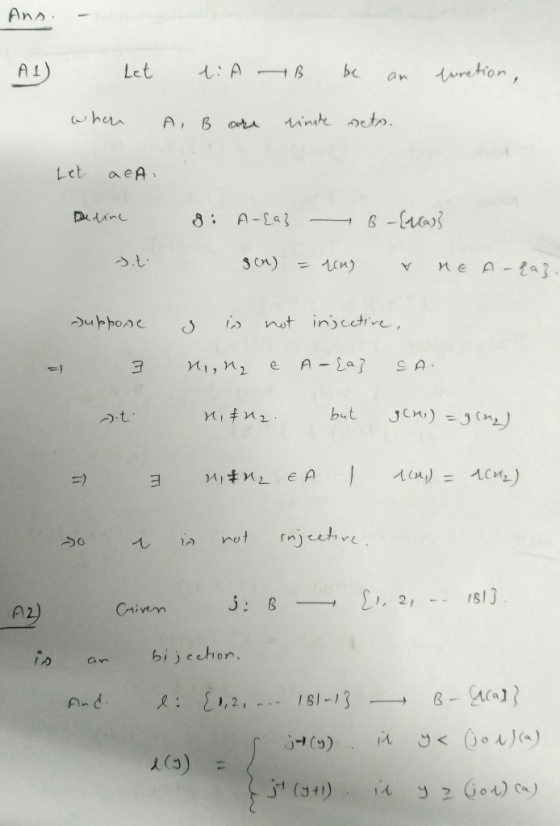

Add Answer to:
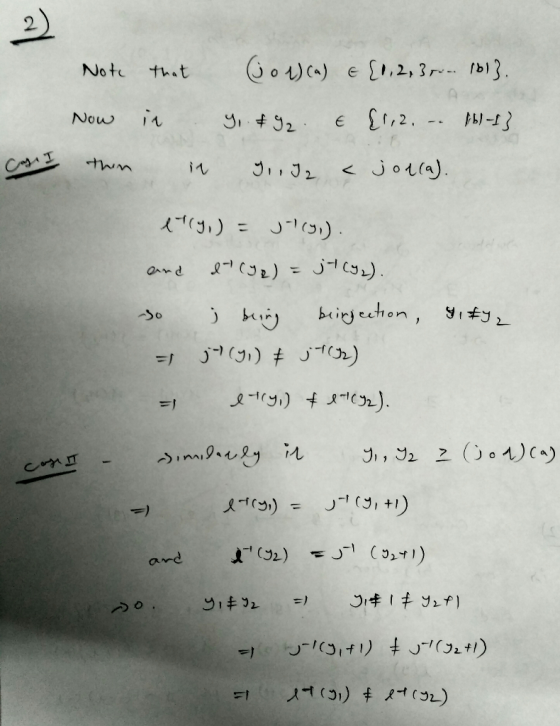
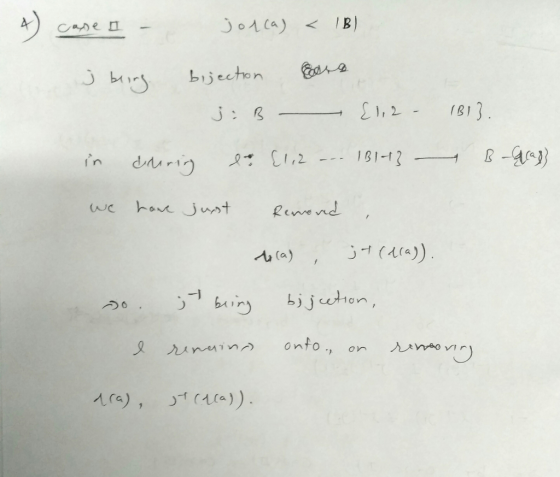
A. (Leftovers from the Proof of the Pigeonhole Principle). As before, let A and B be finite sets with A! 〉 BI 〉 0 and let f : A → B be any function Given a A. let C-A-Va) and let D-B-{ f(a)} PaRT...
A function f : A - B is said to be injective (or one-to-one) provided Va,...
 A function f : A - B is said to be injective (or one-to-one) provided Va, a2 € A, f(a) = f(az) ► a1 = . A function g: A + B is said to be surjective (or onto) provided W6 € B, 3 some a € A such that g(a) = b. A function h: A → B is said to be bijective (or a bijection or a one-to-one correspondence) if it is both injective and surjective. The following...
Let X and Y be any sets and let F be any one-to-one (injective) function from...
Let X and Y be any sets and let F be any one-to-one (injective) function from X to Y . Prove that for every subset A ⊂ X: (a) (10 points) A ⊂ F^(−1) (F(A)). (b) (10 points) F ^(−1) (F(A)) ⊂ A
Problem 4.22. Five basic properties of binary relations R : A-> B are: 1. R is a surjection1 in 2...
 Problem 4.22. Five basic properties of binary relations R : A-> B are: 1. R is a surjection1 in 2. R is an injection [S 1 in] 3. R is a function 1 out 4. R is total1 out] 5. R is empty0 out] Below are some assertions about R. For each assertion, indicate all the properties above that the relation R must have. For example, the first assertion impllies that R is a total surjection. Variables a, a1.... range...
3. Let f be a continuous function on [a, b] with f(a)0< f(b). (a) The proof of Theorem 7-1 showed that there is a smallest x in [a, bl with f(x)0. If there is more than one x in [a, b] with...
 3. Let f be a continuous function on [a, b] with f(a)0< f(b). (a) The proof of Theorem 7-1 showed that there is a smallest x in [a, bl with f(x)0. If there is more than one x in [a, b] with f(x)0, is there necessarily a second smallest? Show that there is a largest x in [a, b] with f(x) -0. (Try to give an easy proof by considering a new function closely related to f.) b) The proof...
Question4 please (1). Let f: Z → Z be given by f(x) = x2. Find F-1(D)...
 Question4 please
(1). Let f: Z → Z be given by f(x) = x2. Find F-1(D) where (a) D = {2,4,6,8, 10, 12, 14, 16}. (b) D={-9, -4,0, 16, 25}. (c) D is the set of prime numbers. (d) D = {2k|k Ew} (So D is the set of non-negative integer powers of 2). (2). Suppose that A and B are sets, C is a proper subset of A and F: A + B is a 1-1 function. Show that...
Question4 please
(1). Let f: Z → Z be given by f(x) = x2. Find F-1(D) where (a) D = {2,4,6,8, 10, 12, 14, 16}. (b) D={-9, -4,0, 16, 25}. (c) D is the set of prime numbers. (d) D = {2k|k Ew} (So D is the set of non-negative integer powers of 2). (2). Suppose that A and B are sets, C is a proper subset of A and F: A + B is a 1-1 function. Show that...
3. Let t be the co-ordinate on A (C) and let z, y be the co-ordinates on A2(C). Let f 4z? + 6xy +...
 3. Let t be the co-ordinate on A (C) and let z, y be the co-ordinates on A2(C). Let f 4z? + 6xy + x-2y® E C[x, y] and let C be the curve C-V((f)) C A2(C) (You may assume without proof that f is an irreducible polynomial, therefore C is irreducible and I(C)- (f).) (a) Show that yo(t) = (2t3, 2t2 + t) defines a morphism p : A1 (C) → C. [3 marks] (b) Show that (z. У)...
#4 ,0, C, d, e, f,g, h}. (a) Using these elements, construct two sets A and...
 #4
,0, C, d, e, f,g, h}. (a) Using these elements, construct two sets A and B satisfying | A=5, |B| = 4 and |An Bl 2 (b) Using the sets you chose, compute An B| 4. Let A {r : -1 < x < 1}, B = {x : -2 < x < 2}and C = {x : -2 < x < 3}, where xER. Determine whether the following statements are true or false. (a) AC B (b) C...
#4
,0, C, d, e, f,g, h}. (a) Using these elements, construct two sets A and B satisfying | A=5, |B| = 4 and |An Bl 2 (b) Using the sets you chose, compute An B| 4. Let A {r : -1 < x < 1}, B = {x : -2 < x < 2}and C = {x : -2 < x < 3}, where xER. Determine whether the following statements are true or false. (a) AC B (b) C...
just part c,d, and e please!! Let V be a finite-dimensional vector space over F. For...
 just part c,d, and e please!!
Let V be a finite-dimensional vector space over F. For every subset SCV, define Sº = {f eV" f(s) = 0 Vs ES}. (a) Prove that sº is a subspace of V* (S may not be a subspace!) (b) If W is a subspace of V and r & W, prove that there exists an few with f(x) +0. (c) If v inV, define u:V* → F by 0(f) = f(v). (This is linear...
just part c,d, and e please!!
Let V be a finite-dimensional vector space over F. For every subset SCV, define Sº = {f eV" f(s) = 0 Vs ES}. (a) Prove that sº is a subspace of V* (S may not be a subspace!) (b) If W is a subspace of V and r & W, prove that there exists an few with f(x) +0. (c) If v inV, define u:V* → F by 0(f) = f(v). (This is linear...
do part 3!! Part I: Given the following sets. Let A-10.12.3.5.8: B-10.2.4.6: C-11.3.5.7): S - (0.1.2.3.4.5.6.7.8,9.10)...
 do part 3!!
Part I: Given the following sets. Let A-10.12.3.5.8: B-10.2.4.6: C-11.3.5.7): S - (0.1.2.3.4.5.6.7.8,9.10) (OAUBUA AVOVA - AUB (t)-B=.,5,7,8,9,10) (ADA.,5.37 (iv) CUB CUB=0 (w)Buc-BoC = Co: 2,4,6,8,9,10) (1) AUC- A) = 1,2,4,5,7,3,4,1%) W BUS.BUCA'Alns. DOCAR :07.4 Cui) S (BUY - (1) BACAU Letea subset of A. D. ) Or Let Ebe a subset of 8. (wit) LatFbe a subset of B. E-B0,27 P-C ), Part I: In the diagram below, the numbers describe "shaded regions in the sets...
do part 3!!
Part I: Given the following sets. Let A-10.12.3.5.8: B-10.2.4.6: C-11.3.5.7): S - (0.1.2.3.4.5.6.7.8,9.10) (OAUBUA AVOVA - AUB (t)-B=.,5,7,8,9,10) (ADA.,5.37 (iv) CUB CUB=0 (w)Buc-BoC = Co: 2,4,6,8,9,10) (1) AUC- A) = 1,2,4,5,7,3,4,1%) W BUS.BUCA'Alns. DOCAR :07.4 Cui) S (BUY - (1) BACAU Letea subset of A. D. ) Or Let Ebe a subset of 8. (wit) LatFbe a subset of B. E-B0,27 P-C ), Part I: In the diagram below, the numbers describe "shaded regions in the sets...
Let U ={a, b, c, d, e, f, g, h, i, j, k}. Let A={d, f,...
 Let U ={a, b, c, d, e, f, g, h, i, j, k}. Let A={d, f, g, h, i, k}. Let B={a, d, f, g, h}. Let C={a, c, f. i, k} Determine (AUC) U ( AB). Choose the correct answer below and, if necessary, fill in the answer box in your choice. OA. (AUC) U(ANB)= } (Use a comma to separate answers as needed.) OB. (A'UC) U (ANB) is the empty set. LE This Question: 1 pt Let U={x|XEN...
 A function f : A - B is said to be injective (or one-to-one) provided Va, a2 € A, f(a) = f(az) ► a1 = . A function g: A + B is said to be surjective (or onto) provided W6 € B, 3 some a € A such that g(a) = b. A function h: A → B is said to be bijective (or a bijection or a one-to-one correspondence) if it is both injective and surjective. The following...
 Problem 4.22. Five basic properties of binary relations R : A-> B are: 1. R is a surjection1 in 2. R is an injection [S 1 in] 3. R is a function 1 out 4. R is total1 out] 5. R is empty0 out] Below are some assertions about R. For each assertion, indicate all the properties above that the relation R must have. For example, the first assertion impllies that R is a total surjection. Variables a, a1.... range...
 3. Let f be a continuous function on [a, b] with f(a)0< f(b). (a) The proof of Theorem 7-1 showed that there is a smallest x in [a, bl with f(x)0. If there is more than one x in [a, b] with f(x)0, is there necessarily a second smallest? Show that there is a largest x in [a, b] with f(x) -0. (Try to give an easy proof by considering a new function closely related to f.) b) The proof...
 Question4 please
(1). Let f: Z → Z be given by f(x) = x2. Find F-1(D) where (a) D = {2,4,6,8, 10, 12, 14, 16}. (b) D={-9, -4,0, 16, 25}. (c) D is the set of prime numbers. (d) D = {2k|k Ew} (So D is the set of non-negative integer powers of 2). (2). Suppose that A and B are sets, C is a proper subset of A and F: A + B is a 1-1 function. Show that...
Question4 please
(1). Let f: Z → Z be given by f(x) = x2. Find F-1(D) where (a) D = {2,4,6,8, 10, 12, 14, 16}. (b) D={-9, -4,0, 16, 25}. (c) D is the set of prime numbers. (d) D = {2k|k Ew} (So D is the set of non-negative integer powers of 2). (2). Suppose that A and B are sets, C is a proper subset of A and F: A + B is a 1-1 function. Show that...
 3. Let t be the co-ordinate on A (C) and let z, y be the co-ordinates on A2(C). Let f 4z? + 6xy + x-2y® E C[x, y] and let C be the curve C-V((f)) C A2(C) (You may assume without proof that f is an irreducible polynomial, therefore C is irreducible and I(C)- (f).) (a) Show that yo(t) = (2t3, 2t2 + t) defines a morphism p : A1 (C) → C. [3 marks] (b) Show that (z. У)...
 #4
,0, C, d, e, f,g, h}. (a) Using these elements, construct two sets A and B satisfying | A=5, |B| = 4 and |An Bl 2 (b) Using the sets you chose, compute An B| 4. Let A {r : -1 < x < 1}, B = {x : -2 < x < 2}and C = {x : -2 < x < 3}, where xER. Determine whether the following statements are true or false. (a) AC B (b) C...
#4
,0, C, d, e, f,g, h}. (a) Using these elements, construct two sets A and B satisfying | A=5, |B| = 4 and |An Bl 2 (b) Using the sets you chose, compute An B| 4. Let A {r : -1 < x < 1}, B = {x : -2 < x < 2}and C = {x : -2 < x < 3}, where xER. Determine whether the following statements are true or false. (a) AC B (b) C...
 just part c,d, and e please!!
Let V be a finite-dimensional vector space over F. For every subset SCV, define Sº = {f eV" f(s) = 0 Vs ES}. (a) Prove that sº is a subspace of V* (S may not be a subspace!) (b) If W is a subspace of V and r & W, prove that there exists an few with f(x) +0. (c) If v inV, define u:V* → F by 0(f) = f(v). (This is linear...
just part c,d, and e please!!
Let V be a finite-dimensional vector space over F. For every subset SCV, define Sº = {f eV" f(s) = 0 Vs ES}. (a) Prove that sº is a subspace of V* (S may not be a subspace!) (b) If W is a subspace of V and r & W, prove that there exists an few with f(x) +0. (c) If v inV, define u:V* → F by 0(f) = f(v). (This is linear...
 do part 3!!
Part I: Given the following sets. Let A-10.12.3.5.8: B-10.2.4.6: C-11.3.5.7): S - (0.1.2.3.4.5.6.7.8,9.10) (OAUBUA AVOVA - AUB (t)-B=.,5,7,8,9,10) (ADA.,5.37 (iv) CUB CUB=0 (w)Buc-BoC = Co: 2,4,6,8,9,10) (1) AUC- A) = 1,2,4,5,7,3,4,1%) W BUS.BUCA'Alns. DOCAR :07.4 Cui) S (BUY - (1) BACAU Letea subset of A. D. ) Or Let Ebe a subset of 8. (wit) LatFbe a subset of B. E-B0,27 P-C ), Part I: In the diagram below, the numbers describe "shaded regions in the sets...
do part 3!!
Part I: Given the following sets. Let A-10.12.3.5.8: B-10.2.4.6: C-11.3.5.7): S - (0.1.2.3.4.5.6.7.8,9.10) (OAUBUA AVOVA - AUB (t)-B=.,5,7,8,9,10) (ADA.,5.37 (iv) CUB CUB=0 (w)Buc-BoC = Co: 2,4,6,8,9,10) (1) AUC- A) = 1,2,4,5,7,3,4,1%) W BUS.BUCA'Alns. DOCAR :07.4 Cui) S (BUY - (1) BACAU Letea subset of A. D. ) Or Let Ebe a subset of 8. (wit) LatFbe a subset of B. E-B0,27 P-C ), Part I: In the diagram below, the numbers describe "shaded regions in the sets...
 Let U ={a, b, c, d, e, f, g, h, i, j, k}. Let A={d, f, g, h, i, k}. Let B={a, d, f, g, h}. Let C={a, c, f. i, k} Determine (AUC) U ( AB). Choose the correct answer below and, if necessary, fill in the answer box in your choice. OA. (AUC) U(ANB)= } (Use a comma to separate answers as needed.) OB. (A'UC) U (ANB) is the empty set. LE This Question: 1 pt Let U={x|XEN...
Most questions answered within 3 hours.
-
Where is the error in this code sequence?
String s1 = "Hello";
String s2 = "ello";...
asked 11 months ago -
Financial data for Joel de Paris, Inc., for last year
follow:
Joel de Paris, Inc.
Balance...
asked 11 months ago -
Consider this reaction:
Al2(SO4)3 (aq)+ BaCl3
(aq) Al2Cl6 (aq)- +
3BaSO4(s) . What is the...
asked 11 months ago -
Suppose that Savneet is considering increasing her
recent random sample from 20 car rentals to 40...
asked 11 months ago -
Trucks arrive at an unloading terminal at an average rate of 120
per hour.
Trucks arrive...
asked 11 months ago -
Why are methanol and ethanol completely soluble in water while
octanol is not very little soluble....
asked 11 months ago -
A facilities manager at a university reads in a research report
that the mean amount of...
asked 11 months ago -
When the CuSO4 is rehydrated by adding water to the anhydrous
compound, is this an endothermic...
asked 11 months ago -
A ray of sunlight is passing from diamond into crown glass; the
angle of incidence is...
asked 11 months ago -
A block of mass 0.249 kg is placed on top of a light, vertical
spring of...
asked 11 months ago -
how do the kidneys compensate in the presences of acidosis
a) trigger hyperventilate
b) reserve acid...
asked 11 months ago -
Question 501 pts
The rental rate of capital to the firm increases. Which of the
following...
asked 11 months ago