Problem 3. Consider two independent samples, X1, . . . , Xm from a N(µ1, σ12 ) distribution and Y1, . . . , Yn from a N(µ2, σ22 ) distribution. Here µ1, µ2, σ12 and σ2 are unknown. Consider testing th...
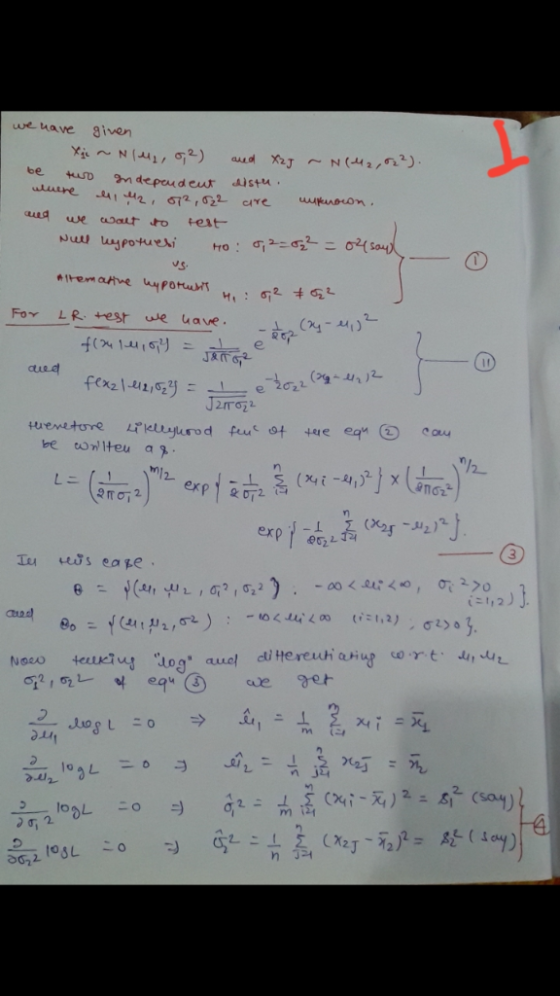
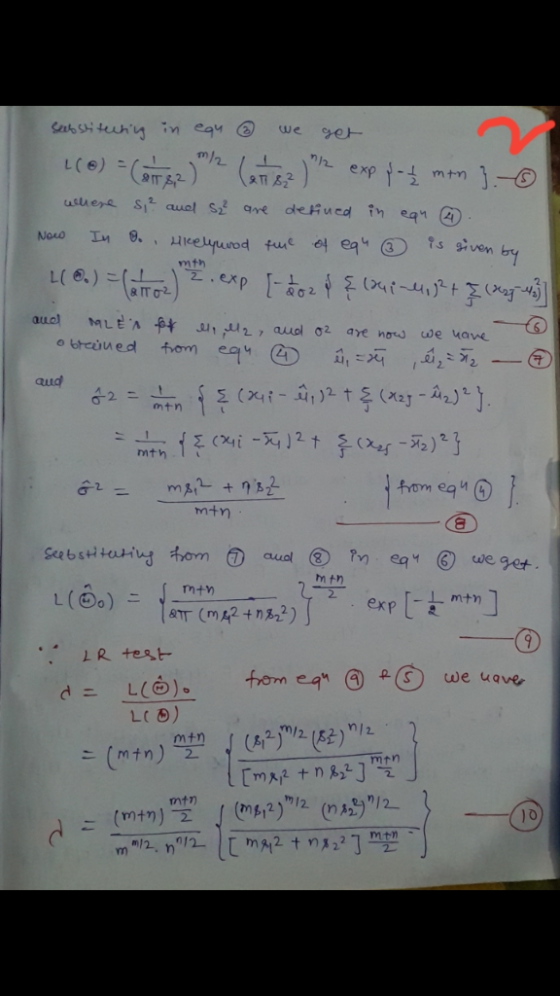
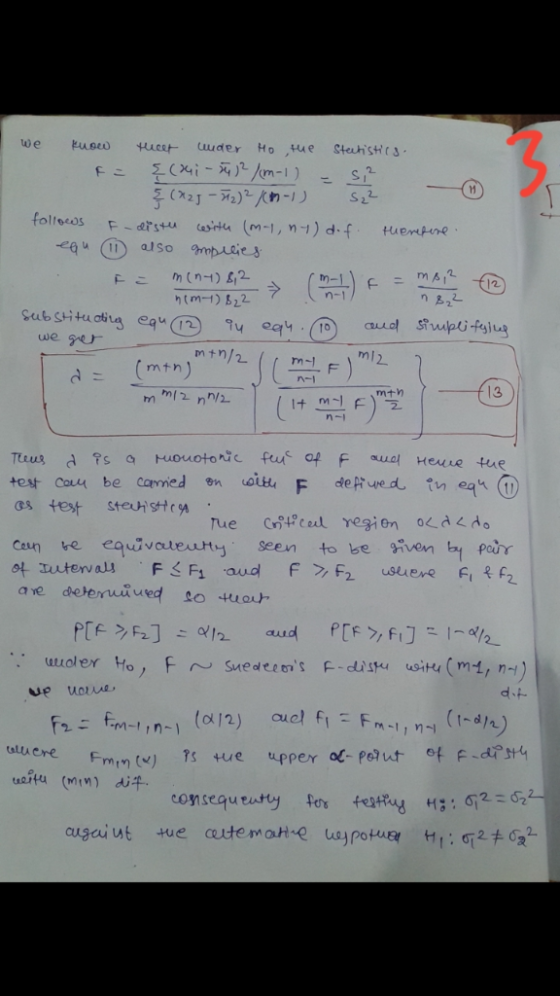
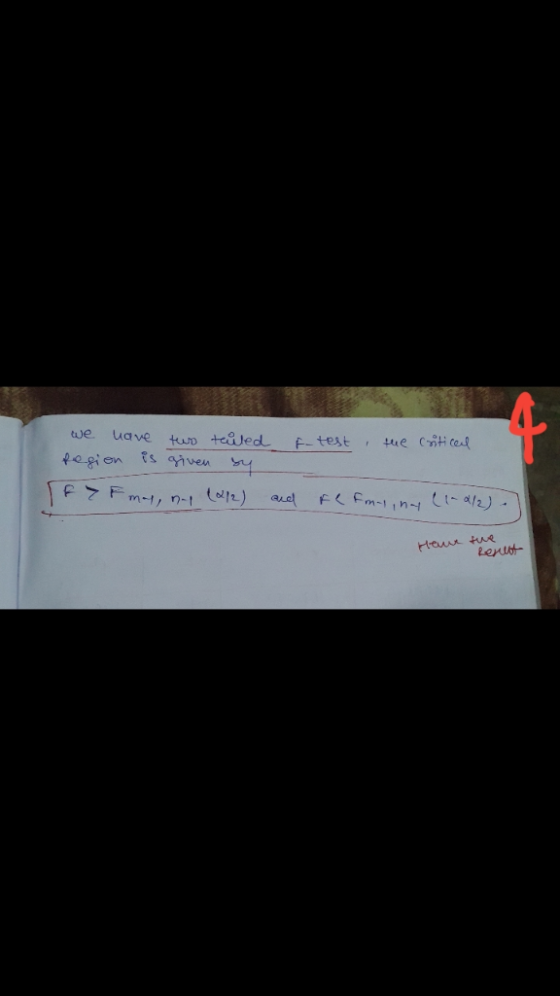
Problem 3. Consider two independent samples, X1, . . . , Xm from a N(µ1, σ12 ) distribution and Y1, . . . , Yn from a N(µ2, σ22 ) distribution. Here µ1, µ2, σ12 and σ2 are unknown. Consider testing the null hypothesis that the two population variance are equal, H0 : σ12 = σ22 , against the alternative that these variances are different, H1 : σ12 ≠ σ12 .
(a) Derive the LR test statistic Λ
Homework Answers
Add Answer to:
Problem 3. Consider two independent samples, X1, . . . , Xm from a N(µ1, σ12 ) distribution and Y1, . . . , Yn from a N(µ2, σ22 ) distribution. Here µ1, µ2, σ12 and σ2 are unknown. Consider testing th...
Let X1, . . . , Xn be i.i.d. from N(µ1, σ2 ), and Y1, ....
Let X1, . . . , Xn be i.i.d. from N(µ1, σ2 ), and Y1, . . . , Ym be i.i.d. from N(µ2, σ2 ). If the two samples are independent, find the maximum likelihood estimates for µ1, µ2, and the common variance σ 2 .
Let X1, ...., Xm be iid N(μ1,σ2) and Y1, ..., Yn be iid N(μ2,σ2), and X's...
Let X1, ...., Xm be iid N(μ1,σ2) and Y1, ..., Yn be iid N(μ2,σ2), and X's and Y's are independent. Here -∞<μ1,μ2<∞ and 0<σ<∞ are unknown. Derive the MLE for (μ1,μ2,σ2). Is the MLE sufficient for (μ1,μ2,σ2)? Also derive the MLE for (μ1-μ2)/σ.
please answer both with an explanation (14) For testing Ho : µ1 = µ2 versus H1...
 please answer both with an explanation
(14) For testing Ho : µ1 = µ2 versus H1 : µ1 # µ2, a completely randomized design used two indpendent samples of sizes n = m = 10 and obtained t-statistics = -2.87. If the assumption of equal but unknown population variances is justified, what is the p-value? The following "answers" have been proposed. (a) Approximately 0.005 (b) Approximately 0.01 (c) Approximately 0.025 (d) Approximately 0.05 (e) None of the above. The correct...
please answer both with an explanation
(14) For testing Ho : µ1 = µ2 versus H1 : µ1 # µ2, a completely randomized design used two indpendent samples of sizes n = m = 10 and obtained t-statistics = -2.87. If the assumption of equal but unknown population variances is justified, what is the p-value? The following "answers" have been proposed. (a) Approximately 0.005 (b) Approximately 0.01 (c) Approximately 0.025 (d) Approximately 0.05 (e) None of the above. The correct...
Suppose that X1, X2, . . . , Xn is an iid sample of N (0, σ2 ) observations, where σ 2 > 0 is unknown. Consider testing H0 : σ 2 = σ 2 0 versus H1 : σ 2 6= σ 2 0
 Suppose that X1, X2, . . . , Xn is an iid sample of N (0, σ2
) observations, where σ
2 > 0 is
unknown. Consider testing
H0 : σ
2 = σ
2
0 versus H1 : σ
2
6= σ
2
0
;
where σ
2
0
is known.
(a) Derive a size α likelihood ratio test of H0 versus H1. Your rejection region should
be written in terms of a sufficient statistic.
(b) When the null...
Suppose that X1, X2, . . . , Xn is an iid sample of N (0, σ2
) observations, where σ
2 > 0 is
unknown. Consider testing
H0 : σ
2 = σ
2
0 versus H1 : σ
2
6= σ
2
0
;
where σ
2
0
is known.
(a) Derive a size α likelihood ratio test of H0 versus H1. Your rejection region should
be written in terms of a sufficient statistic.
(b) When the null...
12 marks Let independent random samples of sizes n and n2 be taken respectively from two normal distributions with unkn...
 12 marks Let independent random samples of sizes n and n2 be taken respectively from two normal distributions with unknown means 1 and 2 and unknown variances oand o. Denote the two samples by . . ,Jn, and y,... , yn2: Which have means T and T, and sample variances s and s2, respectively (a) 4 marks Show that when of = o2, the likelihood ratio test statistic for testing Ho 12 against H 2 can be written as T2...
Concept Check: Terminology 0/3 points (graded) Suppose you observe iid samples X1,…,Xn∼P from some unknown distribution...
 Concept Check: Terminology
0/3 points (graded)
Suppose you observe iid samples X1,…,Xn∼P from some
unknown distribution P. Let F denote a parametric
family of probability distributions (for example, F could be the
family of normal distributions {N(μ,σ2)}μ∈R,σ2>0).
In the topic of goodness of fit testing, our
goal is to answer the question "Does P
belong to the family F, or is P
any distribution outside of F
?"
Parametric hypothesis testing is a particular case of goodness
of fit testing...
Concept Check: Terminology
0/3 points (graded)
Suppose you observe iid samples X1,…,Xn∼P from some
unknown distribution P. Let F denote a parametric
family of probability distributions (for example, F could be the
family of normal distributions {N(μ,σ2)}μ∈R,σ2>0).
In the topic of goodness of fit testing, our
goal is to answer the question "Does P
belong to the family F, or is P
any distribution outside of F
?"
Parametric hypothesis testing is a particular case of goodness
of fit testing...
Consider independent random samples from two populations that are normal or approximately normal, or the case...
Consider independent random samples from two populations that are normal or approximately normal, or the case in which both sample sizes are at least 30. Then, if σ1 and σ2 are unknown but we have reason to believe that σ1 = σ2, we can pool the standard deviations. Using sample sizes n1 and n2, the sample test statistic x1 − x2 has a Student's t distribution where t = x1 − x2 s 1 n1 + 1 n2 with degrees...
eBook Video Exercise 10.1 (Algorithmic)) Consider the following results for two independent random samples taken from...
 eBook Video Exercise 10.1 (Algorithmic)) Consider the following results for two independent random samples taken from two populations. Sample 1 Sample 2 n 50 n2 35 1-1=13.6 X2= 11.1 a. What is the point estimate of the difference between the two population means? | b. Provide a 90% confidence interval for the difference between the two population means (to 2 decimals). c Provide a 95% confidence interval for the difference between the two population means to 2 decimals eBook Video...
 please answer both with an explanation
(14) For testing Ho : µ1 = µ2 versus H1 : µ1 # µ2, a completely randomized design used two indpendent samples of sizes n = m = 10 and obtained t-statistics = -2.87. If the assumption of equal but unknown population variances is justified, what is the p-value? The following "answers" have been proposed. (a) Approximately 0.005 (b) Approximately 0.01 (c) Approximately 0.025 (d) Approximately 0.05 (e) None of the above. The correct...
please answer both with an explanation
(14) For testing Ho : µ1 = µ2 versus H1 : µ1 # µ2, a completely randomized design used two indpendent samples of sizes n = m = 10 and obtained t-statistics = -2.87. If the assumption of equal but unknown population variances is justified, what is the p-value? The following "answers" have been proposed. (a) Approximately 0.005 (b) Approximately 0.01 (c) Approximately 0.025 (d) Approximately 0.05 (e) None of the above. The correct...
 12 marks Let independent random samples of sizes n and n2 be taken respectively from two normal distributions with unknown means 1 and 2 and unknown variances oand o. Denote the two samples by . . ,Jn, and y,... , yn2: Which have means T and T, and sample variances s and s2, respectively (a) 4 marks Show that when of = o2, the likelihood ratio test statistic for testing Ho 12 against H 2 can be written as T2...
 Concept Check: Terminology
0/3 points (graded)
Suppose you observe iid samples X1,…,Xn∼P from some
unknown distribution P. Let F denote a parametric
family of probability distributions (for example, F could be the
family of normal distributions {N(μ,σ2)}μ∈R,σ2>0).
In the topic of goodness of fit testing, our
goal is to answer the question "Does P
belong to the family F, or is P
any distribution outside of F
?"
Parametric hypothesis testing is a particular case of goodness
of fit testing...
Concept Check: Terminology
0/3 points (graded)
Suppose you observe iid samples X1,…,Xn∼P from some
unknown distribution P. Let F denote a parametric
family of probability distributions (for example, F could be the
family of normal distributions {N(μ,σ2)}μ∈R,σ2>0).
In the topic of goodness of fit testing, our
goal is to answer the question "Does P
belong to the family F, or is P
any distribution outside of F
?"
Parametric hypothesis testing is a particular case of goodness
of fit testing...
 eBook Video Exercise 10.1 (Algorithmic)) Consider the following results for two independent random samples taken from two populations. Sample 1 Sample 2 n 50 n2 35 1-1=13.6 X2= 11.1 a. What is the point estimate of the difference between the two population means? | b. Provide a 90% confidence interval for the difference between the two population means (to 2 decimals). c Provide a 95% confidence interval for the difference between the two population means to 2 decimals eBook Video...
Most questions answered within 3 hours.
-
Where is the error in this code sequence?
String s1 = "Hello";
String s2 = "ello";...
asked 1 year ago -
Financial data for Joel de Paris, Inc., for last year
follow:
Joel de Paris, Inc.
Balance...
asked 1 year ago -
Consider this reaction:
Al2(SO4)3 (aq)+ BaCl3
(aq) Al2Cl6 (aq)- +
3BaSO4(s) . What is the...
asked 1 year ago -
Suppose that Savneet is considering increasing her
recent random sample from 20 car rentals to 40...
asked 1 year ago -
Trucks arrive at an unloading terminal at an average rate of 120
per hour.
Trucks arrive...
asked 1 year ago -
Why are methanol and ethanol completely soluble in water while
octanol is not very little soluble....
asked 1 year ago -
A facilities manager at a university reads in a research report
that the mean amount of...
asked 1 year ago -
When the CuSO4 is rehydrated by adding water to the anhydrous
compound, is this an endothermic...
asked 1 year ago -
A ray of sunlight is passing from diamond into crown glass; the
angle of incidence is...
asked 1 year ago -
A block of mass 0.249 kg is placed on top of a light, vertical
spring of...
asked 1 year ago -
how do the kidneys compensate in the presences of acidosis
a) trigger hyperventilate
b) reserve acid...
asked 1 year ago -
Question 501 pts
The rental rate of capital to the firm increases. Which of the
following...
asked 1 year ago