
Homework Answers
MATLAB Script (Run it as a script, NOT from command window):
close all
clear
clc
% Letting u' = v
% v' = gamma*(1 - u^2)*v - a*u
% Part (c)
h = 0.05;
ti = 0; tf = 1;
n = (tf - ti)/h;
t = ti:h:tf;
u(1) = 2; v(1) = 0;
% RK2 Heun
for i=1:n
m1 = func_u(t(i), u(i), v(i));
n1 = func_v(t(i), u(i), v(i));
m2 = func_u(t(i) + h, u(i) + m1*h, v(i) + n1*h);
n2 = func_v(t(i) + h, u(i) + m1*h, v(i) + n1*h);
u(i+1) = u(i) + 0.5*h*(m1 + m2);
v(i+1) = v(i) + 0.5*h*(n1 + n2);
end
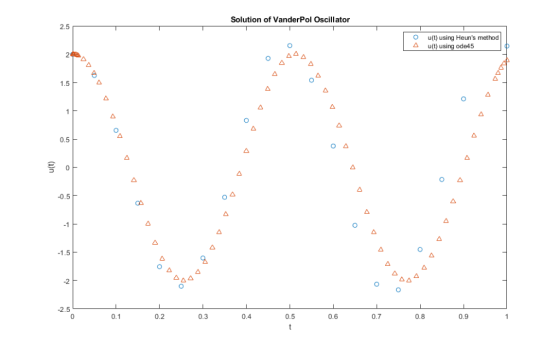
figure, plot(t, u, 'o'), hold on % plotting for part (e)
% Part (d)
[t,y] = ode45(@vdp, [0 1], [u(1); v(1)]);
plot(t, y(:,1), '^'), xlabel('t'), ylabel('u(t)')
title('Solution of VanderPol Oscillator')
legend('u(t) using Heun''s method', 'u(t) using ode45')
function f = func_u(~,~,v) % u'
f = v;
end
function f = func_v(~,u,v) % v'
a = 150; gamma = 1.0;
f = gamma*(1 - u^2)*v - a*u;
end
function dydt = vdp(~,y)
a = 150; gamma = 1.0;
dydt = [y(2);
gamma*(1 - y(1)^2)*y(2) - a*y(1)];
end
Plot:
Add Answer to:
2. Coupled Differential Equations (40 points) The well-known van der Pol oscillator is the second-order nonlinear differential equation shown below: + au dt 0. di The solution of this equation exhibi...
The van der Pol equation is a second order ODE which is written as follows: 91 where μ > 0 is a s...
 Matlab Code Please
The van der Pol equation is a second order ODE which is written as follows: 91 where μ > 0 is a scalar parameter. Rewrite this equation as a system of first-order ODEs and solve it using the Euler method for t E 10.2, where μ-1. Explain the physics behind vour numerical results.
The van der Pol equation is a second order ODE which is written as follows: 91 where μ > 0 is a scalar parameter....
Matlab Code Please
The van der Pol equation is a second order ODE which is written as follows: 91 where μ > 0 is a scalar parameter. Rewrite this equation as a system of first-order ODEs and solve it using the Euler method for t E 10.2, where μ-1. Explain the physics behind vour numerical results.
The van der Pol equation is a second order ODE which is written as follows: 91 where μ > 0 is a scalar parameter....
The van der Pol equation is a second order ODE which is written as follows: 91 where μ > 0 is a s...
 The van der Pol equation is a second order ODE which is written as follows: 91 where μ > 0 is a scalar parameter. Rewrite this equation as a system of first-order ODEs and solve it using the Euler method for t E 10.2, where μ-1. Explain the physics behind vour numerical results.
The van der Pol equation is a second order ODE which is written as follows: 91 where μ > 0 is a scalar parameter. Rewrite this equation...
The van der Pol equation is a second order ODE which is written as follows: 91 where μ > 0 is a scalar parameter. Rewrite this equation as a system of first-order ODEs and solve it using the Euler method for t E 10.2, where μ-1. Explain the physics behind vour numerical results.
The van der Pol equation is a second order ODE which is written as follows: 91 where μ > 0 is a scalar parameter. Rewrite this equation...
Consider the following problem Solve for y(t) in the ODE below (Van der Pol equation) for...
 Consider the following problem Solve for y(t) in the ODE below (Van der Pol equation) for t ranging from O to 10 seconds with initial conditions yo) = 5 and y'(0) = 0 and mu = 5. Select the methods below that would be appropriate to use for a solution to this problem. More than one method may be applicable. Select all that apply. ? Shooting method Finite difference method MATLAB m-file euler.m from course notes MATLAB m-file odeRK4sys.m from...
Background The van der Pol equation is a 2nd-order ODE that describes self-sustaining oscillations in which energy is withdrawn from large oscillations and fed into the small oscillations. This equat...
 Background The van der Pol equation is a 2nd-order ODE that describes self-sustaining oscillations in which energy is withdrawn from large oscillations and fed into the small oscillations. This equation typically models electronic circuits containing vacuum tubes. The van der Pol equation is: dy2 dy where y represents the position coordinate, t is time, and u is a damping coefficient The 2nd-order ODE can be solved as a set of 1st-order ODEs, as shown below. Here, z is a 'dummy'...
Please provide the matlab code solution for this problem. Exercise 2 Consider the differential equation for...
 Please provide the matlab code solution for this problem.
Exercise 2 Consider the differential equation for the Van der Pol oscillator (use ode45) which has a nonlinear damping term a (y -1) y 1. For E 0.25, solve the equation over the interval 0,50 for initial conditions y (0) 0.1 and y' (0) -1. TASK: Save y as a column vector in the file A04.dat TASK: Save y' as a column vector in the file A05.dat 2. For a 10,...
Please provide the matlab code solution for this problem.
Exercise 2 Consider the differential equation for the Van der Pol oscillator (use ode45) which has a nonlinear damping term a (y -1) y 1. For E 0.25, solve the equation over the interval 0,50 for initial conditions y (0) 0.1 and y' (0) -1. TASK: Save y as a column vector in the file A04.dat TASK: Save y' as a column vector in the file A05.dat 2. For a 10,...
using matlab thank you 3 MARKS QUESTION 3 Background The van der Pol equation is a 2nd-order ODE that describes self-sustaining oscillations in which energy is withdrawn from large oscillations and fe...
 using matlab thank you
3 MARKS QUESTION 3 Background The van der Pol equation is a 2nd-order ODE that describes self-sustaining oscillations in which energy is withdrawn from large oscillations and fed into the small oscillations. This equation typically models electronic circuits containing vacuum tubes. The van der Pol equation is: dt2 dt where y represents the position coordinate, t is time, and u is a damping coefficient The 2nd-order ODE can be solved as a set of 1st-order ODEs,...
using matlab thank you
3 MARKS QUESTION 3 Background The van der Pol equation is a 2nd-order ODE that describes self-sustaining oscillations in which energy is withdrawn from large oscillations and fed into the small oscillations. This equation typically models electronic circuits containing vacuum tubes. The van der Pol equation is: dt2 dt where y represents the position coordinate, t is time, and u is a damping coefficient The 2nd-order ODE can be solved as a set of 1st-order ODEs,...
Solve the ordinary differential equation below over the interval 0 sts 2s using two different methods: the Euler method and the second-order Runge-Kutta method (midpoint version). Begin by writin...
 Solve the ordinary differential equation below over the interval 0 sts 2s using two different methods: the Euler method and the second-order Runge-Kutta method (midpoint version). Begin by writing the state space representation of the equation. Use a time step of 1 s, and place a box around the values of x and x at t- 2 s obtained using each method. Show your work. 20d's +5dr +20x = 0 dt d x(0) = 1, x'(0) = 1
Solve the...
Solve the ordinary differential equation below over the interval 0 sts 2s using two different methods: the Euler method and the second-order Runge-Kutta method (midpoint version). Begin by writing the state space representation of the equation. Use a time step of 1 s, and place a box around the values of x and x at t- 2 s obtained using each method. Show your work. 20d's +5dr +20x = 0 dt d x(0) = 1, x'(0) = 1
Solve the...
Problem Thre: 125 points) Consider the following initial value problem: dy-2y+ t The y(0) -1 ea dt ical solution of the differential equation is: y(O)(2-2t+3e-2+1)y fr exoc the differential equat...
 Problem Thre: 125 points) Consider the following initial value problem: dy-2y+ t The y(0) -1 ea dt ical solution of the differential equation is: y(O)(2-2t+3e-2+1)y fr exoc the differential equation numerically over the interval 0 s i s 2.0 and a step size h At 0.5.A Apply the following Runge-Kutta methods for each of the step. (show your calculations) i. [0.0 0.5: Euler method ii. [0.5 1.0]: Heun method. ii. [1.0 1.5): Midpoint method. iv. [1.5 2.0): 4h RK method...
Consider the second order partial differential equation du/dt= d^2u/dx^2 +2du/dx+u over the domain x in [0,l) and t>=...
 Consider the second order partial differential equation du/dt=
d^2u/dx^2 +2du/dx+u over the domain x in [0,l) and t>=0. It is
given that u(0,t)=u(l,t)=0. Use the method of separation of
variables to prove that the general solution with the given
boundary condition is u(x,t)= infinity series n=1
bnsin(npix/l)exp(-x-((npi/l)^2)t) where bn is
a constant for every n N
Hint u(x,t)=X(x)T(t)
tnsit te Seind ond partial difertinl cuatan +2n St the dowain e To,e) an Use metod o Separet ion Vaiades to rore...
Consider the second order partial differential equation du/dt=
d^2u/dx^2 +2du/dx+u over the domain x in [0,l) and t>=0. It is
given that u(0,t)=u(l,t)=0. Use the method of separation of
variables to prove that the general solution with the given
boundary condition is u(x,t)= infinity series n=1
bnsin(npix/l)exp(-x-((npi/l)^2)t) where bn is
a constant for every n N
Hint u(x,t)=X(x)T(t)
tnsit te Seind ond partial difertinl cuatan +2n St the dowain e To,e) an Use metod o Separet ion Vaiades to rore...
 Matlab Code Please
The van der Pol equation is a second order ODE which is written as follows: 91 where μ > 0 is a scalar parameter. Rewrite this equation as a system of first-order ODEs and solve it using the Euler method for t E 10.2, where μ-1. Explain the physics behind vour numerical results.
The van der Pol equation is a second order ODE which is written as follows: 91 where μ > 0 is a scalar parameter....
Matlab Code Please
The van der Pol equation is a second order ODE which is written as follows: 91 where μ > 0 is a scalar parameter. Rewrite this equation as a system of first-order ODEs and solve it using the Euler method for t E 10.2, where μ-1. Explain the physics behind vour numerical results.
The van der Pol equation is a second order ODE which is written as follows: 91 where μ > 0 is a scalar parameter....
 The van der Pol equation is a second order ODE which is written as follows: 91 where μ > 0 is a scalar parameter. Rewrite this equation as a system of first-order ODEs and solve it using the Euler method for t E 10.2, where μ-1. Explain the physics behind vour numerical results.
The van der Pol equation is a second order ODE which is written as follows: 91 where μ > 0 is a scalar parameter. Rewrite this equation...
The van der Pol equation is a second order ODE which is written as follows: 91 where μ > 0 is a scalar parameter. Rewrite this equation as a system of first-order ODEs and solve it using the Euler method for t E 10.2, where μ-1. Explain the physics behind vour numerical results.
The van der Pol equation is a second order ODE which is written as follows: 91 where μ > 0 is a scalar parameter. Rewrite this equation...
 Consider the following problem Solve for y(t) in the ODE below (Van der Pol equation) for t ranging from O to 10 seconds with initial conditions yo) = 5 and y'(0) = 0 and mu = 5. Select the methods below that would be appropriate to use for a solution to this problem. More than one method may be applicable. Select all that apply. ? Shooting method Finite difference method MATLAB m-file euler.m from course notes MATLAB m-file odeRK4sys.m from...
 Background The van der Pol equation is a 2nd-order ODE that describes self-sustaining oscillations in which energy is withdrawn from large oscillations and fed into the small oscillations. This equation typically models electronic circuits containing vacuum tubes. The van der Pol equation is: dy2 dy where y represents the position coordinate, t is time, and u is a damping coefficient The 2nd-order ODE can be solved as a set of 1st-order ODEs, as shown below. Here, z is a 'dummy'...
 Please provide the matlab code solution for this problem.
Exercise 2 Consider the differential equation for the Van der Pol oscillator (use ode45) which has a nonlinear damping term a (y -1) y 1. For E 0.25, solve the equation over the interval 0,50 for initial conditions y (0) 0.1 and y' (0) -1. TASK: Save y as a column vector in the file A04.dat TASK: Save y' as a column vector in the file A05.dat 2. For a 10,...
Please provide the matlab code solution for this problem.
Exercise 2 Consider the differential equation for the Van der Pol oscillator (use ode45) which has a nonlinear damping term a (y -1) y 1. For E 0.25, solve the equation over the interval 0,50 for initial conditions y (0) 0.1 and y' (0) -1. TASK: Save y as a column vector in the file A04.dat TASK: Save y' as a column vector in the file A05.dat 2. For a 10,...
 using matlab thank you
3 MARKS QUESTION 3 Background The van der Pol equation is a 2nd-order ODE that describes self-sustaining oscillations in which energy is withdrawn from large oscillations and fed into the small oscillations. This equation typically models electronic circuits containing vacuum tubes. The van der Pol equation is: dt2 dt where y represents the position coordinate, t is time, and u is a damping coefficient The 2nd-order ODE can be solved as a set of 1st-order ODEs,...
using matlab thank you
3 MARKS QUESTION 3 Background The van der Pol equation is a 2nd-order ODE that describes self-sustaining oscillations in which energy is withdrawn from large oscillations and fed into the small oscillations. This equation typically models electronic circuits containing vacuum tubes. The van der Pol equation is: dt2 dt where y represents the position coordinate, t is time, and u is a damping coefficient The 2nd-order ODE can be solved as a set of 1st-order ODEs,...
 Solve the ordinary differential equation below over the interval 0 sts 2s using two different methods: the Euler method and the second-order Runge-Kutta method (midpoint version). Begin by writing the state space representation of the equation. Use a time step of 1 s, and place a box around the values of x and x at t- 2 s obtained using each method. Show your work. 20d's +5dr +20x = 0 dt d x(0) = 1, x'(0) = 1
Solve the...
Solve the ordinary differential equation below over the interval 0 sts 2s using two different methods: the Euler method and the second-order Runge-Kutta method (midpoint version). Begin by writing the state space representation of the equation. Use a time step of 1 s, and place a box around the values of x and x at t- 2 s obtained using each method. Show your work. 20d's +5dr +20x = 0 dt d x(0) = 1, x'(0) = 1
Solve the...
 Problem Thre: 125 points) Consider the following initial value problem: dy-2y+ t The y(0) -1 ea dt ical solution of the differential equation is: y(O)(2-2t+3e-2+1)y fr exoc the differential equation numerically over the interval 0 s i s 2.0 and a step size h At 0.5.A Apply the following Runge-Kutta methods for each of the step. (show your calculations) i. [0.0 0.5: Euler method ii. [0.5 1.0]: Heun method. ii. [1.0 1.5): Midpoint method. iv. [1.5 2.0): 4h RK method...
 Consider the second order partial differential equation du/dt=
d^2u/dx^2 +2du/dx+u over the domain x in [0,l) and t>=0. It is
given that u(0,t)=u(l,t)=0. Use the method of separation of
variables to prove that the general solution with the given
boundary condition is u(x,t)= infinity series n=1
bnsin(npix/l)exp(-x-((npi/l)^2)t) where bn is
a constant for every n N
Hint u(x,t)=X(x)T(t)
tnsit te Seind ond partial difertinl cuatan +2n St the dowain e To,e) an Use metod o Separet ion Vaiades to rore...
Consider the second order partial differential equation du/dt=
d^2u/dx^2 +2du/dx+u over the domain x in [0,l) and t>=0. It is
given that u(0,t)=u(l,t)=0. Use the method of separation of
variables to prove that the general solution with the given
boundary condition is u(x,t)= infinity series n=1
bnsin(npix/l)exp(-x-((npi/l)^2)t) where bn is
a constant for every n N
Hint u(x,t)=X(x)T(t)
tnsit te Seind ond partial difertinl cuatan +2n St the dowain e To,e) an Use metod o Separet ion Vaiades to rore...
Most questions answered within 3 hours.
-
Where is the error in this code sequence?
String s1 = "Hello";
String s2 = "ello";...
asked 11 months ago -
Financial data for Joel de Paris, Inc., for last year
follow:
Joel de Paris, Inc.
Balance...
asked 11 months ago -
Consider this reaction:
Al2(SO4)3 (aq)+ BaCl3
(aq) Al2Cl6 (aq)- +
3BaSO4(s) . What is the...
asked 11 months ago -
Suppose that Savneet is considering increasing her
recent random sample from 20 car rentals to 40...
asked 11 months ago -
Trucks arrive at an unloading terminal at an average rate of 120
per hour.
Trucks arrive...
asked 11 months ago -
Why are methanol and ethanol completely soluble in water while
octanol is not very little soluble....
asked 11 months ago -
A facilities manager at a university reads in a research report
that the mean amount of...
asked 11 months ago -
When the CuSO4 is rehydrated by adding water to the anhydrous
compound, is this an endothermic...
asked 11 months ago -
A ray of sunlight is passing from diamond into crown glass; the
angle of incidence is...
asked 11 months ago -
A block of mass 0.249 kg is placed on top of a light, vertical
spring of...
asked 11 months ago -
how do the kidneys compensate in the presences of acidosis
a) trigger hyperventilate
b) reserve acid...
asked 11 months ago -
Question 501 pts
The rental rate of capital to the firm increases. Which of the
following...
asked 11 months ago