
Homework Answers
Add Answer to:
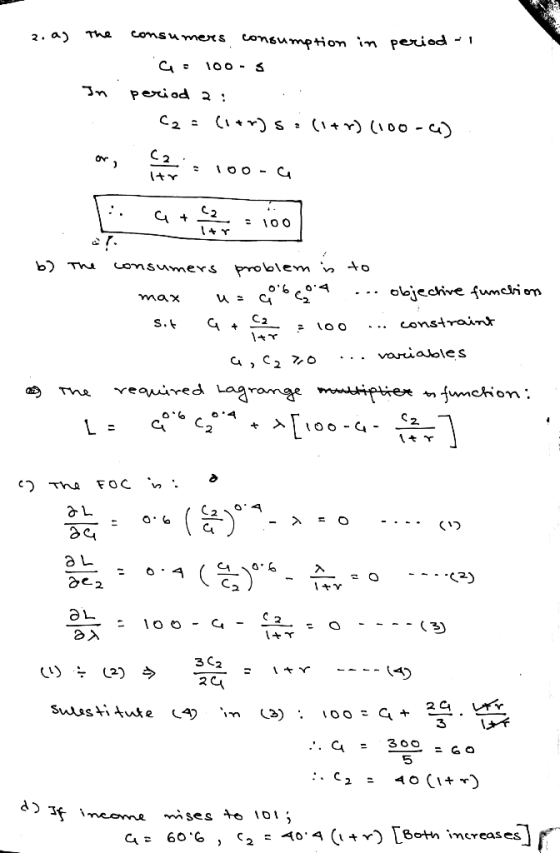
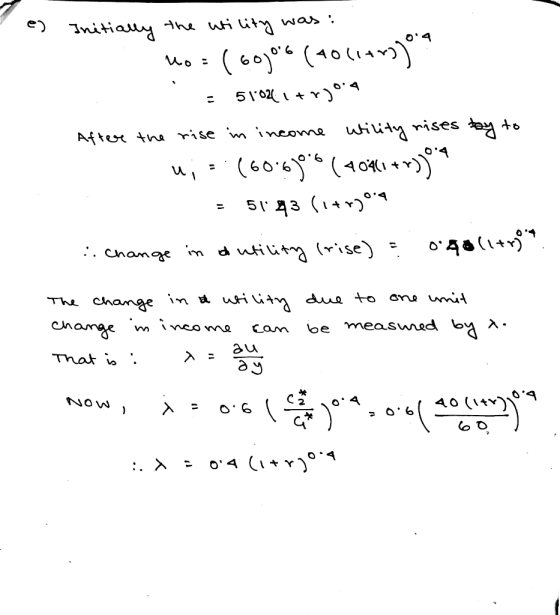
can anyone help me with this question? 2. An review of intertemporal optimization: Suppose a consumer's utility function is given by U(c,2) where ci is consumption in period 1 and ca is consum...
Question 3 John has the utility function is u(ci,C2) -c2, where c, is consumption today and c2 is consumption tomorrow. The price of consumption today is £1 and the price of consumption tomorrow...
 Question 3 John has the utility function is u(ci,C2) -c2, where c, is consumption today and c2 is consumption tomorrow. The price of consumption today is £1 and the price of consumption tomorrow is p2. John gets an income of m, today and m2 tomorrow. (a) John also faces the interest rate, r. Write out John's intertemporal budget constraint in present value and future forms. (4 marks) (b) It turns out that John earns an income of £15000 today and...
Question 1. (Consumption-Saving Problem): Suppose that a consumer lives for two periods. The utility function of...
 Question 1. (Consumption-Saving Problem): Suppose that a consumer lives for two periods. The utility function of the consumer is given by with u> 0 where c and c2 are consumption in period 1 and period 2 respectively. Sup- pose that consumer has income y in the first period, but has no income in the second period. Consumer has to save in the first period in order to consume in the second period. Let s be the savings in the first...
Question 1. (Consumption-Saving Problem): Suppose that a consumer lives for two periods. The utility function of...
 Question 1. (Consumption-Saving Problem): Suppose that a consumer lives for two periods. The utility function of the consumer is given by with u> 0 where c and c2 are consumption in period 1 and period 2 respectively. Sup- pose that consumer has income y in the first period, but has no income in the second period. Consumer has to save in the first period in order to consume in the second period. Let s be the savings in the first...
Question 1. Suppose Kala's utility function is a function of consumption c, with U = 150-102...
 Question 1. Suppose Kala's utility function is a function of consumption c, with U = 150-102 Her income is 6. What is the expected value of a gamble where she wins 4 with probability 75% and loses 4 with probability 25%? Would Kala take this gamble? Question 3. Laura is deciding how much to consume in periods o, 1 and 2. Suppose Laura's income in period o is o, her income in period 1 is y, and her income in...
Question 1. Suppose Kala's utility function is a function of consumption, with U = 150 cm...
 Question 1. Suppose Kala's utility function is a function of consumption, with U = 150 cm Her income is 6. What is the expected value of a gamble where she wins 4 with probability 75% and loses 4 with probability 25%? Would Kala take this gamble? Question 2. What is the present value of $100 in two years, if the yearly interest rate is 7%? Question 3. Laura is deciding how much to consume in periods o, 1, and 2....
Question 1. (Consumption-Saving Problem): Suppose that a consumer lives for two periods. The utility function of...
 Question 1. (Consumption-Saving Problem): Suppose that a consumer lives for two periods. The utility function of the consumer is given by 1-1 1-1 with μ > 0 where c1 and c2 are consumption in period 1 and period 2 respectively (Portfolio Choice Problem) Now suppose that the consumer can save in terms of two instruments: financial savings (s) and capital investment (k). Capital investment done in period 1 yields output ka with 0 < α < 1 in period 2....
1. Suppose you are given the utility function: VC U = vc + 1.10 CI уг...
 1. Suppose you are given the utility function: VC U = vc + 1.10 CI уг and the budget constraint: c+ =yt 1+r 1+r where y = 5, y' = 10, and the interest rate r = 0.10. Now suppose that y=5 again, and there is only one consumer in the entire economy. If we add in government expenditures and taxation, the consumer's budget constraint is now: c+ y' = y + -t- +r 1+r 1+r If current and future...
Suppose we are in a two-period environment where the representative consumer has a utilit;y function of...
 Suppose we are in a two-period environment where the representative consumer has a utilit;y function of the form: Let the discount factor, β , represent the idea that the consumer values consumption at the future with some weight less than 1. Let initial assets, a 0 and the households income in the two periods be given as y,-5, y,-10. The real interest rate in this economy, r is equal to .1 (ie 10% return on any wealth saved). 1. Intuitively,...
2. TIME PREFERENCE In class, we solved a two-period savings model where a consumer allocates income...
2. TIME PREFERENCE In class, we solved a two-period savings model where a consumer allocates income across two periods. We assumed the consumer’s intertemporal utility function was given by: U(c1,c2) = log(c1) + δlog(c2) and that their intertemporal budget constraint was M1 + M2 = c1 + c2 . 1+r 1+r Along the way to solving that problem, we found that consumers should select their consumption in each period so that: u′(c1) = δ(1 + r)u′(c2), where δ is the...
Question 4. Laura is deciding how much to consume in periods o, 1 and 2. Suppose Laura income in period o is o, her...
 Question 4. Laura is deciding how much to consume in periods o, 1 and 2. Suppose Laura income in period o is o, her income in period is y, and her income in period alsay. The price of consumption in period / is p. Assuming the interest rate is T, and consumption in period is denoted. In the utility maximization problem what variables are endogenous and which are exogenous ? Figure 1. Consider the following diagram of an indifference curve...
 Question 3 John has the utility function is u(ci,C2) -c2, where c, is consumption today and c2 is consumption tomorrow. The price of consumption today is £1 and the price of consumption tomorrow is p2. John gets an income of m, today and m2 tomorrow. (a) John also faces the interest rate, r. Write out John's intertemporal budget constraint in present value and future forms. (4 marks) (b) It turns out that John earns an income of £15000 today and...
 Question 1. (Consumption-Saving Problem): Suppose that a consumer lives for two periods. The utility function of the consumer is given by with u> 0 where c and c2 are consumption in period 1 and period 2 respectively. Sup- pose that consumer has income y in the first period, but has no income in the second period. Consumer has to save in the first period in order to consume in the second period. Let s be the savings in the first...
 Question 1. (Consumption-Saving Problem): Suppose that a consumer lives for two periods. The utility function of the consumer is given by with u> 0 where c and c2 are consumption in period 1 and period 2 respectively. Sup- pose that consumer has income y in the first period, but has no income in the second period. Consumer has to save in the first period in order to consume in the second period. Let s be the savings in the first...
 Question 1. Suppose Kala's utility function is a function of consumption c, with U = 150-102 Her income is 6. What is the expected value of a gamble where she wins 4 with probability 75% and loses 4 with probability 25%? Would Kala take this gamble? Question 3. Laura is deciding how much to consume in periods o, 1 and 2. Suppose Laura's income in period o is o, her income in period 1 is y, and her income in...
 Question 1. Suppose Kala's utility function is a function of consumption, with U = 150 cm Her income is 6. What is the expected value of a gamble where she wins 4 with probability 75% and loses 4 with probability 25%? Would Kala take this gamble? Question 2. What is the present value of $100 in two years, if the yearly interest rate is 7%? Question 3. Laura is deciding how much to consume in periods o, 1, and 2....
 Question 1. (Consumption-Saving Problem): Suppose that a consumer lives for two periods. The utility function of the consumer is given by 1-1 1-1 with μ > 0 where c1 and c2 are consumption in period 1 and period 2 respectively (Portfolio Choice Problem) Now suppose that the consumer can save in terms of two instruments: financial savings (s) and capital investment (k). Capital investment done in period 1 yields output ka with 0 < α < 1 in period 2....
 1. Suppose you are given the utility function: VC U = vc + 1.10 CI уг and the budget constraint: c+ =yt 1+r 1+r where y = 5, y' = 10, and the interest rate r = 0.10. Now suppose that y=5 again, and there is only one consumer in the entire economy. If we add in government expenditures and taxation, the consumer's budget constraint is now: c+ y' = y + -t- +r 1+r 1+r If current and future...
 Suppose we are in a two-period environment where the representative consumer has a utilit;y function of the form: Let the discount factor, β , represent the idea that the consumer values consumption at the future with some weight less than 1. Let initial assets, a 0 and the households income in the two periods be given as y,-5, y,-10. The real interest rate in this economy, r is equal to .1 (ie 10% return on any wealth saved). 1. Intuitively,...
 Question 4. Laura is deciding how much to consume in periods o, 1 and 2. Suppose Laura income in period o is o, her income in period is y, and her income in period alsay. The price of consumption in period / is p. Assuming the interest rate is T, and consumption in period is denoted. In the utility maximization problem what variables are endogenous and which are exogenous ? Figure 1. Consider the following diagram of an indifference curve...
Most questions answered within 3 hours.
-
Where is the error in this code sequence?
String s1 = "Hello";
String s2 = "ello";...
asked 10 months ago -
Financial data for Joel de Paris, Inc., for last year
follow:
Joel de Paris, Inc.
Balance...
asked 10 months ago -
Consider this reaction:
Al2(SO4)3 (aq)+ BaCl3
(aq) Al2Cl6 (aq)- +
3BaSO4(s) . What is the...
asked 10 months ago -
Suppose that Savneet is considering increasing her
recent random sample from 20 car rentals to 40...
asked 10 months ago -
Trucks arrive at an unloading terminal at an average rate of 120
per hour.
Trucks arrive...
asked 10 months ago -
Why are methanol and ethanol completely soluble in water while
octanol is not very little soluble....
asked 10 months ago -
A facilities manager at a university reads in a research report
that the mean amount of...
asked 10 months ago -
When the CuSO4 is rehydrated by adding water to the anhydrous
compound, is this an endothermic...
asked 10 months ago -
A ray of sunlight is passing from diamond into crown glass; the
angle of incidence is...
asked 10 months ago -
A block of mass 0.249 kg is placed on top of a light, vertical
spring of...
asked 10 months ago -
how do the kidneys compensate in the presences of acidosis
a) trigger hyperventilate
b) reserve acid...
asked 10 months ago -
Question 501 pts
The rental rate of capital to the firm increases. Which of the
following...
asked 10 months ago