I'm stuck on question 9

this is all the info I could find
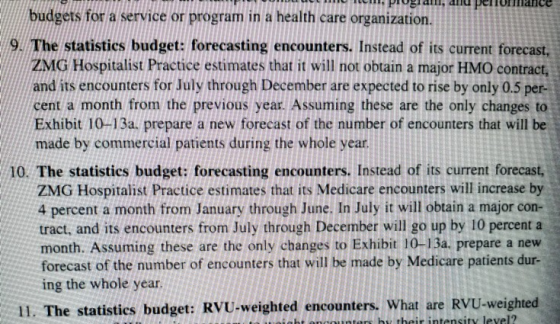
budgets for a service or program in a health care organization. 9. The statisties budget: forecasting encounters. Instead of its current forecast, ZMG Hospitalist Practice estimates that it will not obtain a major HMO contract, and its encounters for July through December are expected to rise by only 0.5 per- cent a month from the previous year. Assuming these are the only changes to Exhibit 10-13a. prepare a new forecast of the number of encounters that will be made by commercial patients during the whole year 10. The statistics budget: forecasting encounters. Instead of its current forecast, ZMG Hospitalist Practice estimates that its Medicare encounters will increase by 4 percent a month from January through June. In July it will obtain a major con- tract, and its encounters from July through December will go up by 10 percent a month. Assuming these are the only changes to Exhibit 10-13a. prepare a new forecast of the number of encounters that will be made by Medicare patients dur- ing the whole year 11. The statisties budget: RVU-weighted encounters. What are RVU-weighted
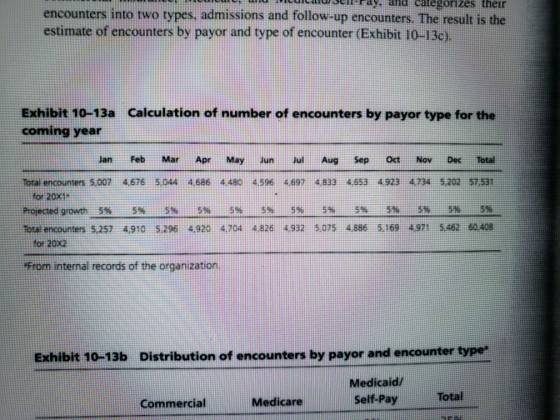
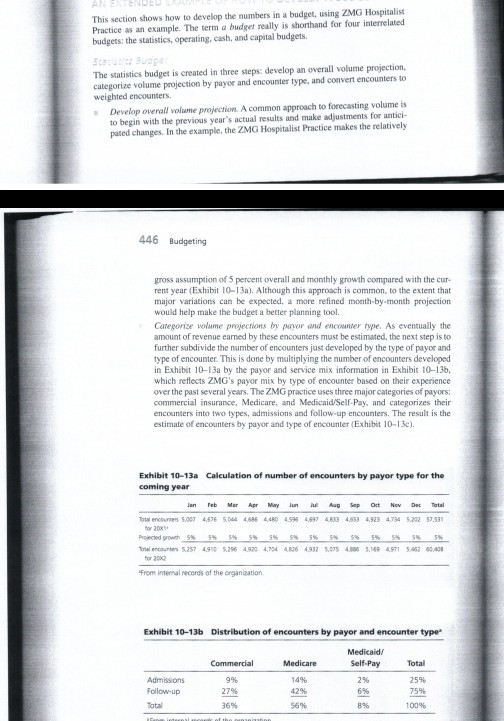
This section shows how to develop the numbers in a budget, using ZMG Hospitalist Practice as an example. The term a budget really is shorthand for four interrelated budgets: the statistics, operating, cash, and capital budgets. audg 5La The statistics budget is created in three steps: develop an overall volume projection, categorize volume projection by payor and encounter type, and convert encounters to weighted encounters Develop overal volume projection. A common approach to forecasting volume is to begin with the previous year's actual results and make adjustments for antici- pated changes. In the example, the ZMG Hospitalist Practice makes the relatively 446 Budgeting gross assumption of 5 percent overall and monthly growth compared with the cur- rent year (Exhibit 10-13a). Although this approach is common, to the extent that major variations can be expected. a more refined month-by-month projection would help make the budget a better planning tool Categorize volume projections by payor and encounier type. As eventually the amount of revenue earned by these encounters must be estimated, the next step is bo further subdivide the number of encounters just developed by the type of payor and type of encounter. This is done by multiplying the number of encounters developed in Exhibit 10-13a by the payor and service mix information in Exhibit 10-13b which reflects ZMG's payor mix by type of encounter based on their experience over the past several years. The ZMG practice uses three major categories of payors: commercial insurance, Medicare, and Medicaid Self-Pay, and categorizes their encounters into two types, admissions and follow-up encounters. The result is the estimate of encounters by payor and type of encounter (Exhibit 10-13e). Exhibit 10-13a coming year Calculation of number of encounters by payor type for the Jan Feb Mar Apr May un AuSep Oct Now Dc Toal for 20 for 20 From imernal records af the organzation Exhibit 10-13b Distribution of encounters by payor and encounter type Commercial 9% 27% 36% Medicare 14% 42% 56% Self-Pay 2% 6% 8% Total 25% 75% 100% Admissions Follow-up Total
Homework Answers
| JAN | FEB | MAR | APR | MAY | JUNE | JULY | AUG | SEP | OCT | NOV | DEC | TOTAL | |
| TOTAL ENCOUNTERS (20X1) | 5,007 | 4,676 | 5,044 | 4,686 | 4,480 | 4,596 | 4,697 | 4,833 | 4,653 | 4,923 | 4,734 | 5,202 | 57,531 |
| PROJECTED GROWTH | 5% | 5% | 5% | 5% | 5% | 5% | 0.5% | 0.5% | 0.5% | 0.5% | 0.5% | 0.5% | |
|
TOTAL ENCOUNTERS (20X2) |
5,257 | 4,910 | 5,296 | 4,920 | 4,704 | 4,826 | 4,720 | 4,857 | 4,676 | 4,948 | 4,758 | 5,228 | 59,100 |
| COMMERCIAL ENCOUNTERS | 36% | 36% | 36% | 36% | 36% | 36% | 36% | 36% | 36% | 36% | 36% | 36% | |
| TOTAL COMMERCIAL ENCOUNTERS | 1,893 | 1,768 | 2,123 | 1,771 | 1,693 | 1,737 | 1,699 | 1,749 | 1,683 | 1,781 | 1,713 | 1,882 | 21,492 |
TOTAL COMMERCIAL ENCOUNTERS = 21,492
Add Answer to:
I'm stuck on question 9 this is all the info I could find encounters into two types, admissions and follow-up encounters. The result is the estimate of encounters by payor and type...
16. Revenue budget: calculating gross revenues. Calculate ZMG Hospitalists Practice's January February, and March commercial payor...
 16. Revenue budget: calculating gross revenues. Calculate ZMG Hospitalists Practice's January February, and March commercial payor gross revenues if the fee for an admission is $250 and the fee for a follow-up encounter is $100 (Exhibits 1.1e and 1.2a). EXHIBIT I.1e WEIGHTED ENCOUNTERS BY PAYOR AND TYPE Dec Total Sep Oct Nov Jun Jul Aug Feb Mar Apr May Jan Commercial 1.768 1,828 2,740 1,860 1,788 1,968 21,748 Admissions 1,892 1,908 1,772 1,692 1,736 1,776 1,760 2,652 Follow-up 2,838 2,860...
10. Statistics budget: forecasting encounters. Instead of its current forecast, ZMG Hospi- talist Practice now e...
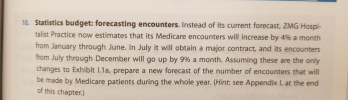 10. Statistics budget: forecasting encounters. Instead of its current forecast, ZMG Hospi- talist Practice now estimates that its Medicare encounters will increase by 4% a month from January through June. In July it will obtain a major contract, and its encounters from July through December will go up by 9% a month. Assuming these are the only changes to Exhibit l.1a, prepare a new forecast of the number of encounters that will be made by Medicare patients during the whole...
 16. Revenue budget: calculating gross revenues. Calculate ZMG Hospitalists Practice's January February, and March commercial payor gross revenues if the fee for an admission is $250 and the fee for a follow-up encounter is $100 (Exhibits 1.1e and 1.2a). EXHIBIT I.1e WEIGHTED ENCOUNTERS BY PAYOR AND TYPE Dec Total Sep Oct Nov Jun Jul Aug Feb Mar Apr May Jan Commercial 1.768 1,828 2,740 1,860 1,788 1,968 21,748 Admissions 1,892 1,908 1,772 1,692 1,736 1,776 1,760 2,652 Follow-up 2,838 2,860...
 10. Statistics budget: forecasting encounters. Instead of its current forecast, ZMG Hospi- talist Practice now estimates that its Medicare encounters will increase by 4% a month from January through June. In July it will obtain a major contract, and its encounters from July through December will go up by 9% a month. Assuming these are the only changes to Exhibit l.1a, prepare a new forecast of the number of encounters that will be made by Medicare patients during the whole...
Most questions answered within 3 hours.
-
Where is the error in this code sequence?
String s1 = "Hello";
String s2 = "ello";...
asked 10 months ago -
Financial data for Joel de Paris, Inc., for last year
follow:
Joel de Paris, Inc.
Balance...
asked 10 months ago -
Consider this reaction:
Al2(SO4)3 (aq)+ BaCl3
(aq) Al2Cl6 (aq)- +
3BaSO4(s) . What is the...
asked 10 months ago -
Suppose that Savneet is considering increasing her
recent random sample from 20 car rentals to 40...
asked 10 months ago -
Trucks arrive at an unloading terminal at an average rate of 120
per hour.
Trucks arrive...
asked 10 months ago -
Why are methanol and ethanol completely soluble in water while
octanol is not very little soluble....
asked 10 months ago -
A facilities manager at a university reads in a research report
that the mean amount of...
asked 10 months ago -
When the CuSO4 is rehydrated by adding water to the anhydrous
compound, is this an endothermic...
asked 10 months ago -
A ray of sunlight is passing from diamond into crown glass; the
angle of incidence is...
asked 10 months ago -
A block of mass 0.249 kg is placed on top of a light, vertical
spring of...
asked 10 months ago -
how do the kidneys compensate in the presences of acidosis
a) trigger hyperventilate
b) reserve acid...
asked 10 months ago -
Question 501 pts
The rental rate of capital to the firm increases. Which of the
following...
asked 10 months ago