
Homework Answers
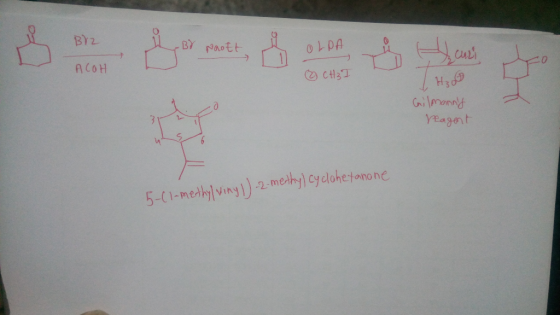
First bromination of ketone then elimination gives enone .
Then LDA is a bulky base and forms enolate at less substituted followed by methylation.
Then Gilmanns reagent undergo Conjugate Addition, gives required target.
Add Answer to:
Synthesis with 10 steps or less Synthesis Problem Show all the steps required, including intermediates, for the synthesis of the following target compound, using any starting material with six (6) ca...
Synthesis of Dihydrocarvone, using any starting material with six carbons or less, plus any other organic...
Synthesis of Dihydrocarvone, using any starting material with six carbons or less, plus any other organic or inorganic reagents necessary. Show intermediates. Determine the IUPAC name.
#19 all 6 synthesis Design a synthesis of each target using the starting material and any...
 #19 all 6 synthesis
Design a synthesis of each target using the starting material and any reagents containing three carbons or less. Read the assigned pages in the text, and do the assigned problems
#19 all 6 synthesis
Design a synthesis of each target using the starting material and any reagents containing three carbons or less. Read the assigned pages in the text, and do the assigned problems
Synthesis is a major area of organic chemistry which often requires multiple material to a target compound. A systemati...
 Synthesis is a major area of organic chemistry which often requires multiple material to a target compound. A systematic way to propose a synthesis e chemistry which often requires multiple steps to convert one organic systematic way to propose a synthesis is to work backwards from the target compound to a readily available starting material. This 'retrosynthesis app arrow wie starting material. This 'retrosynthesis' approach is indicated by the within a synthesis proposal. (See Wade textbook, pg 410ff, Problem Solving...
Propose a simple synthesis for the compound shown below, using the provided starting material and any...
 Propose a simple synthesis for the compound shown below, using
the provided starting material and any organic or inorganic
Reagent. Draw all intermediates. (Use alkene and alkyne
reactions)
Propose a simple synthesis for the compound shown below, using
the provided starting material and any organic or inorganic
Reagent. Draw all intermediates. (Use alkene and alkyne
reactions)
Devise a synthesis of the following compound from the indicated starting material, organic compounds containing one or...
 Devise a synthesis of the following compound from the indicated
starting material, organic compounds containing one or two carbons,
and any other required reagents. Be sure to answer all parts.
Devise a synthesis of the following compound from the indicated starting material, organic compounds containing one or two carbons, and any other required reagents. Be sure to answer all parts. (+ enantiomer) CECH edit structure ... CH,CI edil structure. edit structure
Devise a synthesis of the following compound from the indicated
starting material, organic compounds containing one or two carbons,
and any other required reagents. Be sure to answer all parts.
Devise a synthesis of the following compound from the indicated starting material, organic compounds containing one or two carbons, and any other required reagents. Be sure to answer all parts. (+ enantiomer) CECH edit structure ... CH,CI edil structure. edit structure
6. (18 points total) Synthesis: Devise a synthesis of the following compound from the given starting...
 6. (18 points total) Synthesis: Devise a synthesis of the following compound from the given starting materials. You may use any other organic or inorganic reagents you deem necessary but you must use the given starting materials as your only source of carbon in the final compound OH several steps OH MeOH HO
2. (6 points) Provide a valid synthesis (including all intermediates and reagents required) for the following...
 2. (6 points) Provide a valid synthesis (including all intermediates and reagents required) for the following molecule from the given starting material. several steps
Show, by writing a series of synthetic steps how you could prepare the following target compound...
 Show, by writing a series of synthetic steps how you could prepare the following target compound for the designated two starting materials (a cyclic diene and acetylene) and any other necessary organic or inorganic reagents. You must also show all the intermediate structure(s) for your synthesis indicated by the "?" marks. More than one step will be needed. H CH,CH, CH CHH + H-C=C-H ? ?
Please explain the mechanisms! 1. Propose a synthesis for each of the following problems starting with reagent shown and using any other organic or inorganic reagents allowed in each problem. Mu...
 Please explain the mechanisms!
1. Propose a synthesis for each of the following problems starting with reagent shown and using any other organic or inorganic reagents allowed in each problem. Multiple steps are required. The number of steps you use does not matter. Reactions should give the desired product as a major product. For full credit show the product of each step (reaction). If you make use of organometallic reagents such as Grignard, Wittig, organolithium, organosodium, organocopper, etc. you must...
Please explain the mechanisms!
1. Propose a synthesis for each of the following problems starting with reagent shown and using any other organic or inorganic reagents allowed in each problem. Multiple steps are required. The number of steps you use does not matter. Reactions should give the desired product as a major product. For full credit show the product of each step (reaction). If you make use of organometallic reagents such as Grignard, Wittig, organolithium, organosodium, organocopper, etc. you must...
Synthesis 10. Give a reasonable synthesis for the following compound from the indicated starting material. You...
 Synthesis 10. Give a reasonable synthesis for the following compound from the indicated starting material. You may use any other organic or inorganic reagents you wish unless otherwise indicated. The desired product for each reaction you propose must be the one of the predominant products. Give the reactants, conditions (where appropriate) and products of each synthetic step. NO MECHANISMS! [6 points) Make med og som en ons starting with SO3H
 #19 all 6 synthesis
Design a synthesis of each target using the starting material and any reagents containing three carbons or less. Read the assigned pages in the text, and do the assigned problems
#19 all 6 synthesis
Design a synthesis of each target using the starting material and any reagents containing three carbons or less. Read the assigned pages in the text, and do the assigned problems
 Synthesis is a major area of organic chemistry which often requires multiple material to a target compound. A systematic way to propose a synthesis e chemistry which often requires multiple steps to convert one organic systematic way to propose a synthesis is to work backwards from the target compound to a readily available starting material. This 'retrosynthesis app arrow wie starting material. This 'retrosynthesis' approach is indicated by the within a synthesis proposal. (See Wade textbook, pg 410ff, Problem Solving...
 Propose a simple synthesis for the compound shown below, using
the provided starting material and any organic or inorganic
Reagent. Draw all intermediates. (Use alkene and alkyne
reactions)
Propose a simple synthesis for the compound shown below, using
the provided starting material and any organic or inorganic
Reagent. Draw all intermediates. (Use alkene and alkyne
reactions)
 Devise a synthesis of the following compound from the indicated
starting material, organic compounds containing one or two carbons,
and any other required reagents. Be sure to answer all parts.
Devise a synthesis of the following compound from the indicated starting material, organic compounds containing one or two carbons, and any other required reagents. Be sure to answer all parts. (+ enantiomer) CECH edit structure ... CH,CI edil structure. edit structure
Devise a synthesis of the following compound from the indicated
starting material, organic compounds containing one or two carbons,
and any other required reagents. Be sure to answer all parts.
Devise a synthesis of the following compound from the indicated starting material, organic compounds containing one or two carbons, and any other required reagents. Be sure to answer all parts. (+ enantiomer) CECH edit structure ... CH,CI edil structure. edit structure
 6. (18 points total) Synthesis: Devise a synthesis of the following compound from the given starting materials. You may use any other organic or inorganic reagents you deem necessary but you must use the given starting materials as your only source of carbon in the final compound OH several steps OH MeOH HO
 2. (6 points) Provide a valid synthesis (including all intermediates and reagents required) for the following molecule from the given starting material. several steps
 Show, by writing a series of synthetic steps how you could prepare the following target compound for the designated two starting materials (a cyclic diene and acetylene) and any other necessary organic or inorganic reagents. You must also show all the intermediate structure(s) for your synthesis indicated by the "?" marks. More than one step will be needed. H CH,CH, CH CHH + H-C=C-H ? ?
 Please explain the mechanisms!
1. Propose a synthesis for each of the following problems starting with reagent shown and using any other organic or inorganic reagents allowed in each problem. Multiple steps are required. The number of steps you use does not matter. Reactions should give the desired product as a major product. For full credit show the product of each step (reaction). If you make use of organometallic reagents such as Grignard, Wittig, organolithium, organosodium, organocopper, etc. you must...
Please explain the mechanisms!
1. Propose a synthesis for each of the following problems starting with reagent shown and using any other organic or inorganic reagents allowed in each problem. Multiple steps are required. The number of steps you use does not matter. Reactions should give the desired product as a major product. For full credit show the product of each step (reaction). If you make use of organometallic reagents such as Grignard, Wittig, organolithium, organosodium, organocopper, etc. you must...
 Synthesis 10. Give a reasonable synthesis for the following compound from the indicated starting material. You may use any other organic or inorganic reagents you wish unless otherwise indicated. The desired product for each reaction you propose must be the one of the predominant products. Give the reactants, conditions (where appropriate) and products of each synthetic step. NO MECHANISMS! [6 points) Make med og som en ons starting with SO3H
Most questions answered within 3 hours.
-
Where is the error in this code sequence?
String s1 = "Hello";
String s2 = "ello";...
asked 11 months ago -
Financial data for Joel de Paris, Inc., for last year
follow:
Joel de Paris, Inc.
Balance...
asked 11 months ago -
Consider this reaction:
Al2(SO4)3 (aq)+ BaCl3
(aq) Al2Cl6 (aq)- +
3BaSO4(s) . What is the...
asked 11 months ago -
Suppose that Savneet is considering increasing her
recent random sample from 20 car rentals to 40...
asked 11 months ago -
Trucks arrive at an unloading terminal at an average rate of 120
per hour.
Trucks arrive...
asked 11 months ago -
Why are methanol and ethanol completely soluble in water while
octanol is not very little soluble....
asked 11 months ago -
A facilities manager at a university reads in a research report
that the mean amount of...
asked 11 months ago -
When the CuSO4 is rehydrated by adding water to the anhydrous
compound, is this an endothermic...
asked 11 months ago -
A ray of sunlight is passing from diamond into crown glass; the
angle of incidence is...
asked 11 months ago -
A block of mass 0.249 kg is placed on top of a light, vertical
spring of...
asked 11 months ago -
how do the kidneys compensate in the presences of acidosis
a) trigger hyperventilate
b) reserve acid...
asked 11 months ago -
Question 501 pts
The rental rate of capital to the firm increases. Which of the
following...
asked 11 months ago